
EN
The Checkout Line at the Piggly Wiggly

The day my doctor cleared me, I bought a dress with no back. Five years of treatments had shaved me down to something brittle, and I had promised myself: the first day I woke up with a clean scan, I would wear that exact dress. I walked out of the oncology wing at St. Luke's in Milwaukee with the October wind hitting my spine through the open panel, and I felt like I could fly.
The candles were already burning in the living room when I got home. Elliott had set out takeout from that Thai place on Farwell, the one we used to walk to before I got sick. He sat in the armchair by the window. He didn't stand up when I came in. He didn't turn.
"Ell, look at me."
He kept his eyes on the floor. The shadows under them looked like bruises.
"Lisa, we need to talk."
I spun in the doorway. The dress flared out. I wanted him to see me the way he used to see me, before the hospital bands and the wigs and the cold packs in the bathroom.
"The doctor said the scan is clean. I'm done. I'm free."
"That's good," he said. "I'm glad. Because I'm leaving."
I saw the suitcase then. It had been sitting by the front door the whole time, and I hadn't noticed it because I'd flown past it too fast, too high on my own good news.
He stood up like a man made of splinters. He wouldn't look at me.
"I found someone healthy," he said. "She doesn't need a nurse. She doesn't wake up crying at four in the morning. I gave you five years of appointments and pharmacies and driving you to radiation in the snow. I'm done."
I didn't scream. I didn't cry. I stood there in my backless dress with the smell of Thai basil getting cold on the table, and I felt something in me snap clean in half, like a plate dropped on tile.
The door closed. The candle in the hall guttered out.
A year passed.
I threw everything I had left into my job. I run the marketing department now for a medical supply company out in Wauwatosa. I bought a condo on the river. I cut my hair short and bought clothes that fit the new body I had to re-learn. People at work call me "the machine" because I don't stop.
But there was a splinter under all of it. Elliott never showed up to the divorce hearing. His lawyer handled everything. I signed the papers in a conference room that smelled like printer toner, three days before Christmas.
I saw him once, in March, coming out of a pharmacy on Brady Street. It was sixty degrees and everyone else was in t-shirts. He had on a windbreaker with the hood pulled up, and he was walking with this hitch in his step, like his right leg didn't want to cooperate. He looked thinner than I remembered.
I told myself he'd been out late with his healthy new girlfriend. I told myself I didn't care. I walked into the pharmacy and bought face cream I didn't need, just to prove I could stand in the same building without collapsing.
Fast forward to last Saturday. I was at the Piggly Wiggly on Capitol Drive, picking through apples, trying to remember if I still had cinnamon at home. A shopping cart clipped my hip.
A woman's voice said, "Oh God, I'm so sorry. I wasn't looking."
I turned around. She was wearing a faded Marquette sweatshirt and gray leggings. Her hair was falling out of a ponytail. Her skin had that gray, sleepless look you get when you've been living on coffee and alarms.
And I knew her face. I'd seen it in a screenshot someone sent me right after the divorce. A friend of a friend who thought I should know.
It was Marissa. The healthy one. The one Elliott had chosen.
Something hot and ugly crawled up my throat. I straightened my spine and looked her up and down.
"You look exhausted," I said. "Is my ex-husband keeping you up at night?"
She went white. Her hands slipped off the cart handle. She stared at me like I'd just stepped out of a mirror.
"Lisa?"
I folded my arms. "Surprised? What? Did you think the sick wife would just crawl into a hole and die?"
She grabbed my sleeve. Her hand was shaking.
"Please," she said. "Please don't walk away. I can't keep doing this. I promised him I wouldn't tell you, but I see him every day, and he's folding in on himself. He talks about you in his sleep. He needs you."
I yanked my arm back. "Needs me? He walked out the door an hour after I got a clean scan. He said he found someone healthy. You."
Marissa looked at me. Her eyes were red and wet. And then she said it.
"Elliott's sick, Lisa. He's been sick for almost two years. He never left me for another woman. He hired me."
The produce department got very quiet. Somewhere behind me, a kid was crying about gummy worms. The lady at the deli counter shouted a number.
"What?"
"He hired me to be his caretaker," Marissa said. "Me. A home health aide from Aurora Health. He found you pacing the hospital room one night after your biopsy. You were crying, and he heard you saying you couldn't do it again. That you couldn't survive another year of being a caretaker's patient. He heard you say you were tired of being the sick one."
I stared at her. I could feel the apples in my basket going soft under my grip.
"He found out he had a degenerative condition," she said. "A year before you went into remission. He didn't tell you because you were fighting your own battle. Then when you got better, he left. Because he didn't want you to be his nurse."
"Degenerative condition," I repeated. The words didn't fit in my mouth. They tasted like cardboard.
"His legs are going," she said. "He's been in a wheelchair since August. He made me promise never to tell you." She wiped her face with the back of her hand. "He said you'd just gotten your life back. He wasn't going to take it away again."
The apple basket fell. I didn't even hear it hit the floor. I was already walking. Past the checkout. Past the sliding doors. Past the minivan with its hazards on.
I drove to his apartment on Murray Hill. It took me fourteen minutes. I know because the GPS kept recalculating and the clock on the dashboard clicked over from 4:41 to 4:55.
I stood on his front porch in the rain. I had no coat. I'd left it in the cart at the Piggly Wiggly.
I rang the bell. Nothing. I rang it again. Then I pulled out my phone.
I called him. It went to voicemail. His voice said, "This is Elliott. Leave a message."
I called again. Voicemail. Again. Voicemail.
I texted him.
"I know. I know everything. Open the door."
Nothing.
I walked around the side of the house and looked through the window. The living room was dark. There was a wheelchair folded up next to the couch. On the coffee table, I could see a brown legal envelope with my name on the front.
I called Marissa. She answered on the second ring.
"He's not home," she said. "He had a doctor's appointment. He should be back by six."
"Give me the address."
"Lisa, I don't think—"
"Give me the address, or I swear to God I'll call every hospital in Milwaukee until I find him."
She gave it to me.
I drove to the clinic on Watertown Plank Road. I pulled into the parking lot in front of St. Luke's outpatient center. It was the same building where I'd gotten my infusions. Same entrance. Same sliding doors.
I walked in. My shoes were wet. My dress was soaked through. My hair was plastered to my face.
And there he was.
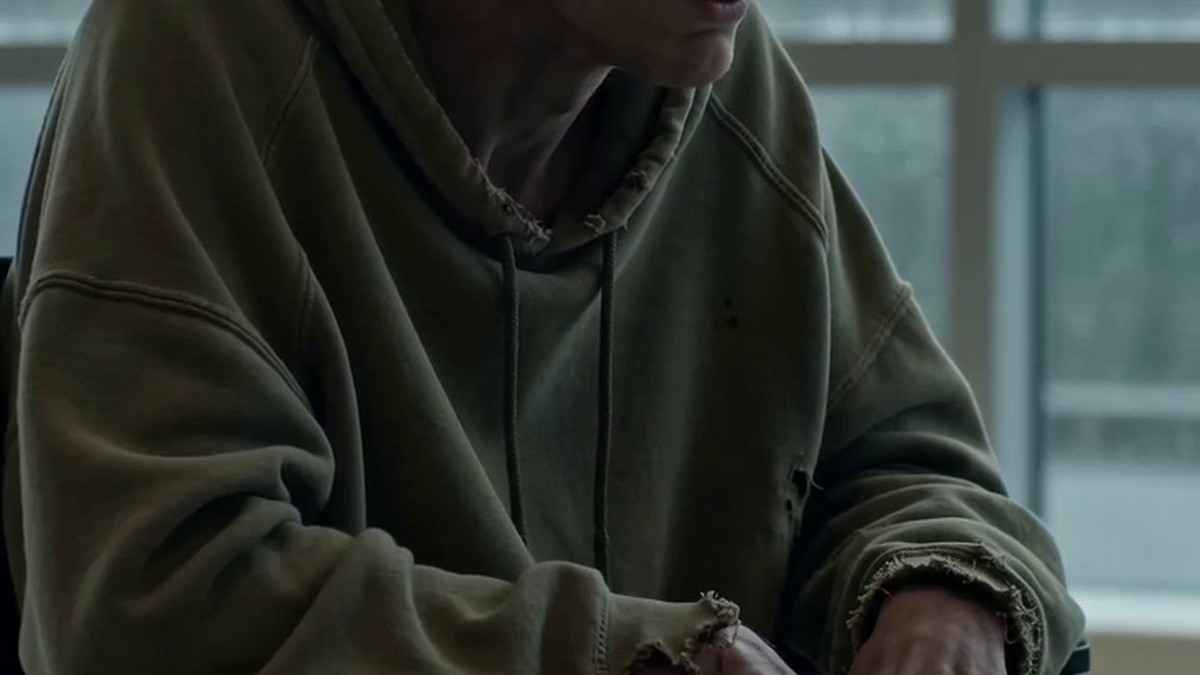
Elliott was sitting in a wheelchair in the lobby. He was facing the window, looking at the rain. He'd lost weight. His shoulders looked narrow, like a boy's. He was wearing the green hoodie I'd bought him for his birthday five years ago, the one with the hole in the left cuff.
I stood there for a second. Then I walked over and sat down in the chair next to him.
He didn't turn his head. He just said, "Marissa told you."
"She was buying apples. I made a crack about her looking tired. She broke."
He closed his eyes.
"Elliott."
"Don't."
"Elliott, look at me."
He wouldn't.
So I took his hand. It was cold. The fingers were thin. I could feel a tremor running under the skin, and for a long minute neither of us said anything. The rain hit the glass. The receptionist typed something. A nurse pushed a cart past us.
"I heard you in the hospital that night," he said. His voice was rusted. "You were on the phone with your mother. You said you'd rather die than go through another year of being sick. You said you were so tired of being the patient. And I thought, I'm not going to make her be the caregiver. Not after everything she's already been through." He shook his head. "So I left. I was a coward about it. I told you I'd found someone healthy. I said the most hurtful things I could think of because I needed you to hate me. That was the only way you'd let me go."
We sat there like that, in the lobby of the building where I'd fought for my life, and the truth landed between us like a stone.
"You're an idiot," I said.
"I know."
"You're a complete, stubborn, self-sacrificing idiot."
"I know."
I reached into my pocket. My fingers were wet, and my phone had water on the screen. I wiped it on my dress. Then I opened my calendar.
"Your next appointment," I said. "What day?"
"Lisa—"
"What day?"
"Thursday. Ten a.m."
I added it to my calendar. I added a reminder. I set it to repeat every week.
"Thursday at ten," I said. "I'll pick you up at nine-forty. Wear the green hoodie. It suits you."
He looked at me then. And for the first time in a year, I saw the man I'd married.
That night, I called my lawyer. I still had the number saved in my phone from the divorce. I told him I needed to update some paperwork.
"A power of attorney," I said. "And a medical directive."
He asked if I was sure.
"This isn't about taking anything from him," I said. "I'm building something."
The next morning, I wrote my mother a long email. I told her the truth. I told her what Elliott had done and why. She wrote back in twenty minutes. I read it twice. Then I deleted his goodbye text from a year ago. The one that said, "You'll be happier without me. I promise."
I kept the green hoodie. I wear it now when I drive him to his appointments. The hole in the left cuff? I sewed it shut.
Elliott didn't want me to become his nurse. So I didn't.
I became his Thursday.



Lenoška, to je v tvé podstatě, Irčo
Dlouho jsem to nikomu nedokázala vyprávět. Ptaly se: "Jak to s tím Liborem?" A já se usmála: "Super, všechno v...


עשרים ושתיים שנים על חלקה אחת ברחוב הדקל
כשטל היה בן שלוש עשרה, אביו יצא בבוקר חמסיני לנסיעת עבודה לאשדוד ולא חזר. פיצוץ בלורי משא, הכביש הראשי חלק...


De sleutel die ik niet meer teruggeef
Ik heet Ingrid Bergman, ben 64 en heb zevenendertig jaar bij de gemeente Almere op de afdeling burgerzaken gewerkt. Toen...


Il miracolo nella sala di Lucca
La sala dei ricevimenti di Villa Bonsignori brillava di luci dorate quella sera di settembre, il profumo di gigli bianchi...


Le coffre du 412
Il pleuvait sur Annecy ce soir-là, et la pluie dégoulinait sur le manteau usé d'Odette Rambert quand elle traversa le...


Terepjáró kulcs a széfben
Nina és a mesterautó – három perc, ami mindent eldöntött Szombat délután volt, amikor Tamás letette a villát a tányér...


Autobusas septintą, jūra trečią
– Jūra atšaukiama. Mama atvažiuoja, – Tomas net telefono nepadėjo, kai tai pasakė. Aš stovėjau koridoriuje su nauju skėčiu nuo...


A kulcs, ami nem fordult a zárban
Ilona Varga ötvenhat éves volt, amikor vasárnap hajnalban, négy óra körül felébredt a nyíregyházi kis házban, és az első gondolata...