
З життя
Emily realized instantly when she yanked the rag sticking out of the hedge. The rag turned out to be an old, colorful diaper, and she pulled it even harder. She froze: in the corner of the diaper lay a tiny baby.

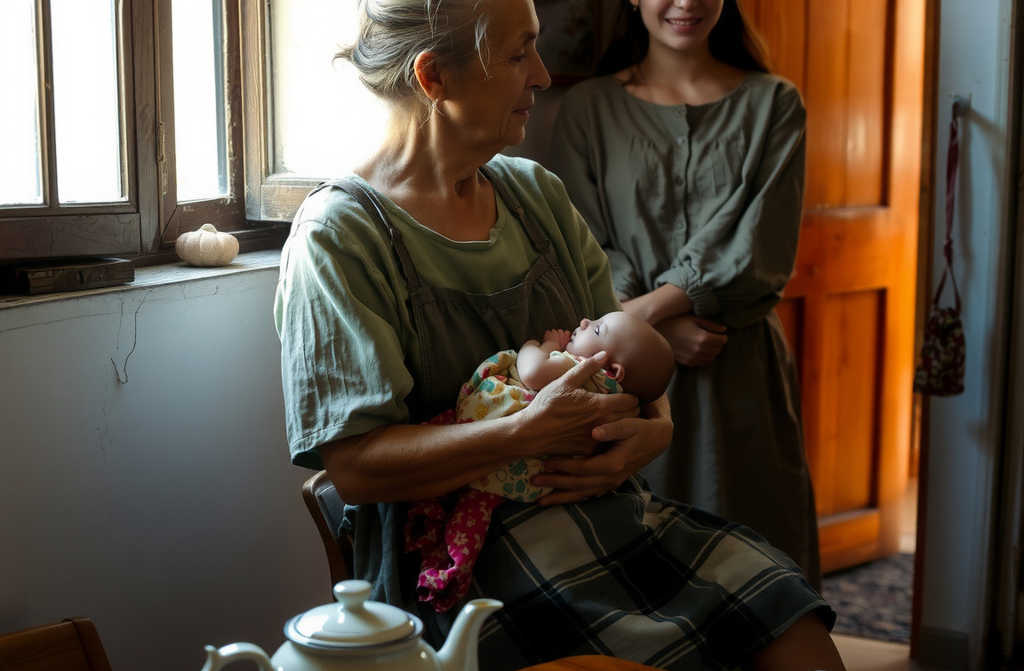
Eleanor realised at once, when she tugged at the rag sticking out of the brambles, that the rag was in fact an old coloured blanket, and she pulled harder. In that instant she froze: in the corner of the cloth lay a tiny child.
The following morning Eleanor dreamed a strange vision: as if her son, Thomas, stood on the doorstep and knocked on the door. She awoke with a start, slipped her bare feet across the cold floor and fled to the front door.
Quiet. No one. Such dreams visited her often and always deceived her, yet each time she ran to the door and flung it wide. And now she did the same, peering into the nights emptiness.
Silence and dusk wrapped around her. Trying to calm a heart that thumped anxiously, she sat upon the step of the porch. In that hush a faint sound broke througheither a squeak or a rustle.
Another neighbours kitten has tangled itself again, she thought, and went to free the creature from the hawthorn, as she had done many times before.
But it was not a kitten. Eleanor knew instantly when she yanked the rag from the thicket. The rag proved to be an aged, multicoloured blanket, and she grasped it tighter.
And she stopped, stunned: in the blankets corner lay a little infant. The babe was utterly naked, perhaps having shed its swaddling as it lay there; it was a boy. From the fresh umbilical stump it was clear he was only a few days old.
The child could not even cry; he was damp, utterly exhausted and, no doubt, starving. When Eleanor lifted him into her arms he let out a feeble whimper.
Without a clear thought of what to do, she pressed the child close to her chest and bolted back into the house. She found a clean sheet, wrapped the infant, covered him with a warm quilt and set about warming some milk.
She fetched a bottle, found a nipple that had survived from the spring when she had once nursed a kid goat. The boy gulped greedily, then, warmed and fed, fell asleep.
Morning came, yet Eleanors mind lingered on her discovery. She was over forty, and the village folk already called her Auntie. She had lost both husband and son to the war years ago and was left utterly alone. She could never quite become accustomed to the solitude, but the harsh truth of life kept reminding her, and eventually she learned to rely only on herself.
Now she was bewildered, not knowing what to do next. She looked at the sleeping child, his soft snuffles like any other babes.
She thought perhaps to seek counsel from her neighbour, so she glanced once more at the infant and walked to Margarets house. Margarets life, unlike anyone elses, had been smooth and tranquil: she never married, never lost anyone to war, and had never known a funeral. She lived for her own comfort.
All the men Margaret knew came and went, never staying long enough for her to hold them dear. At that moment Margaret, tall and graceful, stood by her own porch, a shawl draped over her shoulders, basking in the warm sun. After hearing Eleanors tale of the nights events, she said briefly:
Now, what good will that do you? and slipped back into her cottage. Eleanor caught, out of the corner of her eye, a curtain flutter as a lovers night visitor drifted past.
What good? Indeed, what good? Eleanor whispered to herself.
She returned home, tended the child, wrapped him in dry cloth, gathered some provisions and set off for the coach stop to catch a ride to the city. A carriage did not wait long; five minutes later a lorry bound for London slowed beside her.
To the infirmary? the driver asked, nodding toward the bundle in her arms.
To the infirmary, Eleanor replied, voice steady.
At the shelter, while the papers for the infants care were being processed, she could not shake the feeling that something was awry, a tiny ache in her heart that would not settle.
It was the same hollow she had felt when the telegram arrived announcing her husbands death, and later her sons.
What shall we call the boy? What name shall he have? asked the matron.
A name? Eleanor echoed, pausing a heartbeat before answering, Thomas.
A fine name, the matron replied. We have many Thomases and Charlottes here. It is clear when families have been cut down, but a child like yourswho knows who will raise him? There are no men now, rejoice for the child, though the world may turn its back on you.
Those words, though not aimed at her, struck Eleanor deep within. Returning home at dusk, she entered her empty dwelling and lit a lantern.
There, in the corner, lay the old blanket she had set aside. She had not thrown it away; she had merely put it aside. Now she took it in her hands and sat on the bed.
Methodically she ran her fingers over the damp, timeworn cloth, as if nothing else mattered. Then her hand brushed a small knot tucked in the fabrics edge.
Inside the knot lay a tiny grey scrap of paper and a simple tin cross on a string. Unfolding the paper, she read:
Kind, gentle woman, forgive me. I cannot keep this child; I am lost in life, and tomorrow I will be gone. Do not abandon my son; give him what I cannotlove, care, and protection.
Below was the childs birth date. At the words Eleanor burst into tears, wailing as though the heavens themselves had opened. Rivers of tears flowed, though she thought she had long run out of sorrow.
She recalled the day she had married, the happiness she had shared with her husband. Then Thomas was born, and joy returned. The village women envied her: she seemed to shine with contentment.
Why not shine, she thought, when a beloved husband and son surrounded her? Her men had loved and adored her. Just before the war, Thomas finished his driving course and promised to take her in the new car the collective farm would provide.
Then tragedy struck In August 1942 a telegram brought the bereavement notice for her dear husband, and in October the same year for her beloved son. From that moment, Eleanors happiness faded, the light gone forever.
She became like every other woman in the village, like almost every second wife there. She would seize at night, run to the door, fling it open, and stare into the dark.
That night she could not sleep, ran outside, listened to the night and waited for something. At dawn she again set off for the city.
The shelter matron recognised her instantly and was unshaken when Eleanor declared she wanted to take the boy back, as her dead son had wished.
Very well, said the matron, well help you with the papers.
Wrapping Thomas in a blanket, Eleanor left the shelter with a lighter heart; the heavy, lingering grief that had haunted her for years had begun to lift.
New feelings moved injoy and love. If a person is destined to be happy, then happiness will indeed come, as it did for Eleanor.
In her empty house, photographs of her husband and son hung on the wall. This time their faces seemed transformedno longer solemn or mournful, but illuminated, soft, approving, and encouraging.
Eleanor pressed young Thomas close, feeling strong enough for herself, for she knew he would need her help and protection for many years to come.
Will you help me? she whispered to the pictures.
Twenty years passed. Thomas grew into a good young man. Every maiden dreamed of a happy life with him, yet he chose the one whose heart he loved mosthis mothers beloved, of courseher daughterinlaw, Lucy.
One day Thomas brought Lucy to meet his mother, and Eleanor finally saw that her son had become a true man. She blessed the young couple.
They celebrated their wedding, the couple began to build their own nest, children arrived, and the youngest son they named Thomas as well, making Eleanor rich in family.
One night she woke to a noise at the window and, as was her habit, went to the door. She opened it and stepped out into the gloom. A storm approached, lightning flashing nearby.
Thank you, my boy, Eleanor whispered into the darkness, now I have three Thomases, and I love you all.
The great oak by the porchplanted by her husband when Thomas was bornshook, and a bolt of lightning split the sky like a bright smile from her son.
End She felt the wind curl around her, pulling at the folds of the old blanket still draped over the porch rail. In the flash of the lightning, the bark of the oak seemed to glow from within, and a soft, familiar scent of lilacsher husbands favoritewafted through the storm. As the thunder rolled, a faint, childlike laugh rose above the clamor, as if the tiny boy she had rescued were whispering from the roots of the tree. Eleanor’s heart swelled, a warm tide washing away the years of sorrow, and she understood that love, once kindled, never truly fades; it lives in the soil, in the branches, and in the generations that blossom beneath them. She turned back to the house, where Lucy and the newest Thomas waited, their faces lit by candlelight, and she whispered a promise to the wind: that she would guard this lineage, that the stories of loss would become stories of hope. The storm passed, leaving a sky washed clean, and the oak stood tall, its leaves trembling like a chorus of guardians. In that quiet dawn, Eleanor smiled, feeling the presence of the child she had once held, the husband who had planted the tree, and the son who had grown into a manall converging in the steady beat of her own heart. The future stretched before her, a tapestry of lives interwoven, and she knew, without a doubt, that the love she nurtured would echo forever, like the gentle rustle of leaves in an endless summer.



Puchýř pod malíčkem Boženy Kovářové
Tmavá, vlhká noc koncem srpna. Božena Kovářová se probudila ve dvacet minut po jedné, protože ji na pravém chodidle tak...


Жената от третия етаж на улица „Пирин“
Казвам се Весела и от три години работя като нощна портиерка в блок на улица „Пирин“ в Пловдив — стар...


Il frigorifero di mio cognato e i cinquemila euro che non torneranno
Mi chiamo Dario Ferraris, ho quarantatré anni, faccio l'elettricista a Bergamo da quando ne avevo diciannove. Questa storia la devo...


Dvi šunų lizdai Nr. 9 ir nuotrauka, kuri sustabdė furgoną
Mano vardas Audrius Vaitkus, man šešiasdešimt treji, ir jau vienuolika metų savanoriauju Kauno rajono gyvūnų prieglaudoje, netoli Garliavos. Mačiau visko....


A jászberényi diófa, amelyik hatszázezer forintot ért meg egy családnak
A jászberényi diófa, amelyik örökre megmentett egy udvart Negyedik éve dolgozom a jászberényi piacon zöldséges standnál, pont szemben azzal a...


Žentas, kuris liko: Birutės akys devynerius metus
Mane vadina nedėkingu žentu. Taip sako uošvienės draugės prie bažnyčios Pasvalyje, kai aš parvežu ją iš poliklinikos ir padedu išlipti...


האלמנה מרחוב הדקלים
היה סוף אוקטובר, בבאר שבע עוד נשבה החמסין המאוחר שחודר דרך כל בד, לא משנה מה לובשים מתחתיו. אני לבשתי...


Свекървата ми изхвърли дрехите, а мъжът ми мълчеше
Стоях във всекидневната с разкъсан найлонов плик до краката и гледах празния рафт в гардероба. — Къде е ризата ми...