
З життя
My husband and I sacrificed everything so our kids could have more, and in our twilight years we ended up utterly alone.

28October2025
Today I sat at the kitchen table and let the memories spill out, as if I were trying to write them down for the first time. My whole life, my wife Emily and I have stripped ourselves of everything so that our children could have more. And now, in our old age, we find ourselves utterly alone.
All those years we lived for the kidsnot for ourselves, not for ambitionjust for them, our beloved trio, whom we adored, spoiled and for whom we sacrificed every comfort. Who could have imagined that at the end of the road, when health wanes and strength fades, gratitude and care would be replaced by silence and a hollow ache in the soul?
Peter and I grew up on the same culdesac in Leeds, sat on the same school bench. When I turned eighteen we married in a modest ceremony; money was tight. A few months later I discovered I was expecting. Peter quit university and took two jobsany work that could keep a loaf of bread on the table.
We lived in poverty. For days we subsisted on baked potatoes and tea, never complaining, because we knew why we endured it. We dreamed that our children would never know the want we had endured. When things began to improve a little, I became pregnant again. It frightened me, yet we pressed onsurely we would raise that child too. Our own children are never abandoned.
There was no help then. No relatives to look after the youngsters, no family to lean on. My mother had died young, and Peters mother lived far away, wrapped up in her own life. I shuffled between the kitchen and the nursery while Peter laboured until he was exhausted, coming home with weary eyes and hands cracked from the cold.
By the time I was thirty I had already delivered my third child. Difficult? Absolutely. But we never expected an easy life. We were never the type to drift with the current; we simply kept moving forward. Between loans and fatigue we somehow managed to buy two flatlets for the older boys. How many sleepless nights that cost, only God knows. Our little Lucy dreamed of becoming a doctor, so we tucked away every penny and sent her to study abroad. We took another loan and told each other, Well make it.
The years rushed past like a fastforward film. The children grew and spread their wings, each carving out his own path. Then old age arrivednot gently, but like a freight trainbringing Peters diagnosis. He grew weaker, slipping away before my eyes. I cared for him alone. No phone calls, no visitors.
When I begged our eldest, Sophie, to come, she replied curtly, I have my own children, my own life. I cant drop everything. A friend later told me shed seen Sophie in a café with her mates.
Our son Sam appealed to his job, yet the very same day posted a sunny beach picture from Spain on Instagram. And our youngest, Gracewho we had sold half our possessions for, the one who earned a prestigious European degreetexted simply, Cant miss my exams, sorry. And that was that.
The nights were the worst. I sat at Peters bedside, spoonfeeding soup, checking his temperature, holding his hand as pain twisted his face. I didnt expect miraclesI only wanted him to know he was still useful to someone, because he mattered to me.
In that moment I realized we were completely alone. No support, no warmth, not even a crumb of interest. We had given everythingskimped on our own meals so they could eat well, wore threadbare clothes so they could have fashionable ones, never took a holiday so they could afford sunny trips.
Now we were a burden. The cruelest part wasnt betrayal; it was the realization that we had been erased from their lives. Once we were needed. Now we were just an inconvenience. They are young, they have bright futures. We are relics of a past nobody wishes to recall.
Sometimes I heard the neighbours laughing in the hallwaytheir grandchildren visiting. Sometimes I saw my old friend Maggie with her daughter in tow. My heart would race at every footstep, hoping it was one of my children. It never wasjust couriers or nurses entering the flat next door.
One damp November morning Peter slipped away in silence. He clasped my hand and whispered, Youve been wonderful, John. Then he was gone. No one was there for a final goodbye. No flowers, no hurried flights. Just me and the hospice nurse, who wept more than all my children together.
I didnt eat for two days. I couldnt even boil water for a cup of tea. The silence was unbearabledense, heavy, like a wet blanket draped over my life. His side of the bed remained untouched, though I hadnt slept there for months.
The strangest thing? I felt no anger, only a muted, painful emptiness. I stared at the framed school photos on the mantle and wondered, Where did we go wrong?
A few weeks later I did something Id never done beforeI left the front door ajar. Not because Id forgotten to lock it, nor hoping anyone would come in, but because I no longer cared. If a thief wanted the cracked teacups or my knitted basket, let them have them.
It wasnt theft, though. It was a new beginning.
It was about four in the afternoonI remember the time because a ridiculous talk show I despise was on the telly. I was folding a towel when a soft knock sounded, followed by a voice: Good afternoon?
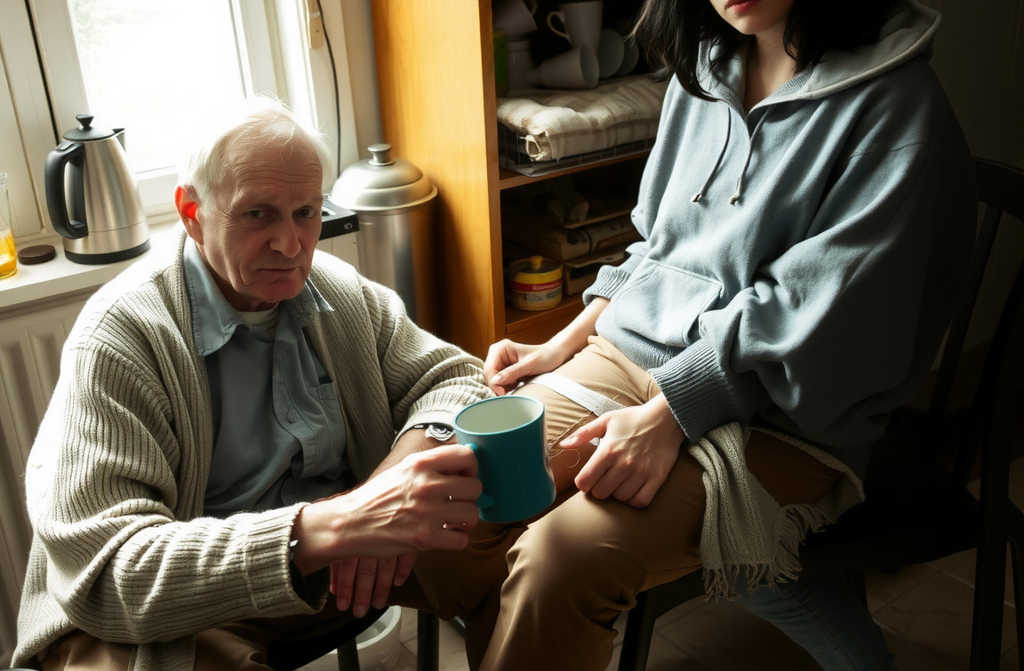
I turned sharply and saw a young woman standing on the doorstep. She must have been twenty, dark curls spilling over an oversized hoodie, looking hesitant as if shed knocked on the wrong door. Sorry, I think Ive got the wrong address, she mumbled. I could have shut the door and gone on with my day, but I didnt. No problem, I said. Would you like a cup of tea? She stared at me as if Id gone mad, then nodded. Yes, thank you. That would be lovely.
Her name was Hannah. She had just moved into the neighbouring flat after her stepfather threw her out. We sat at the kitchen table, drank tea that had gone cold, and talked about everything and nothing. She told me about her nightshift at the supermarket and how often she felt invisible. I know that feeling, I replied.
From that day Hannah visited often. Sometimes she brought a slice of banana cake she called hardly edible, other times a discarded puzzle shed rescued from a charity bin. I began to look forward to the sound of her footsteps. She never saw me as a burden. She asked about Peter, laughed at my stories, and even fixed a leaking tap without me asking.
For my birthdayone the children had completely forgottenshe brought a tiny cake with the words Happy Birthday, John! written in icing. I broke down in tears, not for the cake, but because she remembered.
That same night I received a message from Grace: Sorry Ive been distant. Exams are crazy. Hope youre well. No call, just a text. And you know what? I didnt feel crushed. I felt free. Free from the hope that they would become exactly the people Id imagined. Free from years of chasing crumbs of attention. I stopped chasing them.
I started going out again. I enrolled in a pottery class, planted basil on the windowsill. Sometimes Hannah dines with me; sometimes she doesnt, and thats fine. She has her own life, but she still finds room for me.
Last week a letter arrived, unsigned. Inside was an old photograph of the five of us on a seaside holiday, sunburnt cheeks and toothless grins. On the back were three words: Im so sorry. I didnt recognise the handwritingmaybe Sophies, maybe not. I placed the photo on the shelf beside where Peter used to leave his keys and whispered, Its all right. I forgive you.
Heres the hard truth no one tells you: being needed is not the same as being loved. We were needed all our lives. Only now, in this quiet, do I begin to understand what love truly is. Its the person who stays beside you even when theres no obligation.
So, if youre reading this and feel forgotten, know that your story isnt over. Love can arrive in an oversized hoodie, not on a postcard. Keep your door ajarnot for those who have left, but for those who might still walk in.
JohnI now greet each sunrise knowing that even the smallest gestures of kindness can fill the silence that once seemed endless.



**Der Kindergeburtstag, an dem Mareike Wachtmeisterin Voss die Urkunde in der Aktentasche fand**
Ich bin seit sechzehn Jahren bei der Polizei Leipzig, die letzten vier davon im Streifendienst Süd. Man denkt, nach so...


Die Akte unter der Bank
Bettina Kranz stand hinter dem Empfangstresen in der Werkshalle der ehemaligen Nordtex-Weberei in Chemnitz und wartete darauf, dass die alte...


Тварини у під’їзді на Вишневій
У дворі на околиці Луцька, у той листопадовий день, коли дощ стає напівснігом і лізе за комір навіть під теплим...


Двадцять сервісних боксів у Броварах, друга черга стоянки на п’ятнадцять фур
Мене звати Тарас Ковальов, мені сорок два, і я той самий зять, про якого моя теща Ганна Петрівна рік розповідала...


Тарасові Руки під Білим Рушником
Мене звати Оксана Приходько, я працюю адміністраторкою в банкетному залі готелю "Дністер" на околиці Чернівців уже одинадцять років. Бачила тут...


Заклад на Оболоні
Мене звати Тарас Коваленко, мені сорок два, і я розповідаю це від себе, бо той ранок біля каси в АТБ...


Als Peterson die Werkstatt in Herrn Vogts Namen betrat
Ich heiße Edna Brandt, ich bin einundsechzig, und an jenem Sonntag im Oktober kniete ich auf dem kalten Fliesenboden im...


Der Aktenordner auf dem Tresen
Als ich Tobias heute Morgen sagte, dass ich das Geld für die Mallorca-Reise seiner Mutter nicht überweisen würde, hat er...