
EN
The red carpet swallowed everything in its glare — the popping flashbulbs, the couture gowns, the rehearsed waves and hollow smiles. A celebrated actress moved through the gauntlet of cameras like she owned the air around her, photographers calling out her name like a prayer.

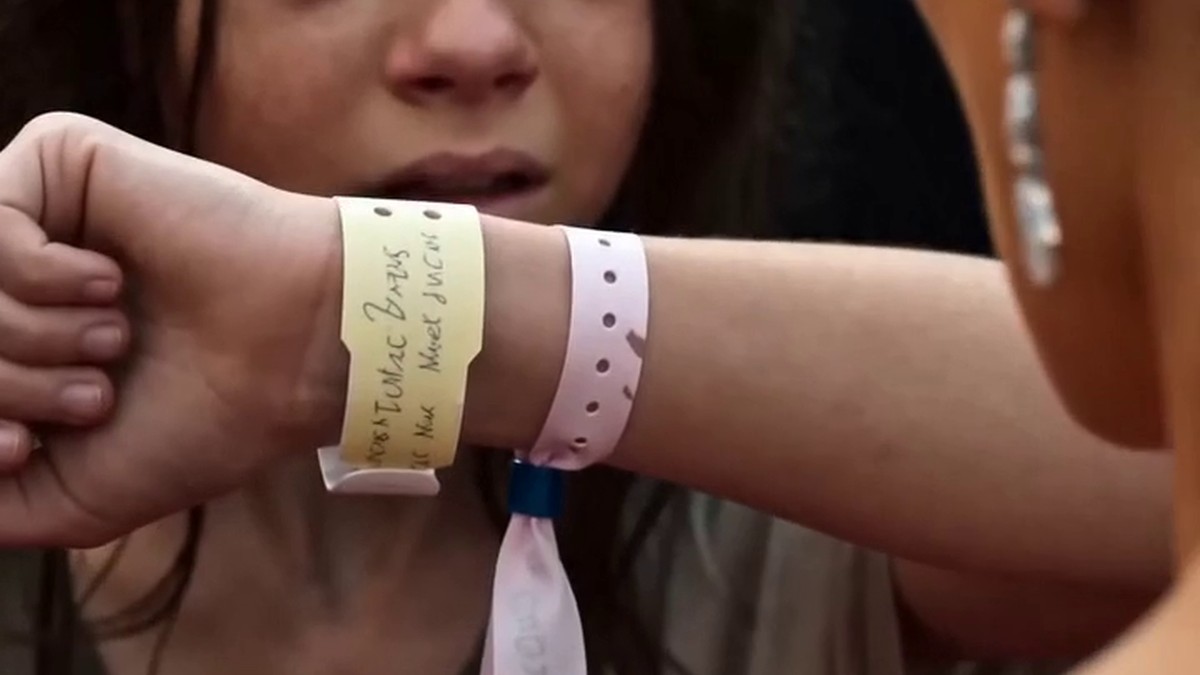
That's when security stepped in front of a small, homeless girl trying to cross the velvet rope.
"Keep her away from me," the actress said — not a glance, not a pause.
The girl didn't run. She didn't crumble. She just stood there, something ancient and quiet burning behind her eyes.
Then, slowly, she lifted her wrist.
Dangling from it was a hospital newborn bracelet, yellowed with age, threaded through a faded pink ribbon and knotted like a secret kept too long.
The actress turned around.
She went completely still.
She moved closer. She leaned in. She read the handwriting on the bracelet — and the breath left her body all at once.
"I wrote those letters myself," she said, barely above a whisper. "The night they took my baby away from me."
Every camera on that carpet went quiet.
The girl's eyes filled. One tear broke loose, then another.
"Then why did everyone tell me," she managed, voice barely holding together, "that you never wanted me?"
The word landed like a stone dropped into still water.
*Never wanted me.*
The actress — Vivienne Cole, the name on a thousand marquees, the face on a thousand magazine covers — felt something inside her chest crack open like old plaster. She forgot the cameras. She forgot the photographers still half-raising their lenses, unsure if this was performance or something rawer and more terrifying than that.
She took one step forward. Then another.
The security guard — big, block-shouldered, already reaching for the girl's arm — stopped when Vivienne raised one hand.
"Don't." Her voice was quiet. It left no room for argument.
She crouched down, right there on the red carpet, couture gown pooling around her knees like spilled wine, and she looked at the girl the way people look at something they thought they'd lost forever and had given up hoping to find again.
"What's your name?" she asked.
The girl swallowed. Clutched the bracelet at her wrist. "They called me Lily. At the last home."
*The last home.*
Two words that gutted Vivienne where she knelt.
"Lily." She said it slowly, like she was measuring the weight of it. "I named you Clara. After my mother."
Something moved across the girl's face — not warmth, not yet, but a door cracking open a half-inch in a house that had been sealed a long time.
"I don't know anyone named Clara," she said.
"No," Vivienne said. "I don't imagine you do."
—
The publicist materialized at Vivienne's elbow — a sharp-faced woman named Sandra who had been managing Vivienne's image for eleven years and who treated every unscripted moment the way a bomb disposal expert treats a suspicious package.
"Viv," Sandra said, low and urgent. "Inside. Right now. Whatever this is, we handle it inside."
Vivienne didn't move.
"Viv—"
"Sandra." She looked up at her. "If you say one more word, you're done."
Sandra's mouth closed.
The cameras kept shooting. Someone in the back of the press line was doing a live phone video, arm raised overhead, trembling.
Vivienne stood. She held out her hand to the girl — to Lily — palm up, an offering, not a command.
"Come with me," she said. "Please. Just — five minutes. Somewhere quiet. You can leave whenever you want. I just need to tell you the truth."
Lily looked at the hand. Looked at her. Those eyes — God, those eyes — dark and watchful and older than seventeen years had any right to make them.
She didn't take the hand.
But she walked through the door.
—
They found a side room off the venue's main hall. Someone's green room, half-stocked with untouched fruit platters and bottled water and a rack of pressed suits nobody was wearing. Sandra tried to follow. Vivienne shut the door in her face.
Just the two of them. The noise of the carpet bleeding through the walls like something far away.
Lily stood near the door. Arms crossed. She'd positioned herself close to the exit, Vivienne noticed. Old habit. The kind of habit you build when every room has been temporary.
"You said you wrote those letters yourself," Lily said. She wasn't accusing. She was just holding the fact up to the light, turning it over. "The night they took me."
"I was nineteen," Vivienne said. "I didn't have money. I didn't have family — not any that would help. The man who—" She stopped. Chose her words. "Your father wanted nothing to do with either of us. I had nothing."
"So you gave me up."
"I signed papers to place you in foster care," Vivienne said. "Temporary guardianship. I signed up for the reunification program. I worked two jobs. I went back for you."
Lily's chin lifted slightly. "What?"
"Eight months later, I had enough saved. I had an apartment. Small — one room — but I had it." Vivienne's voice was steady, but just barely. "I went back to the agency. I had every form they gave me. I did everything right."
A long pause.
"They told me you'd been adopted," she said. "Closed adoption. No contact information. No forwarding anything." She pressed two fingers to her mouth for a moment. "They told me it was what you wanted. That you were happy. That pursuing it further would—" Her voice frayed at the edges. "That it would only cause harm."
Lily had gone very still.
"They lied to you," she said. Not a question.
"I didn't know that then," Vivienne said. "I was twenty. I believed them. I thought — I thought you were safe somewhere. With a family." Her eyes burned. She didn't let herself look away. "I spent the next sixteen years trying to find you through every legal channel I could. Every one."
"You're Vivienne Cole," Lily said, something sharp entering her voice now. "You have money. You have lawyers."
"I have had lawyers on this since I had money to hire them," Vivienne said. "The adoption was sealed. The agency records were — they had irregularities. There was a lawsuit three years ago against Meadow Path Children's Services. Falsified placements, documents altered. Eight families. I was one of them."
Something shifted in Lily's face.
"Meadow Path," she repeated slowly.
Vivienne looked at her.
"You know that name," she said.
Lily's jaw tightened. "That's the agency that placed me with the Harmons." A beat. "The last real home I had. Before."
The pieces were there between them. Both of them could see them.
—
It came out in pieces, the way these things do — slowly at first, then all at once.
Lily had been placed with a family called the Harmons when she was two. Good people, she said, and something softened in her face when she said it, something young and unguarded that she quickly covered back up. She'd been with them six years. Then the Harmons had hit a financial crisis. They'd tried to pursue formal adoption to secure Lily's placement.
Meadow Path had blocked it.
Instead they'd sent a woman to the house — official, clipboard, lanyard — who told Lily, aged eight years old, sitting in a kitchen she thought was her home, that her *real mother* had been contacted about adoption proceedings and had declined to be involved. Had specifically requested no contact. Had moved on.
*She doesn't want you, sweetheart. Some moms aren't ready to be moms. It's not your fault.*
Lily said this without expression, the way you repeat something you've said inside your own head so many times it has lost all texture.
Vivienne sat down on the edge of a folding chair. Her legs had stopped being reliable.
"I was never contacted," she said.
"I know that now," Lily said. "I didn't know it for a long time."
"Lily—"
"Don't." Her voice cracked, just slightly, and she pulled it back together fast. "Don't do the thing where you cry and I have to — I can't do that right now. I've been on the street for four months. Before that I was couch-surfing for a year. I came to this thing tonight because someone said there was media, and I thought—" She stopped. Laughed, a short hard sound. "I thought if she was real, maybe I could find her face somewhere. See what I came from. I didn't actually think—"
She stopped again.
She looked at Vivienne.
And something in her — some old calcified thing she'd been carrying since she was eight years old in a kitchen that stopped being her home — started to give way. Not dramatically. Not all at once. Just a hairline fracture in something that had been holding too much weight for too long.
"I look like you," she said quietly.
"Yes," Vivienne said. "You do."
"I used to pretend — when I was little — that my mom was famous. That she had a reason." A pause. "Kids do that."
"I know."
"It's a stupid thing to do."
"It's not," Vivienne said. "It's surviving."
—
She called her lawyer from that room. Right then. Sandra knocked twice and Vivienne ignored her both times. The lawyer picked up on the second ring — he was used to that — and Vivienne told him to pull every file on the Meadow Path case, tonight, and to find her the name of the caseworker who had handled a placement in 2009 for a girl called Clara, now Lily, and she said it the way people say things when they have made a decision so deep in their bones that nothing is going to move it.
Lily watched her do all of this.
When Vivienne hung up, the girl said, "What happens now?"
"Now," Vivienne said, "someone answers for what they did." She looked at Lily directly. "And I find you somewhere to sleep tonight that isn't a doorway."
A long silence.
"I don't need saving," Lily said.
"I know you don't," Vivienne said. "You've been saving yourself your whole life. You're extraordinary at it." A beat. "But you don't have to anymore. If you don't want to."
The door opened. Sandra, abandoning diplomacy. She took one look at both their faces and for once in eleven years of crisis management said absolutely nothing.
The noise from the carpet drifted in with the light from the hallway.
Lily looked at the bracelet on her wrist. The old hospital plastic, yellowed and small. She'd found it in a manila envelope in the back of a social services file when she was sixteen, along with a photo — a young woman, dark-haired, eyes exhausted and full of something that could only be described as love and terror in equal measure — holding a baby and looking directly at the camera like she was making a promise she didn't know how to keep.
Lily had carried both for two years. Through four addresses and one bad winter and the slow erosion of whatever plan she'd started with.
She'd kept them.
She looked at Vivienne.
"Clara," she said, testing it. The name sat strange in her mouth. New-strange, not wrong-strange.
Vivienne's eyes filled. She didn't move. She let the girl set the pace. She had learned — in all the years of not finding her, of carrying the absence of her like a stone in the center of everything — she had learned to wait.
Lily crossed the room.
She didn't hug her. Not yet. That was going to take time, and they both knew it, and neither of them pretended otherwise.
But she sat down next to her.
Close enough that their shoulders almost touched.
And she said, "Okay. Tell me. From the beginning."
Outside, the red carpet continued its spectacle — the lights and the names and the beautiful noise of a world performing itself. Photographers called out into the dark, wondering where Vivienne Cole had gone, why she'd stepped away in the middle of everything.
Nobody in that room was wondering.
In that room, Lily had let her hand fall open in her lap — the bracelet still on her wrist, but no longer clutched.



Дідусева шафа з горіха
Оксана Верещак років зо два тому почала називати посилки свекрухи «мотлохом» і була переконана, що та просто економить на них...


Дідусева шафа з горіха
Оксана Верещак років зо два тому почала називати посилки свекрухи «мотлохом» і була переконана, що та просто економить на них...


Le silence après le portail vert
Je m'appelle Bastien Ferrand, j'ai quarante-six ans, et pendant onze ans j'ai porté l'uniforme de la gendarmerie à Vézenne, un...


**Gdynia, lotnisko Chopina w Warszawie, wtorkowa noc przed Wszystkimi Świętymi**
**Warszawa, lotnisko Chopina, wtorkowa noc przed Wszystkimi Świętymi** Myślałam, że mój mąż ratuje ludziom życie na sali operacyjnej. Zamiast tego...


**Gdynia, lotnisko Chopina w Warszawie, wtorkowa noc przed Wszystkimi Świętymi**
**Warszawa, lotnisko Chopina, wtorkowa noc przed Wszystkimi Świętymi** Myślałam, że mój mąż ratuje ludziom życie na sali operacyjnej. Zamiast tego...


The Night My Mother Tapped Morse Code Through a Garden Wall
# The Night My Mother Tapped Morse Code Through a Garden Wall The taxi dropped me at the main gate...


# The Kid Who Didn’t Eat
I never thought I'd be the one telling this, but somebody has to explain why I did what I did...


Le Cri dans les Roses
Je travaille au manoir depuis neuf ans. J’ai vu des mariages, des anniversaires, des veillées funèbres, des réconciliations à deux...