
EN
The Wrong Reflection

The late afternoon light pressed against the floor-to-ceiling windows of the Glencoe mansion, turning the polished walnut of the study into slabs of amber. Outside, Lake Michigan was a sheet of hammered pewter. Inside, the silence was heavier than the antique furniture.
Eliza Reyes stood three steps inside the doorway, fingers digging into the seam of her apron pocket. James Crowford hadn't looked up from his desk. He never did. A man who'd built a shipping empire out of a single rust-bucket freighter didn't waste eye contact on house staff. Especially not staff who'd been there less than six months.
"Mr. Crowford," she said.
The pen kept scratching.
"I found your daughter."
The scratching stopped.
Crowford's head came up slowly, like a gun turret rotating. His face was all hard lines and old disappointment — the kind you get from losing something precious and spending twenty-two years blaming the world for it.
"What did you say?"
"I found Helen."
The name hung in the air. Nobody said that name in this house. The portraits in the upstairs hall skipped from his son Malcolm's graduation straight to the grandchildren. A whole chapter erased.
Crowford stood. Six-four, shoulders still broad at sixty-eight. "You've been here five months. You don't know anything about my daughter."
"I know she was seven when she vanished from the backyard. I know it was June fourteenth. I know your wife died two years later and never stopped believing Helen was alive."
The color drained from his face. "You've been digging through family records."
"No." Eliza pulled a small velvet pouch from her apron. "I've been digging through a storage unit in Skokie where a woman named Lena Marchetti kept her things until she died three weeks ago."
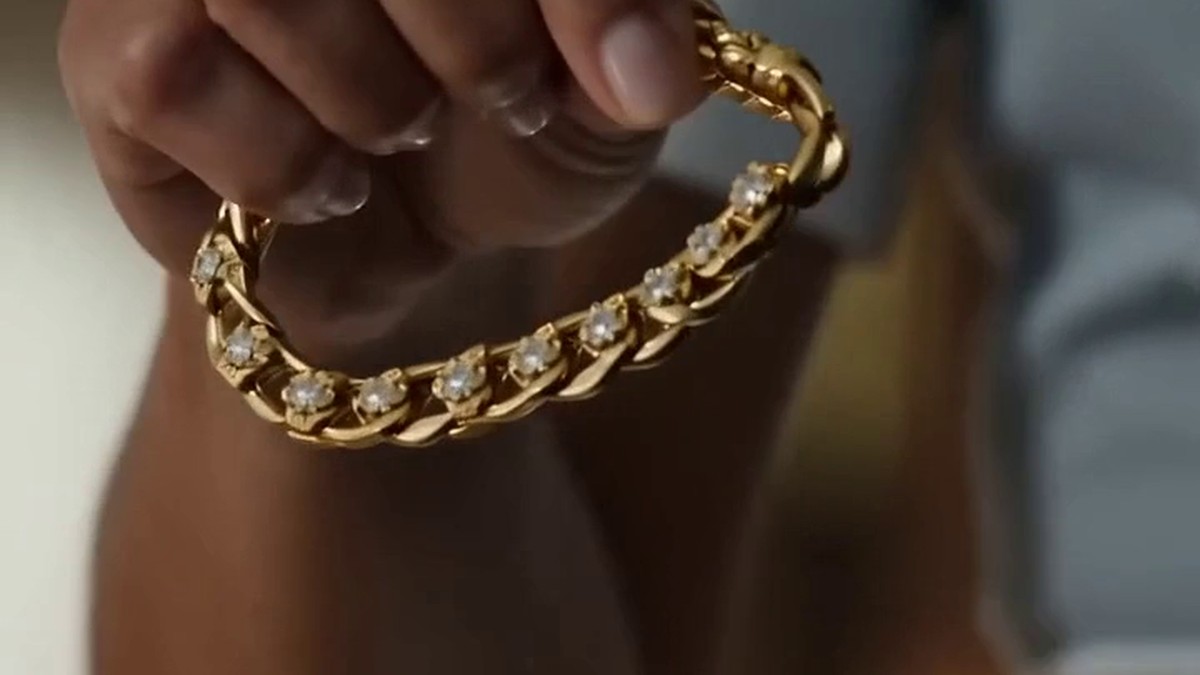
She tipped the pouch. A bracelet slid out onto the desk — delicate gold chain, child-sized, with a tiny charm in the shape of a star. Crowford's hand froze halfway to it.
"The back of the star," Eliza said.
He turned it over with fingers that had suddenly gone clumsy. Etched into the gold: *Bears. Cubs. Joy. 6-14-89.*
Helen's seventh birthday. He'd had the bracelet made at a jeweler's on Wabash Avenue. She'd worn it to her party in this very backyard — a petting zoo, a clown, cake with buttercream roses. The last happy day before the world cracked open.
"Where did you get this?" His voice had gone gravelly. "Who the hell is Lena Marchetti?"
"That's the question, isn't it?" Eliza didn't flinch. "Lena Marchetti was your wife's personal assistant for eleven years. She quit three months after Helen disappeared. Moved to Arizona. Changed her name twice. And she took something with her — something she hid before she left, because she knew someone in this house would destroy it."
Crowford's jaw worked. "You're telling me my wife's assistant knew what happened to my daughter and said nothing? For twenty-two years?"
"I'm telling you the evidence was here the whole time. You just never knew where to look."
She pointed past him.
Crowford turned. On the far wall, above the marble fireplace, hung a portrait of a little girl in a butter-yellow dress, one hand resting on a velvet chair, a half-smile that always looked like she knew a secret. The artist had caught something in her eyes — something too clever for seven. The painting had hung there since Helen was eight. For years after she vanished, it had been too painful to move. Eventually, it had just become wallpaper.
"Behind the canvas," Eliza said. "There's a false backing. Inside, you'll find a manila envelope Lena hid sometime in June of '96. She didn't trust your security. She didn't trust your brothers. And she really didn't trust your wife's new husband."
Crowford flinched at that. The second marriage had lasted four miserable years before the cancer took Marjorie. He'd never spoken of it to anyone on staff. Ever.
He crossed to the painting, lifted it off its hooks with a grunt, and laid it face-down on the leather couch. The brown paper backing was brittle with age. He worked a letter opener under the edge and split it clean.
The envelope was there — yellowed, flattened, sealed with packing tape gone brown and gummy. Inside: a sheaf of emails printed on dot-matrix paper, a photograph, and a folded letter in handwriting he recognized.
The photograph was of a woman in a nondescript motel room, leaning against a window frame. She had close-cropped dark hair streaked with gray, tired eyes, and a familiar set to her jaw.
His breath stopped.
It was Helen. Grown. Alive. Taken maybe five, six years ago, judging by the date stamp in the corner.
The letter was from Lena Marchetti. Four pages, tightly spaced. He read the first sentence and felt the floor tilt.
*If you're reading this, James, then I'm dead and someone finally looked in the right place. Your wife tried to have me killed in '96. Helen has been in protective hiding ever since. Here is everything.*
—
The story unraveled over the next hour.
Marjorie Crowford — fragile, grieving Marjorie — hadn't been grieving at all. She'd been covering. Helen's "disappearance" was an abduction staged to look random, but it was anything but. Marjorie had discovered her husband was planning to divorce her and take full custody, armed with evidence of her prescription drug abuse and a string of affairs stretching back to Helen's infancy. The prenup would leave her with nothing. But if she were a grieving mother whose child was presumed dead, the sympathy and the money would keep flowing.
She'd paid two men to snatch Helen from the backyard during the birthday party chaos. The plan was to hold her for forty-eight hours in a rented warehouse and then… Marjorie hadn't thought that far ahead. She'd been high on a cocktail of barbiturates and rage. Lena had overheard a phone call that wasn't meant for her and made a choice.
She'd called a cousin in the FBI field office in Detroit. Within twelve hours, Helen was recovered from the warehouse, the two men were in custody, and a deal was being hammered out. Marjorie had friends in the Chicago PD — a deputy superintendent with whom she'd been sleeping. Going through official channels risked the whole case evaporating. So Lena and the FBI agent made a different call. They staged a kidnapping gone wrong overseas — planted evidence, leaked it to a friendly reporter, let the trail go cold. Helen Crowford "disappeared." Her mother never knew whether she was alive or dead. That had been the point.
Helen, by this account, had been living in Seattle for the last fifteen years under the name Claire Ruskin. She'd graduated from University of Washington, worked as a high school biology teacher, and gotten married. Two kids. A daughter named after her grandmother.
She'd tried to contact her father three times. All three letters had been intercepted by private security — men still loyal to Marjorie's money, even after her death.
Crowford read the last page with hands that shook so badly he had to set the paper down to finish it.
—
Eliza waited by the window, arms crossed, watching the ice form along the lakeshore.
"How did you know?" Crowford asked. His voice was a ruin.
"I didn't." She turned to face him. "Lena Marchetti was my aunt. She never told me the story. Never said a word. But her last week in hospice, she kept mentioning a painting she should have done more about. A star charm. A little girl in a yellow dress." She shrugged. "I put it together. I wasn't sure until I found the backing on the canvas this morning."
"You could have told me. You could have explained before—"
"Before what? Before the millionaire with the army of lawyers decided to have me arrested for snooping? Before I got fired and discredited and the last evidence got destroyed?" Her voice was steady, but her eyes were wet. "My aunt spent her whole life scared. She moved six times. She never married. She was told if the truth came out while Marjorie was alive, people would die. Those people are dead now. So I'm done being scared."
Crowford looked at the photograph again. His daughter. The last time he'd seen her, she'd been wearing fairy wings and sneakers with light-up soles, chasing a baby goat around the lawn and shrieking with laughter. Now she had crow's feet and gray in her hair and a life he knew nothing about.
"There's a phone number," Eliza said quietly. "Third page from the end. It's current."
He fumbled with the pages, found the number, and stared at it. Ten digits. The distance between twenty-two years of grief and the sound of his daughter's voice compressed into ten digits.
"What if she doesn't want to hear from me?"
"She tried to write you three times. Move."
—
The call took six hours to arrange. The number went through a service — some sort of security protocol Lena had set up — and then a callback from a blocked ID, and then an intermediary, and then a long silence filled with the hum of the house's heating system.
When the phone finally rang, Crowford grabbed it before the first ring finished.
"Hello?" A woman's voice, cautious.
"Helen." His throat closed. "It's Dad."
Silence. Then a sound he couldn't identify — a half-laugh, half-sob, muffled as if she'd put her hand over the receiver.
"I know," she said finally. "I know. They called me. I just—" A breath. "I didn't know how to start."
"Start with hello. Start with anything."
"Hello, Dad."
He pressed the phone so hard against his ear that it hurt. Outside, the first real snow of winter was starting to fall, dusting the lawn where a petting zoo had stood twenty-two years ago, where the last good day had ended and the long dark had begun.
"I've got a picture of you," Helen said. "On a swing set. You're pushing me. I'm missing my front teeth."
"I remember that day. You threw up from eating too much cotton candy."
"Still do. Can't even smell the stuff now."
He laughed. It came out as a sob, but it was a laugh. "I have so much to tell you. Years. Decades. I don't even know where to—"
"Start," she said, "take your time. I'm not going anywhere."
Through the window, the snow kept falling. In the study, Eliza slipped quietly out the door, leaving the old man alone with the telephone and the portrait and twenty-two years of silence finally breaking.



Прощання на пероні в Ніжині
Мене звати Тарас Ковальчук, мені сорок три, і вісімнадцять років я працюю провідником на потязі "Ніжин-Київ". Того ранку я саме...


Браслет Каспара: сім років брехні під одним дахом
П'ятирічна дівчинка тицьнула пальцем у великий портрет у передпокої й запитала так, ніби це найзвичайніше питання на світі: — А...


Вінстон і хлопчик, що навчив собаку довіряти знову
Собака-бульдог лежить у самому кутку вольєра, на сірій ковдрі, притиснувши голову до бетонної підлоги, і слухає кроки в коридорі притулку...


Коробка з книжками на Раневській, або чому батько мовчав три роки
Мене звати Тарас Коваленко, мені сорок два, і я керую мережею автосервісів у Дніпрі. Того четверга мені скасували переговори з...


Автомийка на Богунській, три роки мовчання
Мене звати Максим Ковальчук, мені тридцять шість, і я власник автомийки на Богунській у Житомирі. П'ять постів, компресорна станція, яку...


Колесо від воза
Пам'ятаю той звук ще до того, як розплющила очі, — метал, що б'ється об тверду глину подвір'я, рівний, ніби хтось...


Тато продав овець, щоб я мав диплом
Мар'ян Ковальчук приїхав до Залісся в середу вранці, двадцять другого липня. Вийшов з "Тойоти" на краю ґрунтової дороги, там, де...


Ранкова зміна в кав’ярні на розі Дерибасівської
Мене звати Оксана Гриценко, я двадцять третій рік працюю в невеликій кав'ярні "Затишок" неподалік Привозу в Одесі. Бачила за цей...