
EN
The Girl Who Called Me Bear

The phone rang at 4:40 in the morning, and before I even opened my eyes, I knew something was wrong. Men like me don't sleep deep. Not after years of walking through flooded timberlands, burned-out fields, ravines, frozen lakes, and empty highways with a search dog at my side. Sleep comes in fragments. Ten minutes here. Thirty minutes there. One ear always open, one part of my mind always listening for the sound that means somebody's lost. So when my phone buzzed on the wooden crate beside the bed, my hand was already reaching for it before the second ring.
"Desmond Fenn," I said.
The woman on the other end hesitated, like she'd been expecting someone else. Her voice was careful, official, too quiet for that hour of the morning.
"Mr. Fenn, this is Deputy Laura Quinn with the Skagit County Sheriff's Office. I'm sorry to wake you, but we have a little girl here. She was found walking barefoot along State Route 20 outside Concrete just before sunrise."
I sat up in the dark. My older search dog, Koda, lifted his head from the rug. The rain ticked against the windows. The woodstove was cold. Boots by the door. Nothing in my life had changed in the last thirty seconds, and yet I felt the ground shifting under my feet.
"Little girl?" I asked.
"Yes, sir. Approximately six years old. She's shaken up, but physically stable. She gave us your phone number."
I looked around the cabin like the room might explain the call. "I think you've got the wrong man. I don't have a daughter."
Another pause.
"Sir," Deputy Quinn said gently, "that's what I thought too. But she keeps asking for someone named Bear."
The word hit me so hard I forgot how to breathe.
Bear.
Nobody had called me that in twenty-five years. Nobody living, anyway. My brother Julian gave me that name when we were boys in foster care, when I was seven and afraid of every dark hallway in every new house they put us in. Julian was nine, skinny as a rail, and twice as brave as any adult I'd ever known. When I cried at night, he'd climb down from the top bunk, put one hand on my chest, and murmur, "I'm right here, Bear."
Julian had been dead for four years.
His wife, Lisa, was dead with him. Their unborn baby, a girl, was dead too. At least that's what the world told me. That's what the death certificates said. That's what the closed caskets said. That's what the headstone in the Concrete cemetery said every time I stood in front of it and felt my own life go quiet.
Deputy Quinn's voice came back through the phone. "Mr. Fenn? You still there?"
I swung my legs off the bed. Koda was already at the door, ears up, nose pointed toward the dark window like he'd caught a scent through the rain.
"I'm coming," I said.
I pulled on jeans, boots, and an old search-and-rescue jacket. The drive into town took twenty-three minutes. I remember every one of them because my hands were shaking on the wheel the entire way.
The county building smelled like burnt coffee, wet uniforms, and floor wax. A social worker met me at the hallway door. She had kind eyes and the cautious expression of someone who'd already heard too many sad things before breakfast.
"She's calm now," the woman said. "She's got a blanket and some juice. She said she's been waiting for you."
"I told your deputy," I replied, though my voice sounded strange to my own ears, "I don't have a child."
The social worker just nodded. Then she opened the door.
The little girl sat on a plastic chair with bare feet tucked under the edge of a county-issue blanket. Her hair was dark and tangled. Her cheeks were pale. She had scratches on her ankles and dirt under her fingernails. She wore a gray cardigan that hung to her knees. But it was her eyes that stopped me. Gray-green. Julian's eyes.
She looked up at me, and relief spread across her face so completely I almost stepped back.
"Bear?" she whispered.
My chest tightened.
She slid off the chair, dragging the blanket behind her. "Daddy said to find Bear," she said. "Daddy said Bear always comes."
I knelt on one knee before I realized I was moving. "What's your name?" I managed.
Her small cold hand slipped into mine.
"Clementine," she said. "Clementine Fenn."
And then, from the doorway behind her, a woman's voice: "I'm sorry, Desmond."
I looked up.
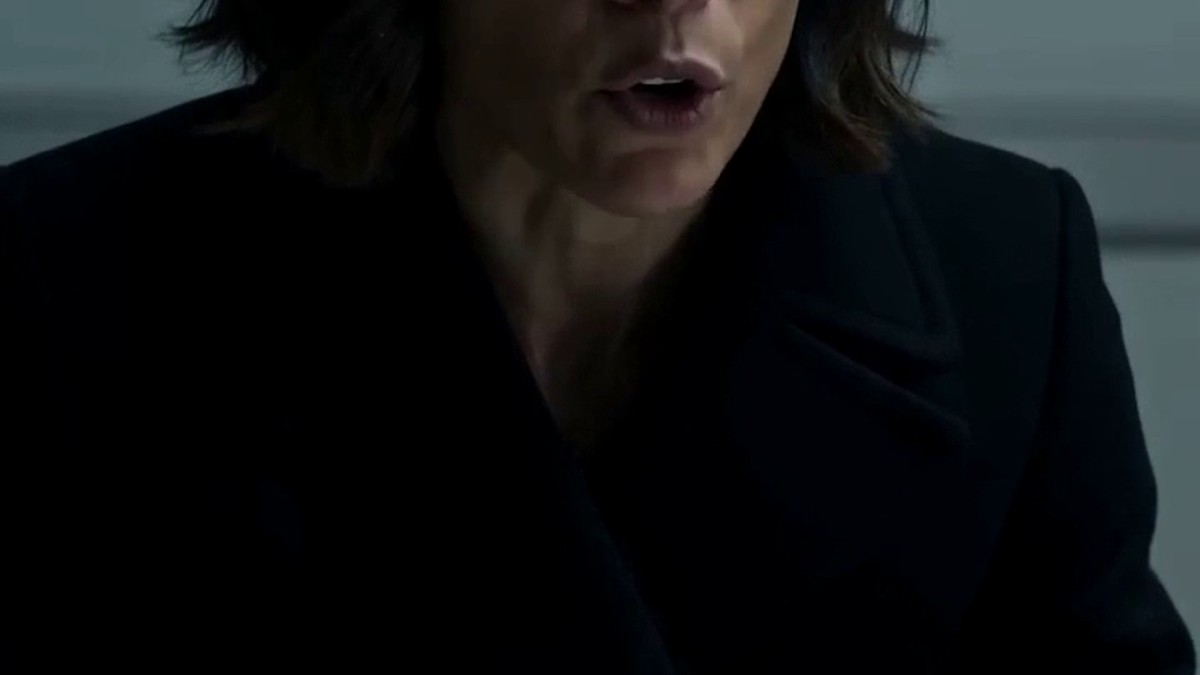
A woman stood there in a long black coat, thinner than I remembered, her hair cut short and dyed dark. Her face was older, sharpened by fear, but I knew her. I'd seen that face in wedding photos. I'd seen that face next to my brother on the dock. I'd watched a casket with her name on it sink into the ground.
"Lisa," I said.
She looked at me with hollow eyes. "You buried Julian," she said. "Not me."
—
Deputy Quinn, the social worker, and the girl named Clementine all seemed to blur at the edges of my vision. I was still on one knee, holding a cold little hand, but my eyes were on the woman in the doorway. Lisa. Four years dead. Standing in the hallway of the county building at five in the morning.
"You were in the car," I said. My voice came out flat. "The accident on Highway 20. Both of you. The report said—"
"I know what the report said." Lisa's voice was thin, but steady. "The car went into the Skagit River. They found Julian's body downstream. They found my purse. My shoes. They assumed."
Clementine tugged at my hand. "Bear," she said, "I'm hungry."
Nobody answered her. The social worker was staring at Lisa like she'd seen a ghost, which—I realized—she pretty much had.
"Can we talk somewhere private?" Lisa asked. She was looking at me, not at the officials.
The social worker stepped forward, uncertain. "Ma'am, I'm going to need to see some identification."
Lisa reached into her coat and pulled out a worn leather wallet. She handed over a driver's license. The social worker looked at it, then at Lisa, then back at the license. Her face went pale.
"This says… Lisa Fenn."
"That's right."
"You're listed as deceased in our records."
"I know." Lisa's jaw tightened. "I've been trying to fix that for four years."
Deputy Quinn had stepped closer, one hand resting on the radio at her hip. "Ma'am, I'm going to have to ask you to come with me."
"No," I said. I stood up. "Let's all go somewhere. Sit down. Figure this out." I let go of Clementine's hand. "But first—someone get this kid some actual food. She's been walking all night."
—
An hour later, we were in a windowless conference room. Deputy Quinn sat at one end of the table, a notepad in front of her. The social worker, whose name I'd learned was Mrs. Alvarez, sat beside Clementine, who was working her way through a vending-machine muffin and a carton of chocolate milk. Lisa sat across from me. I couldn't stop looking at her hands. They were thin, with cracked skin around the nails. Not the hands I remembered from the wedding photos.
"Start from the beginning," I said.
Lisa pressed her palms flat on the table. "Julian found out something. About the clinic where we were doing IVF. About the embryos."
I blinked. "Embryos."
"We tried for years, Desmond. You knew that. After the third miscarriage, we went to a clinic in Seattle. Northwest Fertility Associates. They said they could help. They did. I got pregnant." She touched her stomach, a reflex, like the body remembered. "Eight weeks later, Julian found something in the clinic's records. They'd lied about how many embryos they'd created. They'd transferred one, but there were… more. And Julian found out what they were doing with them."
Deputy Quinn was writing. "What were they doing?"
"Selling them." Lisa's voice cracked. "To overseas brokers. To private adoptions. Without consent. Without documentation. They had a whole room full of freezers, and half the embryos in there weren't even matched to the right parents."
I sat back. "Julian found this out."
"He confronted the clinic director. A man named Dr. Alan Whitfield. Julian recorded the conversation. He told me we were going to expose everything. He said…" She stopped, looked at Clementine, then back at me. "He said we had to be careful. That these people had money. Connections."
"And then the accident happened."
Lisa nodded slowly. "The brakes failed. That's what the highway patrol said. Failed brakes on a curve. Julian went into the river. I was thrown clear. I crawled up the bank and I just… ran. I was eight weeks pregnant and I ran."
"You didn't come to me." My voice sounded strange. "You didn't call anyone."
"Julian told me if anything happened to him, I had to disappear. He said they'd come after me. After the baby." Her eyes were wet now, but she didn't blink. "I drove to my sister's place in Idaho that night. She knew. She helped me. I had the baby in Boise under a different name. Born at home, no hospital records. I've been hiding for four years, Desmond. Four years. I only had time to grab a bag before I left the house. A few clothes. Julian's old flannel. One of my cardigans that Clementine grew into."
Clementine had stopped eating. She was watching her mother with big, solemn eyes.
"Why come back now?" I asked.
Lisa reached into her coat again. This time she pulled out a folded piece of paper, creased and soft at the edges. She slid it across the table toward me.
I unfolded it. It was a death threat. Typed, unsigned. Dated two weeks ago. It listed an address in Boise. It listed Clementine's name.
"They found us," Lisa said. "My sister's house was broken into while we were at the grocery store. They left this on the kitchen table. They took nothing. That was the message."
I looked at the paper for a long time. The address was right. The name was right. They'd found out everything.
"So I took Clementine and I ran," Lisa continued. "I couldn't go back to the sister's place. Couldn't use my cards. Couldn't use my phone. I drove through the night and I just… headed north. Toward home. Toward you. Julian always said if anything went wrong, if it all fell apart, find Bear. Bear always comes."
The room was silent. Deputy Quinn had stopped writing. Mrs. Alvarez had one hand on Clementine's shoulder.
"Where's the car?" I asked.
"Parked off a logging road about a mile from where she was found. It ran out of gas. I walked to the highway with her, but I—I panicked when I saw the deputy's car. I hid in the trees. I watched them pick her up. I followed on foot." Lisa's voice dropped. "I didn't know what else to do."
I looked at Clementine. She was picking crumbs off the table with one small finger, methodical, patient. A kid who'd learned not to ask too many questions. A kid who'd spent four years hiding.
"Deputy Quinn," I said, "who else knows about this? About Clementine being found?"
"The call went out on the scanner. Standard procedure. BOLO for a missing child, possibly endangered."
"Then they already know." I stood up. "They know she's here."
Lisa's face went white. "We have to leave."
"No." I put the death threat back on the table. "You've been running for four years. Running is what they want you to do. Running is how they keep you weak. You said Julian left a recording. Do you still have it?"
Lisa hesitated. Then she reached into the collar of her shirt and pulled out a small silver pendant on a chain. She unscrewed it. Inside was a micro SD card, no bigger than a fingernail.
"He made me take it. The night before the accident. He said it was the only copy."
I picked up the card. "Deputy Quinn, is there anyone in this department you trust? Completely?"
She met my eyes. "There's one person. My father. He's a detective in Mount Vernon. Retired FBI before that."
"Call him."
She pulled out her phone and dialed.
—
We moved in pieces. I left Clementine with Mrs. Alvarez, who locked the conference room from the inside. I sent Koda to my truck—he'd been waiting in the cab the whole time, watching the building. Lisa stayed in the hallway, out of sight, while Deputy Quinn and I walked out the front door like nothing had changed.
Her father met us in the parking lot of a closed gas station off Highway 20. He looked like his daughter—same gray eyes, same careful way of moving. He listened to the recording on a handheld player I never got the name of. His face didn't change, but his hands did. They curled into fists on his knees.
"That's Whitfield," he said when it was over. "I know him. He donated to the sheriff's department campaign fund. Big donor." He looked at his daughter. "This is bigger than Skagit County. We need to move this to the state level. Maybe federal. I've got two men I trust from my old field office. I'll bring them in, station them at the building. Nobody touches that girl."
"How long before we can move on Whitfield?" I asked.
"A day. Maybe two. If I make the right calls."
"That's a long time for a man with a death threat and a little girl in a locked room."
"Then we make the building safe," the old man said. "You, me, my two guys. We don't let her out of our sight. We don't let anyone in unless we know them."
I nodded. "Defense buys us the time. But I'm not spending two days just waiting for him to find us first."
—
I won't pretend I had a plan. I'm not a cop. I'm a guy who spends his life finding lost people in the woods. But I know something about how people hide. And I know something about men like Dr. Alan Whitfield. Julian did too. He always said the problem with people who think they're untouchable is that they stop paying attention to the ground under their feet.
Whitfield lived in a big glass house on the ridge above the river, just outside of town. You could see the whole valley from his living room window. You could see the highway, the river, the old bridge. You could see everything.
Which meant everyone could see him.
We called a reporter. Not a big network name—a local woman from the Mount Vernon paper who'd been digging into fertility clinic practices for two years and had gotten nothing but silence. Her name was Dana Reyes. She met us in the cabin at noon, took one look at the SD card, and her whole face changed. Like someone who'd been told the sky was green for twenty years and suddenly saw it turn blue.
"I've had a source inside that clinic for six months," she said. "A former lab tech. She's been feeding me billing records, but I could never prove intent. This—" she held up the card— "this is the missing piece. Give me two days. I want it airtight before it runs. If we go too fast, his lawyers pick it apart and it dies in a week."
"Take the two days," I said. "But work fast."
—
For two days, nothing seemed to happen, and everything did. Deputy Quinn's father and his two retired-Bureau friends took shifts at the county building, one of them always in the hallway outside the room where Lisa and Clementine slept on a cot borrowed from the break room. Dana Reyes worked the phones from a motel room she wouldn't name. Her source inside the clinic, the lab tech, finally agreed to hand over internal files—storage logs, unmatched consent forms, wire transfers routed through a shell company in Nevada.
On the third morning, the story went up.
It ran nine hundred words under Dana's byline, with the clinic's own paperwork reproduced alongside it. By noon, it had been picked up by a Seattle television station. By that afternoon, the state medical board had opened a formal inquiry. Reporters started calling the sheriff's office, the clinic's front desk, Whitfield's home number.
Whitfield called my phone that evening, before the six o'clock news had even finished airing. His voice was still smooth, still working an angle, like a man who hadn't yet understood how far the ground had already fallen away beneath him.
"Mr. Fenn," he said. "I understand there's been a misunderstanding."
"There's no misunderstanding." I was standing in the parking lot of the county building, leaning against my truck. Inside, Deputy Quinn's father and his two men had already swept every room, every window, every door, and posted themselves at the stairwell. "There's a woman and her daughter. There's a recording. And there's a dead man you thought you'd gotten rid of."
"Julian made unfortunate choices." Whitfield paused. "He could have come to me. We could have worked something out. Instead he threatened me. In my own office. What would you have done?"
"I'd have gone to the police."
Whitfield laughed, soft and dry. "The police. Yes. The police who take my donations. The police who golf with me on Sundays. You think they'd have believed a man with no family, no money, no standing, over me? A man with a troubled past from foster care? They'd have locked him up for extortion."
"You killed him."
"I didn't kill anyone, Mr. Fenn. The accident was just that. An accident. Tragic. I sent flowers."
I watched a car pull into the far end of the lot. Black sedan, tinted windows. It stopped about fifty feet from me. Two men got out, broad-shouldered, jackets zipped against the cold, and stood by the car with their hands in their pockets, watching the building.
"What do you want?" I asked.
"I want what was taken from me. The recording. And I want the woman and her child to go away. For good. I'm prepared to be generous. Name your price. Everyone has a price."
Behind me, the building's side door opened. Deputy Quinn's father stepped out first, and one of his two men followed, positioning himself near the front steps, eyes on the sedan. I hadn't heard them come out. I hadn't needed to call them. They'd been watching the lot from the window the whole time.
"I was just thinking the same thing," I said into the phone. "I was thinking about price. You're a doctor, right? You know all about exchange rates. Value. Equity. This is the part where I tell you what it's going to cost."
"We're listening."
"It's going to cost you everything," I said. "Not money. Not property. All of it. The clinic. The practice. The house on the hill. Your reputation. Your future. The way people look at you in the grocery store. Bank accounts frozen. Passports canceled. Federal agents going through every file, every freezer, every embryo. Every single one. And it's already started. Turn on your own television, Doctor."
There was a long silence on the line.
"Who did you call?" Whitfield finally asked, and for the first time his voice had lost its polish.
"A reporter," I said. "The one you'd been ignoring for two years. Turns out she's patient. And thorough."
The line went dead.
The two men by the sedan exchanged a look, then glanced toward the building, where Deputy Quinn's father now stood plainly on the steps, badge visible, one hand resting near his hip. In the distance, down the highway toward town, a line of headlights was moving our way—more than one car, moving in formation, light bars catching the wet asphalt. State police, called in an hour earlier when the medical board's statement broke.
The two men got back in the sedan without a word and pulled out of the lot. They didn't get far. The highway was already blocked at the bridge.
—
Whitfield was arrested at his home the next morning. He'd been packing a suitcase for most of the night, the neighbors told police later—lights on until dawn, blinds drawn. There was a boat waiting at the dock below his house, registered under a false name. He made it as far as the kitchen before the first officers came through the door.
The recording was the key. Julian's voice, steady and clear, confronting Whitfield about the embryos, the sales, the fake files. Whitfield's voice in response, smooth as ever, saying, "You don't know who you're dealing with, Mr. Fenn. I have friends in high places. Low ones too."
The medical board revoked his license pending a full investigation. The FBI opened a case. Two other clinic employees were arrested within the week. The clinic was shut down. The freezers were cataloged, and what they found made national news.
But all of that was later.
That night, after the arrest, I drove Lisa and Clementine back to the cabin. Koda sat in the back with the girl, his big square head resting on her lap. She was asleep by the time we reached the trailhead, her small fingers tangled in his fur.
Lisa sat in the passenger seat. She didn't speak for a long time.
"He would have been proud of you," she said.
I kept my eyes on the road.
"He named her after the town," Lisa said. "Clementine. We always talked about moving there. Buying a little place with a garden. Julian said she'd grow up chasing fireflies in the yard."
The cabin was dark when we arrived. I built a fire and made tea. Lisa put Clementine to bed in my room, under a pile of blankets, the way you'd tuck in a kid who'd spent four years sleeping in borrowed beds.
We sat in the kitchen. Koda lay by the stove. Outside, the rain had stopped. The sky was clearing.
"What now?" Lisa asked.
I looked at her. At the gray in her hair. At the scars on her hands. At the cardigan Clementine had worn to bed, folded now over a chair — Lisa's own, one of the few things she'd grabbed the night she ran.
"I don't know," I said. "But I know you don't have to run anymore."
—
Three weeks later, I stood in the Concrete cemetery. Lisa and Clementine were with me, and so was Deputy Quinn, and so was Mrs. Alvarez, and so was Dana Reyes. The sun was out. I'd driven up in the morning to see the stone.
Someone had paid to have it replaced. The new one read:
*Julian Fenn. 1980–2020. Beloved husband. Beloved father.*
There was a small metal box set into the base of the stone. Inside, behind a pane of glass, was a photograph of Julian and Lisa on the dock, their arms around each other. Under it, a single line: "I'm right here, Bear."
Lisa and Clementine stood beside me. The girl held her mother's hand. She was wearing new shoes. They didn't fit quite right yet.
"He left it in the cabin," I said. "A will. Not the official one. A paper he wrote when he was nineteen. It said if anything ever happened, to bury that picture with him. I found it when I cleaned out the house." I paused. "I didn't read it until after the funeral."
"You kept it," Lisa said.
"I kept everything."
She reached into her pocket and pulled out the silver pendant. It hung open, the SD card slot empty.
"The recording is with the FBI now," I said.
"I know." She closed the pendant and put it back around her neck. "It's empty, but I like the weight of it."
Clementine tugged at my sleeve. "Bear," she said, "are we staying?"
I looked down at her. The gray-green eyes. Julian's eyes. My brother's eyes, looking up at me from a face I'd never seen before and yet recognized all the same.
"I don't know," I said. "Do you want to stay?"
She considered the question for a long time, the way children do when they're deciding something important. Then she pointed at Koda, who had sat down in the wet grass and was now watching us with his head tilted.
"The dog likes it here."
"The dog likes it everywhere."
"He likes it here because you're here." She nodded, satisfied with her own logic. "And if you're here, and we're here, then everyone's here. That's what Daddy would've wanted."
I knelt down in the grass. My knees were wet. My hands were shaking again, but for a different reason now.
The grass was wet. The stone was new. The sky was clearing.



The Heels She Stopped Wearing for Daniel
Priya met him at a friend's engagement party in Astoria, one of those crowded Queens apartments where somebody's cousin is...


Le Manoir des Trois Roses
Six fois. Six fois il m'a frappée devant elle, avant de me jeter sous l'orage et de me laisser pliée...


Mieszkanie na Woli, dwa pokoje i osiemnaście lat kredytu — a oni chcieli mnie zrobić potworem
Nazywam się Robert, mam czterdzieści dwa lata i pracuję jako kierownik warsztatu samochodowego przy Górczewskiej. Ta historia zaczęła się we...


Mieszkanie na Woli, dwa pokoje i osiemnaście lat kredytu — a oni chcieli mnie zrobić potworem
Nazywam się Robert, mam czterdzieści dwa lata i pracuję jako kierownik warsztatu samochodowego przy Górczewskiej. Ta historia zaczęła się we...


No me llames Bear
Trabajo turnos de doce horas en el hospital comunitario de Fresno. Esa noche, lo que me tocó fue la sala...


The Girl Who Called Me Bear
The phone rang at 4:40 in the morning, and before I even opened my eyes, I knew something was wrong....


My Husband Drugged My Tea and Fled with His Mistress at 2 AM — by Sunrise, the FBI Was Waiting at Gate C17
The sound of a suitcase zipper cut through the dark at exactly 2:00 AM. I didn't move. Lying on my...


Le Douzième Anniversaire de Naël
Les amandes grillées craquaient encore dans la poêle quand Naël a posé la question. Il était assis sur le tabouret...