
З життя
After My Husband’s Funeral, My Son Took Me to a Woodland Path and Said: ‘This Is Your Destiny.’

After my husbands funeral, my son drove me out to a lonely lane in the woods and said, This is where you belong.
I hadnt sobbed at the graveside, not because I didnt love George wed shared fortytwo years, weathered poverty, illness and the occasional sparkle of joy. I just couldnt find the tears; they seemed stuck somewhere deep, like a stone lodged in my throat. They didnt come at the burial, nor later when the neighbour, Mrs. Wilkinson, shuffled over a tin of porridge and said, Hold on, Mrs. Thompson, dear. I nodded, offered a polite smile and closed the door.
Andrew, my son, stood by me at the service tall, proper, dressed in a sleek black suit that probably cost more than my halfyear pension. He gave me his arm, as one does in a respectable family, but his grip was icy, not from the cold but from duty, as if I were a burden rather than a mother.
During the wake he delivered speeches with theatrical pauses, grand gestures and booming voice. Everyone clapped and cooed, What a son! What a handsome fellow! How clever! I sat in the corner, watching his familiar yet alien face. His eyes were mine, his nose his fathers, his smile belonged to someone else entirely a man who had long stopped being my husband.
Three days after the funeral Andrew dropped by while I was brewing a strong cup of tea, just the way George liked it milk, no sugar. The habit lingered. He settled at the kitchen table, placed the car keys and my passport in front of me and said, Mum, Ive thought it through. A care home in the countryside would be better for you. Quiet, cosy, a proper death. The airs cleaner and the residents are all retirees, just like you. You dont have to sit alone in that flat any more. You remember how dad fell ill, right? You could”
He didnt finish the sentence, but I understood. He meant, You might as well die now, quickly, so you dont get in the way.
I stayed silent, sipping the hot tea, burning my lips but keeping the cup in my hands so I wouldnt tremble, shout, or fling it at him.
The flat and the business are now mine, he went on. Dad signed everything over to me last year. He always thought about me, so I wouldnt get into arguments.
I knew that George had transferred everything to Andrew a year before he died, without even asking me. I hadnt protested; I thought, Fine, as long as hes around to look after me. Foolish, wasnt it?
You see, he continued, you cant manage on your own out there. Youre tired, youre old.
His last words were soft, almost sympathetic, as if diagnosing a broken thing that needed discarding.
When? I asked.
He seemed to expect tears, screams, threats. I simply asked, When?
Tomorrow morning, he replied. Everythings ready. You wont even need to pack; theyve got everything there. Just bring the essentials. And Ill visit, of course.
He lied. I knew he wouldnt. Not once.
The next morning he arrived in his Mercedes. I walked out with a suitcase that contained a photo of George, my passport, a few pounds Id been stashing away for years, and my little notebook of favourite recipes the ones George used to devour with gusto.
Andrew flung the suitcase into the boot like a sack of spuds, opened the passenger door and I slipped into the back seat. He didnt even say Lets go. He just turned the key and drove out of the driveway.
We rode in silence. The city faded behind us, then the suburbs, then the countryside. The road turned from tarmac to a bumpy, potholeriddled track. I stared out the window at the trees, the hush, the birds, the eerie beauty and a creeping dread.
Andrew, where exactly is this care home? I asked.
He didnt answer at once, then tossed over his shoulder, Youll see soon enough.
After about twenty minutes he turned onto a narrow woodland lane. The car lurched over the bumps; I clutched the door handle, my heart thudding not from the jolt but from a gut feeling.
He stopped, got out, opened the passenger door for me. I stepped out into a place with no sign of life no houses, no fences, just dense, silent forest.
This is it, he said. Your place.
I looked at him, at his calm, almost satisfied face.
What do you mean your place? I asked.
Just how it is, he said. Youll be better off here. Quiet. No one to bother you.
He set a bag down; it held enough food for a couple of days. Youre a clever woman; youll manage.
A white noise filled my head, as if someone had switched off the worlds volume.
Are you actually leaving me here? I asked.
He shrugged. Im not leaving you. Im letting you go. Youll end up moving on anyway. Why bother with a flat or a city? Youre just a nuisance, honestly. A reminder that I should feel something, and I dont want that. My life, my family my wife, my kids they dont want a granny around, especially one as weary as you.
He said it as easily as reading a shopping list.
Andrew, I whispered, Im your mother.
He corrected, No, youre a burden now. Sorry. Itll be better for everyone.
He slipped back into the car, revved the engine, and I lunged for the door, grabbing the handle.
Andrew! Wait! Ill give you everything! The flat, the money, all of it! Just dont leave me here! I shouted.
He floored the accelerator. The car lurched forward, I fell, landed hard on a stone, my knee bruised beneath my stockings. I screamed, crawled after the vehicle, but he didnt look back.
I sat on the cold ground, my knee bleeding, the pain not just physical but a deep, aching emptiness where my heart used to beat.
I opened the bag, pulled out a bottle of water, a couple of sandwiches and a chocolate bar. Andrew must have thought I shouldnt die instantly, so his conscience could sleep. I ate the chocolate, drank the water, stood up and surveyed the surroundings.
Just forest: trees, no paths, no human traces, only animal tracks and a heavy silence that rang in my ears.
I walked. Just walked wherever my eyes fell maybe toward a road, a river, death itself. It didnt matter.
An hour later I found a narrow stream, cupped my hands and drank, washed my face, stared at my reflection: grey hair, wrinkles, hollow eyes.
Youre old, hed said, and yes, I was old, but not dead.
Night fell. I curled under a pine, wrapped my coat around me, shivering not from cold but from anger, hurt, a lingering ache.
I thought of George, of his mint tea when I was ill, of his hand on my trembling one, of his words, Youre my rock. Now I felt like discarded rubbish.
I didnt want to die there, not like that.
The next morning I kept walking, all day, aimlessly, just to keep my mind from cracking.
On the third day I stumbled upon a dusty track, a gravel road. A lorry pulled up; the driver was a middleaged man with a kind face.
Afternoon, love. Wherere you off to? he asked.
I didnt know what to say. The first thing that popped into my head was, To the town. To my son.
He nodded, opened the door. Hop in, Ill give you a lift.
I sat, silent all the way. He didnt ask questions, merely turned on the radio. An old ballad drifted out, and I closed my eyes, finally letting the tears that had been held for three days flow freely.
He stopped at the bus station, handed me a bottle of water and a sandwich, and said, Dont worry, things will get better.
I thanked him, got out, and headed straight for the police station. I recounted everything plainly, without drama, just facts.
The officer listened, took notes, and said, Without evidence we cant do much. He didnt assault you, he just abandoned you. Legally its a grey area. You might want to talk to a solicitor or social services for housing help.
I stared at his indifferent eyes, at his badge.
So he could do this again, to someone else, and get away with it? I asked.
If theres no proof, yes, he replied. Id advise a lawyer.
I left, the rain beginning to drizzle. People rushed past, ignoring an old lady with a suitcase.
I spent the next week at the public library, using the free internet, drafting letters to the prosecutor, the humanrights commission, journalists, blogs anywhere that might hear my story.
A young reporter from the local paper called. Her eyes were bright, hungry for a story.
Mrs. Thompson, tell us everything. Well publish it. People need to know.
I gave her the plain account. The article ran three days later, headline: Son Dumps Mother in the Woods: Your Place Is Here.
My funeral photo, grey dress, vacant stare, went viral. Hundreds of comments, thousands of shares. Outrage, tears, demands for justice.
The next day Andrew called, his voice shaking.
Mum, what have you done?!
Im alive, I said.
Youre killing me! I lost my job! My wife left! My kids are embarrassed! Do you understand what youve caused?! he shouted.
I understand, I replied. You left me in the woods. I told the world. Its fair.
Ill come, Ill take everything back the flat, the money, everything! he pleaded.
Its too late, I said. I dont want your flat. I want you to realise a mother isnt rubbish, old age isnt a sentence, a person isnt an object.
He fell silent, then sobbed, the first real tears hed ever shed.
Im sorry, he whispered. Forgive me.
Ill forgive you, I said. Bring flowers, not cash or a flat, and say Mum, I love you. If youre sincere, Ill believe you.
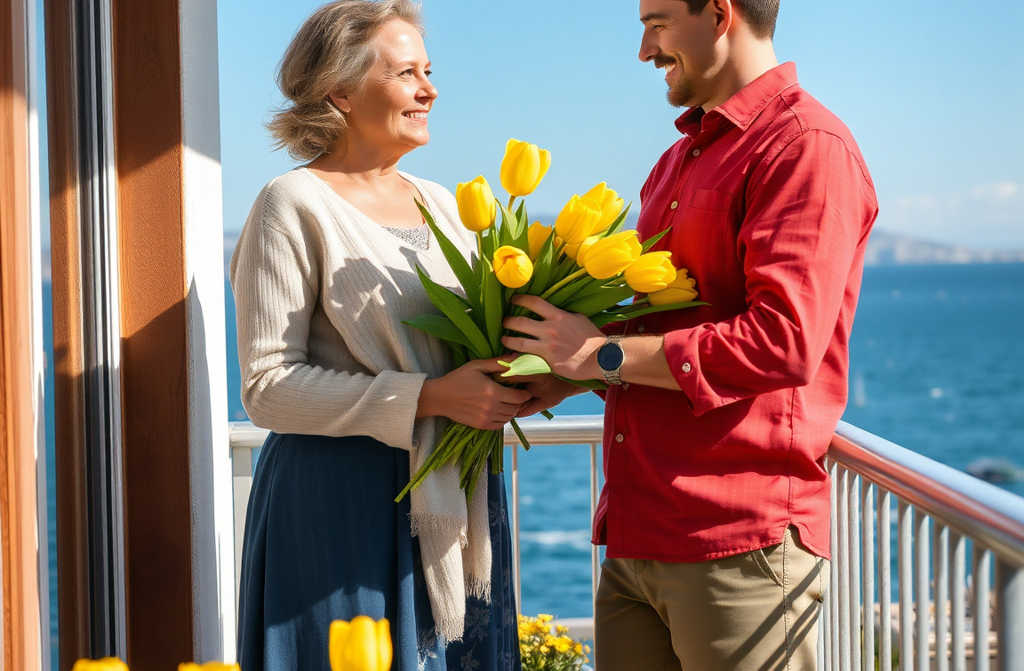
A week later he turned up with a bunch of bright yellow tulips my favourite. He knelt, wept, kissed my hands.
I looked at his tears, his fear, his remorse.
Stand up, I told him. Im not a deity. Im a mother, and I forgive.
I didnt move into a care home or his flat. I rented a tiny seaside flat with a balcony, gulls and sunshine.
Andrew visits every week, bringing food, flowers, stories about his children, his job, his life. He seems changed, or perhaps just pretending. I cant tell, but his eyes now hold a flicker of fear fear of losing me again, fear of staying unforgiven.
I havent gone back to live under his roof, but I havent pushed him away either. Everyone deserves a chance at redemption, even a son who once abandoned his mother in a forest.
In the evenings I step onto the balcony, gaze at the sea, think of George and how hed be proud not for surviving, but for not hardening, for not becoming the quiet, obedient, forgotten thing he once imagined.
Im alive. Im strong. Im a mother.
My place isnt a forest, nor a care home. Its wherever I choose to be.
Today Im by the sea. Tomorrow perhaps the hills, perhaps a new flat with grandchildren, perhaps a window full of tulips.
Because Im not a burden, not old, not a piece of junk.
Im a human being with a right to life, love, respect.
Even if they left me in the woods.
Even if they said, Your place is here.
I chose another place.
And thats my right.



Who Would Ever Want You, Clara? Toothless, Childless, Classless—The Story of a Woman Reinvented Afte…
Who would ever want you? Toothless, barren, mongrel Clara. Who would ever want you? shouted Paul before spitting on the...


The Last Love “Ira, I told you, I have no money left! Yesterday I gave my last penny to Natasha! Yo…
LAST LOVE “Ellie, I havent got a penny left, honestly! Gave my last tenner to Lucy just yesterdayher two little...


I’m a Pensioner – While Selling Bagels at My Corner Stall, Two Smartly Dressed Conmen Tried to Scam …
I am a pensionerwhile selling my bagels, someone tried to trick me. There I stood at my little stall, on...


Olga Spent All Day Preparing for Her First New Year’s Eve Away from Her Parents, Dreaming of Her Bel…
31st December I spent most of today getting ready for New Years Evetidying up the flat, doing a big shop,...
Monica Hardly Noticed When She Started Tiptoeing Around Her Own Home, Quietly Doing Everything So She Wouldn’t Disturb Her Daughter and Son-In-Law
Oh, Mum, youre frying fish again, said Charlotte, peeking into the kitchen.Yes, but Ive opened the windows and turned on...
While Visiting My Friend Alice, My Husband Suddenly Called Her. I Answered and Heard Something Astonishing—Here’s the Story of Our Relationship, Alice’s Recent Struggles, and an Unexpected Turn of Events
Half a year ago, Mary was left by her husband, and I tried my best to cheer her up through...


I’ll get married one day, but definitely not to this handsome guy. Yes, he’s wonderful in every way—…
I suppose Ill get married one day, but never to that handsome fellow. Yes, hes quite the charming bloke in...


VIC, PLEASE DON’T TAKE IT PERSONALLY, BUT I WANT MY DAD TO WALK ME DOWN THE AISLE — HE’S MY REAL FAT…
JAMES, PLEASE DONT TAKE THIS THE WRONG WAY. BUT I REALLY WANT MY DAD TO WALK ME DOWN THE AISLE....