
З життя
At the Wedding, the Son Called His Mother “An Absolute Mess” and a Beggar, Telling Her to Leave. But She Took the Microphone and Delivered a Stunning Speech…

28April2025
Tonight I stood at the doorway of my bedroom, the heavy oak door barely ajar, just enough to see without being seen. I watched my son, Jack, through the cracked gap, his eyes a mixture of pride, tenderness and a solemnity that felt almost sacred. He was in front of the fulllength mirror, dressed in a crisp lightblue suit with a butterflycut lapel, the sort of outfit his mates had teased him into buying.
The scene could have been lifted straight from a British period dramaJack looking handsome, composed, the very picture of a groom about to step into his future. Yet inside me a knot of pain tightened. I felt suddenly superfluous, as if I were a ghost in my own life, invisible and uninvited.
I smoothed the hem of my faded teadress, halfimagining how it would look with the new jacket Id sewn for tomorrow. I had decided, absurdly perhaps, to attend the wedding even without an invitation. Before I could take a step forward, Jack, as if sensing my stare, turned and his expression shifted in an instant. He closed the door behind him and lingered in the room.
Mom, we need to talk, he said, his voice measured but firm.
I straightened my back, my heart thudding like a drum.
Of course, love. Whats on your mind? I asked, trying to keep my tone light.
Do you remember those shoes I showed you last month? I bought them, I began, the words spilling out before I could stop them. And
Mom, Jack cut in sharply, I dont want you to come tomorrow.
The words hit me like a cold shower. For a breath I couldnt even process what hed just said; my mind seemed to reject the pain.
Why? My voice trembled. I I thought
Its a wedding, he said, each syllable like ice. Therell be guests. You wont look appropriate. And my work Mom, understandI dont want people thinking Im from some low background.
His accusations fell like sleet. I tried to interject.
Ive booked a stylist, a manicure I have a modest dress, but
No, please, he interrupted again. Dont try to fix it. Youll still stand out. Just dont come.
He left without waiting for a reply. The room fell into a hushed gloom, the ticking of the mantel clock the only sound. I sat there, motionless, until something inside me nudged me upright. I opened the old, dustcovered chest at the back of the wardrobe and pulled out a battered photo album. Its leather cover smelled of newspaper ink and glue, and the pages were thick with forgotten years.
The first photograph was a yellowed picture of a little girl in a crumpled dress standing beside a woman clutching a bottle. I remembered that daymy mother shouting at the photographer, then at me, then at passersby. A month later she lost her parental rights, and I was placed in a childrens home in Manchester.
Page after page showed us in matching uniforms, faces blank, overseen by a stern matron. That was the moment I first felt truly unwanted. We were beaten, punished, left without supper. I never cried; only the weak did, and the weak were never spared.
The next chapter was my teen years. After leaving school I took a job as a waitress in a roadside café. It was hard, but at least I tasted a sliver of freedom. I learned to sew skirts from cheap cloth, curled my hair in the old-fashioned way, and practiced walking in heels at night just to feel beautiful.
Then came the accident. I knocked over a glass of tomato juice onto a customer, the kitchen erupted in shouting, the manager barked orders. Everyone was angryuntil Victor, the tall, calm man in a light shirt, stepped forward and said, Its just juice, a spill. Let her work. His smile was the first genuine kindness Id ever received. My hands shook as I grabbed the keys.
The next day he brought flowers and placed them on the counter, saying simply, May I invite you for a coffee? No strings attached. He smiled so warmly that for the first time in years I felt anything other than a waitress from a childrens home.
We met on a park bench, sipping coffee from disposable cups. He talked about literature and travel; I spoke of the home Id grown up in, of dreams, of a family I imagined in my sleep. When he took my hand, I could not believe it. The touch was softer than any tenderness Id ever known. From that moment I waited for him, and whenever he appearedin that same shirt, with those same eyesI forgot what pain felt like. I was ashamed of my poverty, but he never seemed to notice. He would say, Youre beautiful. Just be yourself.
I believed him.
That summer stretched long and warm, a bright chapter written in love and hope. Victor and I drove to the river, walked the woods, lingered for hours in tiny cafés, and he introduced me to his friendssmart, witty, educated folk. At first I felt out of place, but Victor would squeeze my hand under the table, and that simple gesture gave me strength.
We watched sunsets from the roof of his flat, sipping tea from thermoses, wrapped in blankets. He talked about his ambition to work for an international firm, yet insisted he didnt want to leave England forever. I listened, breath held, memorising every word, feeling the fragility of it all.
One evening, jokingly yet halfseriously, he asked how Id feel about marriage. I laughed, brushed it aside, but inside a voice shouted, Yes, a thousand times yes. I was terrified to say it out loud, fearing I might ruin the fairy tale.
The fairy tale was shattered that night in the very café where I had once worked. Someone laughed loudly at the next table, then a sudden splash of cocktail flew across my dress. Victor sprang up, but it was too late.
At the adjacent table sat his cousin, her voice dripping with contempt: Is this her? Your chosen one? A cleaner from a childrens home? Is this what you call love? The room stared, some snickered. I didnt cry; I simply wiped my face with a napkin and left.
From that moment the pressure tightened. My phone buzzed with vicious whispers and threats: Leave while you still can, Well tell everyone who you are, You still have a chance to disappear. Rumours spreadpeople called me a thief, a prostitute, a druguser. An elderly neighbour, Mr. Jacob Whitby, approached me one evening and whispered, Youre a good woman; theyre the ones scurrying about. Hold on. I clung to his words.
I kept everything from Victor, not wanting to ruin his upcoming internship in Europe. I waited, hoping the storm would pass, that we could survive.
But the storm was not mine alone to weather.
A few weeks before Victors departure, his father, the influential Mayor Nicholas Sutherland, summoned me to his office. He was a stern, powerful man, his gaze treating me like dust under his shoes. You have no idea who youre dealing with, he snarled. My son is the future of this family. You are a stain on his reputation. Leave, or I will make sure you disappear forever. I clenched my hands on my lap. I love him, I whispered. And he loves me. He scoffed, Love is a luxury for the equal. You are not equal. I walked out, head held high, saying nothing to Victor. He left on his flight, never learning the truth.
A week later the café owner, Stan, a perpetually disgruntled man, accused me of stealing supplies, claiming someone saw me take items from the storeroom. The police arrived, the investigation began, and Stan pointed his finger at me. Others stayed silent, fearful of the truth.
The stateappointed solicitor was young, weary, disinterested. In court, his arguments were limp, the evidence flimsysecurity footage showed nothing, yet the eyewitnesses were convincing. The mayor pulled strings, and the verdict was three years in a mediumsecurity prison.
When the cell door slammed shut, I realised everythinglove, hope, a futurewas now behind bars.
Months later, a routine health check returned a shocking result: I was pregnant. Victors child. The news hit me like a punch, then settled into a quiet resolve. I would survive for this baby.
Pregnancy in prison was a nightmare. I was taunted, degraded, yet I remained silent, rubbing my swollen belly, speaking to the unborn child at night, pondering namesperhaps Jack after my son, or Oliver after a saint. The labour was hard, but a healthy baby boy emerged. I wept, not from despair but from a fierce, quiet hope.
Two women, one convicted of murder, the other of theft, helped me in the maternity wingrough but respectful of the infant. They taught me, guided me, their harshness softened by the shared responsibility of a new life.
After a year and a half, I was released on parole. Waiting outside was Mr. Whitby, clutching an old envelope. Here, he said, they gave this to us. Lets start anew. My son, Jack, lay in his pram, clutching his stuffed bear.
Morning now begins at six. Jack in his cot, I at the office cleaning, then a car wash, evenings a parttime job at a warehouse. Nights I sewnapkins, aprons, pillowcases. Days bleed into nights, a fog of endless tasks, but I keep moving.
One afternoon on the high street I ran into Liza, the girl from the café kiosk. She halted, eyes widening. Emma you alive? she whispered. What could have been? I replied calmly, What else could have been? She told me Stans business had collapsed, the mayor had moved to London, Victor had marriedunhappily, drinking heavily. I listened, felt a sting, but merely nodded, Thanks, good luck. I walked on, no tears, no hysteriajust a silent release of the nights weight.
Jack grew. I tried to give him everything: bright toys, a sturdy coat, good food, a decent backpack. When he fell ill I stayed by his bedside, whispered stories, applied compresses. When he broke a knee, I rushed from the car wash, covered in foam, scolding myself for not watching. When he asked for a tablet, I sold the only gold ring I owneda keepsake from my past.
Mom, why dont you have a mobile like everyone else? he asked once. Because I have you, Jack, I smiled. Youre my most important call.
He grew confident, charismatic, did well at school, gathered many friends. Yet he often said, Mum, could you buy yourself something nice? Im tired of seeing you in these rags. I laughed, Ill try, love. Inside, a small ache whispered that perhaps I was becoming just another ordinary person.
When he announced he would marry, I embraced him, tears brimming, My dear Jack, Ill stitch a white shirt for you, alright? He nodded, distracted. Then came the inevitable words that had haunted me for years: Youre a cleaner. Youre a disgrace. Those words cut like knives. I sat before a photo of young Jack in blue overalls, smiling at the camera. Sweetheart, I whispered, Ive lived for you, all my life. But maybe its time I live for myself too.
I opened an old tin where I kept a modest rainyday fund. The sum was small, not enough for luxury, but sufficient for a decent dress, a haircut, a manicure. I booked an appointment at a suburban salon, chose a subtle makeup, a tidy hairstyle, and bought an elegant navy dresssimple, but fitting.
On the day of the wedding, I stood before the mirror for what felt like an eternity. My face no longer bore the fatigue of a carwash worker; it held the poise of a woman with a story. I even applied lipsticka first in many years.
Jack, I murmured, today youll see me as I once waslovable, worthy. At the registry office, heads turned. Women whispered, men stole glances. I walked slowly, back straight, a faint smile playing on my lips, eyes devoid of fear or shame.
Jack barely noticed me at first. When he did, his face paled. I told you not to come! he snapped. I leaned close, voice gentle, Im not here for you. Im here for me. Ive already seen everything.
I glanced at Daisy, a warm, openhearted woman beside me, who gave a shy nod. I took a seat at the back, observing rather than intervening. When Jack finally caught my eye, a flicker of recognition passedhe finally saw me, not as a shadow, but as a woman. That was all that mattered.
The reception buzzed with clinking glasses, the crystal chandelier sparkling. Yet I felt detached, as if I were in another world, wearing the same blue dress, hair neatly done, a calm stare. Around me, Daisy, sincere and kind, approached. Youre beautiful, she said softly. Thank you for coming. I wish you happiness and patience. I replied, Its your day, love. Be happy. And be patient. Her father, a dignified gentleman, stepped forward politely, Please, join us. Were delighted.
Jack watched, his jaw clenched, as I stood, my dignity intact, free from his control. The moment for toasts arrived. Guests laughed, shared anecdotes, then fell silent. I rose.
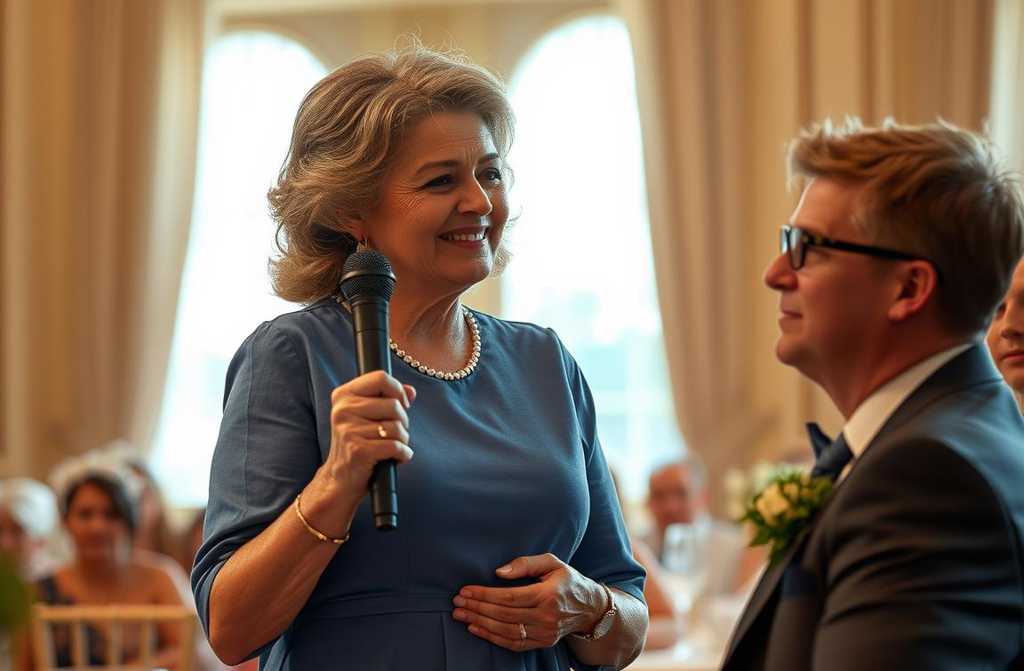
If youll allow me, I began quietly, Id like to say a few words. All eyes turned to me. Jack tensed. I took the microphone as if it were an old friend and spoke calmly, I wont speak at length. I merely wish you lovesteady love that holds when life is heavy, that asks no questions of who you are or where you come from. Simply love. Look after each other, always. My voice wavered slightly, but I held steady. The hall fell silent, then erupted into genuine applause.
As I returned to my seat, a familiar shadow fell across the tablecloth. I lifted my gaze and saw himVictor, now silverhaired but with the same keen eyes. Emma? he asked, surprised.
Im still here, I answered, breath quickening, yet refusing to let tears fall.
He confessed, I thought youd vanished. I heard you married I was foolish. My father he pushed me to believe I was right. He reached out. Shall we talk?
We stepped into a quiet corridor. I was no longer the frightened girl the world had tried to crush. I gave birth, I said, in prison. To you, and raised him alone. Victors eyes closed, a storm inside him.
Where is he? he asked.
Hes here, in the hall, at the wedding. He paled.
Its our son, Jack, I stated.
A heavy silence hung, broken only by the soft echo of our footsteps on marble. Victor, finally steady, asked, May I see him? Talk? I shook my head, He isnt ready, but he will understand everything in time. I hold no hatred. Things have simply changed.
Victor extended his hand, and we shared a brief, tender waltz, the centre of the room, all eyes on us. Jack froze, bewilderedwho was this man? Why was his mother now a queen? Why did everyone stare at her?
For the first time, shame washed over himshame for his indifference, for the years of ignorance. When the dance ended, Victor approached, Son who is this? I met his gaze, smiled calmly, both sad and proud. This is Victor, your father. Jacks face went pale, the world went mute.
Victor added, Hello, Jack. No words, just eyes, a raw truth.
We three have much to discuss, I said, and we walked away together, not pompously, but simply, three people stepping into a new chapterfree of the past, bearing truth, perhaps even forgiveness.

Our Neighbor Loved Blasting Rock Music at 2 AM, So I Bought My Son a Violin and We Started Practicing Scales Right at 8 in the Morning, Just as the Neighbor Was Finally Getting to Sleep
Every night at half past two, the ceiling above my bedroom would come alive with a suspicious amount of activity....


My Father Abandoned Us, Leaving My Mum Buried in Debt—Since Then, I Lost My Right to a Happy Childhood
When I was ten years old and my younger brother was just three, our dad walked out on us. Hed...


My brother and his family wanted to settle in London at my expense, but I made sure they understood from the start that this wasn’t going to happen!
My brother and I have an age gap of six years, with him being the elder. Three years ago, he...
A Coworker Tried to Dump Her Reports on Me, So I Forwarded Her Request to the Manager: “Please Help Mary, She’s Struggling”
Today was another one of those days when my patience in the office was really put to the test, and...


No One Will Ever Forget My Son’s Wedding: Two Shocking Secrets Revealed
My son has just recently gotten married. Of course, before that, he brought his girlfriend over several times so that...


Jack discovered that his colleague’s wife was pregnant, and instantly felt uneasy—after all, he had a good reason for feeling uncomfortable.
When Jack arrived at work, he was taken aback. The staff were having a celebration. Is there a special occasion...


“Wouldn’t You Like to Have a Daughter? I Could Be Your Daughter, If You’d Like.” The Girl Joined Our Family On Her Own
This story takes place 15 years ago. A girl at the orphanage looked up at me with her bright green...


A Friend of Mine Is 35 and Has Never Worked—Now He’s Running for a Top Management Position with a High Salary
Theres this woman I went to school withlets call her Charlotte. Charlotte was, in a word, the star of our...