
Connect with us

З життя

He Set His Sights on Another Man’s Wife Living together, Dudley revealed himself to be weak-willed and spineless. Each day depended on the mood with which he woke. Occasionally, he’d be cheerful and bright, cracking jokes all day and laughing loudly. But mostly, he spent his days in gloomy contemplation, drinking copious amounts of tea and wandering around the house with a stormy face, as was typical for people in the creative professions. Victor Dudley belonged to that sort: he worked at the village school, teaching art, woodwork, and, occasionally, music lessons when the music teacher was off sick. He had an affinity for the arts. School didn’t let him fulfil his creative ambitions, so the house became his canvas—Victor made himself a studio, taking over the largest and brightest room. Which, as it happened, Sophie had earmarked as a future nursery. But the house belonged to Victor, so Sophie didn’t object. Dudley filled the room with easels, scattered paint tubes and clay everywhere, and set to work—painting feverishly, sculpting, creating… He could stay up all night working on a strange still life, or spend the entire weekend crafting a puzzling sculpture. He never sold his “masterpieces.” They filled the house, the walls thick with paintings that—truth be told—Sophie didn’t like; the cupboards and shelves buckled under the weight of his clay figurines. If the things had been truly beautiful, it might have been different—but they weren’t. The few artist and sculptor friends from Victor’s college days who visited would fall silent, avert their eyes, and sigh quietly as they looked at his creations. Not one ever complimented him. Only Leo Peabody—the oldest in the group—burst out, after finishing a bottle of rowanberry liqueur: “My word, what a load of meaningless daubs! What is all this? I haven’t seen a single worthwhile thing in this house—except, of course, your wonderful wife.” Dudley couldn’t stand the criticism. He shouted, stamped his feet, and told his wife to show the rude guest the door. “Get out!” he yelled. “You philistine! It’s you who knows nothing about art, not me! Ah, I see it now! You’re just angry that you can’t hold a paintbrush in your shaky drunk hands! You simply envy me, so you belittle everything!” Peabody barely made it down the steps, and paused at the gate, almost tripping, when Sophie caught up and apologised for her husband’s behaviour. “Please don’t mind him. You shouldn’t have criticised his work, but I should have warned you.” “Don’t make excuses for him, dear child,” nodded Leo. “Don’t worry, I’ll call a cab and head home. I do pity you, though. You’ve got such a beautiful house, but Victor’s dreadful paintings ruin everything! And those horrid figurines… they should be hidden, not shown off. But knowing Victor, I can only imagine how difficult your life must be. You see, for us artists, the things we create reflect our souls. And Victor’s soul is as empty as his canvases.” He kissed Sophie’s hand in farewell and left the unwelcoming house. Victor did not recover emotionally for a long time—he yelled, smashed some of his own “sculptures,” tore up paintings, and raged for a month before he calmed down. *** Still, Sophie never opposed her husband. She decided that, in time, children would arrive and her darling would set aside his hobbies. He’d turn the studio into a nursery, but until then, let him amuse himself with still lifes. Shortly after their wedding, Victor played the part of the model husband—bringing home fresh fruit and his wages, caring for his young wife. But he soon lost interest. He became distant, stopped sharing his pay, and Sophie had to take care of the home, her husband, the vegetable patch, the henhouse, and her mother-in-law. When Sophie became pregnant, Victor was delighted. But their joy was short-lived: a week later, Sophie fell ill, was hospitalised, and suffered a miscarriage. When Victor heard the news, he changed immediately—becoming whiny, nervous, and shouting at Sophie before locking himself in the house. Sophie left the hospital a shadow of herself. No one met her, but the worst was yet to come: Victor wouldn’t let her in. “Open up, Victor!” “No, I won’t,” he sniffled from behind the door. “Why did you come back? You were supposed to carry my child. But you failed! And today my mother ended up in hospital with a heart attack—because of you!” You’ve brought nothing but trouble. Get off the doorstep—I don’t want to live with you anymore.” Sophie’s vision went black and she sat down on the porch. “Oh Victor… I’m suffering too, let me in!” He didn’t respond, and Sophie waited until nightfall. Finally, the door creaked open. Victor, thin with grief, locked the door with a bolt, but couldn’t find the key—he never knew where anything was, usually asked Sophie. He mulled it over, then left for the gate, not looking at his wife. When he was gone, Sophie entered quietly. She waited for him all night. The next morning, a neighbour brought dreadful news: her mother-in-law hadn’t survived the heart attack. The loss devastated Victor. He quit his job, took to bed and told Sophie, “I never really loved you. I only married you because my mother wanted grandchildren. But you ruined everything. I’ll never forgive you for that.” Those words hurt, but Sophie resolved not to leave him. Time passed, but things did not improve. Victor became bedridden, refusing food, claiming he had an ulcer, until finally he stopped getting up at all. And then he filed for divorce; the Dudleys separated. Sophie wept bitterly. She tried to hug Victor, to kiss him, but he pushed her away, whispering that he’d throw her out as soon as he recovered—that she’d ruined his life. *** Sophie couldn’t leave because she had nowhere to go. Her own mother, delighted to have married her daughter off early, quickly moved to the seaside to live with her new husband—after hastily selling the family home. So Sophie was left trapped by circumstance. *** Eventually, the food ran out. She scraped together the last bits, boiled a final egg from the only surviving hen, and fed Victor watery porridge and mashed yolk. Life had dealt her a cruel hand—she might have been feeding a child by now (had she not been hauling water and logs on her own), but instead had to please her ex-husband, who didn’t value her at all. “I’ll pop out for a bit—the market’s in town from the next village. I’ll try to sell the hen, or trade her for food.” Victor, staring emptily at the ceiling, croaked: “Why sell her? Boil her up for broth. I’m sick of porridge, I want a proper meal.” Sophie pulled at her only dress—it was the one she’d worn for graduation, then at her wedding, and now on hot days: she had nothing else. “You know I can’t… I’ll sell or trade. I could give her to the neighbours, like the others, but I think this hen would keep coming back. She’s too attached.” “‘Penny’—” Victor sneered, “you name your hens now? For goodness’ sake… but what can one expect of you…” Sophie bit her lip and looked down. “You said you’re going to market? Take some of my paintings or figurines—maybe someone will buy them.” She tried to refuse, but Victor insisted. She grabbed two whistling clay birds and a large piggy bank—Victor’s pride—and bolted outside, hoping he wouldn’t demand she lug out the paintings as well. Statues she could rustle up the courage to offer; the paintings, never. They were just too awful. She was too ashamed to take them out in public. *** It was a hot day. Despite the light dress, Sophie was slick with sweat. Her face shone, her fringe stuck to her forehead. It was the village fête. Sophie couldn’t remember when she last went out, gazing in wonder at the bustling crowds around the stalls. There was honey of every kind, colourful silk scarves, children’s sweets, the irresistible aroma of barbecue, music, laughter. She stopped by the last stall, holding her hen close. She hated to part with the old bird, but she truly loved her. Years ago, she’d nursed this hen back to health, and Penny had become a beloved pet, always limping after Sophie. Now, she tried to poke her beak out from Sophie’s bag, pecking at her hand curiously. *** An elderly stallholder eyed her. “Fancy some jewellery, love? Stainless steel, silver, even a few gold chains.” “No, thanks. I’m here to sell a live hen, an excellent layer,” Sophie replied politely. “A hen… what would I do with it…” Then a young man at the stall piped up: “Let’s have a look at your hen.” Sophie carefully handed him the bird. “She limps a bit, but she’s a fine layer.” “How much? So cheap—what’s the catch?” Sophie flushed under his steady look, feeling sweat prickle anew. “She’s just lame, nothing else.” “Alright, I’ll buy her. And those?” He gestured at her clay figures. “Oh, these… figurines. Whistles and a piggy bank.” He laughed at the pig. “Handmade, eh?” “Yes, very much so. I’ll sell them cheap—I really need the money.” “I’ll take the lot. I love unusual things.” The jewellery seller rolled her eyes: “What do you need all that for, Dennis? Off to play with toys now? Your brother could use your help on the barbecue stand.” Sophie backed away, startled: “You—work on the barbecue stand? Then I can’t sell you the hen!” She tried to snatch Penny back, but Dennis dodged and laughed. “Take your money back, please! Penny isn’t for barbecue—she’s not a meat bird!” “I know. She’ll go to my mum—she keeps chickens. And of course you can visit Penny any time.” … Sophie was almost home when Dennis pulled up in a car. “Excuse me, miss—have you any more clay figurines? I’d like to buy them for gifts and such.” Squinting against the sun, Sophie smiled: “You’re in luck! There are plenty more back home.” *** Back home, Dudley lay groaning at voices in the hall. “Who’s there, Sophie? Bring me some water, I’m thirsty.” The visitor glanced at bedridden Victor and turned away, looking at the paintings. “Incredible,” he murmured. “Who painted this—was it you?” he asked Sophie as she walked past with a glass of water. “I did!” Victor leapt from the bed. “And I didn’t just paint! Children paint with chalk on the pavement—I *compose*!” He sat up, watching the stranger. “What do you care about my paintings?” he demanded. “I like them. I’d like to buy one. And these sculptures—yours as well?” “Of course!” Victor cried, shoving Sophie aside. “Everything here is mine!” He jumped up, limped about, showing off canvases and figurines—all the while, Dennis glanced at Sophie, noting the blush in her cheeks, her shy glance. Epilogue Sophie was surprised by her ex-husband’s “miraculous recovery.” As it turned out, Dudley had never been ill! As soon as someone paid attention to his “art,” he was a new man. The mysterious visitor—Dennis—came every day, buying painting after painting. When the canvases ran out, he bought up all the figurines. Victor, thrilled, shut himself in the studio to make more. He never realised that Dennis was interested not in the “art,” but in the ex-wife. Each day, Dennis left with another “masterpiece,” then waited at the gate to chat with Sophie. Something blossomed. And soon enough, Dennis walked away from that house with just what he’d wanted—Dudley’s ex-wife. And that was why he’d come at all. Back home, Dennis tossed Victor’s paintings in the fire and bagged up the clay “grotesques,” unsure what to do with them. But he remembered Sophie’s lovely face. He’d noticed her at the fair in that light dress, from the moment she appeared—and he’d known instantly she was his fate. He’d learned of her miserable life with a madcap fool who fancied himself an artist—but nowhere to go. So Dennis visited daily, snapping up “art,” just to see her. In time, Sophie understood everything. Dudley never saw it coming. Dennis vanished once Sophie left with him; Dudley heard they’d married and he was left feeling utterly bitter at being so easily deceived. After all, finding a good wife is no easy thing—and Sophie was just that. It took time for him to realise he’d lost the most precious thing in his life: a caring, loyal wife. He’d never find another one like her—Sophie had not only endured him, but pitied him, cared for him almost like a mother. And what a woman she was! And like a fool, he’d let her slip away. Dudley considered wallowing in self-pity—but then realised: there was no one left to feed him eggs, or bring him water. No one to take over the house and garden…

Published

on

Coveting Another Mans Wife

Living together, Victor Dudley revealed himself to be a man of weak character and little willpower.

Every day was determined by the mood with which he woke up. Sometimes, hed rise cheerful and lively, telling jokes from breakfast to dinner and laughing loudly at the smallest things.

But for the most part, he dwelled in gloomy musings, drank endless cups of tea, and drifted around the house as sour-faced as a washed-up artistapt, since he taught at the village school: art, woodwork, and, on occasion, music, whenever the music teacher fell ill.

He fancied himself a creative soul. Yet, unable to express his artistic urges at school, he took it out on the houseVictor claimed the largest, sunniest room as his studio. It was meant, really, to be the nursery for future children, as Emma had gently suggested, but as the house belonged to Victor, Emma didnt protest.

He filled the room with easels, tripods and scattered the floors with paint tubes and lumps of clay. He would spend hours sketching, sculpting, mouldingimmersed in a world of his own creations.

He could spend all night painting a bizarre still life or devote an entire weekend to shaping a curious figure out of clay.

His masterpieces never left the home; they accumulated on the walls and shelves, much to Emmas quiet dismay. The paintings didnt appeal to her, and the shelves groaned with grotesque clay creatures.

It would have been endurable, perhaps, if the work was breathtakingbut it wasnt.

The few old school friends Victor sometimes invitedother artists and sculptorswere always silent when viewing his work, their eyes darting away, stifled sighs betraying their opinions.

Not a single word of praise was ever uttered.

Except for Leonard Petherbridge, by far the oldest among them, who (having polished off a bottle of sloe gin in the kitchen) finally exclaimed:

My word, what utter nonsense! What is all this? I havent seen a single worthwhile thing in this houseexcept, of course, the delightful lady of it.

Victor didnt take well to criticism. He shouted, stomped his feet, and demanded Emma ask the rude oaf to leave at once.

Get out, you blithering dolt! You know nothing of art! I see it nowyoure just sore you cant hold a brush in those shaking hands, ruined by drink! Youre jealoustrying to undermine talent youll never possess!

Leonard stumbled down the front steps, nearly tumbling, and lingered uncertainly by the gate. Emma caught up with him and hastily apologised for her husbands outburst.

Please, dont take his words to heart. You probably shouldnt have criticised his work, but I should have warned you.

No need to excuse him, my dear child, Leonard nodded kindly. But truly, such a lovely housespoiled by those dreadful paintings of Victors. And those hideous clay monstrositieshe should hide them away, not be parading them about. But knowing Victor, it can’t be easy for you. You see, with us artists, what we create reflects our soul. Victors soul is as empty as his canvases.

Bowing gallantly and kissing Emmas hand, he departed.

Victor took weeks to recover. He spent a month shouting, smashing his sculptures, tearing his paintings, and brooding relentlessly before settling down.

***

Yet through it all, Emma never contradicted her husband.

She told herself, in time, children would come, Victor would tire of his hobbies and convert the studio into a nursery. For now, he could amuse himself with odd still lifes.

At the very start of their marriage, Victor strove to play the dutiful husbandbringing home fresh fruit and his modest pay, taking care of his young wife.

But that faded quickly. He grew cold to Emma, stopped sharing his wages, and left all household and garden responsibilities to her. She juggled everything: keeping the home, tending the chickens, managing the vegetable patch, and looking after the mother-in-law.

When news came that Emma was expecting, Victor was elated. But his joy was short-lived; within a week, Emma fell ill, landed in hospital, and tragically lost the baby in early pregnancy.

As soon as Victor received the news, he changed overnight. He became sullen, agitated, shouted at Emma, and shut himself away.

By the time Emma was dismissed from hospital, she looked like a shadow of herself. She walked home alone.

No one met her, and worse was waiting: Victor had locked himself inside and refused to let her in.

Open the door, Vic!

I wont! came Victors tearful voice from behind the door. Why are you here? You were meant to bear my child, but you failed! Now, thanks to you, my mothers in hospital with a heart attack! I regret ever marrying youyouve brought nothing but misfortune! Stop standing therejust go! I want nothing more to do with you.

Emma felt the world go dark and sank down on the doorstep.

Vic, for heavens sake Im suffering too, cant you see? Please, open the door!

Her tears made no impression. She sat outside until darkness fell.

Eventually, the front door creaked, and Victor stepped out, gaunt with grief. He tried to lock the door, failing to find the right keyhe never remembered where anything was and always relied on Emma.

He hesitated, then left for the gate without once looking at her.

Once hed disappeared round the corner, Emma unlocked the door and let herself into the silent house, dropping onto the bed.

She waited up for him all night. In the morning, a neighbour brought grim news: Victors mother hadnt survived her heart attack.

The loss broke Victor completelyhe resigned from work, took to his bed, then told his young wife bitterly,

I never loved you. I married you only because Mother insistedshe wanted grandchildren. But you destroyed our lives. Ill never forgive you.

The words cut deep, but Emma told herself shed stick by him.

Time passed, but nothing improved. Victor refused to leave his bed, survived on only water, barely ate.

He had, truthfully, a flare-up of his ulcer. He lost his appetite, fell into apathy, kept to his bed, moaning about weakness from malnutrition and lack of vitamins.

Then, suddenly, she found out hed filed for divorce, and soon the Dudleys were no more.

Emma shed many tears.

Whenever she tried to embrace or console Victor, he brushed her off, muttering that, once he got better, hed throw her out for ruining his life.

***

Emma couldnt just leave. She literally had nowhere to go.

Her mother, whod married her off youngbarely out of schoolquickly turned her attention to her own life, moving in with a widower down in Cornwall. They married, and Mother returned only briefly to sell the family house, pocketed her small sum, then left for good.

Thats how Emma found herself trapped.

***

Eventually, every last morsel in the house was gone. Emma scraped out the cupboards, boiled the final egg taken from under the last laying hen, and started feeding Victor thin porridge and the mashed yolk.

She thought bitterlyshe might be spoon-feeding a baby by now if she hadnt hauled heavy buckets to the garden herself or stacked wood logs alonebut instead, here she was, fussing over an ungrateful ex-husband.

Im off for a bitthe weekly markets come to the next village. Ill try to sell a hen, or swap her for some food, she said.

Victor, staring blankly at the ceiling, croaked,

Why sell her? Boil her for broth. Im sick of porridge. Give me a proper soup.

Emma fiddled with the hem of her thin cotton dressthe only decent garment she owned, having worn it at her graduation, her wedding, and now, simply because she had nothing else.

You know I cantshes become my pet. Ill swap her or sell her. I could give her to the neighbours, like the others, but I know Patch will just keep coming back. Shes far too attached.

Patch? You name all your chickens? Victor sneered. What nonsenseyou really are daft. But then, what does one expect

Emma bit her lip and dropped her gaze.

Are you going to the market? Victor perked up. Take along some of my paintings and figures. Maybe someone will buy them.

Emma tried to avoid it,

But darling, youre so fond of them

I said take them, he snapped.

Emma surveyed the dress table, picked up two bird-shaped whistlesclumsily painted blue and whiteand grabbed the round piggy-bank her husband had always been bizarrely proud of.

She dashed out, fearful Victor would appear, pressing her to take the dreadful paintings as well.

If the little figures could be sold, she could bear it, but the paintings were hideous. No one would buy them. She was mortified at the very thought.

***

The day was scorching. Emma, despite her light dress, was slick with sweat, her fringe plastered to her forehead.

It was fair day in the village.

She couldnt recall the last time she went out for a stroll. Now, she marvelled at the chatting and laughing crowd, the rows of stalls: honey in every variety, silk scarves, sweets for children, the scent of roasting meats, music in the air.

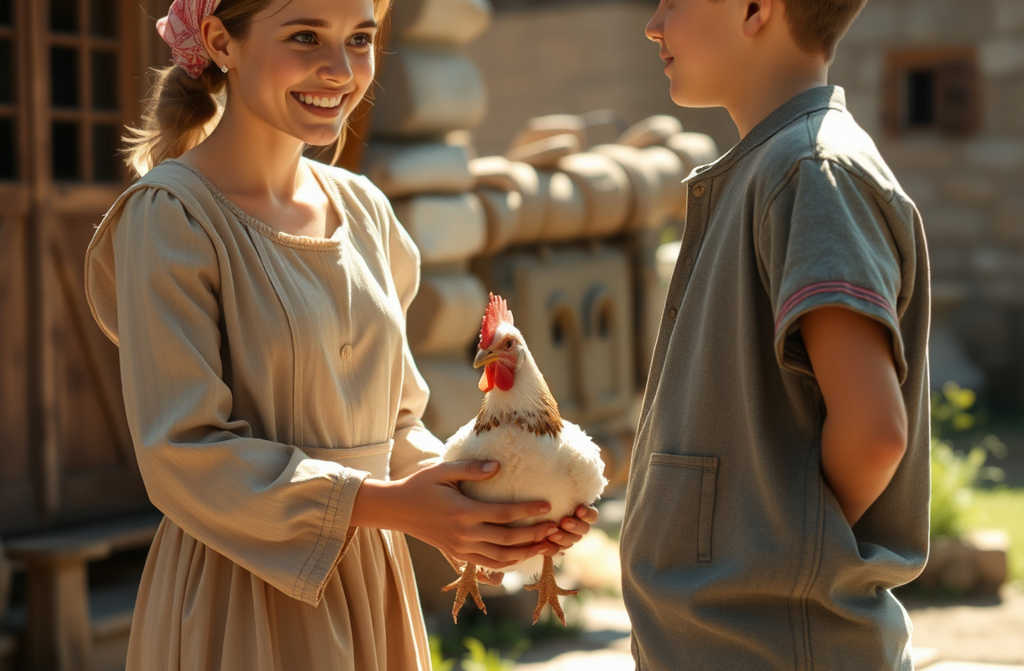
She stopped at one of the last stalls, clutching her fabric bag close, stroking the hen inside.

Truthfully, she hated parting with Patch, her favourite hen.

Shed raised her from a scraggly chick. One day, Patch injured her leg, and Emma nursed her back to health. Patch had followed her everywhere, always cheerful, curious.

Patch had become a pet. Whenever Emma entered the chicken coop, Patch limped towards her, eager for attention.

Even now, the hen peered out inquisitively at her, pecking Emmas hand affectionately through the fabric.

***

The elderly woman at the stall eyed Emma.

Fancy a new necklace, love? Ive got stainless steel, lovely silver, gold-plated chains.

No, thank you. Im hoping to sell a live hena good layer. She gives lovely large eggs, Emma explained politely.

A hen? And whatever would I do with it

A young man at the neighbouring stall suddenly piped up.

Lets see this hen then.

Emma carefully handed Patch over. She didnt know the man.

How much do you want? That little? Whats wrong with her?

Emma felt his keen gaze and flushed, uneasy.

Shes a little lame, but otherwise strong and healthy.

Ill buy her. And those, what are they?

He nodded at the clay figures in her arms.

Oh, these? Little sculptures. Whistles and a piggy-bank.

He looked at the pig, then smiled crookedly.

Homemade, are they?

All hand made. Ill let them go cheapI really do need the money, Emma admitted.

Ill have the lot. Ive a fondness for the unusual.

The jeweller at the stall smirked.

What on earth for, Dennis? Havent you outgrown toys? Your brother needs you at the barbecue stall.

Emma, suddenly anxious, said,

You do sell barbecued meats? Then I cant sell you Patch!

She tried to fetch the hen back, but Dennis quickly dodged away from her.

Take your money! she pleaded. You mustnt put Patch on a spit! Shes not for eating!

Dont worryIve no plans for that. Ill give her to my mumshe keeps hens herself.

Really?

Truly, Dennis smiled. You can come visit Patch anytime. I never knew hens had names.

***

Emma was nearly home when Denniss car pulled up beside her, the window rolled down.

Excuse me, he called, do you have any more of those clay figures? Id buy a few. Good for gifts, arent they?

Emma squinted against the sun and managed a small smile.

Thats brilliant! Weve loads more at homeyoure welcome to come see.

***

Victor, hearing voices, groaned from his bed.

Whos that, Em? Bring me a drink, Im parched.

Dennis glanced at the ailing Victor, then looked at the paintings crowding the walls.

Incredible, he whispered, turning to Emma as she walked past with a glass. Who did thesewas it you?

Me! Victor scrambled upright. I dont drawkids draw with chalk on pavements, I paint! Paint, I tell you!

He sat up, watching Dennis warily.

So, whats so fascinating about my art, eh? Victor pouted.

I rather like them. Id buy a few. And these statueswho made them?

I did! Victor snapped, batting Emmas hand away as she offered him water. Everything heres mine!

He yanked aside the covers, got up and hobbled over, legs stiff.

Your studies are interesting, Dennis said, flicking a glance at Emma.

And as Victor launched into a monologue about form and composition, Dennis eyes kept straying to Emmas blushing cheeks and her restrained nervousness.

Epilogue
Emma was astonished by her former husbands miraculous recovery.

It soon became clear that Victor had never been unwell at all! The moment someone showed an interest in his work, he perked right up.

The mysterious customerDennisvisited daily, buying a painting here, a figure there.

When Victor ran out of paintings, Dennis bought the figures.

With his art suddenly in demand, Victor retreated to his studio in a frenzy of creative activity.

He never twigged, the poor fool, that Dennis was only coming round for Emma.

And gradually, as Dennis stood at the gate each time, he and Emma began to linger, talk, and soon, something gently blossomed.

Soon enough, Dennis took from Victor the thing he wantedhis former wife.

Indeed, that had always been the real reason for his visits.

Returning from village trips, Dennis would chuck Victor’s paintings on the fire, while the clay monsters piled up in a sack, still unsure what to do with them.

He remembered Emmas sweet, calm face. He’d set his heart on her the moment he saw her at the market, dressed simply, bag slung over her shoulder.

Hed learned about her home lifehow she suffered under a deluded, selfish man pretending to be an artist, and how she had nowhere to go.

So, Dennis kept coming, buying those ridiculous trinkets for the chance to see her. In the end, Emma understood.

***

Victor never imagined things would turn out this way.

Dennis, whod bought up all his art, stopped showing up after taking Emma away.

Victor later heard theyd married, and felt bitter, realising hed been so easily duped.

Its truegood wives are hard to find, and Emma had been a gem.

It took time for him to understand what hed losta woman so kind, patient, and loving; capable of great tenderness and care. She had been, in her quiet way, wonderful.

And he, like a fool, let that treasure slip away.

Victor nearly succumbed to despair, but then thought better of itafter all, there was no one left to feed him mashed eggs, no one to bring him a glass of water, and no one to shoulder the burdens of the home.

Click to comment

Leave a Reply

Ваша e-mail адреса не оприлюднюватиметься. Обов’язкові поля позначені *

14 − 4 =

Також цікаво:

З життя4 хвилини ago

We’re Moving Into Your Flat — Polly’s got a brilliant flat in the city centre. Freshly renovated—can’t ask for more! — It’s a lovely place for a single woman, — Rustam smiled patronisingly at Inna, as if she were a child. — But we’re planning to have two—maybe even three kids, one after another. It’s noisy downtown—not enough air, no parking. And most importantly, there are only two rooms. Here? You’ve got three. Quiet street, nursery right outside. — The neighbourhood is really good, — agreed Sergei, still unsure where his future son-in-law was leading. — That’s why we chose to settle here. — Exactly! — Rustam snapped his fingers. — I keep telling Polly: why should we cram ourselves in, when there’s a perfect solution? There’s three of you—including your daughter—and honestly, this place is far too big. What do you need all this space for? You don’t even use one of your rooms; it’s just storage. It’d suit us perfectly. Inna tried to squeeze the vacuum cleaner into the tiny hallway cupboard… * * * After five years of peaceful family life and a fair inheritance split—Sergei got his gran’s spacious three-bed in a quiet part of town, his sister Polly got a two-bed in the central “Golden Triangle”—Olya and her fiancé Rustam arrive with big news: They’re getting married and have come up with a “fair” proposal: “We’re moving in here, and you can go live in Polly’s flat.” What follows is a tense family standoff, as Rustam insists they swap homes for his future family’s “perspective,” dismissing Inna’s work from home and the couple’s daughter’s routines. Loyalty, inheritance, entitlement, and family bonds are all thrown into the mix as battle lines are drawn—and even Polly starts doubting where her loyalties should lie. We’re Moving Into Your Flat: When Family Drops By With an Unbelievable Proposition and One Pushy Fiancé Tries to Swap Your Life Out From Under You

Were Moving Into Your Flat Emilys got a fantastic flat right in central London. Its practically spotlessmove in and start...

З життя1 годину ago

It Doesn’t Seem Fair That Your Children Have Their Own Flats, While My Son Has Nothing – Let’s Get Him a Home with a Mortgage! Recently, my husband Anthony pointed out that my children have their own flats, while his son doesn’t, and now we need to figure out how to make sure his son gets one too. To clarify, my children are both mine and Anthony’s, while Anthony’s son is from his first marriage. Why should it be my responsibility to worry about finding a place for his son to live? Of course, I always knew Anthony had been married before and had a child. That’s one reason I didn’t rush into marrying Anthony. We lived together for three years before we got married. I watched carefully to see what his feelings were towards his ex-wife and his son. A year after we married, I had a boy. Two years later, I gave birth to our second son. I’m perfectly happy with Anthony – both as a husband and a father. He spends time with me and the children. He’s the main breadwinner. Of course, we argue sometimes – but what family doesn’t? We were living in the flat I’d inherited from my father. My mother divorced him when I was still at nursery. She’s now remarried, but had no children with her second husband. Anthony and his first wife always rented. For years they tried to save for a mortgage but never managed it. After their divorce, his ex-wife moved back in with her parents and Anthony rented a flat. When we married, he moved in with me. We didn’t focus on whose name was on the flat. We just lived in my place and did everything together: renovations, new furniture. Then, about a year and a half ago, both my grandmothers died in quick succession – my mum’s and my dad’s mothers. Both left me their flats in their wills. While my boys are still small, I’ve decided to rent the flats out. Later, each of my sons will inherit one. For now, the money from one goes to my mum as a pension top-up, and the money from the other supplements my salary. Extra cash is always handy. My husband never interfered with the flat situations – after all, they’re nothing to do with him. I told him from the start that when our boys grow up, I’ll give each a flat. He agreed. That was that, as far as I was concerned. Then suddenly, my husband said to me: —My son will finish sixth form in a few years. He’s nearly an adult; he needs to start thinking about his future! I didn’t really get where he was going, but I listened anyway. —Your children have their own homes. My son doesn’t. Let’s get a mortgage and buy my son a flat!—he blurted out. I was shocked! I had so many questions. The first thing I asked was why our children – mine and Anthony’s – were suddenly just “my” children? Anthony told me not to get hung up on wording. —But my son will never inherit anything. I want him to have a place of his own! —That’s good that you care! But your son has a mother and a father. Isn’t this their responsibility? Why isn’t your ex-wife taking care of it? My husband explained that his ex-wife’s income is very low, her parents help her, and he himself can’t afford a mortgage. But if I helped, everything would be fine. It turns out I’m supposed to agree to Anthony taking out a mortgage for his son’s flat, but WE would pay it back, even though the flat would be in his son’s name. “We both have good salaries and rental income! We’ll manage!” said Anthony. We might, but we’d have to tighten our belts. Anthony also pays child maintenance for his son. When the boy goes to uni, Anthony plans to support him again because his ex-wife can’t afford it. So because of his son, my children and I won’t have holidays, won’t travel to the seaside, will always have to save. For what? Just so Anthony looks like the perfect dad? I would understand if Anthony had provided both our children with flats, and now wanted to do the same for his eldest son. But the truth is, I secured homes for our boys with no help from Anthony. Why should I pay for a mortgage on top? I told Anthony straight away – if he’s that worried, let his ex-wife take out the mortgage, and pay it off with the child maintenance money. —But I’m not getting involved!—I said. My husband’s furious with me and hasn’t spoken to me for a week. It’s a shame he can’t see my side.

It doesn’t look right that your children will have their own flats and my son wont. Let’s sort out a...

З життя1 годину ago

He Set His Sights on Another Man’s Wife Living together, Dudley revealed himself to be weak-willed and spineless. Each day depended on the mood with which he woke. Occasionally, he’d be cheerful and bright, cracking jokes all day and laughing loudly. But mostly, he spent his days in gloomy contemplation, drinking copious amounts of tea and wandering around the house with a stormy face, as was typical for people in the creative professions. Victor Dudley belonged to that sort: he worked at the village school, teaching art, woodwork, and, occasionally, music lessons when the music teacher was off sick. He had an affinity for the arts. School didn’t let him fulfil his creative ambitions, so the house became his canvas—Victor made himself a studio, taking over the largest and brightest room. Which, as it happened, Sophie had earmarked as a future nursery. But the house belonged to Victor, so Sophie didn’t object. Dudley filled the room with easels, scattered paint tubes and clay everywhere, and set to work—painting feverishly, sculpting, creating… He could stay up all night working on a strange still life, or spend the entire weekend crafting a puzzling sculpture. He never sold his “masterpieces.” They filled the house, the walls thick with paintings that—truth be told—Sophie didn’t like; the cupboards and shelves buckled under the weight of his clay figurines. If the things had been truly beautiful, it might have been different—but they weren’t. The few artist and sculptor friends from Victor’s college days who visited would fall silent, avert their eyes, and sigh quietly as they looked at his creations. Not one ever complimented him. Only Leo Peabody—the oldest in the group—burst out, after finishing a bottle of rowanberry liqueur: “My word, what a load of meaningless daubs! What is all this? I haven’t seen a single worthwhile thing in this house—except, of course, your wonderful wife.” Dudley couldn’t stand the criticism. He shouted, stamped his feet, and told his wife to show the rude guest the door. “Get out!” he yelled. “You philistine! It’s you who knows nothing about art, not me! Ah, I see it now! You’re just angry that you can’t hold a paintbrush in your shaky drunk hands! You simply envy me, so you belittle everything!” Peabody barely made it down the steps, and paused at the gate, almost tripping, when Sophie caught up and apologised for her husband’s behaviour. “Please don’t mind him. You shouldn’t have criticised his work, but I should have warned you.” “Don’t make excuses for him, dear child,” nodded Leo. “Don’t worry, I’ll call a cab and head home. I do pity you, though. You’ve got such a beautiful house, but Victor’s dreadful paintings ruin everything! And those horrid figurines… they should be hidden, not shown off. But knowing Victor, I can only imagine how difficult your life must be. You see, for us artists, the things we create reflect our souls. And Victor’s soul is as empty as his canvases.” He kissed Sophie’s hand in farewell and left the unwelcoming house. Victor did not recover emotionally for a long time—he yelled, smashed some of his own “sculptures,” tore up paintings, and raged for a month before he calmed down. *** Still, Sophie never opposed her husband. She decided that, in time, children would arrive and her darling would set aside his hobbies. He’d turn the studio into a nursery, but until then, let him amuse himself with still lifes. Shortly after their wedding, Victor played the part of the model husband—bringing home fresh fruit and his wages, caring for his young wife. But he soon lost interest. He became distant, stopped sharing his pay, and Sophie had to take care of the home, her husband, the vegetable patch, the henhouse, and her mother-in-law. When Sophie became pregnant, Victor was delighted. But their joy was short-lived: a week later, Sophie fell ill, was hospitalised, and suffered a miscarriage. When Victor heard the news, he changed immediately—becoming whiny, nervous, and shouting at Sophie before locking himself in the house. Sophie left the hospital a shadow of herself. No one met her, but the worst was yet to come: Victor wouldn’t let her in. “Open up, Victor!” “No, I won’t,” he sniffled from behind the door. “Why did you come back? You were supposed to carry my child. But you failed! And today my mother ended up in hospital with a heart attack—because of you!” You’ve brought nothing but trouble. Get off the doorstep—I don’t want to live with you anymore.” Sophie’s vision went black and she sat down on the porch. “Oh Victor… I’m suffering too, let me in!” He didn’t respond, and Sophie waited until nightfall. Finally, the door creaked open. Victor, thin with grief, locked the door with a bolt, but couldn’t find the key—he never knew where anything was, usually asked Sophie. He mulled it over, then left for the gate, not looking at his wife. When he was gone, Sophie entered quietly. She waited for him all night. The next morning, a neighbour brought dreadful news: her mother-in-law hadn’t survived the heart attack. The loss devastated Victor. He quit his job, took to bed and told Sophie, “I never really loved you. I only married you because my mother wanted grandchildren. But you ruined everything. I’ll never forgive you for that.” Those words hurt, but Sophie resolved not to leave him. Time passed, but things did not improve. Victor became bedridden, refusing food, claiming he had an ulcer, until finally he stopped getting up at all. And then he filed for divorce; the Dudleys separated. Sophie wept bitterly. She tried to hug Victor, to kiss him, but he pushed her away, whispering that he’d throw her out as soon as he recovered—that she’d ruined his life. *** Sophie couldn’t leave because she had nowhere to go. Her own mother, delighted to have married her daughter off early, quickly moved to the seaside to live with her new husband—after hastily selling the family home. So Sophie was left trapped by circumstance. *** Eventually, the food ran out. She scraped together the last bits, boiled a final egg from the only surviving hen, and fed Victor watery porridge and mashed yolk. Life had dealt her a cruel hand—she might have been feeding a child by now (had she not been hauling water and logs on her own), but instead had to please her ex-husband, who didn’t value her at all. “I’ll pop out for a bit—the market’s in town from the next village. I’ll try to sell the hen, or trade her for food.” Victor, staring emptily at the ceiling, croaked: “Why sell her? Boil her up for broth. I’m sick of porridge, I want a proper meal.” Sophie pulled at her only dress—it was the one she’d worn for graduation, then at her wedding, and now on hot days: she had nothing else. “You know I can’t… I’ll sell or trade. I could give her to the neighbours, like the others, but I think this hen would keep coming back. She’s too attached.” “‘Penny’—” Victor sneered, “you name your hens now? For goodness’ sake… but what can one expect of you…” Sophie bit her lip and looked down. “You said you’re going to market? Take some of my paintings or figurines—maybe someone will buy them.” She tried to refuse, but Victor insisted. She grabbed two whistling clay birds and a large piggy bank—Victor’s pride—and bolted outside, hoping he wouldn’t demand she lug out the paintings as well. Statues she could rustle up the courage to offer; the paintings, never. They were just too awful. She was too ashamed to take them out in public. *** It was a hot day. Despite the light dress, Sophie was slick with sweat. Her face shone, her fringe stuck to her forehead. It was the village fête. Sophie couldn’t remember when she last went out, gazing in wonder at the bustling crowds around the stalls. There was honey of every kind, colourful silk scarves, children’s sweets, the irresistible aroma of barbecue, music, laughter. She stopped by the last stall, holding her hen close. She hated to part with the old bird, but she truly loved her. Years ago, she’d nursed this hen back to health, and Penny had become a beloved pet, always limping after Sophie. Now, she tried to poke her beak out from Sophie’s bag, pecking at her hand curiously. *** An elderly stallholder eyed her. “Fancy some jewellery, love? Stainless steel, silver, even a few gold chains.” “No, thanks. I’m here to sell a live hen, an excellent layer,” Sophie replied politely. “A hen… what would I do with it…” Then a young man at the stall piped up: “Let’s have a look at your hen.” Sophie carefully handed him the bird. “She limps a bit, but she’s a fine layer.” “How much? So cheap—what’s the catch?” Sophie flushed under his steady look, feeling sweat prickle anew. “She’s just lame, nothing else.” “Alright, I’ll buy her. And those?” He gestured at her clay figures. “Oh, these… figurines. Whistles and a piggy bank.” He laughed at the pig. “Handmade, eh?” “Yes, very much so. I’ll sell them cheap—I really need the money.” “I’ll take the lot. I love unusual things.” The jewellery seller rolled her eyes: “What do you need all that for, Dennis? Off to play with toys now? Your brother could use your help on the barbecue stand.” Sophie backed away, startled: “You—work on the barbecue stand? Then I can’t sell you the hen!” She tried to snatch Penny back, but Dennis dodged and laughed. “Take your money back, please! Penny isn’t for barbecue—she’s not a meat bird!” “I know. She’ll go to my mum—she keeps chickens. And of course you can visit Penny any time.” … Sophie was almost home when Dennis pulled up in a car. “Excuse me, miss—have you any more clay figurines? I’d like to buy them for gifts and such.” Squinting against the sun, Sophie smiled: “You’re in luck! There are plenty more back home.” *** Back home, Dudley lay groaning at voices in the hall. “Who’s there, Sophie? Bring me some water, I’m thirsty.” The visitor glanced at bedridden Victor and turned away, looking at the paintings. “Incredible,” he murmured. “Who painted this—was it you?” he asked Sophie as she walked past with a glass of water. “I did!” Victor leapt from the bed. “And I didn’t just paint! Children paint with chalk on the pavement—I *compose*!” He sat up, watching the stranger. “What do you care about my paintings?” he demanded. “I like them. I’d like to buy one. And these sculptures—yours as well?” “Of course!” Victor cried, shoving Sophie aside. “Everything here is mine!” He jumped up, limped about, showing off canvases and figurines—all the while, Dennis glanced at Sophie, noting the blush in her cheeks, her shy glance. Epilogue Sophie was surprised by her ex-husband’s “miraculous recovery.” As it turned out, Dudley had never been ill! As soon as someone paid attention to his “art,” he was a new man. The mysterious visitor—Dennis—came every day, buying painting after painting. When the canvases ran out, he bought up all the figurines. Victor, thrilled, shut himself in the studio to make more. He never realised that Dennis was interested not in the “art,” but in the ex-wife. Each day, Dennis left with another “masterpiece,” then waited at the gate to chat with Sophie. Something blossomed. And soon enough, Dennis walked away from that house with just what he’d wanted—Dudley’s ex-wife. And that was why he’d come at all. Back home, Dennis tossed Victor’s paintings in the fire and bagged up the clay “grotesques,” unsure what to do with them. But he remembered Sophie’s lovely face. He’d noticed her at the fair in that light dress, from the moment she appeared—and he’d known instantly she was his fate. He’d learned of her miserable life with a madcap fool who fancied himself an artist—but nowhere to go. So Dennis visited daily, snapping up “art,” just to see her. In time, Sophie understood everything. Dudley never saw it coming. Dennis vanished once Sophie left with him; Dudley heard they’d married and he was left feeling utterly bitter at being so easily deceived. After all, finding a good wife is no easy thing—and Sophie was just that. It took time for him to realise he’d lost the most precious thing in his life: a caring, loyal wife. He’d never find another one like her—Sophie had not only endured him, but pitied him, cared for him almost like a mother. And what a woman she was! And like a fool, he’d let her slip away. Dudley considered wallowing in self-pity—but then realised: there was no one left to feed him eggs, or bring him water. No one to take over the house and garden…

Coveting Another Mans Wife Living together, Victor Dudley revealed himself to be a man of weak character and little willpower....

З життя2 години ago

Recently, I Met a Woman Taking a Stroll Down the Street with Her 18-Month-Old Daughter, Completely Oblivious to Everything Around Her

Not long ago, I met a woman strolling down the street with her eighteen-month-old daughter, seemingly lost in her own...

З життя2 години ago

For Better, For Worse (A Story of Love, Loss and New Beginnings in the English Countryside)

Both in Sorrow and in Joy Charlotte was widowed early, at forty-two. By then, her daughter, Emily, had already married...

З життя3 години ago

A Fiancée and a Father Karina only pretended to want to meet Vadim’s parents. Why would she need to bother with them? She wasn’t planning on living with them, and as for his supposedly well-off father, he seemed like nothing but a source of problems and suspicion. Still, if you’re going to play the part, you have to play it to the end—especially when you’ve decided to get married. Karina dressed up, but kept it understated, wanting to come across as the sweet, girl-next-door type. Meeting your future in-laws is always a minefield, but navigating clever and perceptive parents is a true test of character. Vadim believed she just needed some reassurance. “Don’t worry, Karina—seriously, don’t. Dad’s a bit moody, but he’s reasonable. They won’t say anything horrible, and I just know they’ll love you. Mum’s the life of the party, of course, and Dad’s… well, a bit odd,” he said as they stood outside his parents’ house. Karina only smiled, brushing a stray lock of hair from her shoulder. So, Dad was gruff, Mum was a social butterfly—a classic combination. She stifled an inward laugh. The house held no surprises. She’d been to grander ones before. They were met at the door straight away. Karina felt little anxiety. Why fret over meeting ordinary people? She knew from Vadim that his mum, Nina, was a lifelong housewife, who sometimes went on girly trips but otherwise wasn’t particularly noteworthy. His father, Valery, was reputedly rather dour but at least silent—a mixed blessing. Only his name had sounded oddly familiar… They were greeted… And Karina froze at the threshold. This was the end. She didn’t know her future mother-in-law, but she recognized her future father-in-law in an instant. They’d met before—three years ago. Not many times, but enough, and on mutually agreeable terms. In bars, hotels, restaurants. No one—neither Valery’s wife nor his son—knew about their past. Well, this was a disaster. Valery recognised her too. A flash of something—surprise, alarm, or a deeper, more calculating look—crossed his eyes, but he said nothing. Vadim, blissfully unaware, beamed as he introduced her. “Mum, Dad, this is Karina. My fiancée. I’d have brought her sooner, but she’s just so shy.” Oh dear… Valery offered his hand. His handshake was firm—verging on harsh. “Very pleased to meet you, Karina,” he said, and there was a note in his voice Karina couldn’t immediately decode. Was it anger? A warning? Or something else? Karina wondered how long she had before Valery revealed her past. “It’s a pleasure, Valery,” she replied, matching his tone, doing her best not to give the game away. She squeezed his hand and adrenaline surged. What would happen next? But… nothing. Valery forced a polite smile and even pulled a chair out for her at the table. Maybe he’d bring the drama later… But nothing happened. Then it dawned on Karina—he wouldn’t say anything. If he exposed her, he’d expose himself to his wife. Once she relaxed, the atmosphere was oddly relaxed. Nina told childhood stories about Vadim, while Valery seemed to take a genuine interest in Karina, asking about her job. Ha—he already knew plenty. His subtle irony didn’t bother her anymore. Once or twice he even cracked a joke, and, to her own surprise, Karina laughed. But there were double entendres only she and he understood. For example, while looking at Karina, Valery remarked: “You remind me of a former… colleague. Very clever. She had a knack for handling people—all sorts of people.” Karina didn’t miss a beat. “Everyone has their own talents, Valery.” Vadim, giddy in love, gazed at Karina, oblivious to the undercurrents. He truly loved her. That was perhaps the sweetest—and the saddest—part. For him, anyway. Later, when talk turned to travel, Valery looked at Karina and mused, “I’m fond of quiet places. Somewhere you can sit and think—with a good book, of course. How about you, Karina? Where do you like to go?” He was baiting her. “I prefer crowds and noise—life and energy,” Karina replied coolly. “Although, sometimes too many ears can be dangerous.” For a moment, it seemed Nina noticed something and frowned, but she brushed off the thought. Valery knew Karina wasn’t one who craved peace and quiet. And he knew why. When the evening wrapped up, and they prepared for bed, Valery hugged Vadim. “Take care of her, son. She’s… special.” It sounded both like praise and a warning. Only Karina understood the hidden meaning. She felt the room’s temperature plummet. “Special.” He’d chosen his word carefully. *** That night, when the house fell silent, Karina couldn’t sleep. She lay awake, thinking over this unforeseen encounter and wondering how to navigate her new reality. The future was looking bleak. Karina suspected Valery was just as sleepless as she was—he, over this sudden reckoning; she, over the difficult conversation looming. Everything, really. She got up, threw on her favourite hoodie over top and quietly padded downstairs. She deliberately let her footsteps fall just heavily enough that anyone else awake would notice. She slipped outside to the veranda, anticipating this would lure out Valery. She didn’t have to wait long. “Can’t sleep?” he asked, approaching from behind. “Not tonight,” said Karina. A faint breeze carried Valery’s distinctive cologne. He examined her closely. “What do you want from my son, Karina?” His pleasant mask was gone. “I know what you’re capable of. I know how many men like me you’ve known. And I know you’ve always chased money. You never hid your price—however discreetly stated. Why Vadim?” If he wouldn’t reminisce, she wouldn’t play nice. “I love him, Valery,” she purred. “Why not?” He didn’t buy it. “Love? You? That’s a joke. I know your type, Karina. And I’ll tell Vadim everything. What you did. Who you really are. Think he’ll marry you then?” Karina closed the distance between them, stopping just out of reach. She tilted her head, scrutinizing him as if she hadn’t seen enough already. “Go ahead, Valery. But then your wife will learn our little secret too.” He hesitated. “This isn’t blackmail. It’s equality. If you reveal how we met, you can’t hide what we did. Trust me, I’ll fill in the details.” “It’s not the same…” “Really? Is that what you’ll tell your wife?” Valery froze. Karina’s bluff had succeeded—he realized he was trapped with her in this. “What would you tell her?” “Not just her. Everyone. Vadim, too. I’ll tell them what kind of family man you are, where you really spent your late nights. The whole story. I’ll have nothing left to lose. You want to save your son from me? Try it.” A tough call—getting his son to call things off would trigger his own divorce. “You wouldn’t dare.” “You think I wouldn’t?” Karina scoffed. “You’d dare, but I wouldn’t? Try me—if you don’t tell on me, I won’t tell on you. You know NIna values loyalty above all.” Once, far too drunk, he’d confessed to Karina his guilt about cheating on his faithful wife. Nina would never forgive him—ever. Which meant he really would have to choose. He knew Karina wasn’t bluffing. “Fine,” he said finally. “I’ll keep quiet. And you…. you too. No one says anything. We forget the past.” That’s why Karina hadn’t been worried. He stood to lose much more than she did. “As you wish, Valery.” The next morning, they left Vadim’s family home. Under Valery’s venomous gaze, Karina said goodbye to his wife—who now called her “daughter.” Valery twitched. He longed to warn his son about this scheming bride-to-be, but he couldn’t risk exposing himself. Losing Nina would cost him more than a wife—it would cost him much of his wealth. She’d never leave the marriage empty-handed. And Vadim might never forgive him… Another time, Karina and Vadim stayed another fortnight with his parents. The holiday was in full swing. Valery avoided Karina, claiming endless work. But one day, alone at home, curiosity got the better of him. He decided to snoop through Karina’s handbag. Maybe, just maybe, he’d find leverage. He rummaged through her things—makeup bag, diary, notebook—and then he spotted something blue and white. A pregnancy test. Two clear lines. “I thought my son’s marrying you was a catastrophe,” he muttered, replacing the test. “No, THIS is a catastrophe!” But he hadn’t closed the bag before Karina entered. “Really, Valery, you shouldn’t poke about in a lady’s belongings,” she scolded wryly—though she didn’t seem bothered. Valery didn’t try to hide his snooping. “You’re pregnant by Vadim?” Karina took her bag from him, looked him in the eye and said, “Well, you’ve spoiled the surprise, Valery.” Valery was furious. Now Karina would never leave his son. If he told the truth now—well, that would bring everything crashing down. Now he had to keep silent. Hard as it was to bite his tongue, watching his son walk into a trap. *** Nine months passed… and then six more. Vadim and Karina were raising Alice. Valery did his best to stay away. Out of sight, out of mind. He didn’t consider the child truly his granddaughter. Karina unsettled him—her coldness to Vadim, her shady history. And now, again… Nina decided to visit Vadim and Karina. “Valery, are you coming?” “No. I’ve got a headache.” “Again? You know, I think this might actually be serious.” “It’s just tiredness. You go ahead.” Valery, as ever, played the invalid—migraine, cold, earache, weak legs—always some excuse. He even popped a few pills for effect. He couldn’t bear seeing Karina, but he couldn’t tell the truth either. The evening dragged, interrupted only by his anxious thoughts. He lounged. He read a bit. Eventually, he realised how late it was. Past eleven, and Nina wasn’t home. No answer on the phone. He called Vadim in alarm. “Vadim, is everything okay? Has Nina left already? She’s not home yet.” “Dad, you’re the last person I want to talk to right now.” Click. Valery was about to drive over when, outside, Karina’s car pulled up. Seeing her almost made his knees give way. “What are you doing here? Tell me—what’s happened?” he demanded, shaken. Karina seemed unbothered. She poured herself a glass of his wine, took a sip, then settled in. “Everything’s collapsed.” “What do you mean?” “Our shared disaster. Vadim found old photos of us on the website of a café he was going to book for our anniversary. That party at The Lily, remember? Some blasted photographer uploaded every picture. Vadim’s hit the roof. Your Nina’s threatening divorce. And, well—you got your wish, I’m probably divorcing Vadim too.” Valery stared, replaying the events in his head. That party, those photos… He’d warned them not to take pictures, but who’d have predicted this? He sank onto the floor beside her. “So why come to me?” “I needed to get out for the evening.” Karina smiled. “It’s chaos at home. Alice is with the nanny. Want some wine?” She offered him his own bottle. They sat on the veranda, drinking. Only the hum of crickets united them. “This is all your fault,” Valery muttered. Karina nodded, eyes on her glass. “Yup.” “You’re insufferable.” “That’s true.” “You don’t even pity Vadim.” “I do—but I pity myself more.” “You only love yourself.” “I won’t deny it.” He reached out, lifted her chin, made her look at him. “You know I never loved you,” he whispered. Karina shrugged. “I believe you.” *** In the morning, when Nina finally arrived—ready to forgive her husband, even if it cost her half her sanity—she walked in on Karina and Valery asleep together. “Who’s there?” Karina stirred. “It’s me,” said Nina, gazing at the ruin of her life. Karina just smiled serenely. Valery woke up a moment later, but he didn’t go after his wife.

Wife and Father Claire only pretended to be eager to meet Williams parents. What did she need them for, anyway?...

З життя3 години ago

Changed His Mind About Getting Married Late Nights, Duck Soup, and Dodgy In-Laws: Archibald’s Hilariously Calamitous Engagement Journey—from the Lab Bench to a Village Showdown with his Fiancée’s Outrageous Mum and Ducky Domestic Dramas

Changed His Mind About Marriage Archibald was often the last to leave the laboratory, pouring solutions from one test tube...

З життя4 години ago

His Wife Packed Her Bags and Disappeared Without a Trace: When Family Becomes a Battlefield of Control, Betrayal, and Hard Choices

The wife packed her things and disappeared in an unknown direction “Stop acting like a martyr. It’ll all settle down....