
Connect with us

З життя

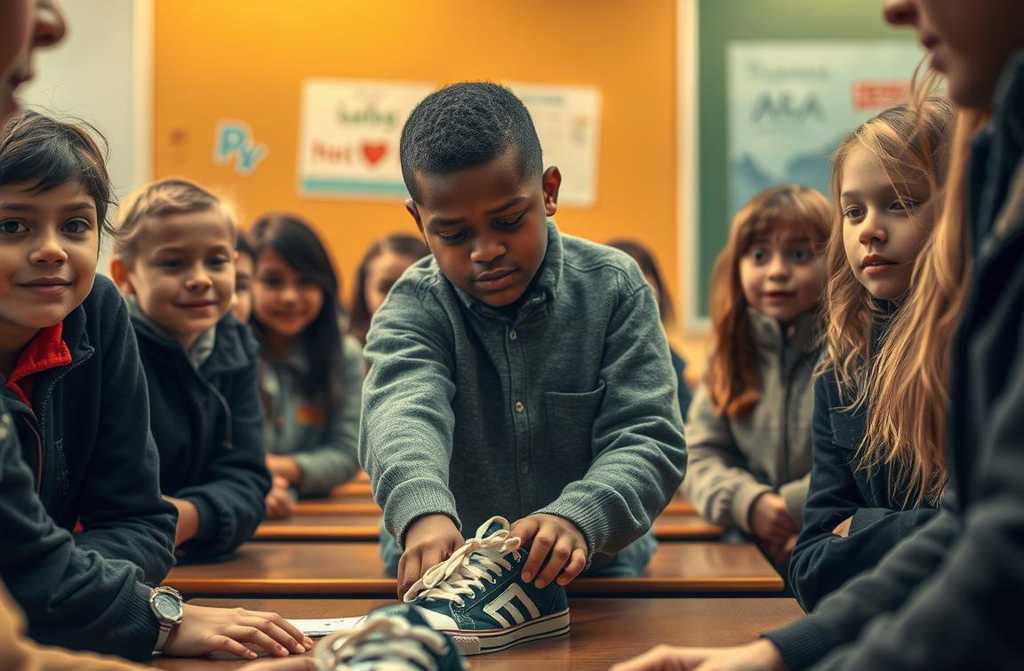
Impoverished African-American Boy Endures Taunts for Worn-Out Sneakers — His Teacher’s Shocking Revelation Stuns the Entire Classroom

Published

on

The morning bell hadnt yet chimed when Oliver Whitby slunk into St. Albans Secondary, shoulders hunched, praying no one would glance his way. But they always did.

Look at Whitbys wrecked trainers! someone crowed, and the room burst into giggles. His shoes were frayed at the edges, the right sole flapping like a loose tongue. Olivers cheeks burned, but he kept walking, eyes fixed on the scuffed linoleum. He knew better than to react.

It wasnt new. Olivers mum, Margaret, juggled two jobs just to keep the heating onwaitressing at a café by day, cleaning offices by night. His dad had vanished years ago. Every time Oliver outgrew his clothes, there was never enough to replace them. Shoes became a dream they couldnt afford.

But today stung worse. It was school photo day. His classmates strutted in designer jumpers, crisp polos, and spotless trainers. Oliver wore second-hand trousers, a threadbare jumper, and those shoes that betrayed the truth he hid: he was skint.

During PE, the taunts sharpened. As they lined up for football, a boy stomped on Olivers sole, splitting it wider. He stumbled, met with another wave of jeers.

Cant even afford proper boots, and he thinks he can play, one sneered.

Oliver clenched his fists, not at the insult, but at the memory of his little sister, Emily, at home with no proper winter coat. Every penny went to rent and food. He wanted to shout, *You dont know a thing!* But he swallowed the words.

At lunch, Oliver sat alone, nibbling his cheese sandwich while others wolfed down chips and burgers. He tugged his sleeves to hide the unravelling threads, curled his toes to hide the flapping sole.

At her desk, Miss Eleanor Davies watched him closely. Shed seen teasing before, but something about Oliverthe way his shoulders sagged, eyes dull, burdened beyond his yearsmade her chest tighten.

That afternoon, after the final bell, she asked softly, Oliver, how long have you had those trainers?

He stiffened, then murmured, Ages.

It wasnt much. But in his eyes, Miss Davies saw a story far bigger than a pair of shoes.

Miss Davies lay awake that night. Olivers quiet shame gnawed at her. She checked his records: grades steady, attendance near-perfectrare for kids in tough spots. The nurses notes stood out: frequent tiredness, threadbare uniform, skips free meals.

The next day, she asked Oliver to stay behind. At first, he bristled, suspicion in his gaze. But her tone held no pity.

Is everything alright at home? she asked gently.

Oliver bit his lip. Finally, he nodded. Mums always working. Dads gone. I look after Emily. Shes seven. Sometimes I make sure she eats first.

The words lodged in Miss Davies throat. A twelve-year-old boy with the weight of a parent.

That evening, with the school counsellor, she drove to Olivers estate. The flat was tidy but sparse: a flickering lamp, a worn sofa, a nearly empty fridge. Margaret greeted them, still in her waitress apron, exhaustion etched in her smile.

In the corner, Miss Davies spotted Olivers study spotjust a stool, a notebook, and above it, a university leaflet. One line was circled in biro: *Bursary Information.*

That was when Miss Davies understood. Oliver wasnt just poor. He was relentless.

The next day, she spoke to the headmaster. Quietly, they arranged help: free meals, uniform vouchers, a donation from a local charity for new shoes. But Miss Davies wanted more.

She wanted his classmates to see Olivernot as the boy with wrecked trainers, but as the boy carrying a story heavier than any of them knew.

On Monday, Miss Davies faced the class. New project, she announced. Each of you will share your real storynot the surface, but whats beneath.

There were groans. But when Olivers turn came, silence fell.

He stood, voice barely above a whisper. Some of you laugh at my shoes. Theyre old. But I wear them because my mum cant afford new ones. She works two jobs so me and Emily can eat.

The room froze.

I look after Emily after school. Help with her maths, make sure shes fed. Sometimes I skip meals, but its fine if shes alright. I study hard because I want a bursary. I want a proper job so Mum doesnt have to work herself to the bone. So Emily never has to wear shoes like mine.

No one moved. No one laughed. The boy whod mocked him stared at his desk, face flushed.

Finally, a girl murmured, Oliver I didnt know. Im sorry. Another muttered, Yeah. Me too.

That afternoon, the same lads whod taunted him called Oliver over for football. For the first time, they passed him the ball, cheering when he scored. A week later, a group pooled their pocket money and, with Miss Davies help, bought Oliver a new pair of trainers.

When they handed them over, Olivers eyes welled up. But Miss Davies reminded the class:

Strength isnt in what you wear. Its in what you carryand how you keep going, even when lifes unfair.

From then on, Oliver wasnt just the boy with wrecked trainers. He was the boy who taught his class about grit, heart, and the quiet battles no one sees.

And though his shoes had once made him a target, his story turned them into something elseproof that true strength cant be worn down.

Click to comment

Leave a Reply

Ваша e-mail адреса не оприлюднюватиметься. Обов’язкові поля позначені *

одинадцять − десять =

Також цікаво:

З життя2 секунди ago

Mother-in-Law Anna Peters was sitting in her kitchen, watching the milk quietly simmering on the stove. She had forgotten to stir it three times already, each time remembering too late: the milk would froth, spill over, and she would clean the stove irritably with a cloth. In those moments she felt it keenly: it wasn’t really about the milk. Ever since her second grandchild was born, everything in the family seemed to derail. Her daughter grew tired, thinner, and quieter. Her son-in-law came home late, ate in silence, sometimes heading straight to the bedroom. Anna saw this and thought: how can you just leave a woman to cope alone? She spoke up. At first gently, then more sharply. First to her daughter, then to her son-in-law. And then she noticed something strange: after she spoke, the house didn’t feel lighter, but heavier. Her daughter defended her husband, he grew gloomier, and Anna returned home with a sinking feeling that once again, she hadn’t done things right. That day she went to see their vicar, not for advice, but because there was nowhere else to go with this feeling. “I suppose I’m just not a good person,” she said, not meeting his gaze. “I always do things wrong.” The vicar was sitting at his desk, writing. He set his pen aside. “Why do you think that?” Anna shrugged. “I tried to help. Instead, I only seem to make everyone angry.” He looked at her attentively, but without judgment. “You’re not a bad person. You’re just exhausted. And very anxious.” She sighed. That rang true. “I’m so worried for my daughter,” she said. “She’s so different since the baby. And him…” She waved a hand. “It’s like he doesn’t even notice.” “Do you notice what he does?” the vicar asked. Anna thought for a moment. She remembered how, last week, he washed the dishes late at night when he thought no one saw. How on Sunday he took the pram out for a walk, even though he looked as if he’d rather collapse into bed. “He does help… I suppose,” she replied doubtfully. “But not the way he should.” “And what way is that?” the vicar asked gently. Anna wanted to reply at once, but realised she didn’t know. She could only think: more, better, more attentively. But what, exactly, was hard to explain. “I just want things to be easier for her,” she said. “Then say that,” the vicar replied quietly. “Not to him, but to yourself.” She looked at him. “What do you mean?” “I mean you’re not fighting for your daughter — you’re fighting her husband. And fighting means being tense. That exhausts everyone: you, and them.” Anna was silent for a long while. Then she asked, “So what should I do? Pretend everything’s fine?” “No,” he replied. “Just do what helps. Not words, but actions. And not against someone, but for someone.” On her way home, she thought over his words. Remembered how, when her daughter was a little girl, she would just sit beside her quietly if she cried — never lecturing. Why was it different now? The next day, she arrived unannounced. She brought soup. Her daughter was surprised; her son-in-law embarrassed. “I won’t stay long,” Anna said. “Just wanted to help.” She watched the children while her daughter slept. Left quietly, without a word about how hard things were, or what they ought to do. The next week, she came again. And again, the week after. She still noticed that her son-in-law was far from perfect. But she began to see other things: the way he gently picked up the baby, how at night he tucked a blanket around her daughter when he thought no one was looking. One day, in the kitchen, she couldn’t help herself and asked him, “Is it hard for you right now?” He looked startled, as if no one had ever asked before. “It’s hard,” he answered, after a pause. “Very.” And nothing more. But something sharp in the air between them was gone. Anna realised she’d been waiting for him to change. But it needed to start with her. She stopped discussing him with her daughter. When her daughter complained, she didn’t say “I told you so.” She just listened. Sometimes she took the children to give her daughter a break. Sometimes she called her son-in-law to ask how things were. It wasn’t easy. It was much easier to stay angry. But gradually, the house grew quieter. Not better, not perfect — just quieter. Free of endless tension. One day her daughter said, “Mum, thank you for being with us now, not against us.” Anna thought about those words for a long time. She understood something simple: reconciliation doesn’t come from someone admitting they’re wrong. It comes when someone is willing to stop fighting first. She still wanted her son-in-law to be more attentive. That wish hadn’t gone away. But alongside it lived something more important: for her family to have peace. And every time the old feeling — frustration, resentment, the urge to criticise — rose up, she asked herself: Do I want to be right, or do I want to make things easier for them? Almost always, the answer showed her what to do next.

Mother-in-Law Margaret Williams sat in the kitchen, her eyes resting on the saucepan of milk gently simmering on the hob....

З життя43 секунди ago

Excuse Me, Sir, Please Don’t Push—Oh, Is That Smell Coming From You? A Chance Encounter, a Perfectly Laid Bathroom Tile, and a Second Wind: How Rita’s Life Changed at 53 When a Homeless Stranger with Sapphire Eyes Built Her Happiness and Challenged Her Son’s Inheritance Plans

– Excuse me, sir, please dont push. Oh, goodness. Is that smell coming from you? – Sorry, the man muttered,...

З життя60 хвилин ago

“My Grandchildren Only See Fresh Fruit Once a Month, But She Buys Expensive Food for Her Cats!”: My Daughter-in-Law Accuses Me of Being Cold-Hearted for Putting My Pets First, but I Won’t Let Her Guilt Me into Supporting Their Growing Family

My grandchildren only see fresh fruit once a month, yet she spends a fortune on fancy cat food, my daughter-in-law...

З життя1 годину ago

Oxana, Are You Busy? – A Festive New Year’s Eve Tale of Family, Holiday Hustle, a Mishap in the Snow, and an Unexpected Encounter with a Doctor That Changed Everything

Annie, are you busy? her mum calls, poking her head through the door to her daughters room. Just a second,...

З життя2 години ago

Vitaly Settles in with Coffee and His Laptop to Finish Work—Until an Unexpected Call from the Maternity Ward Changes Everything: A Stranger’s Baby, a Past Affair in Brighton, and the Decision That Will Change His Life Forever

Edward settled himself at his mahogany desk, laptop open and a steaming mug of tea beside him. He had a...

З життя2 години ago

Igor Never Came Back from Holiday: “Why hasn’t your husband written or called?” “No word, Vera—not after nine days, not after forty,” Lyuda would joke, adjusting her work apron over her broad waist. “So he’s gone off the rails, or worse, then,” her neighbour nodded sympathetically. “Well, wait and see. Have the police said anything?” “Everyone’s silent, Vera—quiet as fish in that sea of his.” “Life, eh… fate.” That conversation weighed heavy on Lyudmila as she swept the autumn leaves from her doorstep in the dreary fall of 1988. Three years into her well-earned retirement, she’d had to take up work as a council cleaner to make ends meet. Life had always been simple—she and her husband, both dutiful workers, had raised a son, no scandal, no sorrow. Then Igor went on a seaside holiday and never returned. She’d phoned every hospital, every police station, even the morgue. Her son, stationed with the military, helped with inquiries—it was discovered Igor checked out of his hotel but never boarded the train home. Lyudmila wanted to go search for her husband, but her son insisted he’d handle it. Weeks passed, and she kept herself busy to stifle her fears. Then, as suddenly as he’d vanished, Igor reappeared—no suitcase, just the same navy suit and a weary silence. As she fussed to feed him and her son, the truth unravelled: Igor had been living with another woman by the sea, seeking “freedom.” The shock, the ache of betrayal—Lyudmila couldn’t bear it. Igor, shamed and lost, tried to return weeks later, but Lyudmila stood firm. It wasn’t just heartbreak—it was the pain of not knowing, of years shared and suddenly made strange. She swept her pathway, watching leaves collect and blow away, knowing sometimes those who hurt us most have already gone with the wind. (Original Title Adapted for English Culture: Igor Never Came Back from Holiday: The Disappearance, the Heartbreak, and the Road Swept Clean)

Yours hasnt written or rung you yet? No, Vera, not a word after nine days, not after forty either, Lydia...

З життя3 години ago

You Drive Me Up the Wall!… I Can’t Eat Right, Can’t Dress Right, Can’t Do Anything Right! — Pavel’s voice broke into a shout. — You can’t do anything!… Can’t even earn proper money!… We never get any help from you around the house!… — Marina burst into tears, — …And there are no children…, — she whispered. Belka — a white-and-ginger cat of about ten, perched atop the wardrobe, silently witnessed yet another “family tragedy”. She knew, she could sense, that Mum and Dad truly loved each other… But she didn’t understand why they said such cruel words that hurt everyone. Mum, sobbing, locked herself in the bedroom as Dad lit one cigarette after another. Belka, seeing her family falling apart, thought, “There must be happiness in this house… and happiness means children… we need to find some children…” Belka couldn’t have kittens herself — she’d been spayed years ago, and as for Mum… the doctors said she could, but something just wouldn’t work out… The next morning, after her humans left for work, Belka, for the very first time, slipped out the window to visit her neighbour Pawsy — for advice. — Why would you want kids? — scoffed Pawsy. — Ours come with children, and I have to hide from them… they smear lipstick on your face or squeeze you until you can’t breathe! Belka sighed: — We just need normal children… If only we could find some… — Hmmm… That street cat Molly’s had a litter… five of them… — mused Pawsy. — Take your pick… Taking her chances, Belka leapt balcony to balcony to the street. Shivering nervously, she squeezed through the railings of a basement window and called out: — Molly, could you come out for a minute, please… From deep within came desperate squeaks. Carefully crawling through, eyes darting in fear, Belka began to cry. Under the radiator, on the hard gravel, lay five tiny, sightless kittens, nudging the air and wailing for their mum. One sniff told her: Molly hadn’t been back for at least three days. The babies were starving. Fighting tears, Belka gently carried each kitten to the entrance. Trying to calm her hungry, squeaking brood, Belka lay down beside them, anxiously watching the end of the yard, waiting for Mum and Dad. Pavel, silent as he met Marina after work, brought them home. As they reached the doorway, they froze — there was their Belka, (who had never set paw on the street alone), and five multicoloured kittens clambering to nurse from her. — What on earth? — Pavel was stunned. — A miracle…, — echoed Marina, and together they scooped up the cat and kittens and rushed inside… Watching Belka purr happily in a box with her new babies, Pavel asked: — But what do we do with them? — I’ll feed them with a dropper… once they’re bigger, we’ll find them homes… I’ll call my friends…, — Marina whispered. Three months later, still stunned by the turn of events, Marina sat stroking her “cat pack” and murmured, over and over: — Things like this just don’t happen… this just doesn’t happen… Then, she and Pavel broke down in happy tears; he swept her into his arms, and they both laughed and chattered at once: — I’m glad I finished building the house! — Perfect for a child to get some fresh air! — And let the kittens run in the garden! — There’ll be room for everyone! — I love you! — And I love you even more! Wise Belka brushed away a tear — life, it seemed, was finally coming together…

How you get on my nerves! Nothing I do is right not even how I eat, not even what I...

З життя3 години ago

I Called Out the Window: “Mum, Why Are You Up So Early? You’ll Catch Your Death!” — She Turned and Waved Her Shovel Cheerfully: “I’m Doing This for You Lazybones!” — And the Next Day, My Mum Was Gone… I Still Can’t Walk Past Our Garden Gate Without Tears
 Every Time I See That Pathway, My Heart Clenches Like Someone’s Gripped It in Their Fist. I Took That Photo on the Second of January… I Only Stopped When I Noticed Her Footprints in the Snow—Now That Photo Is All I Have Left of Those Days… We’d Spent New Year Together, Just as Always: Mum in Her Favourite Apron I Gave Her at School, the Smell of Fried Burgers, Family Jokes, Dad Arriving with an Enormous Tree, All of Us Decorating, Singing Old Christmas Songs, Laughing Until We Cried… On 2nd January, I Looked Out to See Mum Clearing a Perfect Pathway from the Gate to Our Door, Her Scarf Tied Up, Red-cheeked, Shovelling Snow So We Wouldn’t Have to Struggle Through the Drifts. “It’s for You, My Lazy Lot—Go Put the Kettle On,” She Called, Smiling. That Was the Last Time I Heard Her Voice So Cheerful. The Next Day She Was Gone, So Suddenly It Didn’t Seem Real. Only Her Little Footprints Remain—Marks in the Snow, and In My Heart.

I remember shouting out the window, Mum, what are you doing out there so early? Youll freeze! She turned around,...