
З життя
Let Someone Else Pick You Up

“Let someone else pick you up,” the voice whispered from the ceiling.
“I refuse to be a sacrificial lamb. What happened to you youre to blame, you know?” his wife murmured, hovering over his narrow hospital cot, eyes as cold as the frost that clung to the windowpanes. David could barely shift, his mouth a slack hinge, and yet he did not even mutter; he simply listened as she wove the final threads of his humiliation.
“Do you expect me to lay my whole youth on the altar of your disability? Look at me with that contemptuous stare! You think Im just the last scrap of your pride?” she snapped, running a finger over the orange chrysanthemums perched on his nightstand. Angela recognized the vasethey were identical to the one in her motherinlaws drawingroom, but she would never have bought those flowers herself. Perhaps it was the girl he once rescued who had placed them there. It mattered little.
“I still believe youll rise again, find a normal life. Maybe someone else will gather the pieces,” the wife sighed, her tone softening. “My father is already waiting in his car. Ive taken nothing of yoursonly the juicer, which you never used. Do not try to contact me for reconciliation. Well divorce when the time comes; Im not in a rush. Goodbye.”
She slipped out, her perfume lingering in the stale air for a full twenty minutes, an odd, sweet haze that refused to dissolve.
A low chuckle drifted from the neighboring cot. “Well, well, ladshe dumped you, eh? Not a gentle goodbye, that.” The voice belonged to a lanky man in a faded flat cap, his words slithering like a cat through the silence.
David stared up at the plaster ceiling, his mind a fog of broken bones and shattered pride. He tried to understand Angelas betrayal. His thoughts drifted to his mother, the one love that never wavered. Everything else seemed temporary, a tradeoff for survival.
“The old womans just a cat, hunting for a softer spot,” the stranger continued. “Whats there to blame?” He wanted nothing more than to shut his ears against the strangers rambling. Yet the man, sensing Davids quiet attention, pressed ontalk of exgirlfriends, of work, of women like Angela, of the endless parade of human misery. “Lord, what a torment! Have they taken enough from me?” David thought, feeling the words sting like a slap.
The torment stretched on, winding through the long, grey days of autumn and winter. It had begun in late August, when the air had already begun to bite with early chill, heralding the coming fall. Streetlamps flickered on earlier each night. David, stooped from double shifts at the steel mill, staggered off the rattling city bus, his limbs aching. That morning his partner called from the factory gate, voice trembling between panic and relief: “Emilys in labour! I cant leave her alone! Cover my shift, please!” He answered without hesitation, Go on, Ill manage.
He reached for a cigarette, but a sudden, highpitched shriek pierced the distant hum of traffic, abruptly cut off by a coarse laugh. Fatigue melted away. He flung the unlit cigarette aside and cursed under his breath, turning toward the sound.
In the dim shadows of a deserted back alley, three burly lads in tracksuits formed a loose circle. In the centre, a fragile figure in a light dress was being tugged at the sleeve and waist. Leave her alone! the girl sobbed. Ill call the police! she threatened. The biggest of the trio sneered, Call them, sweetheart, while you can. Their laughter echoed off the brick walls.
Davids ingrained sense of chivalry surgedan echo of his fathers words: Stand up for a woman, protect the weak. He stepped forward, voice steadier than he felt. What are you doing? Harassing a woman?
The three turned, smirks peeling from their faces. Who are you, hero? the largest taunted, stepping closer. Get out while you still can, another snarled, fists clenched.
David lunged, shoving the nearest thug aside, shielding the girl. Run! he shouted. She fled, her footsteps fading into the night.
The world snapped back for David, a blinding flash of pain searing his temple. He fell heavily to his knees as a barrage of blows rained down. He heard his own ribs crack, felt a sticky warmth on his lips, saw a boot arc toward his face. Thoughts tangled, but one remained clear: She escaped. Thats all that matters.
Later, in the trauma ward, his mother wept at his bedside. Why did you do it? You got yourself almost killed for a stranger! she chided. David, swathed in plaster and tubes, could not even turn his head. His eyes burned with stubborn resolve. I cant just walk past, he thought. My father taught me that.
Paramedics arrived, doctors hovering over his battered body in the grimy dust of the alley, murmuring, We made it in time I think. In that first, crucial battle for his life, David emerged victorious, but the price was steep. His injuries demanded weeks, perhaps months, of confinement to the hospital bed.
When the days grew longer and his strength returned in small, shaky increments, a new figure appeared at his bedside: a stranger whose rescue had been the catalyst for his own suffering. Her name was Molly, and she perched on a chair, a faint wisp of perfume swirling in the antiseptic air. She was striking, yet an invisible wall stood between them; he could see her features, not feel any connection. Why are you here? he wondered, the question echoing hollowly.
One afternoon, Mollys mother arriveda gaunt woman with creased skin and tired eyesbearing a towering bouquet of lilies. The lilies replaced the wilted chrysanthemums on the nightstand, their pale heads reminiscent of funeral wreaths. David stared at the flowers with a quiet bewilderment, wondering why anyone would drag such somber symbols into a place of healing.
During one of Mollys silent vigils at the window, David finally spoke. Why do you keep coming? he asked, his voice low but steady. I can see it burdens you.
Mollys eyes widened, and she hurriedly untied a small parcel. I brought you grapes and a new book, everyones raving about it. Weeks passed, and David clawed his way back from illness, regaining enough vigor to sit up unaided. He asked Molly to stop visiting.
Promise me one thing, he said, looking straight into her eyes. Be more careful. Dont wander alone down dark alleys. Youre too bright, you deserve to stay safe for the one youll someday love. Mollys tears fell silently; she could not find words.
Enough, stop crying, David muttered, turning his gaze to the cracked plaster wall. It makes me sick to see tears. He forced himself to promise that he would stand again, even if that promise felt like a faroff dream. They said their goodbyes, forever.
Molly never returned. The weight of her sorrow, her tears, had become too heavy for him to bearlike a mothers wail at a bedside. In the absence of her presence, nothing hindered his relentless fight: the searing ache that coursed through every muscle, the fierce determination to prove every doctor wrong.
From that day, steel resolve pulsed in Davids veins. He endured daily, grueling battles with his own body. Pain became his constant companion, threading through each nerve, each joint, turning even the tiniest attempt at movement into a storm. Lying still and accepting a wheelchair was the easy way out, but he needed to prove to himself and to the world that he could be whole again, that happiness was his right, no matter the cost.
He mastered the simple act of sitting upsomething the medical staff called a miracle. Yet only he knew the true price: sleepless nights slick with sweat, fists torn raw, muscles spasming as if twisted inside out. Then, at last, a faint, coveted twitch of his toes signaled a breakthrough.
Still, a poisonous worm of doubt whispered in time with his heartbeat: Who will love a cripple? Who will stay? His wife Angela remained a phantom, just as she had askedno contact, no messages. The former, happy life lay in ruins, but surrender was not in his nature.
Spring rain tapped against the window, and, leaning on crutches, David took his first tentative steps across his flats hallway after months of immobilization. His mother, watching his struggle, finally exhaled, hope flickering anew in her eyes.
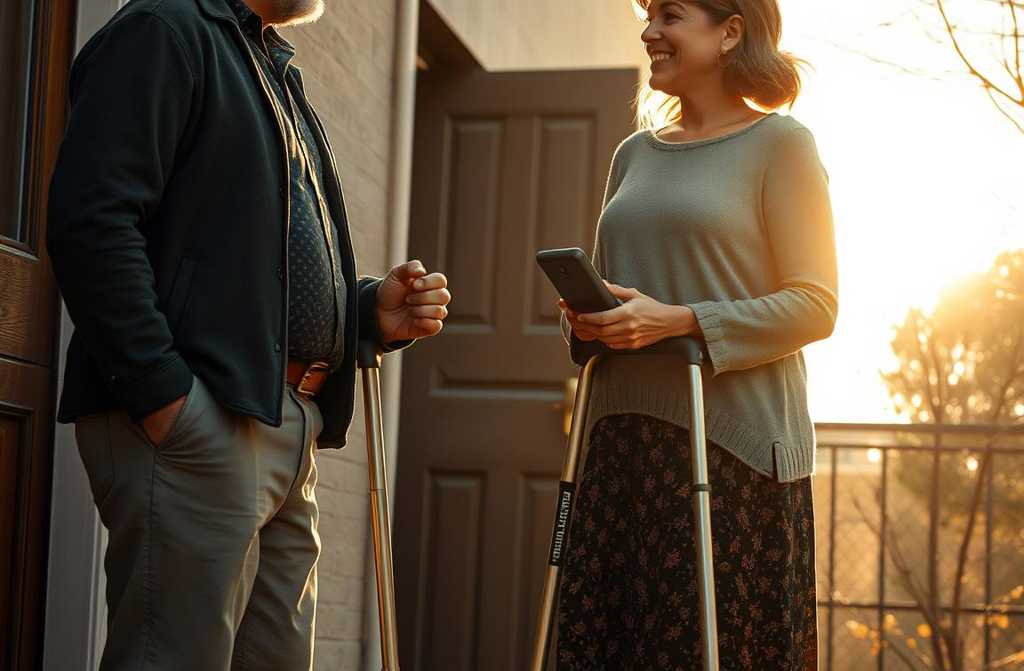
One bright summer morning, with resolve clenched like a fist, David ventured out for a solitary walk. He shuffled down the familiar cobbled lane of his childhood neighbourhood, his crutch clicking against the pavement. Fatigue surged, and he collapsed onto a cool bench. Above, a fifthfloor window slammed open. A young man shouted something, then flailed, and a battered flipphone arced through the air. Instinctively, David lunged, snatching the device from the sky.
The phone was an old, buttonfilled relic, far from the sleek smartphones of today. He waited, expecting its owner to scramble down, but nothing happened. The street fell silent; after a few minutes, a furious teenager sprinted past, oblivious to Davids find.
Thirty minutes later, the phone rang. Hello? a woman’s voice trembled on the other end, familiar and aching. Is this? Wheres Michael? The voice belonged to a woman who sounded like a ghost from his past. Hes home. I found his phonesomeone threw it out of a window half an hour ago.
Silence stretched across the line. Thats my phone please tell me where I can collect it.
Later, as David sat on the steps outside his block, Molly appeared again, frozen in place before rushing into his arms. He brushed her hair awkwardly, trying to calm the surge of emotion. She explained that Michael, her exboyfriend, was a jealous, possessive man who had snatched the phone, convinced shed hidden a secret number. In truth, the device was an old handmedown from her father, containing his final messages sent before he died eight years earlier.
It was a treasured keepsake, Molly whispered, voice cracking. Those last texts from him I cant lose them.
Missed you, David breathed, a small smile tugging at his lips. Dont drive me away again.
I wont, she promised, eyes shining. Without you, my world spins out of control.
They took that first tentative step toward a shared futuretwo solitary halves, fatewoven, determined never to be torn apart again.

Our Neighbor Loved Blasting Rock Music at 2 AM, So I Bought My Son a Violin and We Started Practicing Scales Right at 8 in the Morning, Just as the Neighbor Was Finally Getting to Sleep
Every night at half past two, the ceiling above my bedroom would come alive with a suspicious amount of activity....


My Father Abandoned Us, Leaving My Mum Buried in Debt—Since Then, I Lost My Right to a Happy Childhood
When I was ten years old and my younger brother was just three, our dad walked out on us. Hed...


My brother and his family wanted to settle in London at my expense, but I made sure they understood from the start that this wasn’t going to happen!
My brother and I have an age gap of six years, with him being the elder. Three years ago, he...
A Coworker Tried to Dump Her Reports on Me, So I Forwarded Her Request to the Manager: “Please Help Mary, She’s Struggling”
Today was another one of those days when my patience in the office was really put to the test, and...


No One Will Ever Forget My Son’s Wedding: Two Shocking Secrets Revealed
My son has just recently gotten married. Of course, before that, he brought his girlfriend over several times so that...


Jack discovered that his colleague’s wife was pregnant, and instantly felt uneasy—after all, he had a good reason for feeling uncomfortable.
When Jack arrived at work, he was taken aback. The staff were having a celebration. Is there a special occasion...


“Wouldn’t You Like to Have a Daughter? I Could Be Your Daughter, If You’d Like.” The Girl Joined Our Family On Her Own
This story takes place 15 years ago. A girl at the orphanage looked up at me with her bright green...


A Friend of Mine Is 35 and Has Never Worked—Now He’s Running for a Top Management Position with a High Salary
Theres this woman I went to school withlets call her Charlotte. Charlotte was, in a word, the star of our...