
Connect with us

З життя

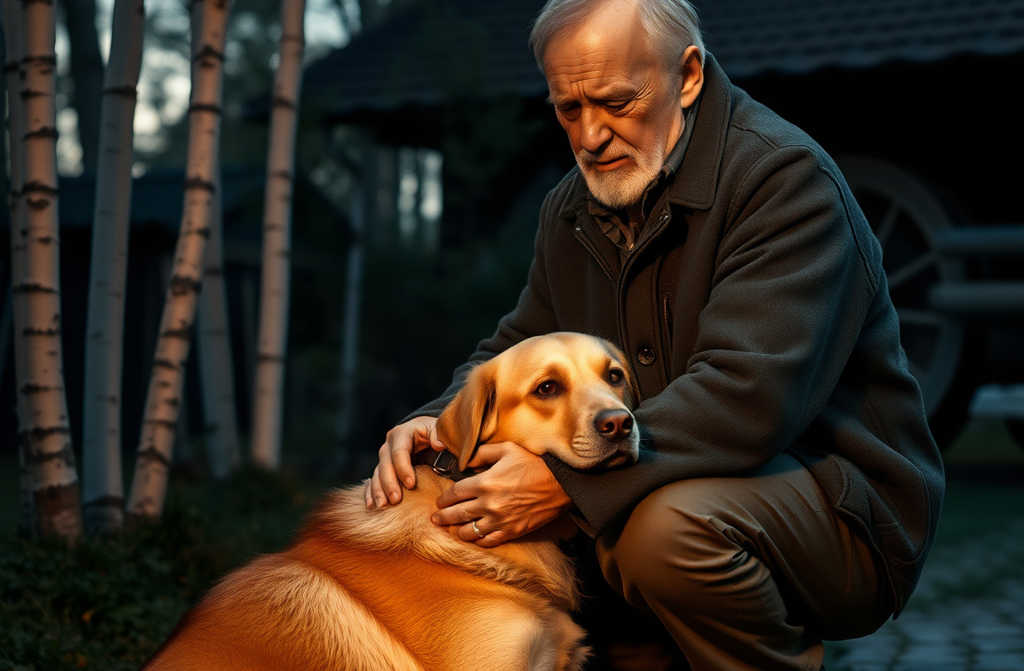
Michael Froze: From Behind the Tree, a Dog He’d Recognise Anywhere Watched Him with Sad, Knowing Eyes

Published

on

I frozepeering from behind an old oak tree, a dog watched me with a sadness Id have recognised anywhere.

Dust hung lazily over the country lane, swirling in sleepy spirals as if reluctant to move on. I killed the engine beside a sagging garden fence but didnt climb out straight awayjust sat, absorbing the gentle shudder of the old car beneath me.

Fifteen years Id kept away from this place. Now, suddenly, I was here. Why? I couldnt say for sureeven to myself. Perhaps to finish a conversation that never started, or to ask forgiveness far too late to be granted.

Well, you old fool, I muttered, you made it.

Turning the key, the engine wound down to silenceheavy, rural, thick with the scent of hay and faded memories. Far off, a dog barked in clipped bursts. Somewhere, a gate creaked. Still, I lingered inside the car, as though stepping out meant meeting the past head-on.

A memory elbowed its way forward; she stood at that very gate, waving to me as I left. I looked back only once. Shed already let her hand fall, head tilted, just watching.

Ill come back, I shouted then.

But I never did.

At last, I left the car, adjusted my collar, legs suddenly unsteady. Ridiculous, I thought. Sixty years old, and still afraid to meet my own past.

The gate no longer squeakedsomeone had finally oiled the hinges. Valerie always complained, Squeaky doors are like nervous tics. Just get some oil, Michael. I never bought it.

The garden looked almost the same. Only the old apple tree stooped lower, burdened by years, and the house seemed to breathe more softly, as if twice its age. New curtains now framed the windowsnot Valeries. Anothers.

I walked the familiar pathto the churchyard. That was where I planned to say what had been left unsaid these past fifteen years.

Then I stopped dead.

A rusty, gold-flecked dog sat by the birch tree, white chest bared and eyes so intent Id once called them golden. Not just similarher. My old friend.

Clever, I whispered.

She didnt come running. She didnt bark. Only watched, quietly, waiting. As if to ask, Where have you been? We waited.

I struggled to breathe.

Clever didnt move. She simply stayed there, silent as a shadow, those very same eyes as before. Valerie always laughed, Clevers half-psychiatrist. She sees straight through youright into your soul.

My God I breathed. Are you really still alive?

Dogs dont live this long.

But Clever rose slowly, as gently as a pensioner, every movement careful. She padded over, sniffed my hand, then glanced away. It wasnt hurt she showedjust a dogs way of saying, I remember. But youve come too late.

You do remember me. I didnt have to ask. Of course you do.

Clever whimpered softly.

Forgive me, Valerie, I murmured, crouching beside the gravestone. Forgive me my cowardicefor running away, for choosing career and empty rooms and pointless journeys. Forgive the fear that kept me from staying.

I talked for a long time, sitting on the cold stone, telling her about wasted work, women for whom my heart never ached, the number dialled but never rung, always lacking time, courage, or belief that someone still waited.

I returned from the churchyard no longer aloneClever, trailing behind, seemed to accept me back in her circle. Not warmly, but without malice.

A door snapped shut by the house.

Who are you? demanded a firm, female voice.

A woman in her forties stood on the stepdark hair tied back, face set and serious, but the eyes Valeries eyes.

Im Michael, I faltered. I used to

I know who you are, she interrupted. Anna. Her daughter. Dont you recognise me?

Anna, Valeries child by her first marriage. She looked at me as though every word burned inside her.

She stepped down, Clever shuffling nearer her side.

Mums been gone six months, Anna said, voice level. Where were you before? While she was ill? While she waited? While she believed?

The words struck hard. I found nothing to say.

I I didnt know.

Didnt know? She gave a humourless laugh. Mum never threw away your letters. Kept every one. Knew all your addresses. You werent hard to find. But you never looked.

There was nothing to say. Id written for the first few years, then less, until those letters were swept away by business and endless hotels and other lives. Valerie faded away, like a dream you cant return to.

She was ill? I managed at last.

No. Just her heart. It had grown tired of waiting.

She said it calmly. That hurt more.

Clever whimpered. I shut my eyes.

Mums last words, Anna continued, were, If Michael ever comes back, tell him Im not angry. I understand.

She always did. But I never managed to understand myself.

And Clever? Why was she at the churchyard?

Anna exhaled, eyes somewhere distant.

She goes every day. She just sits beside her. She waits.

Dinner was a silent affair. Anna told me she worked as a nurse, married but living apartLife never fell into place. No children. Only Clever, her companion now. Her anchor to Mum.

Could I stay here for a few days? I asked.

Anna met my gaze steadily.

And then disappear again?

I dont know, I admitted honestly. I really dont.

In the end, I stayed. Not just daysa week, then two. Anna stopped asking when Id leave. Maybe she knew I didnt have an answer.

I mended the fence, relaid some boards, drew water from the well. My body ached, but my mind felt at peace, as though something inside me finally gave in.

Clever accepted me, truly, after a week. She came over herself, laying her head on my boot. When Anna noticed, she remarked, Shes forgiven you, you know.

I looked from the windowat the dog, the tree, the house that still seemed to hold Valeries warmth.

And you? I asked Anna quietly. Can you forgive me?

She hesitated, as if testing every word in her mind.

Im not my mother, she said at last. Its harder for me. But Ill try.

Clever was always first awake, vanishing as dawn lit the sky. At first, I thought nothing of itdogs have their habits. But I soon realised, she walked the same route each time. To the churchyard.

She goes there daily, Anna explained. Since Mum died. She just lies down by her side. Like a sentry for forgotten memories.

Dogs remember longer than people, perhaps. Humans bury pain, invent reasons, hide behind routine. Dogs simply wait, love, remember.

One morning, thunderheads lay so low they seemed to brush the rooftops. By midday, it drizzled. By dusk, rain drove in sheets, the wind howling. The earth turned to mud, birch trees bending as if trying to duck away.

Clevers not back yet, Anna said, peering into the gloom. She always comes for dinner. Now its after nine.

I looked out too. Rain blurred everything, road and earth and sky, only the odd flash of lightning revealed the world.

Maybe shes found shelter, I offered, but did not quite believe it myself.

Shes old. Anna gripped the windowsill. A night like this what if somethings wrong?

Have you got an umbrella?

She passed me one, blue with daisies and far too cheerful for such weather.

What, youre going now? she asked, eyebrows raised.

But I was already fastening my coat.

If shes out there, shell stay till the rain stops. At her age a night out in this I didnt finish. Anna understood; words werent needed. She handed over a torch and the flowery umbrella, the sturdiest one she had.

The trek to the churchyard was all mud and wind, my torch barely piercing the downpour, umbrella blowing inside out with every gust. I slipped, cursed under my breath, but pressed on.

Sixty years old, knees creak like rotten floorboards, I grumbled, Ill be laid up tomorrow. But I have to go. I owe it.

The gate to the churchyard banged in the windthe latch had come loose. I stepped inside, torch beam sweeping the sodden ground, and there she was.

Clever, huddled by Valeries grave, head pressed to the wooden cross. Soaked through, breath shallow, but she hadnt left. Didnt even lift her head until I knelt by her.

Hey, old girl I knelt straight into the mud. Why dyou do this

She looked at me thenquiet and tired. As if she meant, I cant leave her. I remember.

Mums gone, I whispered, voice rough. But youre still here. I am too. Were not alone anymore. Were together now.

I wrapped her in my coat and lifted her carefully. She didnt resistthere wasnt the strength left. I didnt have much either, but that didnt matter.

Forgive us, Valerie, I murmured, sheltering Clever against the night. Forgive me for being too late. And herfor never forgetting you.

The rain eased at dawn. All night, I sat by the fire, Clever wrapped in my coat, stroking her, comforting her with nonsense, the way you do with sick children. Anna brought a bowl of milk. She drank a little.

Is she ill? Anna asked.

No I shook my head. Just worn out.

Clever survived two more weekspeaceful, never more than a step from me. Guarding the bit of time she had left, unwilling to let a moment slip by.

Day by day, she faded. Movements slower, eyelids heavier. But there was no fear. Only peace, and, strangely, gratitudeas if she knew she could let go at last.

Clever slipped away at dawn, lying by the porch, head on her paws. I found her with the first rays of light.

We buried her beside Valerie. Anna agreed immediatelysaid her mother would have smiled at them being reunited.

That evening, Anna handed me a set of keys.

I think Mum would have wanted you to stay. Not to leave again.

I stared at the time-blackened keys. The very ones that were once in my pocket, before I walked away and left everything behind.

And you? I asked quietly. Do you want me here?

Anna exhaled, and in that breath was a lifetime unlived.

Yes. She nodded. I do. The house shouldnt be empty. And I still need a dad.

A father. The word Id always feared. Not from lack of desire, but simply never knowing how. But maybe, while were alive, its not too late to learn.

Alright, I said. Ill stay.

A month later, the flat in London was sold, and I moved here for good. Tended the garden, patched the roof, painted the house. The silence no longer crushed me. It felt like the countrysides gentle breath.

I visited the churchyard. I talked to Valerie. And to Clever. Told them about the day, the weather, what Id planted, the neighbours I met.

Sometimes, I could swear they listened. And in those moments, peace settled around me in a way I hadnt felt for years.

So Ive learned this much, too late perhaps, but learned it still: sometimes, its the waiting, the forgiving, the coming homeeven if you believe its too latethat matters in the end.

Click to comment

Leave a Reply

Ваша e-mail адреса не оприлюднюватиметься. Обов’язкові поля позначені *

7 + 2 =

Також цікаво:

З життя16 хвилин ago

Aunt Rita I’m 47 years old. Just an ordinary woman—a bit of a wallflower, not attractive, not blessed with a great figure. Lonely. Never been married, never wanted to be, because I believe most men are all the same—interested only in stuffing their faces and lounging on the sofa. Not that anyone’s ever proposed or asked me out, for that matter. My elderly parents live up in Newcastle. I’m an only child—no brothers or sisters. I do have cousins, but I don’t keep in touch. Nor do I want to. I’ve lived and worked in London for 15 years, in a regular office job. Each day is work and home, work and home. I live in a standard block of flats in a typical residential neighbourhood. I’m bitter, cynical—I don’t love anyone. I don’t like children. At Christmas, I went to visit my parents in Newcastle, as I do once a year. When I got back, I decided to clean out my fridge, throwing away old frozen food—dumplings, burgers, things I’d bought and never liked. I bundled it all up in a box to toss it out. In the lift, there was a little boy, maybe seven; I’d seen him with his mum and a baby sibling before. I even thought, “Some people—she’s gone and had another one!” The boy stared at my box. When we got out, he quietly followed me to the bins and asked in a timid voice if he could have the food. I warned it was old, but let him take it—none of it was rotten, after all. As I turned to leave, I watched him gently pick up the packets, close them up, and clutch them to his chest. I asked where his mum was. He told me she and his sister were ill—couldn’t get out of bed. I went back home and started cooking dinner, but couldn’t get that boy out of my mind. I’m not usually inclined to help, but something nudged me. I grabbed what I had in the kitchen: sausage, cheese, milk, biscuits, potatoes, onions, even some meat from the freezer. I realised I hadn’t a clue what floor their flat was on, but knew it was above mine, so I worked my way up, floor by floor. I got lucky; after two flights, the boy opened the door. He hesitated, but let me in. The flat was poor but spotless. His mum lay curled up on the bed next to her youngest, a bowl of water and cloths on the table. High fever, trying to cool her daughter down. The medicine they had was long out-of-date. I felt her mum’s forehead—hot as a stove. She woke and stared at me in confusion, then suddenly sat up, asking where her son was. I explained I was a neighbour and quickly got the details before calling for a paramedic. While we waited, I gave her tea and sausage—she wolfed it down, must have been starving. Barely able to feed herself, yet still breastfeeding her baby. The ambulance came, checked them over, wrote out a long list of medicines and injections needed for the little girl. I went out, picked up everything from the pharmacy and groceries for them, plus—on a whim—a ridiculous neon yellow monkey toy. I’ve never bought a child a present before. Her name’s Anna, she’s 26. She grew up in Manchester’s outskirts. Her mum and gran were Londoners, but her mum married a local and moved up there to work in a factory. Anna’s dad died in an accident at work. Her mum was left alone, jobless, and quickly spiralled into trouble. By the time Anna was three, neighbours contacted her granny in London, who took her in. When Anna was 15, her gran told her the truth—her mother died of tuberculosis. The gran hardly spoke, was miserly, and chain-smoked. At 16, Anna took a job at the nearest shop, first as a shelf-stacker, then at the till. Her gran died a year later. At 18, Anna dated a boy who promised everything but disappeared as soon as she became pregnant. She kept working, saving up, knowing there was no one to help. When her son was a month old, she’d started leaving him on his own so she could clean stairways and make ends meet. As for her daughter—the shop owner she went back to, when her son was older, raped her repeatedly and threatened to have her fired so she could never work again. When he found out she was pregnant, he gave her £100 and told her never to come back. Anna told me all this that night—thanked me, said she’d repay me by cleaning or cooking. I stopped her, said goodnight, and left. I couldn’t sleep at all, thinking, “Why do I live like this? Why am I so cold? I don’t care for anyone, not even my own parents. I have all this money saved with no one to spend it on, and here’s a little family with nothing—not even enough to get well.” The next morning, the little boy, Anton, brought me a plate of homemade pancakes and dashed off. I stood there, plate in hand, feeling warmth coming from the food, spreading through me as if I were thawing out. Suddenly, I wanted everything at once: to cry, to laugh, to eat. Not far from our block is a small shopping centre. The owner of a children’s shop there, after some confusion over sizes, even offered to come with me to Anna’s flat. I don’t know if she wanted the business, having seen I’d buy a lot, or was just moved by my mission. An hour later, four huge bags of clothes for the kids stood in Anna’s hallway. I bought bedding, food, vitamins, even toys. I wanted to buy everything—I finally felt needed. It’s been 10 days now. They call me Aunt Rita. Anna is quite the crafty homemaker—my flat feels cosier already. I’ve started calling my parents. I even text ‘KINDNESS’ to children’s charity fundraisers. I can’t believe how I lived before. Every day after work I hurry home, because I know someone’s waiting. And this spring, we’re all heading up to Newcastle together—tickets have already been bought.

Aunt Rita I’m 47 years old. Just an ordinary woman, nothing remarkable about me. You could say Im a bit...

З життя26 хвилин ago

My Husband and I Came to the Countryside to Meet His Parents for the First Time — The Warm Welcome, Home-Cooked Meals, and Tall Tales Around the Kitchen Table Would Change Everything

My husband and I have just arrived in the countryside to meet his parents for the first time. Harrys mum...

З життя1 годину ago

Michael Froze: From Behind the Tree, a Dog He’d Recognise Anywhere Watched Him with Sad, Knowing Eyes

I frozepeering from behind an old oak tree, a dog watched me with a sadness Id have recognised anywhere. Dust...

З життя1 годину ago

DO I REMEMBER? I CAN’T FORGET! “Polly, listen… Remember my illegitimate daughter, Anastasia?” My husband spoke in riddles, making me uneasy. “Do I remember? I can’t forget! Why?” I sat down, bracing for bad news. “Well… Anastasia is begging us to take in her daughter—my granddaughter,” he mumbled. “And why on earth should we, Alex? Where’s Anastasia’s husband? Disappeared into thin air?” I was intrigued. “The thing is, Anastasia doesn’t have much time left. She never had a husband. Her mother remarried and lives in America. They’re estranged, and she has no other family. That’s why she’s asking…” Alex couldn’t meet my eyes. “So, what’s your plan?” I had already decided. “Well, I’m asking you, Polly. Whatever you say, that’s what we’ll do,” he finally looked at me. “How convenient. You made mistakes in your youth, and now I’m to shoulder the burden of a stranger’s child? Isn’t that right?” My husband’s feebleness made me furious. “Polly, we’re a family. We should decide together,” Alex pushed back. “Oh, you remembered now! Yet, when you fooled around, did you consult me? I’m your wife!” Tears welled up and I stormed out… In school, I dated a boy named Peter, until a new boy, Alex, arrived and swept me off my feet. I broke up with Peter. Alex noticed me, walked me home, kissed my cheek, and picked flowers for me. A week later, he led me to his bed. I didn’t protest—I fell head over heels for Alex. After we graduated, he went off to serve in the army in another city. We wrote to each other for a year. Then Alex returned on leave. I was overjoyed. He promised we’d marry when he came back for good—already considered me his wife. His sweet words melted me every time, even years later: one loving look from Alex, and I’d melt like chocolate in the sun. Alex went back to the army. I waited, confident I was a betrothed bride. Six months later, a letter arrived: Alex had found “real love” in his garrison town and wasn’t coming back. But I was already carrying Alex’s baby. So much for a wedding—just as my gran warned me. When the time came, I gave birth to my son, Ivan. Peter, my old boyfriend, stepped in to help. Desperate, I accepted. Yes, Peter and I became intimate. I’d long given up hope of seeing Alex again. Then he turned up, surprised to see Peter there. “Can I come in?” Alex asked. “Come on in, since you’re here,” Peter reluctantly allowed. Sensing the tension, Ivan clung to Peter, wailing. “Peter, why don’t you take Ivan for a walk?” I was at a loss. When they left, Alex asked, “Is he your husband?” “What’s it to you? Why are you here?” I was angry and confused. “I missed you. I see you’ve made a life with Peter—you didn’t wait for me. Well, I’ll go—sorry to intrude on your happy family,” he said, heading for the door. “Wait, Alex. Why have you come—just to hurt me? Peter helps me cope with loneliness. He’s been raising your two-year-old son, by the way,” I tried to keep him there. My love for him hadn’t died. “I’ve come back for you, Polly. Will you have me?” Alex asked, hope in his voice. “Come in, dinner’s ready,” my heart leapt—he came back, so he hadn’t forgotten. Why resist? Peter was shoved aside. My Ivan needed his real father. Later, Peter married a lovely woman with two children. A few years passed. Alex could never love Ivan as his own—he was convinced Ivan was Peter’s son. Alex never really cared for Ivan. He always had an eye for the ladies. He was forever chasing after women, easily smitten, just as easily moving on—including some of my own friends. I cried but kept loving him, determined to hold my family together. It was easier for me than for him—the one who loves is always blinded by hope. I never needed to lie or invent excuses; I just loved him. He was my sun. Sometimes I wanted to leave, but then I’d scold myself: Where would I go, who could compare? Besides, Alex would be lost without me. I was wife, lover, and mother to him. Alex lost his own mother at fourteen—she died in her sleep. Maybe that’s why he always looked for lost affection elsewhere. I forgave everything. Once, after a bitter argument, I threw him out. He moved in with his relatives. Months passed—I forgot why we argued—but he didn’t return. At last, I went to his family’s house. His aunt was surprised to see me. “Polly, why do you want Alex? He said you’d divorced—he has a new girlfriend now.” I found out where she lived and paid them a visit. “Hello! Could I see Alex, please?” I asked politely. She just smirked and slammed the door in my face. I left in silence. A year later, Alex came back. By then the girl had given birth to his daughter, Anastasia. To this day, I blame myself for throwing him out—maybe that girl wouldn’t have scooped him up otherwise. I tried harder to please and adore Alex. We never talked about his illegitimate daughter. It seemed if we did, our family would fall apart. We let sleeping dogs lie. After all, what’s one stray child? It happens. I blamed the “temptresses” instead. In time, Alex settled down. Flings ended. He stayed home watching TV. Our son married early, gave us three grandkids. Then, out of nowhere… Anastasia, Alex’s daughter from long ago, reappeared—asking us to take in her daughter. How would I explain a new little girl to Ivan? He never knew about his father’s youthful escapades. In the end, we took legal guardianship of five-year-old Alina. Anastasia passed away, gone at thirty. Graves grow over with grass, but life goes on. Alex spoke to Ivan man-to-man. After hearing his father’s confession, Ivan said, “What’s done is done, you don’t answer to me. But the girl should stay—she’s family.” Alex and I breathed easier. We’d raised a kind son. Now, Alina is sixteen. She adores her Grandpa Alex, whispers secrets to him, calls me Granny, and says she’s my spitting image at her age. I never argue…

DO I REMEMBER? I COULD NEVER FORGET! Polly, darling, theres something I must tell you Well, do you recall my...

З життя2 години ago

Winter had blanketed Andrew’s garden with soft snow, but his loyal dog Duke, a massive German Shepherd, was acting strangely. Instead of curling up in the large kennel Andrew had lovingly built for him last summer, Duke stubbornly insisted on sleeping outside, right in the snow. Watching from his window, Andrew felt a pang of worry—Duke had never behaved like this before. Each morning, as he stepped outside, Andrew noticed Duke watching him tensely. Whenever he approached the kennel, Duke positioned himself between Andrew and the entrance, growling softly and looking at him pleadingly, as if to say: “Please, don’t go in there.” This odd behaviour was so out of character for their years of friendship, it made Andrew uneasy—what was his best friend hiding? Determined to get to the bottom of it, Andrew came up with a plan—he lured Duke into the kitchen with a tempting piece of steak. While the dog, locked inside, barked desperately at the window, Andrew crept towards the kennel and crouched down to peer inside. His heart skipped a beat as his eyes adjusted to the darkness and he saw something that froze him on the spot… …There, curled up in a blanket, was a tiny kitten—dirty, freezing, and barely breathing. Its eyes barely opened, and its frail body shivered with cold. Duke had found it somewhere, and instead of chasing it away or leaving it to its fate, he had sheltered it. He had slept outside to avoid scaring it and guarded the entrance as if there was treasure inside. Andrew held his breath. He reached out, gently lifted the tiny creature and pressed it to his chest. In that moment, Duke raced over and nestled beside his shoulder—not growling, but gently, eager to help. “You’re a good dog, Duke…” Andrew whispered, clutching the kitten. “Better than most people.” From that day on, there were no longer just two friends living in the garden, but three. And the lovingly built kennel found its purpose again—as a little home for souls in need of saving.

Winter had blanketed Davids garden in a soft layer of snow, but his loyal dog Byron, a huge English Mastiff,...

З життя2 години ago

The Little Girl Who Wouldn’t Eat: The Night My Stepdaughter Found Her Voice and Our Family Was Forever Changed

A Little Girl Who Couldn’t Eat: The Night My Stepdaughter Finally Found Her Voice and Everything Changed 8 December 2025...

З життя3 години ago

A 7-Year-Old Boy, Covered in Bruises, Walked Into A&E Carrying His Baby Sister—What He Said Next Broke Everyone’s Heart

Just after one oclock in the morning, a seven-year-old boy, covered in bruises, pushed his way into the A&E at...

З життя3 години ago

My Son Skipped My 70th Birthday, Claiming He Had to Work—That Evening I Saw Him on Social Media Celebrating His Mother-In-Law’s Birthday at a Fancy Restaurant

The phone rang precisely at noon, shattering the careful anticipation that hung in the air. Margaret Palmer hurried to pick...