
З життя
The Key in His Hand Rain drummed against the window of the flat with the bleak consistency of a metronome, each beat ticking out the time left. Michael sat hunched on the edge of his sagging bed, as if by shrinking he could disappear altogether from the notice of fate. His large hands—once strong, shaped by years on the factory floor—now lay powerless in his lap. His fingers curled and uncurled in vain, desperate for something solid to hold on to. He wasn’t looking at the wall; he was seeing a map traced on the faded wallpaper—a map of hopeless journeys: trips from the NHS surgery to the private diagnostic clinic. His gaze, like an old film stuck on a single frame, was dulled and washed out. Another doctor, another kind but weary “Well, you have to understand—you’re not as young as you once were.” He couldn’t muster any anger. Anger took energy, and he had none left. Only fatigue remained. The pain in his back had become more than a symptom—it was the backdrop to every thought and action, a white noise of helplessness drowning everything else out. He did everything he was told: swallowed pills, slathered on gels, lay on the chilly table in the physio clinic, feeling like discarded machinery on the scrapheap. And all that time—he waited. Passive, almost devout, for the lifeline he hoped someone—perhaps the government, or a brilliant doctor, or clever professor—would throw out to him as he sank slowly into the muck. He stared into the horizon of his life and saw only rain-soaked greyness beyond the glass. His own will, once so sharp and practical on the job and at home, was reduced to a single function: to endure and hope for a miracle from somewhere else. Family… There had been family, but it had slipped away, vanishing quickly and with a strange clarity. His daughter Katie was first to go—clever Katie, off to London in search of something more. He’d never begrudged her ambition; if anything, he’d encouraged her to chase it. “Dad, I’ll help you as soon as I’m settled,” she’d said over the phone. He’d known even then that it wasn’t important. Then his wife left—Raia. Not to the shops, but forever. Cancer took her so fast. It was as if her absence magnified the weight in his spine, leaving him, halfway between the chair and the bed, still breathing, but blaming himself for it. She, the wellspring of his strength, faded in three months. He’d nursed her until the end, until her cough turned desperate and her eyes dulled to a distant shine. Her last words, gripping his hand in the hospital: “Hang on, Mike…” He wasn’t able to. He broke. Katie called, begged him to stay with her in her tiny rented flat, but what use was he to her there? In a stranger’s home, a burden. She wouldn’t be coming back. Now only Raia’s younger sister, Val, visited, once a week by the clock—bringing soup in Tupperware, pasta with a lukewarm cutlet and a fresh pack of painkillers. “How are you, Mike?” Val would ask, peeling off her coat. He’d nod, “Alright.” They’d sit in silence, her bustling around, tidying his little room, as if the order of things could somehow restore the order of his life. Eventually, she’d leave behind the scent of another woman’s perfume, and the soft, near-tangible weight of a duty performed. He was grateful. Yet also, crushingly alone. It wasn’t just physical loneliness—it was a prison built from helplessness, grief, and a subdued rage at unfairness. One melancholy night, his wandering gaze fell on a key lying on the tattered rug. He must have dropped it the last time he shuffled in from the surgery. Just a key. Nothing special. A bit of metal. He stared at it as though seeing it for the first time. He remembered his grandfather—brightly, as if someone had turned on a light in a dark corner of memory. Grandad Peter—one sleeve empty and pinned—would sit on the stool and tie his laces with a lone hand and a broken fork. Patient, focused, quirkily triumphant when he managed it. “Look, Mikey,” Grandad would say with a gleam of victory in his eye, “A tool is always close by. Sometimes a tool looks like junk. The trick is spotting the friend in the rubbish.” As a boy, Michael had thought this was just old man talk—a comforting fable. Grandad was a hero, and heroes could always manage. Michael, he decided, was ordinary; his battles with pain and loneliness weren’t fit for brave stories. But now, staring at the key, the old scene rang not like consolation, but as a quiet rebuke. His grandfather never waited for help. He used what he had—a bent fork—and beat back helplessness itself. So what had Michael chosen? Only waiting, bitter and passive, sitting by the door of someone else’s charity. The thought jarred him. Suddenly, the key—the chunk of metal, echoing his grandad’s words—became a silent command. Michael stood, groaning as his body objected, almost shame-faced in the empty flat. He took two shuffling steps, picked up the key. His attempt to straighten was met with the familiar knife of pain. He froze, waiting for it to pass, but this time, instead of collapsing back onto the bed, he pressed on. Moving slowly, he went to the wall. He turned his back to it, pressed the blunt bit of the key to the wallpaper right where the pain sat, and gently, gingerly leant in, applying pressure. There was no plan to ‘massage’ or ‘treat’—just the act of pushing back. Pressure against pain, reality against reality. He found a spot where, miraculously, this struggle brought not agony, but the slightest, dull relief—something inside relented, softened a fraction. He moved the key, tried again, higher then lower, with the same careful experiment. Each movement was slow, full of listening to his own body. It wasn’t treatment—it was negotiation. The key, not some medical gadget, was his tool. It seemed foolish. A key was no miracle. But the next evening, when pain returned, he tried again. And again. He discovered places where pressure brought not more pain, but relief—a sense of opening a vice by fractions. He began leaning against the doorframe to stretch. Drank a glass of water when the empty cup reminded him—something free, at least. Michael had stopped waiting, hands idle. He started using whatever was at hand: the key, the doorframe, the floor for simple stretches, his own resolve. He kept a notebook—not a pain diary, but a list of ‘key victories’: “Today managed five minutes by the cooker.” On the sill, he placed three old baked bean tins—planned for the bin. He filled them with earth from the front garden and planted a few onion bulbs. Not a vegetable plot, but a tiny patch of life that he was now responsible for. A month passed. At the next appointment, the doctor’s eyebrows went up at what he saw in the new scans. “There’s some improvement. Have you been doing the exercises?” “Yes,” Michael said. “I’ve been using what I’ve got.” He didn’t mention the key—the doctor wouldn’t have understood. But Michael knew. Salvation hadn’t come by ship. It had simply lain on the floor, ignored while he watched the wall, waiting for someone else to turn on the light. One Wednesday, when Val appeared with soup, she stopped in the doorway. On the windowsill, in those tin cans, green shoots of spring onion pointed skywards. The room no longer reeked of medicine and defeat, but of something almost hopeful. “You… what’s this?” she managed, seeing him standing confidently at the window. “Kitchen garden,” he replied. After a moment, he added, “Want some for your soup? Home-grown, fresh.” That evening, she stayed longer than usual. Over tea, without discussing his aches and pains, he told her about the stairs—the single extra flight he now climbed each day. His rescue didn’t come from Doctor Dolittle with a magic potion. It had hidden itself as a key, a doorframe, an empty can, and a concrete staircase. It hadn’t removed pain, loss, or age. But it put tools in his hands—not to win a war all at once, but to fight his small daily battles. And it turns out, if you stop waiting for a golden ladder from heaven and see the plain, concrete one at your feet, you might find the climb itself is already a life. Slowly, carefully, step by step—but always upward. And on the windowsill, in those three battered cans, grew the finest green onions in the world.

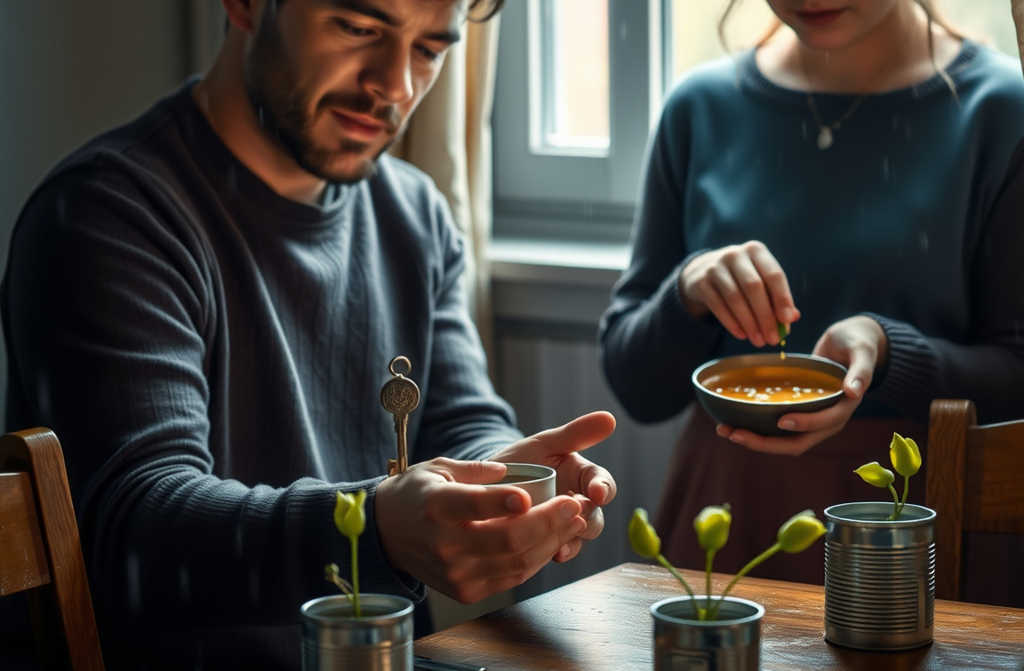
The rain was tapping against the flat window, steady as a grandfather clock, counting down the hours to something you couldnt name. Michael sat hunched on the edge of a sagging single bed, shoulders stooped as if he was trying to disappear, hoping his own fate might overlook him for once.
Those big hands of hisonce strong and nimble from years working with engines down at the factorynow just rested limply on his knees. Every so often his fingers clenched, as though they might catch hold of some invisible thread and pull himself back up. He wasnt really looking at the peeling wallpaper opposite, but at a faded mental map of all his hopeless journeys: from the NHS clinic to the private diagnostic centre and back. His gaze had become pale, worn out, stuck like an old home movie on a single frame.
Another doctor, the same worn-out phrase: Well, Mr. Parker, at your age, its hardly surprising. He felt no angeranger took energy he no longer had. All that remained was a grinding tiredness.
The pain in his back wasnt just a symptom. It was the scenery of his life now, a low white noise that blanketed every thought and action, drowning out anything that might have been left of hope.
Hed followed every instruction: swallowed the pills, rubbed in the ointment, laid still on the frigid plastic of the physio bench, feeling like a dismantled appliance left out for the bin men.
And all the whilehe waited. Listened, almost religiously, for a life ring to be tossed his way by someoneby the Government, or some clever consultant, or a Miracle Man in a white coatsomebody, anybody, to drag him out before he sank for good.
Hed try to peer into the distance of his own life, but all he could see was the grey drizzle dripping down outside the window, washing everything away. The willpower that once drove Michael, helping him fix things both at work and at home, had shrunk now to one absolute function: stick it out and hope for a miracle from somewhere else.
Family that was something hed had once, but it slipped away over time before he realised it. First his daughter Emmabright as a button, she was. Headed off to London, chasing after that better life. He was never against it really; wanted only the best for her. Dad, Ill help you soon as I find my feet, she promised over the phone. Not that it really mattered.
Then Jenny, his wife, was gone too. Not to the high streetgone for good. Jenny went quickcancer that was merciless and late-found. He was left not only with pain in his back, but the silent reproach that he, half-crippled and half-living, was still here.
And she, his lifeline, his energy, his Jennyshe faded away in three months. He cared for her, did his best, till that cough became a rasp and her eyes lost their glimmer. The last thing she managed, in a hospital bed, holding tight to his hand: Hold on, Mike That was it. Thats when he truly broke.
Emma phoned, wanted him to stay with her in her flat, tried to persuade him. But what use would he be there, getting under her feet? Besides, she wasnt about to come back, that much was clear.
Now, only Jennys little sister Christine popped by, regular as clockwork, once a week. Shed bring soup in a Tupperware, maybe some pasta and meatballs, and another pack of painkillers.
Howre you, Mike? shed ask as she hung up her mac. Hed just nod, Oh, same as ever. Theyd sit together in silence while Christine tidied up, as if straightening the flat might sort out his life too. Then shed slip out, leaving behind the scent of her perfume and the quiet, almost tangible sense of an obligation, dutifully paid.
He was grateful, really. But the loneliness was crushinga cell built not only of empty rooms but of his own helplessness and grief and a simmering, silent anger at how unfair it all was.
Then, one especially miserable evening, his eyes drifted across the battered rug and settled on a key lying by the door. He mustve dropped it dragging himself back from the doctors.
Just a key. Nothing special, a chunk of silver metal. But he stared at it like it was something remarkable, and not just a key. It lay there, silent. Waiting.
Suddenly, he remembered his grandad. Clear as if someone had switched on a light in a dark room of his mind. Grandad George, shirt sleeve pinned at the elbow, sitting on a kitchen stool and somehow tying his shoe laces using only one arm and a bent fork. A slow, careful job, and whenever it worked, hed give this triumphant little snort.
Watch, Mikey boy, Grandad would say, and in his eyes was this spark, as if brains could always outdo circumstance. Your tools are always there, lad. Sometimes they look like rubbish. The trick is spotting your allies in all that mess.
Michael, whod only been a boy, had thought this was just an old mans way of cheering himself upa bedtime story for the hopeless. Grandad had been a war hero. Folk like that could do anything, but Michael? He was just a man and this battle with pain and loneliness didnt leave much room for fork-and-string heroics.
Now, staring at the key, that scene was more accusation than comfort. Grandad never waited for saving. He took what was at hand: a fork, a shoelace, and he beat his helplessness.
What had Michael taken? Only waiting, bitter and passive, sitting at the door, hands folded for someone elses mercy. That thought made him buzz all through.
This key this simple key, humming with echoes of Grandads voice, felt suddenly like a silent order. He heaved himself upfirst with a familiar groan, one hed be ashamed of even in front of an empty flat.
Taking slow, shuffling steps, he stretched, his joints cracking like shattered glass. He picked up the key. Then, fighting to straighten his back, the old, familiar knife of pain stabbed deep. He froze, teeth clenched, waiting for the wave to pass. But instead of collapsing back onto the bed, this time he forced himself to the wall.
Not overthinking, not analysing, driven only by some old stubbornness, he turned his back to the wallpaper. He pressed the blunt end of the key against the ache in his spine, at just the right spot, and gently leant into it with all he had.
There was no thought of massaging or working out the painthis was something else entirely. It was blunt, stubborn pressure: pain against pain, reality against reality.
He found the spot where that battle unlocked not a new torture, but instead a weird, deep relieflike something inside him had loosened. He shifted the key up a bit. Down a bit. Leaned again. Repeated, slow and careful, really listening to what his battered body was telling him.
This wasnt healingnot really. It was a negotiation, and the key was just the unlikely tool hed brought to the table.
It seemed silly. It was just a key. And yet, the next evening, when the pain came roaring back, he did it again. And again after that. Oddly enough, he found little spots along his spine where the pressure didnt spark agony but dulled italmost like he was prying open a bit of breathing room inside.
Then he started using the door frame for gentle stretches. The glass of water by his bed reminded himdrink up, Michael, theres no charge for water.
He stopped sitting with his hands in his lap, waiting. He used what he had: the key, the door frame, the floor for the simplest stretches, his own bloody determination. He took to jotting down little key victories in a notebook: Managed to stand by the cooker five minutes longer than yesterday.
On the windowsill, he stood three empty baked bean tins, thinking to throw them away. Instead, he filled them with earth from outside the block. Into each he pressed a few onion bulbs. Not exactly a garden, but three little pods of life to put himself in charge of.
A month on, at his check-up, the GP looked over his new x-rays with a raised eyebrow.
Somethings changed. Have you been doing exercises?
Yes, Michael said softly. Ive been using what Ive got.
He never mentioned the key. The doctor wouldnt get it. But Michael knew. Rescue hadnt come on a rescue boat. It was lying on the floor, waiting, while he’d been staring at the walls.
One Wednesday, Christine turned up with her usual soup and stopped dead in the doorway. On the windowsill, green shoots of young onions for all the world to see, filling the room not with stale air and medicine, but something a bit more promising.
Youwhats all this? she said, staring at himstanding there by the window, steady and certain.
Michael, watering his fresh onion shoots with a mug, turned round and smiled.
A vegetable patch, he said, plain as that. Then after a beat: Want some for your soup? Fresh, home grown.
That night, she stayed longer than usual. They drank tea together, and he told herwithout a single complaintabout how he could now manage an extra flight of stairs in the block each day.
No magical doctor, no miracle elixir had turned up with a ta-da. His rescue was there in the key, the door frame, a tin can and a humble stairwell.
None of this erased the pain or the loss or his stretching years. It just put tools in his handsnot to win some great war, but to fight the daily little battles that added up to life.
Turns out, when you stop waiting for a golden ladder to fall out the sky and notice the concrete one right under your feet, you realise that climbing itthats living. Slow, with plenty of pauses, but always moving up.
And on that windowsill, in those three old tins, the green onions grew tall. It was, in its own small way, the finest vegetable patch in all of England.



How a British Grandmother Left Her Newborn Grandson on the Doorstep of a Maternity Hospital
My name is Edward Smith, and Im jotting down something that happened not too long agoa night that I doubt...
Imagine My Surprise: Visiting My Friend in the Hospital Only to Find My Husband Caring for Her—I Closed My Accounts and Cut Them Both Off
What a shock it was, visiting my friend at the hospital and discovering my husband tending to her. Without hesitation,...
On the Day I Changed the Lock, the Doorbell Rang Precisely at Six in the Morning
The morning I changed the lock, the doorbell rang at precisely six oclock. Id got up early to brew some...


I Became a Mum When My Son Was Just Two Weeks Old
Now, looking back, its been two years since I began to pack my suitcasemine, and my childs as well. I...


A Baby Girl is Born, But She Faces Unexpected Challenges
Everything seemed to be going fine. According to the ultrasound, the baby was perfectly healthy. But the birth was complicated....


He Leaned Down to the Shepherd. She Gazed at the Man with a Hopeless Look and Turned Away—She Had Long Since Lost Faith, Knowing All Too Well What People Are Like…
He leaned down to the old sheepdog. She looked at him with a resigned, weary gaze, then turned her head...


William Left Anna and the Children for Another Woman—But After Anna Overcame a Long Depression, Something Unexpected Happened
Anna didnt come home from work empty-handed. She enjoyed popping into the corner shop, picking up a small bottle of...


“Pack your bags, I’ve met my first love,” my husband announced—yet an hour later, he was the one standing with his suitcase.
Pack your things, Ive met my first love, my husband declared. Yet an hour later, he was the one standing...