
З життя
The Man in the Photograph

When Poppy turned thirty, the world around her seemed to stretch into a single, endless pause.
By day she sat in a cramped office of a modest tech startup in Manchester, polishing copy for the company website, correcting other peoples commas and inventing terse button labels. By night she trudged back to the tiny flat on the seventh floor of a grey council block, its window looking out onto a blank brick wall and a thin slice of sky. Her boyfriend, Mark, a programmer from the same office, was still stuck in a limbo that had lasted a yearneither quite dating nor fully committed.
They met two or three times a week. Sometimes Mark lingered after work, sometimes Poppy showed up at his tidy, almost impersonal apartment with its white walls and a television that dominated one side of the room. Conversations drained into talk of projects, TV series and where groceries were cheapest. Whenever the future came up, Mark would joke or say, Now isnt the time to rush.
Poppy nodded, but inside a knot tightened each time. She could not articulate what she wanted. Marriage and children frightened hershe imagined a list of things she would have to give up. Yet the vague, lingering uncertainty was equally exhausting.
In early April her mother called. We need to clear out Grandmothers things, she said. The flat is being let, and we have to sell some furniture and crockery. She passed away last autumn and no one has bothered with her attic for years.
Dont you think youre the most organized of us? her mother added. Ill be at work until late, Aunt Nora will come to help, but she cant lift heavy boxes. Go over there and decide what can go.
Poppy agreed without enthusiasm. She loved Grandmother Lydia, but in recent years Lydia lived in her own world, mixing up names and forgetting who had visited the day before. The memory of her was less about conversations than the scent of homemade jam and the rustle of old newspapers.
On Saturday morning she drove to the council estate where Grandmothers flat sat. The ninestorey block smelled of dust and something ancient. The door creaked open as it always did. Inside, everything was as it had been in autumn: a faded carpet, a grey sofa draped with a knitted throw, a sideboard with glass doors.
Aunt Nora, short and plump in a dark navy robe, met her in the hallway, brandishing a rag and directing where books and dishes should go.
Dont toss the photo albums, she warned. Your mother kept them safe.
Poppy nodded and reached for the lower shelf of the sideboard, where old folders and boxes lay. Dust tickled her nose, glass trembled as she pulled out stacks of yellowed envelopes.
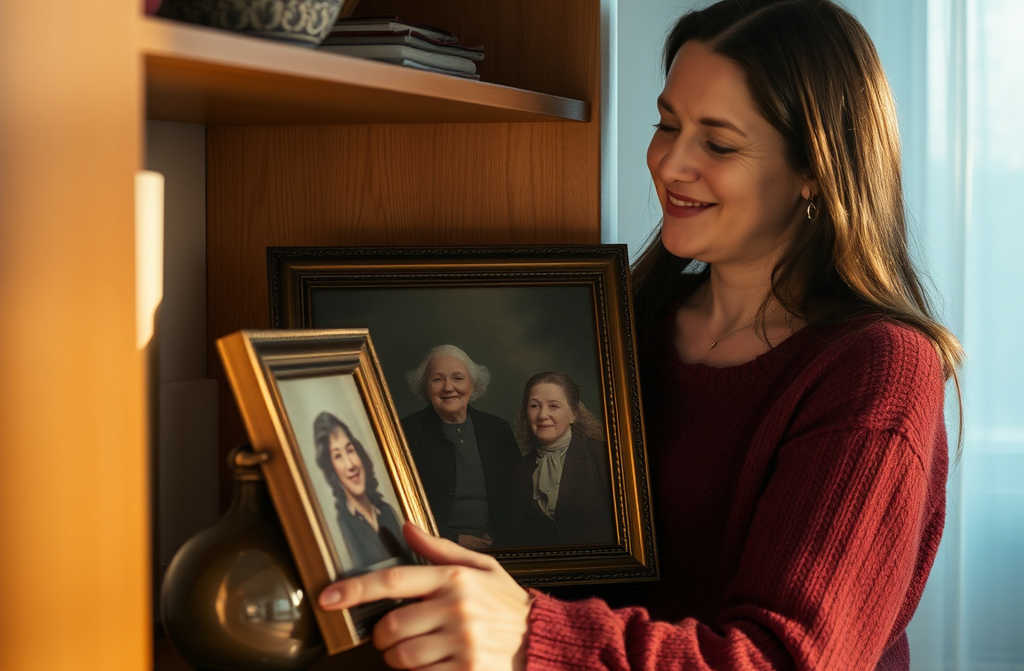
Among the notebooks and postcards she discovered a small wooden frame holding a photograph. The glass was a little clouded, but the faces were clear. Grandmother Lydia, perhaps thirtysomething, stood in a park. Her hair was tied back, she wore a lightpatterned dress. Beside her, a man in a uniform, no cap, dark hair, stared toward the camera while Lydia gazed at him. There was something in her eyes she had never seen in any other picture.
She turned the frame over. Faded ink read, Lydia and Colin. 1947. Beneath it a scrawl of illegible letters, as if someone had started to add more and then stopped.
Aunt Nora, who are they? Poppy asked, holding up the frame.
Nora glanced, then froze for a heartbeat, as if her breath had been caught.
Oh, just old stuff, she said hastily, turning away. Put it with the rest.
But Grandmother and this Colin. Ive never heard of him.
People take all sorts of photos, Nora waved off. Well sort it later. Look at the albums down there, dont mix them with the magazines.
Her tone was too rushed. Curiosity pricked at Poppy. She examined the mans face again. He was unfamiliar, yet the intensity of Lydias stare held her captive.
The rest of the day they spent sorting through boxes. By evening Poppy carried a box of photographs and letters home, saying she would organize them later. Nora simply shrugged.
Back in her flat, she set the box on the table and stared at it. Mark texted that he couldnt come overurgent deadline. She replied okay and muted his chat.
The flat filled with the rustle of paper as she sifted through the images: Lydia as a teenager in school uniform, Poppys mother as a child in a knitted hat, a summer garden table with strangers. The photo of the uniformed man lay slightly apart, propped against the wall.
Poppy caught herself repeatedly glancing at it. Finally she placed the frame in front of her.
Lydia and Colin. 1947.
The family always said Grandmother Lydia married her husband Victor in the late forties. War stories were vague, limited to generic phrases. Victor died when their mother was five. Poppy had never heard of any other man in Lydias life.
She snapped a couple of pictures of the frame with her phone to show her mother later, then set it aside. Sleep would not come; questions churned in her mind.
The next day she visited her mother, who lived two bus stops from the tube in a twobedroom flat with a balcony cluttered with flower pots.
So, did you finish? her mother asked, placing tea and biscuits on the table. Did Nora complain?
Nora was a bit irritable, but its fine, Poppy replied, pulling the photograph from her bag. Mum, do you know who this is?
Her mother squinted at the frame, her expression flickering before settling back into its usual mask.
Its your Grandmother. Dont you recognise her?
And the man?
What man? her mother pretended to study the background. Oh, that one. I dont recall. Everyone was getting photographed back then.
It says Lydia and Colin. You never mentioned him.
Her mother set the frame down, took a sip of tea.
People had their own lives back then. I had my youth, my friends. Whats the point of digging it up now?
Why does it matter to you? her mothers voice hardened. Hes gone, Im gone. Why rummage through the past?
Poppy felt stubbornness rise.
Im just curious. I realised I know so little about Grandmother. She never talked about much.
Then perhaps its best left alone, her mother snapped. Some things are better forgotten.
She rose to make more tea, and the conversation died.
Later, back in her flat, Poppy enlarged the back of the photograph on her phone. Below Lydia and Colin 1947 a faint, almost invisible June appeared, but nothing more.
Days passed with work as usual, but the image of the uniformed man haunted her. During breaks she found herself pulling up the picture on her phone, trying to guess his character.
Mark kept suggesting meetings, but always had an excusetraining, a coffee with friends, a sudden code push. Poppy kept postponing, each time feeling a little more drained.
One evening, while sifting through another album, she found a picture of Lydia with friends in front of a sign that read Railway Workers Hall. The caption: Kensington, 1949. It suggested that after the war Lydia had lived there for a while.
She opened her laptop and typed Kensington postwar history into a search engine. A local history forum mentioned casualty lists and missing soldiers. If Colin had been a soldier, his name might appear on those listsif only she knew his surname.
The weekend she called Aunt Nora.
Aunt Nora, did Grandmother live in Kensington after the war? she asked.
Yes, they were evacuated there for a while, Nora replied. Whats up?
Do you remember Colin, the man in the photograph?
There was a pause.
You keep bringing up that Colin, Nora sighed. Listen, Poppy, leave it alone. The war brought and took a lot of people. Things happened.
But you must know something.
I know, but I dont want to talk about it. It hurts. And Mum wouldnt like us dredging up her past.
Im not trying to blame anyone, Poppy said quietly. I just want to understand who she was, not just the old lady I remember.
Another pause, then Nora spoke softly.
Fine. Come over on Sunday. Just you, no Mum. Well talk.
The whole week Poppy walked on pins and needles. At work she mechanically corrected copy, and at night she kept hunting through letters, hoping for a mention of Colin. Most envelopes contained postcards from friends or rare letters from Victor.
On Thursday Mark said he wanted to take a cheap holiday package for two weeks in August.
Sounds good, Poppy replied. What then?
What then? he asked, confused.
Well go, relax. And after?
He fell silent.
Then autumn will comeprojects, work, life, he finally said. Well see.
A familiar irritation rose in Poppy.
Alright, well talk later, she said, ending the call with a vague excuse.
Sunday arrived. Noras brick house sat near a park, the kitchen scented with fried onions and laundry. Deerpatterned rugs hung on the walls, alongside photos of children and grandchildren.
Come in, Nora said, adjusting her glasses. Tea?
Thanks, Poppy said, taking a seat.
So you want to know about Colin, Nora began without preamble. Listen carefully, then keep it from your mother. She lived through it her own way.
Poppys throat dried.
Your mother was born here in London, Nora continued. Before that, she and Grandmother lived in Kensington. Lydia ended up there during the evacuation. She met Colin there. He was a lieutenant, wounded, convalescing in a field hospital. Later he was assigned to a guard detail.
She sipped tea, then lowered her voice.
They loved each other, Nora whispered. I was little, but I remember him bringing chocolatesomething rare back then. Lydia laughed with him. I never saw her smile like that again.
Why didnt he become my grandfather? Poppy asked, feeling the weight of the question.
Because he was taken, Nora said, looking out the window. In 47 there were checks, background sweeps. His brother had been captured as a prisoner of war, which was a stigma. They called him in, he left and never returned. Lydia wrote petitions, got vague answerstransferred here, then there. Eventually the letters stopped.
Was he arrested?
Probably. Many who returned from the front were vanished, especially if they had family in captivity. We never got a clear answer. His letters stopped.
Did Grandmother wait for him?
At first, yes. A year, then two. Then they told her not to keep looking, that it could be dangerous. She was already raising us aloneher own father had died in the war. She was urged to marry someone reliable.
Victor?
Victor worked at the mill, was a party member. Decent bloke, didnt drink, never hurt us. But he never loved Lydia the way Colin did. You could see it. They lived properly, but without that fire.
Nora sighed.
Your mother was born a year after Lydia and Victors wedding. The house tried to keep Colins memory hidden. Lydia kept his photograph in a distant box, probably the one you found in the frame.
Did Mum know?
She stumbled on his letters as a teenager. Lydia yelled, called it old nonsense. But the girl sensed there was another love, another loss, not of her own making. It shaped her.
Poppy felt a lump rise in her throat, a mixture of pity for all three women and the unknown soldier.
Why does Mum react so sharply? Poppy asked. Its been decades.
Because she lived her whole life feeling her father wasnt the man her mother loved most, Nora said, her voice turning hoarse. She thinks, If I hadnt been there, Mum might have waited for Colin. Children think that way. It stayed with her, so she clings to the right family, the proper life. Any reminder of Colin is a knife.
Poppy recalled her mothers constant mantra: Family first, dont chase fantasies, live quietly. Those words now sounded like a warning.
Did Grandmother regret? Poppy whispered.
Who can say? She never spoke directly. Sometimes, when she thought I wasnt looking, shed pull a letter from the box and read it. Her face was… alive, sad. She loved, she feared, she endured. People then feared a lot.
Silence fell. A car passed outside, the kitchen clock ticked.
Dont be angry with Mum, Nora finally said. Shes doing the best she knows. Youve uncovered something, and thats good. Maybe you can see the whole picture now.
Walking home, Poppy avoided the tube, preferring to stroll along the river. The citys hum surrounded her, the voices of strangers and the occasional laugh from a bus stop. She thought of each persons truth, their fears, the choices forced upon them by a war they never chose.
That night Mark called.
Found any treasure in the archives? he joked.
I found a story, Poppy replied. Not a happy one.
She gave him a brief version, leaving out the raw edges. He listened in silence.
Sounds grim, he said finally. I wouldnt waste my energy on the past. Nothing changes.
Its not about changing, Poppy answered. Its about understanding why Mum is the way she is and why I am the way I am.
What do you mean?
She hesitated.
I keep putting decisions off, hoping things will sort themselves. Now I see Im living halfheartedly.
Well, dont wait forever, Mark laughed. Lifes long.
His laughter rang hollow, and Poppy felt a clear gulf open between themnot physical, but a chasm of unmet expectations. She wanted him to ask deeper questions, to notice her turmoil, but he seemed content to steer her away from it.
Lets meet tomorrow, she said. We need to talk.
Sounds ominous, he replied, trying to joke.
Just talk, she insisted.
He hung up, and the silence that followed felt heavier than his laughter had been.
That night she tossed and turned, the photograph of Lydia and Colin looping in her mind. Grandmothers love and fear, her mothers guarded perfection, her own lingering doubtsall tangled together.
The next morning Poppy went to a café near the station. The place was noisy, people chattered, soft music floated from the speakers. Mark arrived in his familiar sweater, set his phone on the table, and ordered a coffee.
So, whats this serious talk? he asked, leaning in.
Poppy met his eyes, the same ones she had grown accustomed to. She realized she could no longer picture herself ten years from now with him beside her. It wasnt that he was bad; it was that their relationship lacked the inner agreement she now craved.
Ive been thinking a lot about us, she began. It feels like were always halfway. You wont talk about the future, and I keep running from it. That cant go on.
You want to get married? Mark asked directly.
I want to know were heading the same way. That we share a plan, a desire. Right now it feels like were just passing time together.
He stared into his cup.
Im not ready for big steps, he admitted finally. My careers just taking off. I dont want a mortgage, a house. Im happy as I am.
And Im not happy either, Poppy said calmly. I dont want to wake up in five years and realize Ive just floated downstream.
He let out a breath.
So youre suggesting we break up?
The words landed like ordinary dialogue, yet Poppy felt her chest clamp. She knew this was the moment that would reshape her life, even if it lacked the drama of war and loss.
Yes, she said. I think its the honest thing.
He nodded, as if hed been waiting for it.
What a shame, he murmured. But youre right. I cant promise what I dont feel.
They lingered a little longer, sorting out who would take what. The conversation was oddly calm. When they stepped outside, Mark gave her an awkward hug, whispered take care, and disappeared into the rush of the underground.
Poppy stood on the pavement, watching him go. An emptiness settled in, but also a lightness she hadnt felt in years.
That evening she drove to her mothers flat. Her mother met her at the door in a bathrobe, hair wrapped in a towel.
Whats wrong with you? her mother asked, eyes searching.
I broke up with Mark, Poppy said simply.
Her mother flapped her hands.
Why are you all like that, young people always wanting everything straight away? What if it had worked out?
We see the future differentlyShe stared at the empty kitchen, feeling the weight of generations lift as she finally chose her own path.



A VISIT TO MY SON…
Mother, you really shouldnt bother making the trip now, my son Alex said, his voice flat over the phone. Its...


The Man in the Photograph
When Poppy turned thirty, the world around her seemed to stretch into a single, endless pause. By day she sat...


The House on the Outskirts
Hey love, pull up a chair and let me tell you about the night we spent in that old cottage...


My Husband Decided to Send Our Son to the Countryside to Stay with His Mum, Against My Wishes
Dear Diary, Simon decided, without consulting me, to send our nineyearold son Harry to his mothers cottage in Ashwick, a...


I Welcomed My Friend After Her Divorce, But Over Time I Realised I Was Slowly Becoming a Servant in My Own Home
I took my friend in after her divorce. Over time I realized I was slowly turning into a servant in...


The Indispensable One
The first time Elizabeth Hart saw Andrew Bennett at work, he had just turned up for an interview in the...


They Stole My Clothes, Cowboy! ‘Save Me!’ Pleaded the Apache Woman by the Lake!
Someone stole my clothes, cowboy! Help me! a woman wailed by the pond. A battered threewheeler clattered to a stop...


The Handwriting of History
Morning started just the way it always did. Andrew Sinclair woke up a minute before his alarm, like hed been...