
З життя
The Manor Smelled of French Perfume and Lovelessness. Little Lizzie Knew Only One Pair of Warm Hands—Those of the Housekeeper, Nora. But One Day Money Disappeared from the Safe, and Those Hands Were Gone Forever. Twenty Years Passed. Now Lizzie Stands on a Doorstep, Her Child in Her Arms and a Truth Burning in Her Throat… *** The Dough Smelled Like Home. Not the home with a marble staircase and three-tiered crystal chandelier where Lizzie grew up, but a real home—the kind she invented for herself, sitting on a kitchen stool, watching Nora’s hands, red from washing, knead springy dough. “Mum, why is dough alive?” she would ask at five years old. “Because it breathes,” Nora replied without looking up. “See how it bubbles? It’s happy—it knows it’ll soon be in the oven. Strange, isn’t it? To rejoice at fire.” Lizzie didn’t understand then. Now—she got it. She stood by the side of a battered country lane, clutching four-year-old Micky to her chest. The bus had spat them out into the grey February dusk; all around, just silence—the singular village quiet where you can hear snow creak under a stranger’s boots three houses away. Micky didn’t cry. He had almost stopped crying altogether in the last six months—he’d learned. He just looked at her with dark, uncannily grave eyes, and every time Lizzie flinched: her ex’s eyes. His chin. His silences—the kind that always hid something. Don’t think of him. Not now. “Mum, I’m cold.” “I know, sweetheart. We’ll find it soon.” She didn’t know the address. Didn’t even know if Nora was alive—twenty years had passed, a lifetime. All she remembered: “Pinewood, Oxfordshire.” And the scent of dough. The warmth of those hands—the only ones in that whole big house that ever stroked her hair just because. The lane led them past tilting fences; in some windows, lights glowed—dull yellow, but alive. Lizzie stopped at the last cottage, simply because her legs would go no further and Micky had grown too heavy. The gate creaked. Two snow-covered steps up to the porch. A weathered, peeling door. She knocked. Silence. Then—shuffling footsteps. The sound of a bolt dragging. And a voice—hoarse, aged, yet so unmistakable that Lizzie’s breath caught— “Who’s out in this darkness?” The door swung open. On the threshold was a tiny old lady in a knitted cardigan over her nightie. Her face—like a baked apple, a thousand wrinkles. But the eyes—the same. Faded, blue, still full of life. “Nora…” The old woman froze. Then slowly lifted the very same hand—knotted and work-worn—and touched Lizzie’s cheek. “Merciful heavens… Lissie?” Lizzie’s knees buckled. She stood there, clutching her son, unable to speak, tears streaming hot down her frozen cheeks. Nora asked nothing. Not “where from?” Not “why?” Not “what’s happened?” She simply unhooked her old wool coat and threw it round Lizzie’s shoulders. Then gently lifted Micky—he didn’t even flinch, only watched with those solemn eyes—and pulled him close. “Well, you’re home now, my darling,” Nora said. “Come in. Come in, love.” *** Twenty years. It’s enough time to build an empire and lose it. To forget your native tongue. To bury your parents—though Lizzie’s were still alive, just as distant as hired furniture. As a child, she thought their house was the whole world. Four storeys of happiness: a lounge with a fireplace, her father’s wood-panelled study, which smelled of cigars and sternness, her mother’s plush bedroom with velvet drapes, and—down in the basement—the kitchen. Nora’s kingdom. “Lizzie, don’t be in here,” nannies and tutors would chide. “You should be upstairs, with Mummy.” But Mummy was always on the phone. Always. With friends, with business partners, with lovers—Lizzie didn’t understand, but she sensed: something was wrong. Something not right in the way her mother laughed into the phone and how her face changed when Dad walked in. But in the kitchen, things were right. Nora taught her to pinch pierogis—crooked, lumpy, ragged seams. They watched the dough rise together—“Hush, Lizzie, don’t make a sound or you’ll upset it.” When shouts started upstairs, Nora would sit her on her knee and sing—something simple, wordless, just a melody. “Nora, are you my mother?” she once asked at six. “Of course not, miss. I’m just the help.” “Then why do I love you more than Mummy?” Nora fell silent, stroking Lizzie’s hair. Then she whispered, “Love doesn’t ask, see. It just comes, and that’s it. You love your mum, too—just different.” But Lizzie didn’t. She knew it, even then—with a child’s forbidden clarity. Mum was beautiful, Mum was important, Mum bought her dresses and took her to Paris. But Mum never sat up when Lizzie was ill. That was Nora—nights on end, her cool hand on Lizzie’s brow. Then came that night. *** “Eighty thousand,” Lizzie overheard from behind a half-closed door. “From the safe. I know I put it there.” “Maybe you spent it and forgot?” “Edward!” Her father’s voice was tired, flat, like everything about him in those years. “All right, all right. Who had access?” “Nora cleaned the study. She knows the code—I told her to dust.” A pause. Lizzie pressed herself to the wall, feeling something vital tear inside. “Her mother has cancer,” Dad said. “Treatment’s expensive. She asked for an advance last month.” “I didn’t give it.” “Why?” “Because she’s staff, Edward. If staff gets handouts for every mum, dad, brother—” “Harriet.” “What, Harriet? You can see for yourself. She needed the money. She had access—” “We don’t know for sure.” “Do you want the police? A scandal? For everyone to know we have thieves in our house?” More silence. Lizzie closed her eyes. She was nine—old enough to understand, too young to change a thing. Next morning, Nora packed her things. Lizzie watched from behind a door—a small girl in teddy bear pyjamas, barefoot on the cold floor. Nora folded her few possessions: a robe, slippers, a worn Saint Nicholas icon from her bedside. “Nora…” Nora turned. Calm face, just puffy, reddened eyes. “Lissie. Why aren’t you asleep?” “You’re leaving?” “I am, love. To my mother—she’s not well.” “What about me?” Nora knelt—so their eyes were level. She always smelled of dough—even when she hadn’t baked. “You’ll grow up, Lizzie. Grow into a good person. Maybe one day you’ll visit me in Pinewood. Remember?” “Pinewood.” “Good girl.” She kissed Lizzie’s forehead—quick, secretive—and left. The door closed. The lock clicked. That smell—the dough, the warmth, home—vanished forever. *** The cottage was tiny. One room, a stove in the corner, a table with an oilcloth, two beds behind a faded floral curtain. On the wall, that familiar Saint Nicholas icon, blackened by time and candle smoke. Nora bustled—putting the kettle on, fetching jam from the larder, making up the bed for Micky. “Sit, sit, Lissie. There’s no truth in tired feet. Warm up, we’ll talk after.” But Lizzie couldn’t sit. She stood in this poor, shabby hut—she, whose parents once owned a four-storey mansion—and felt something strange. Peace. For the first time in years—real, solid peace. As if something pulled tight within her had finally gone slack. “Nora,” she managed, voice cracking, “Nora, I’m sorry.” “For what, love?” “For not protecting you. For saying nothing for all these years. For…” She faltered. How to say it? How to explain? Micky was already asleep—gone the instant his head hit the pillow. Nora sat opposite her, tea cup in gnarled hands, waiting. So Lizzie told her. How after Nora left, the house became utterly foreign. Her parents divorced two years later—her father’s empire was a house of cards, lost in the crash, their flat, their cars, their country cottage vanished. Her mother fled to Germany with a new husband; her father drank himself to death in a bedsit when Lizzie was twenty-three. She was all alone. “Then there was Tom,” she said, staring at the table. “We knew each other since school. He used to visit us—you remember? Skinny, messy, always stealing sweets from the bowl.” Nora nodded. “I thought—this is it. Family, at last. Mine. But… he was a gambler, Nora. Cards, slots, you name it. I never knew. He hid it. By the time I found out—it was too late. Debts. Lenders. Micky…” She trailed off. Logs crackled in the stove. The candle-mote flickered against the icon, its shadow trembling up the wall. “When I said I was filing for divorce, he… he thought a confession would save him. That I’d forgive. Appreciate his honesty.” “Confess what, love?” Lizzie met her eyes. “He took the money. All those years ago. From the safe. Saw the code—peeked when visiting. He needed… I can’t even remember why. But yes—for his debts. And you were blamed.” Silence. Nora sat motionless. Her face unreadable. Only her hands around the mug whitened at the knuckles. “Nora, I’m sorry. I only found out last week. I didn’t know, I—” “Hush now.” Nora got up, slowly knelt—creaking with age—as she had twenty years before, meeting Lizzie eye to eye. “My darling. What are you guilty of?” “But your mother… You needed money for her treatment—” “She passed a year later, poor soul.” Nora crossed herself. “What of it? I live. Veg patch, goats. Good neighbours. I never needed much.” “They shoved you out—like a thief!” “Doesn’t life sometimes take us to the truth through a lie?” Nora whispered. “If I’d stayed, I’d have missed my mother’s last year. Being with her then—that was worth everything.” Lizzie was quiet. Her chest burned—shame, sorrow, relief, gratitude—all in a tangle. “I was angry,” said Nora. “Of course I was. I’d never so much as scuffed a penny in my life. Yet there I was—a common thief. But after a while… the anger faded. Not right away. Took years. But it did. Because if you carry bitterness, it eats you alive. I wanted to live.” She took Lizzie’s hands—cold, rough, knotted. “And here you are now. With your boy. At my old door. That means you remembered. Means you loved. And that’s worth more than any safeful of cash.” Lizzie cried. Not like adults do—quietly, to themselves. Like children. Sobbing, face pressed to Nora’s thin shoulder. *** In the morning, Lizzie woke to a smell. Dough. She opened her eyes. Micky snored beside her on the pillow. Behind the curtain, Nora clattered softly. “Nora?” “You’re up, sweetheart? Come, the pies will go cold.” Pies. Lizzie got up and, dream-like, stepped into the kitchen. On yesterday’s newspaper sat a tray of golden, misshapen pies, crimped at the edges just like when she was small. And they smelled—like home. “I was thinking,” said Nora, pouring tea into a chipped mug, “they need help at the village library. Pays little, but you don’t need much here. We’ll get Micky into nursery—Val’s in charge, she’s lovely. After that—we’ll see.” She said this so simply, as though everything was settled, everything perfectly natural. “Nora,” Lizzie faltered, “I’m… I’m nobody to you. All these years. Why did you—?” “Why what?” “Why take me in? No questions? Just like that?” Nora looked at her—that same childhood gaze. Clear, wise, kind. “Remember asking why dough is alive?” “Because it breathes.” “Exactly, love. And so does love. You can’t fire it, can’t dismiss it. If it settles in, it stays. Twenty years, thirty—you only have to wait.” She set a pie before Lizzie—warm, soft, filled with apple. “Come on. You’re skin and bone, dear.” Lizzie took a bite. For the first time in years—she smiled. The sky lightened. Snow shimmered under the first rays, and the world—vast, unfair, complicated—seemed briefly simple and kind. Like Nora’s pies. Like her hands. Like the quiet, steadfast love that cannot be sacked. Micky tumbled out, rubbing his eyes. “Mum, it smells yummy.” “Grandma Nora baked for us.” “Grand-ma?” He mouthed the word, studying Nora. She smiled—crinkles scattering, her eyes lighting up. “That’s right, love. Come eat.” And he joined them. For the first time in months, he laughed—when Nora showed him how to shape silly dough men. Lizzie watched—her son and the woman she once called mother—and understood: here was home. Not walls, marble, chandeliers. Just warm hands. Just the smell of dough. Just love—plain, earthy, unspoken. Love that can’t be bought or sold, that just is—while ever a single heart still beats. Funny thing, the memory of the heart. We forget dates, faces, whole eras, yet the aroma of mum’s pies lingers to our last breath. Maybe because love doesn’t live in the mind. It’s somewhere deeper, where neither hurt nor years can reach it. And sometimes you have to lose everything—status, money, pride—just to remember the way home. To the hands that wait.

The manor always smelled of French perfumeand something colder than loneliness. Little Emily knew only one truly loving pair of hands: the hands of their housekeeper, Mrs. Nora Quinn. But one day, money went missing from the safe and those hands vanished forever. Twenty years have passed. Now Emily stands at the doorstep herselfher child in her arms, and a harsh truth in her throat too painful to swallow
***
The scent of dough meant home.
Not the home with marble staircases and three tiers of shimmering crystal chandeliers, the one Emily grew up in. No; a real home, the one she imagined on chilly mornings, perched on a kitchen stool, watching Noras red, water-roughened hands knead the warm mass.
Why is dough alive? five-year-old Emily would ask.
Because it breathes, Nora answered, never slowing. See the bubbles? Its happyit knows its heading to the oven soon. Funny, isnt it? Being happy for the fire.
Emily hadnt understood back then. Now, she does.
She stands at the edge of a winding country lane, holding tightly to four-year-old Michael. The bus is already trundling away, leaving them in the cold violet twilight of a February evening; everywhere around is silentthe deep kind of countryside quiet where you can hear the snow creak under footsteps three gardens away.
Michael doesnt cry; he hardly does anymorehes learnt not to. He simply looks up with those dark, thoughtful eyes and every time, Emily flinches: his fathers eyes. His chin. That stubborn silence behind which things always hid.
Dont think of him. Not now.
Mum, Im cold.
I know, sweetheart. Well find it soon.
She didnt know an address. Not even whether Nora still livedtwenty years was so very long. All she remembered: Little Barton village, Berkshire. And the smell of bread rising, the warmth of the one pair of hands in the enormous house that smoothed her hair for no reason, just because.
The lane leads her past crooked old fences, beneath golden, flickering windowswarm and alive. Emily stops at the last cottage, only because her legs cant carry her farther and Michael is getting heavy.
The gate creaks. Two steps, thick with snow. The front doorswollen and cracked, its paint flaking away.
She knocks.
Silence.
Thenshuffling steps, the clang of a latch drawn back. A voicehoarse, older, but shockingly familiar. Emilys breath hitches.
Whos here in this dark hour?
The door opens.
On the threshold stands a tiny old woman in a cardigan over her nightdress. Her face is like a baked apple, lined by a thousand wrinklesbut her eyes are the same. Faded, blue, alive still.
Nora
The old woman freezes. Then lifts that same workers hand, gnarled with time, and touches Emilys cheek.
Good heavens Emily?
Emilys knees threaten to give. She stands clutching her son, speechless, only tears pouring hot across frozen cheeks.
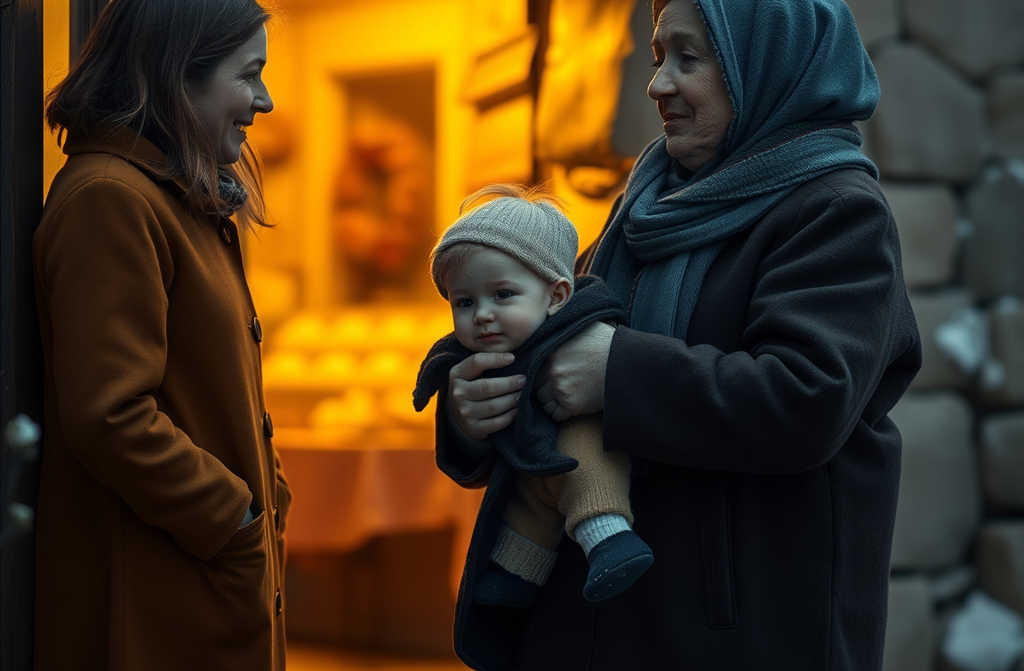
Nora asks nothing. Not where from? or why? or what happened? Instead, she simply lifts her battered coat from the peg and drapes it around Emilys shoulders before gently taking Michaelhe doesnt flinch, only studies her with sombre eyesand drawing him close.
Well, petal, youre home now, Nora says, soft and clear. Come in. Come in, my dear.
***
Twenty years.
Thats long enough to build an empireand watch it crumble. To forget your native tongue. To bury your parentsalthough Emilys were still alive, in name alonestrange now, like the furniture in rented rooms.
As a child, shed thought their house was the entire world. Four floors of happiness: the drawing room with its fireplace, her fathers study with its haze of tobacco and tight-lipped order; her mothers grand bedroom, velvet drapes drawn tight. Anddown in the half-basementThe kitchen. Her domain. Noras kingdom.
Emily, not in here, the nannies and tutors would chide. You belong upstairs, with your mother.
But her mum was always upstairs, glued to a phone. Always. With her friends, or partners, or loversEmily hadnt understood, but she knew: something was wrong. The way her mum giggled down the line, then her face went flat as soon as Dad entered.
But in the kitcheneverything felt right. Thats where Nora let her clumsily pinch and fold pastry. Thats where theyd watch the dough swellHush, Emi, dont scare it or itll flatten right down. When shouting started upstairs, Nora would scoop her onto her lap and hum some old countryside tune, half words, mostly music.
Nora, are you my mummy? Six-year-old Emily had asked, once.
My lady, what are you saying? Im just the help.
But why do I love you more than my mum?
Nora said nothing at first, just stroked Emilys hair. At last, she whispered, Love never waits for permission. It simply arrives. You love your mother too, darling, just differently.
Emily knew that wasnt true. Even back then. Her mother was beautiful, important, bought her dresses and whirled her to Paris. But her mother was never there, not when Emily was ill. That was always Norasitting through long nights, cool palm on forehead.
And then there was that night.
***
Eighty thousand pounds, Emily heard through a door left ajar. From the safe. I know exactly how much I put there.
Maybe you spent it and forgot? her fathers voice, weary, sounded as faded as everything else about him.
Richard!
Fathers sigh. Fine, fine. Who had access?
Nora was cleaning in the study. She knows the codeI had to give it to her, so she could dust.
A pause. Emily stands in the corridor, pressed to the wall, feeling something important splinter inside her.
Her mothers got cancer, said her dad. Treatment costs a fortune. She asked for an advance last month.
I refused.
Why?
Because shes staff, Richard! If you give to every servant for their mother, their brother
Margaret.
What? You see the truth. She needed the money, she had access
We dont know for certain.
What would you have? The police? A scandal? Everyone knowing their things are stolen in our house?
Silence again. Emily closed her eyes. She was nineold enough to understand, too young to change anything.
In the morning, Nora was packing her things.
Emily peered from behind the doorsmall, in bear-print pyjamas, barefoot on cold flagstones. Nora packed her meagre belongings into a battered holdall: a dressing gown, slippers, the small wooden icon that always sat on her bedside stool.
Nora
She turned, face calm, only the red, puffy eyes betraying her.
Emily. Why arent you sleeping, love?
Youre leaving?
I am, darling. I must. My mums not well.
But what about me?
Nora knelt down, eyes level with her own. Even when she didnt bake, she always seemed to smell of bread.
Youll grow up, Emily. Youll be a good person. Maybe, someday, youll even come visit mein Little Barton. Can you remember that?
Little Barton.
Good girl.
She kissed Emily on the foreheadquickly, almost guiltilyand was gone.
The door shut. The key clicked. The smellof dough, and warmth, and homewas gone for good.
***
The cottage was tiny.
Single room, a stove in the corner, a table draped with a plastic cloth, two beds behind a chintz curtain. On the wallthe same little wooden icon, stranger and dimmed by time.
Nora fussesfills the kettle, brings up a jar of jam from the cellar, tucks Michael into bed.
Sit down, Emily, do, theres no sense in standing. Youll feel better once youre warm.
But Emily cannot sit. She stands in the tight disorder of this poor old cottagethe daughter of people who once owned a four-storey manorand feels something unexpected,
Peace.
For the first time in yearsreal peace. As if something inside, stretched painfully taut, at last slackens.
Nora, she says, choking a bit. Nora, Im sorry.
What for, love?
For not standing up for you. For being silent for twenty years. For
She trails off. How to say it? How to explain?
Michael is already asleepout like a light the moment his head touched the pillow. Nora sits across from her, clutching a mug of tea patiently.
And Emily tells her.
How after Noras departure the house felt totally alien. How her parents divorced two years later, once her fathers business collapsed in the crash, taking their flat, cars, and their holiday home. How her mum married someone else and moved to Germany, and her father drank himself to death in a rented one-bedroom when Emily was twenty-three. How, somehow, Emily ended up alone.
Then came Sam, she admits, avoiding Noras eyes. We knew each other since schoolthe skinny one, always snatching chocolates from our dish. Remember?
Nora nods gently.
I remember the lad.
I thoughtat last. A family. A real one, of my own. Emily laughs, bitterly. How wrong I was He was a gambler, Nora. Cards, fruit machines, anything. I never knew, he hid it so well. By the time I found outtoo late. The debts. The creditors. And Michael
She falls silent. The logs in the stove crackle. The lamp before the icon flickers and throws trembling shadows.
When I told him I was filing for divorce, he Emily swallows. He thought a confession might stop me. That Id forgive. That Id see it as some kind of honesty.
Confess what, love?
Emily looks up.
It was him. All those years ago. The money from the safe. He watched you key the numbers one afternoon, when he visited. He needed it forwell his betting. They blamed you.
Silence.
Nora sits utterly motionless, face unreadable. But the knuckles strangling her mug are white now.
I only found out last week, Nora. I swear. I didnt know. Please
Shh.
Nora stands slowly. She kneelsjust as she did all that time ago, painfully, her bones protestingto meet Emilys eye.
My child. You did nothing wrong.
But your mum You needed money for her
Mum passed away the following year. God rest her. And me? Im still here. Veg garden, a goat, kind neighbours. I dont need much.
But they threw you out! Like a thief!
Nora speaks almost in a whisper, Sometimes, God uses a lie to lead us to the truth. If they hadn’t sent me awaymaybe Id never have seen mum again. As it was, I had a whole year by her side. The most important year of all.
Emily says nothing. Everything insidegrief, guilt, love, gratitudeburns together in her chest.
Was I angry? Nora says. Oh, I was furious, no denying. Id never touched a penny in my life, and to be sent away like a criminal hurt dreadfully. But in time you let go. Not at once, no. It took years. But you let go. If you keep turning over anger inside, it only eats away at you. I wanted to live.
She takes Emilys hands between her owncold and tough as wood, knotted with age.
Youre here now, with your boy, in this old wreck. That means you remembered. That means you still loved me. And you know what thats worth? Thats worth more than any sum you could ever lock in a safe.
Emily weepsnot as grown-ups do, quietly, with dignity, but as she did in childhoodnoisy, breathless sobs, buried in Noras narrow shoulder.
***
Emily wakes to the scent of dough.
Michael snoozes next to her, limbs tossed across the pillow. Behind the chintz curtain, Nora bustles, sheets rustling, kettle whistling.
Nora?
Awake at last? Come on up, petpies are cooling!
Pies.
Emily rises, still half-dreaming, and walks beyond the curtain. There they are on the table, resting atop yesterdays newspapergolden, uneven, pinched at the seams, just like childhood. And they smell they smell like home.
I was thinking, Nora says, filling a battered mug with tea, the library up in the next town is looking for another assistant. Not much pay, but itll do out here. And Michael can start nurseryMrs. Valentine runs it, a lovely soul. Well see what happens from there.
She says it with such ease, as if everything is already decided, as if this is the most natural thing in the world.
Nora Emily falters. Im Im no one to you. So many years, and yetwhy did you
Why did I what?
Why did you take me in? No questions. Just just like that?
Nora looks at her that way she did in childhood: eyes clear, wise, endlessly kind.
Do you remember, you asked me once why dough is alive?
Because it breathes.
Thats right. And loves much the sameit breathes all on its own. You can sack a servant, but never dismiss love. Once it finds a home, it never leaves. Wait twenty years, thirtyyoull see.
She lays a warm apple pie before Emily.
Eat up, love. Thin as a rail, you are.
Emily takes a biteand for the first time in years, she smiles.
Outside, dawn is breaking. The snow sparkles as sunlight touches it, and for a blinding moment, the worldwide and unfair and hardfeels soft and gentle. Like Noras pies. Like her hands. Like the kind of love you couldnt ever sack.
Michael tumbles out from behind the curtain, rubbing his eyes.
Mum, it smells nice.
Thats Grandma Noras baking.
Grand ma? He tries the word on his tongue. Looks up at Nora. She beams at himwrinkles deep, eyes aglow.
Thats right, grandson. Come here and sit down. Well eat together.
And he does. And he eats. And for the first time in six months, he laughswhen Nora teaches him how to shape little dough people with his hands.
And Emily watches themher son and the woman she once believed her true motherand knows: this is home. Not brickwork, not marble, not chandeliers. Just warm hands. Just the scent of pastry. Just a kind of everyday, unassuming love.
A love that isnt bought or sold. That just endureswhile any heart is left to beat.
Its a strange thing, the memory of the heart. We forget dates, faces, even whole years, but the scent of a mothers baking lingers until our last breath. Maybe its because love doesn’t live in the head at all, but somewhere deeper, untouched by grudges or time. And perhaps, sometimes, you have to lose everythingposition, money, prideto remember the way home. Back to the hands that waited.



Wealthy Businessman Witnesses a Mother Pretending to Be Full While Sharing a Burger With Her Children—Ten Years Later, Their Lives Are Forever Changed
One afternoon, a wealthy English businessman finds himself witnessing an unforgettable scene. In a modest fast food spot on the...


My Daughter-in-Law Won’t Let Me See My Grandchild Unless I Bring Money, and My Son Doesn’t Say a Word
My son isnt divorcedhe lives with his girlfriendbut he hasnt a whisper of a say in anything. Each time I...


When I Retired, I Moved from a Three-Bedroom Flat to a Studio: Not Once Have I Regretted My Decision
When I retired, I found myself rattling around in a large two-bedroom flat all on my own. Loads of pensioners...


“I’m Not Your Free Canteen!” exclaimed Mum as she greeted her children at the door
Im not your free café! Thats what Mum said as she greeted us on the doorstep. Margaret Bennett had finally...


Helena Was Warned That He Was Harsh and Unyielding and That She Should Stay Away From Him—But She Had a Clever Plan in Mind
Richard is a forty-year-old man who has never been married. Several years back, he was the envy of all the...


Yes, the flat may be small, but we will still buy your cousin a bed.
Honestly, anyone who works full-time will totally get this feeling: that moment when the doorbell goes off on your one...


At a Certain Point, a Woman Reached the Limit Where Her Husband’s Behaviour Became Too Painful, and She Spoke Honestly to Him About It—He Was Completely Taken Aback
Rebecca was late for work that day, though David scarcely seemed to noticefor he always carried himself as if the...


The Father-in-Law Deliberately Tested His Son-in-Law to See If He Was a Worthy Husband for His Daughter
My friends always said that I was terribly unlucky with my wife, though even worse so with her parents. My...