
З життя
The Pancake Pan According to the clock, Galina was running late for work again, which meant another…

The Pancake Pan
Looking back, I marvel that I ever made it to work on time at all in those days. That particular morning, I, Margaret, was late by every clock in the houseone more infraction frowned upon by my punctual, stern manager. I had woken to a jumble of morning troubles. Young William, my son in year three, sat at the kitchen table, refusing his porridge and whining that his throat was sore. Donning my spectacles, I attempted to spy even the slightest redness, but finding none, threatened him with a spanking for his clever little deception, then hoisted his rucksack onto his back.
Meanwhile, my eldest, George, darted from room to room, searching frantically for his school diary, his constant shuffling making my head spin. With a sharp word for his scatterbrained habits, I grabbed Williams hand and hustled us both out to the front door. Even then, we were not away in a flashfor my husband, Arthur, was still fiddling about with washing the car. By the time our endless preparations were done and we turned onto the busy High Road, a miserable traffic jam all but crushed my hopes of arriving at the ticket office on the stroke of nine.
As I hurried toward my place of work at the railway ticket agency, the heel of my shoe slid on slick paving, and I nearly tumbled onto the filthy platform. It was only by grabbing hold of a great battered suitcase that I steadied myself and avoided a fall. Catching my breath, I offered an awkward apology as I returned the case to its elderly owner and entered the office. To my relief, my colleagues told me the manager hadnt yet arrived. I took a grateful gulp of water, sank into my chair, and got on with the mornings business.
Within half an hour, the whirl of ticket sales swept away my fluster. At lunchtime I gazed out the window and saw again the elderly woman with her enormous suitcase. Something fated clung to her; her face was hopeless and resigned. Her travel ticket trembled in her gnarled hand, fluttering in the chill wind like a dead leaf stubbornly hanging on. She seemed blind to the autumn gusts, lost in some stillness I recognised from old statues in churchyards.
How long has she been out there? I asked my desk-mate.
They say its her second day, she replied.
Do you know where her tickets to?
Oxford.
How odd, I mused, pouring tea from my thermos and snagging a slice of homemade cake as I slipped outside to the waiting woman. Surely there are trains to Oxford every day. Why hasnt she left? I offered her the cup and cake. You may not remember me, but your suitcase saved me from a nasty sprawl this morning. Where are you headed?
To Oxford, she replied evenly, sipping her tea.
I glanced at her ticket. But your train left two days ago. Why did you stay?
She adjusted her old felt hat, coughing a little, then spoke with a worn, hollow voice. Seems Im always underfoot. Dont worry, Ill move on in a moment. She set her half-drunk tea on the bench and made to rise, but I gently urged her back.
No, no, please! Sit where you wish. Its dreadfully cold and damp here, though
Believe me, my dear, I feel nothing. It all seems burned out, she murmured. She fished a faded handkerchief from her battered handbag and dabbed at tears that trickled from those pale eyes. The thing is, Ive nowhere to go. Its the typical story, really. Fell out with my sonor should I say, his wife. Shes a striking woman, but quarrelsome and shallow, and my son, besotted, took any suggestion as nagging. In the end, to please his wife, he bought me this ticket to my sister in Oxford, packed me up and dropped me at the station. Poor boy never realised my sister died three years ago, her house long since sold. I couldnt bring myself to tell him. Figured it was better this waylet them sort themselves out while I kept clear. Now here I sit, waiting forwell, perhaps shame to carry me off, or for some kind soul to find me and cart me off to a home. She smiled, fragile and grateful. Thank you, child. I hadnt realised how hungry Id become.
The sound of that wordchilddrew me back to my own orphaned childhood, aching with envy for the lucky, chosen children with new mothers and fathers. I, plain and ginger-haired, never caught anyones eye, and remained unwanted. After the childrens home, I was sent to apprentice at the wool mill and given a tiny room in a boarding house, where I stayed until I marriedthank the Lord, happily.
That gentle wordchildwarmed my cheeks with a tenderness I had never known, soaking into my heart and stoking a melody of compassion within.
Touching her tweed-clad shoulder, I said quietly, Please, dont leave this bench. When my shift ends, well go homeour hometogether. Its a big house, theres plenty of room. If you dislike it, you can always return. Agreed? I met her gaze and saw her chin trembling, tears running from red, grateful eyes.
Introductions took place in the car. Im Margaret, this is my husband Arthur, and our boys, George and William. What should we call you?
Just Granny Edith, she replied, as the cars heater thawed her out.
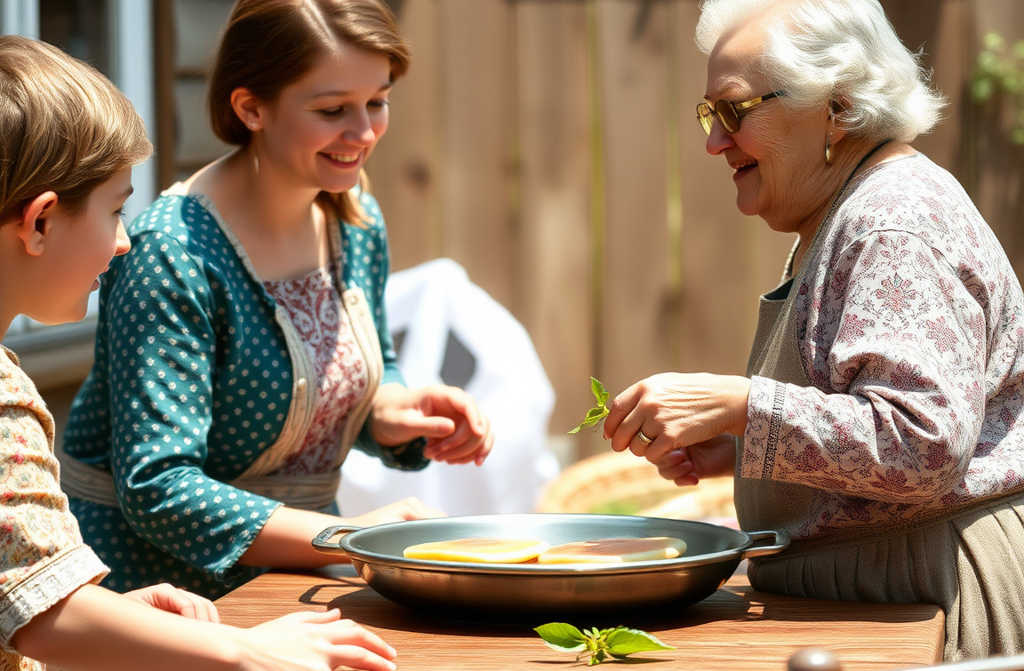
Next morning was a day off. I woke to the scent of something exquisite drifting in from the summer kitchen. Donning my housecoat, I found Granny Edith at the stove, deftly flipping a pile of golden, lace-edged pancakes, serving Arthur and the boys, who beamed with admiration. She grinned sheepishly at me. Dont be cross, dearie. I found a pan in the oven that never sticks, so I took over. Come, sit and taste my baking.
After the hearty breakfast, the whole family raked and burned fallen leaves, not forgetting to slip potatoes into the embers. I watched, amazed, as Edith joined in with tireless cheer, a rosy flush warming her cheeks as she hummed unfamiliar tunes.
Dont be surprised, love, she called. I can stand hard work. They used to call me Edith the Horse at the front, for dragging the wounded to safety, whatever their size, till I was wounded myself. Was sent back, married, had my son. Sadly, my husband never recoveredhis lungs gave out, and one spring he slipped away with the thaw. I raised my son alone, but I managed.
She grew quiet and then, shaking herself, seized the rake and returned to her humming.
Monday arrived and the usual mayhem resumed: Williams whining, Georges last-minute search for books, Arthur preparing the car. As I bustled out with the boys, I saw Edith standing at the door with her suitcase.
Thank you, dearie, youve kept me long enough. I mustnt overstay my welcome
Granny Edith! Didnt you enjoy staying with us?
I loved it, but surely nobody really wants a stranger under their roof.
Please, Granny Edith, stay! Who else will make pancakes like yours? Mine always come out wrongplease, stay. Youre one of us now
I whisked up her heavy suitcase, which felt lighter than a feather now, linked arms with Edith, and together we walked back inside.
As the rest of the family clambered into the car, Edith called cheerfully, Margaret, love! Be a dear and look out for another frying pan, would you? Its twice as easy cooking pancakes with two
She didnt hear as I quietly murmured, Certainly, Mum EdithLaughing, I nodded, a sudden brightness unfurling in my chest. That evening, the house was alive with lightricher laughter, the aroma of roasting apples, William and George squabbling over the last golden pancake as Edith winked across the table. Even Arthurusually so reservedsat back in his chair, smiling at the easy harmony among us.
As night pressed its velvet against the windowpanes, Edith sat beside me near the fire, mending a tear in Williams sleeve. “Funny thing about homes, Margaret,” she said softly, threading her needle, “theyre not built with bricks and boards but with kindness, shared bread, warm arms to land in when the world turns cold.”
I squeezed her hand, her skin paper-thin but sturdy as the oak at our back gate. In that small, busy room, the ache of old sorrows faded, replaced by something newa gentle belonging, golden as the circle of pancakes that had started it all.
And so, in that rambling house on the High Road, the days pressed forward, stitched together by work and play, grief and mending. Truths unspoken found their place at our table. Granny Edith remainedin the laughter at supper, the stories by the fire, the sweet scent of batter on a Sunday morningtill we could scarcely recall a life without her.
Downstairs, one pan always sat readyblack, well-loved, never sticking, waiting for the next mornings feast.



When Olga Stepped Into the Flat, She Paused: Next to Her and Ivan’s Shoes Stood an Expensive Pair of…
Entering the flat, Emily paused. By the doorway, neatly arranged beside hers and Davids shoes, stood a pair of high-heeled...


Natasha Never Imagined Her World Could Fall Apart: Her Husband, the Only Man She Had Ever Trusted, T…
Harriet could scarcely believe what was happening to her. Her husbandher own, her only, the man she thought was her...


The Taste of Freedom – We finished the renovations last autumn, – began Vera Ignatievna, recounting…
A Taste of Freedom We finished refurbishing last autumn, began Vera Bennett, settling into her favourite armchair with that air...


The Pancake Pan According to the clock, Galina was running late for work again, which meant another…
The Pancake Pan Looking back, I marvel that I ever made it to work on time at all in those...


Nine Red Roses… Her Mother Dropped In for a Few Hours, and He Knew He Couldn’t Take It: Said He…
Nine Red Roses The mother-in-law popped round for a few hours, and the son-in-law realised early on: he wasnt going...


The Cottage That Changed Everything: How Inheriting a Little Garden Plot Mended a Fractured Family a…
The Cottage, It Fixes Everything “You’ve lost your mind, haven’t you? I told Daphne you’d be coming! Arranged it so...
Homeless on the Streets of London
HOMELESSEmma has nowhere left to go. Truly, nowhere at all I suppose I could sleep at the train station for...
I read the story of a single mum here who said she didn’t know what to do and couldn’t see a way out. It made me want to share my own story—not to judge anyone, but because when I…
The other day, I was reading this story online from a single mum who said she felt completely lost, couldnt...