
З життя
The Power of Presence

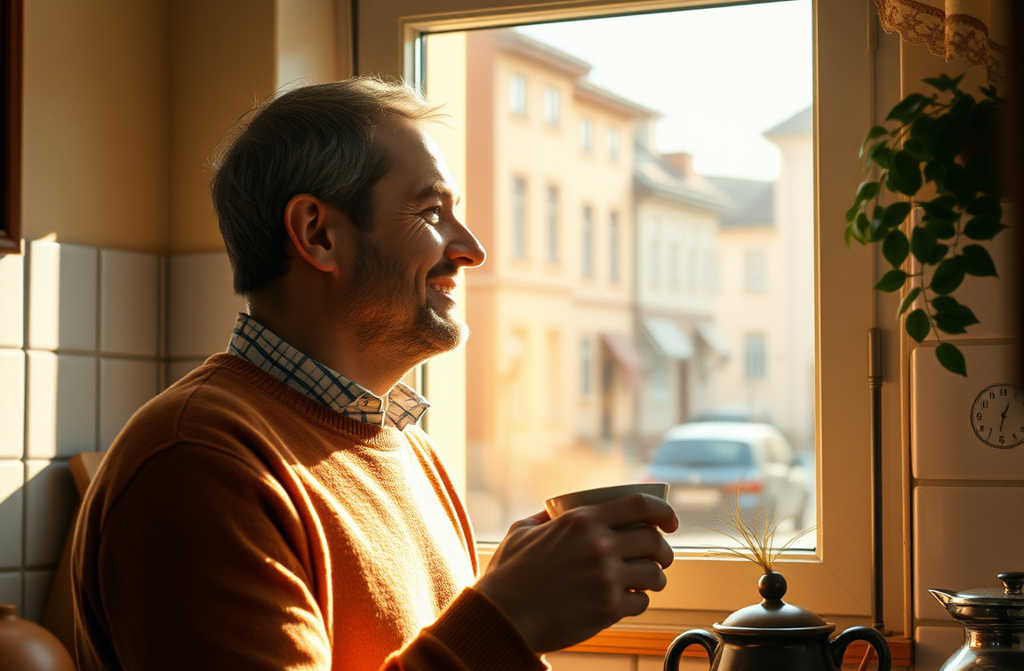
The effect of presence
The sunrise was still painting the sky over the terraced houses of East Ham when Anthony Blake was already perched at the kitchen table of his cramped onebedroom flat, squinting at the monitor. A threedimensional model of a room rotated lazily on the screen, a translucent banner hovering in its centre: Session failed. Beneath it a red column of log entries streamed down like an endless receipt.
He slipped off his glasses, rubbed the bridge of his nose, and stared at the VR headset lying beside him. The dark matte plastic was scarred with fine scratches, the sort of marks a phone gets when you never bother with a case. He ran his thumb over them, halfsmiling at how the device felt almost alive under his fingers, then jerked his hand away.
In the kitchen the kettle hissed. He rose, poured himself a mug of strong coffee, and returned to the table. The air filled with the bitter scent of coffee mingling with the warm, metallic smell of the tower PC. That familiar morning cocktail steadied him. He took a sip, opened his inbox, and saw a new message from the projects producer.
Anthony, hello. The client wants a live demo by the end of the month, with a heavy focus on the emotional wow. Can you deliver?
He stared at the word wow as if it were a splinter. He could have answered that memories werent something you could simply code to spec, that an emotional effect isnt a button you press. But after nearly ten years in commercial development he knew the answer had to be phrased differently.
Hi. Well make it happen. Ill need live data for the test, and Ill pull together the protocols, he typed, hit Send, and kept his gaze on the nowempty screen for a moment longer. Then he turned his chair toward the headset and lifted it gently.
The product was called ReLive. In pitch decks it was described as a VR platform for safe reinterpretation of personal experience. Inside the team they called it more bluntly a memory game. The idea wasnt his, but hed written most of the core. An algorithm that, using video clips, geodata, photographs and fragments of text, stitched together a scene that wasnt a perfect replica of the past but a dense, believable model. The platform filled gaps, added ambient sounds, light, tiny details, so the brain wouldnt stumble.
In theory it sounded beautiful. In practice it meant compromisestrading realism for comfort in some places, preserving rough edges in others so users felt they were looking at a reconstruction, not a dream.
He pressed the button on the headset; a tiny indicator glowed soft blue. Anthony set the device back on the table, opened the project in his development environment, and dove back into code.
By midday he boarded the tube, the carriage already packed with commuters in winter coats and puffy jackets. Someone listened to music without headphones, another thumbed through a stack of printed receipts. Anthony lingered by the door, watching his reflection in the glass. His nose seemed broader than it had in his twenties, the hair on his crown notably thinner. In moments like that the fact that he was past forty hit him harder than any deadline.
The startups office occupied a repurposed office block on the edge of Croydon. A grey façade, glass doors, turnstiles at the entrance. Inside, the openplan space smelled of coffee and pizza, rows of desks, a few glasswalled meeting rooms, and a corner lounge with beanbags and a console.
Anthony! Weve been looking for you, shouted Tim, the junior developer in a hoodie emblazoned with the ReLive logo, as he rushed past.
Whos on? Anthony asked, dropping his satchel beside his desk.
The producer. With the client. Theyre big.
Anthony nodded, flicked open his laptop, glanced at the loading screen, and headed for the meeting room.
Inside three people were already seated. The producer, a crispdressed man in his midthirties without a tie, stood up. Beside him a woman in a dark suit, the clients product strategist, introduced herself as Marlowe. A third figure, a lanky man clutching a tablet, completed the trio.
Anthony, meet Marlowe, the clients product strategist, the producer said.
Good afternoon, Anthony replied.
Were finalising positioning, Marlowe began. We need users to feel this isnt just a gimmick; its a tool for selfwork, but without a heavy psychological load.
Anthony settled into his chair, hands resting on the table.
Technologically we can reconstruct events with decent fidelity, he said. But its crucial to remember this is a reconstruction. Our system fills the blanks to avoid immersion breaks. Otherwise the brain ejects the user.
Marlowe leaned forward. Can you make the scenes a little better than reality? Warmer lighting, more pleasant voices, softened conflicts, so people want to return?
A tightness rose in Anthonys chest.
That ceases to be selfwork; it becomes escapism, he replied.
People already escape, Marlowe said evenly. Into series, social media, games. Were just giving them a more meaningful format. The key is to avoid traumatising scenarios.
The producer interjected quickly. We can add settings: a realistic mode and a comfort mode. Users pick.
Anthony wanted to argue, but the producers glance held a silent warning. Not now.
Later, back at his desk, he stared at the empty space where the headset had been. Marlowes words echoed: a little better than reality. He remembered a test scene hed run days earliera graduation ceremony for his son. The raw version had felt jagged, but when the virtual boy in a jacket stepped onto the stage, something about the moment had come alive.
In reality, at that graduation, Anthony had barely looked at his son, eyes glued to his phone, answering project emails. His exwife would later remind him of that. In the reconstruction, he stood in the aisle, filming with a virtual camera, smiling so broadly his cheeks ached. His son turned, waved, and the scene felt vivid.
That evening he fired up the scene again. The headset sealed his head, shutting out the peeling wallpaper and the humming fridge. In the headphones, voices rose, ceremonial music swelled, and his son appeared taller, shoulders broader, his face confident. The virtual camera hovered in the aisle, the system nudging him back onto a scripted path when he tried to deviate. The scene was preprogrammed.
When the simulation ended, he removed the headset and stared at a single point on the wall. He opened the scene settings, noting the lighting was boosted twenty percent, contrast up ten, applause slightly amplified, his sons face reconstructed from newer photos. He had himself tweaked the enhancement algorithm, convincing himself a little polish was harmless. Now a knot of unease settled in his gut, as if hed swapped something essential.
The next morning he called his exwife.
Hey, he said, leaning against the window of his flat, looking out at the grey courtyard. I need a favour. Im testing the system on live data. Could you come over?
Is it safe? she asked after a pause.
Its just VR. Nothing dangerous. I need to see how a real person reacts.
She arrived that evening, stepping into the flat that had hardly changed since she left. The same bookshelves, the same worn sofa.
Everythings frozen in time here, she remarked, shrugging off her scarf.
Too busy, he replied. Work.
He showed her the headset, explained the basics.
What do you want me to see? she asked.
Any moment. Upload photos, videos, and the system builds a scene. Something important, emotionally charged.
She thought, then pulled out her phone.
I have a video from our first seaside trip. He was terrified of the water.
Anthony nodded, though he barely remembered that day; he had been buried in a sprint deadline. The memory that remained was a child in a floatie, gulls screeching, the scent of sunscreen.
They fed the files into the system. Percentages rolled across the screen as the algorithm stitched together a timeline, pulling geodata, generating 3D masks from faces.
It feels creepy, she said, watching the process. Interesting, but like something is crawling into your head.
Were not invading, he whispered. Were just assembling what already exists.
When the scene was ready, he helped her strap on the headset, tightened the band, adjusted the headphones.
If you feel uncomfortable, tell me, and Ill stop.
She nodded. He pressed start.
For the first minutes she was silent. Then a quiet laugh escaped her.
Hes running on the sand Oh look, he trips. Remember? she asked the empty room.
The monitor displayed only sterile data: pulse rate, breathing frequency, gaze direction. A spike in her pulse appeared at the moment she mentioned the trip.
What happened? Anthony asked.
She removed the headset, eyes glistening. There you were holding his hand, walking into the water. In reality you were on the deck, replying to emails. I remember that clearly. Here youre there with us.
A sickening pressure rose in Anthonys chest.
The algorithm filled in the gaps from the photos and typical patterns. It doesnt know where I was, he said.
But the brain does, she whispered. Now there are two versions. One where youre glued to a screen, another where youre by the sea with us.
She rose, paced the room. Its dangerous, Anthony. People will choose which version to remember.
Dont we already choose? he retorted. Photos, stories, social feeds they all edit reality.
This is still reality, she said. I felt good there, but when I came back it felt empty.
She left, tea unfinished. Anthony remained, staring at the headset, the phrase about two versions looping in his mind.
A week later internal tests began. Volunteers brought flash drives, gave access to cloud photo albums. One wanted to revisit childhood, another their first date, another the day they defended their thesis.
Tim launched a scene where he, in a school uniform, stood at a blackboard. After the session he sat, silent.
How was it? Anthony asked.
Strange, Tim replied. Everything was nicer. The teacher didnt shout, classmates didnt mock. I got the answer I wanted. I didnt even know I wanted to see it.
What do you feel now?
Its easier, but also like Ive been cheated. Still, I chose this mode.
Anthony logged the reactions, noting a rise in subjective satisfaction, a dip in anxiety, an attraction effect. Inside, his doubts grew: were these numbers worth the cost to truth?
One night his son called.
Dad, heard about your thing. Can I try?
Anthony hesitated. Its still rough.
Come on, Im not scared. I want to see how you do it.
He agreed, setting a weekend.
His son arrived in jeans and a hoodie, backpack slung over one shoulder. He glanced around the flat.
Looks like a museum, he said, nodding at the stack of old DVDs.
Work takes precedence over décor, Anthony replied.
They sat, Anthony walking him through the basics.
So you piece everything together from fragments? his son asked. What if I dont want the system to see my messages?
Then it works only with photos and video. Less data means more assumptions.
Alright, lets start with something safe. Remember when we went to Granddads farm as kids?
Anthony recalled the dusty path, the rusted grill, but many details had faded.
They uploaded old photos and a few grainy videos. The system took longer, choking on the obsolete formats.
Ready? Anthony asked.
Lets go, his son said.
He helped him strap the headset, started the scene. At first his son laughed, commenting aloud, then fell quiet as his pulse rose on the monitor.
Dad, his voice turned hollow, why isnt Granddad coughing here?
A jolt of alarm hit Anthony.
What?
Hes walking the yard, healthy. In reality he was already struggling to breathe back then. Here hes younger, fine.
Anthony slammed the pause button.
The algorithm pulled his image from earlier photos, he explained. I can tweak it.
His son removed the headset, stared at him.
Why are you doing this? Who needs that version? Me? You?
People sometimes need to relive the good without the pain, Anthony said.
But pain is part of it, his son replied. If you strip it away, whats left?
He paced the room. Someone could get stuck in this. At uni there are mates who spend days in headsets, replaying their memories. This isnt a game.
Anthony bristled. Im not a child who needs a lecture on responsibility. Were building a tool. How its used is another matter.
His son smirked. Convenient. Youre both in and out of it.
He zipped his bag. Ive got a lecture tomorrow, see you then.
The door shut. Anthony sat alone, the monitor still flashing his sons pulse. He opened the codebase, found the module that allowed outcome correction the part that let scenes subtly rewrite endings. He had loosened its limits weeks ago when the producer begged for more magic.
He began tightening the parameters, capping how far a user could deviate from the original script. He stripped the automatic ageandhealth improvement flag, adding a warning: Reconstruction may differ from actual events. It does not replace memory.
He knew it would irritate the producer, that the wow factor would dim, but he could no longer bear the thought of someones mind being rewired by a polished lie.
Midday, the office buzzed as the producer stormed over.
What have you done? he demanded, not even greeting. The scenes are flat. The client says the new build lost its magic.
I reinstated limits so scenes cant rewrite outcomes, Anthony said calmly. And I removed the autorejuvenation. People need truth, not a filtered fantasy.
Youre jeopardising the whole project, the producer shouted. We could lose the next funding round. Do you want us all kicked out?
I dont want anyone ending up in a mental ward because of our product, Anthony replied. And I dont want my own brain to confuse fiction with reality.
They argued for a long, heated minute. Eventually the producer warned he would report sabotage to senior management. Anthony only nodded.
That evening an HR email arrived, politely suggesting a meeting to discuss his future. He understood the implication.
He stepped out onto a rainslick street, the pavement gleaming, the sky a dull pewter. He walked to the tube, feeling a strange lightness as if something inside had finally clicked.
Back home he set his laptop on the table, stared at the headset for a while, then lifted it, turned it over in his hands.
He could launch any scene now: his sons first steps, a quiet evening on the Thames with his exwife watching the lights, the day he finally dove into the sea instead of staying glued to a screen.
He placed the headset back, rose, and padded into the kitchen. He opened the window; cold air and the scent of wet asphalt flooded the room. He boiled a kettle, fetched two mugs, poured tea, and set one aside. While the water heated, he dialled his son.
Hey, he said when the line clicked. Im stepping back from the project. Ive got some free time. Want to meet up? No VR, just a walk.
A pause. Sure, Dad. Saturday. Lets go to the park.
Sounds good. He hung up, poured tea, and settled at the table, watching the world outside. A woman in a puffy coat walked a dog; a man in a work shirt smoked by the lift; teenagers sprinted past, shouting and jostling.
He realized he was watching them with the same intensity hed given VR scenesexcept now there were no enhanced lights, no scripted emotions, just raw, uneven life with its pauses and unfinished sentences.
Behind him the headsets indicator blinked faintly, still powered on. The technology hadnt vanished; it lay on the desk, a tool ready to be used again.
He took a sip, feeling the hot tea scald his tongueHe stared out at the rainslick street, resolving that some memories were meant to stay imperfect, and that the only true redemption lay in the ordinary moments he could still choose to live.



A New Year’s Eve Adventure
A NEW YEARS EVE INCIDENT Emma had no desire to return home. On the thirty-first of December, her workday was...


An Unexpected Call — “Hello, is this Mr. Paul Evans?” The voice on the phone was cold and formal. —…
A Random Call Mr. Paul Johnson? the voice on the line was icy and official. Yes, Im Paul Johnson. Who...


Love One Evening While Cleaning the Village Clinic, I Stumbled Upon a Beardless, Nervous Michael—Th…
Love Last night, as I was tidying up the clinic, I heard the door creak heavily, as if someone leaned...


My Father-in-Law Assumed We’d Keep Supporting Him Financially
Many years ago, my husband grew up in a cheerful, close-knit family with his parents. But when my father-in-law turned...


I Was Nineteen When I Left Home: After a Bitter Family Row, I Chased My Dreams of Administration Ins…
I was nineteen when I finally left home, mate. It wasnt some peaceful goodbyeit was a proper row. I told...


Not Quite Family
Well, if youve started, best finish what you were saying! Andrews voice rose as he spoke to Natalie, And if...


They Left the Maternity Ward Together, Just the Two of Them. No One Was There to Welcome Them, No Cameras Flashing, No Bouquets of Flowers—And It Would Have Seemed Odd Anyway, Giving Flowers to a Man…
So they stepped out of the maternity ward together. Just the two of them. No one was there waiting for...


I’m 27 and I met her at a time when I was least prepared for someone like her. It happened at a smal…
Im twenty-seven, and I met her at a point in life when I was least prepared for someone like her....