
Connect with us

З життя

To Remain Human: A December Evening at Bristol Coach Station and the Unexpected Power of Simple Kindness

Published

on

Remaining Human

Mid-December in the city of Nottingham is raw and blustery. A sprinkling of slushy snow only half-shields the muddy lawns. The bus station, always swept by drafts and echoing footsteps, feels frozen in timeits air thick with the stale coffee from the canteen, hints of cleaning fluid, and the slow fade of weary travel. The glass double doors slam against the wind, ushering in pockets of cold and people with cheeks flushed pink from the chill.

Charlotte hurries across the concourse, checking the time against the stations battered clock. Shes only here in passinga work trip to Derby wrapped up early, leaving her with two tedious connections before she can finally get back home. This bus station is her first, and most miserable, stopover.

Her ticket is for the evening coach. Now Charlotte has almost three hours to fill, smothered by a dull boredom that seeps through even the plush lining of her pricey camel wool coat. Its been over ten years since shes found herself in a place like this; everything seems diminished, greyer, slowed to the plod of provincial lifeso distant from her world back in London.

Her boot heels beat a crisp rhythm on the linoleum tiles. She stands out, glaringly soa striking wool officers coat, perfectly styled chestnut hair thats held its shape despite the journey, leather satchel slung over her shoulder.

Her sharp, habitually assessing gaze sweeps across the room: a kiosk worker slumped over her phone, an elderly couple tearing chunks from a bread roll in silence, a man in a battered parka staring absently at the wall.

She senses people watching hernot with malice, just faint curiosity: an outsider. And inwardly, Charlotte agrees. Shes here with only one taskto wait, to pass through this void of time and space like a bad dream. Tomorrow morning, shell be back in her bright, snug London flat, far from this marrow-deep dreariness.

Just as shes deciding where to perch, someone blocks her way.

A manperhaps sixty, perhaps older. His weather-beaten face is unremarkable, the kind that rarely registers in memory. He’s wearing an old but neatly mended jacket and a tweed cap, which, perhaps due to the warmth inside, he now clutches in both hands. He doesnt accost her so much as simply materialise in her path, as if the air has shaped itself into a person. When he speaks, his voice is oddly flat, quiet, emotionless.

Excuse me Miss Would you know where I might get a drink of water?

The question lingers, awkward and slightly out of place. Charlotte, without thinking, flicks her wrist towards the kiosk with the dozing attendantrows of water bottles are lined up behind the glass.

Over there. The kiosk, she says curtly, moving to step around him. A brief ripple of irritation flicks at her nerves. A drink of water. And miss, for goodness sake. Why couldnt he just look for himself? It was plain as day.

He nods, murmurs a barely audible, Thank you,but doesnt move. He stands, head bowed, as if gathering his strength for those few steps. That pausethe helplessness in such a simple actmakes Charlotte, halfway past him by now, hesitate for a moment.

She noticesnot the clothes or the age, but rather the sweat on his temples, beading even in the cold, tracing lines down his cheeks. His fingers clench and unclench his cap. Theres an odd pallor to his lips, a glassiness to his gaze, fixed into the ground but clearly unseeing.

Inside, she feels a jolt. Her hurry, her annoyance, her sense of superiorityeach peels away instantly, as if the bedrock of her inner world has fractured. Theres no time to think. Instinct kicks in, ancient and wordless.

Are you alright? she asks, her own voice sounding strange to her ears: gentle, stripped of the icy authority she usually carries. Instead of brushing past, she takes a step towards him.

He lifts his eyes. Theres no plea there, only embarrassment and uncertainty.

Bit faint Heads swimming, thats all he mutters, eyelids fluttering as though it takes sheer effort to stay upright.

Charlotte reacts automatically. She slips her arm under hiswith care, but firmly.

Dont stand. Lets sit. Here, this way, her voice, soft but commanding, guides him to the nearest empty benchthe very one shed just been about to pass by.

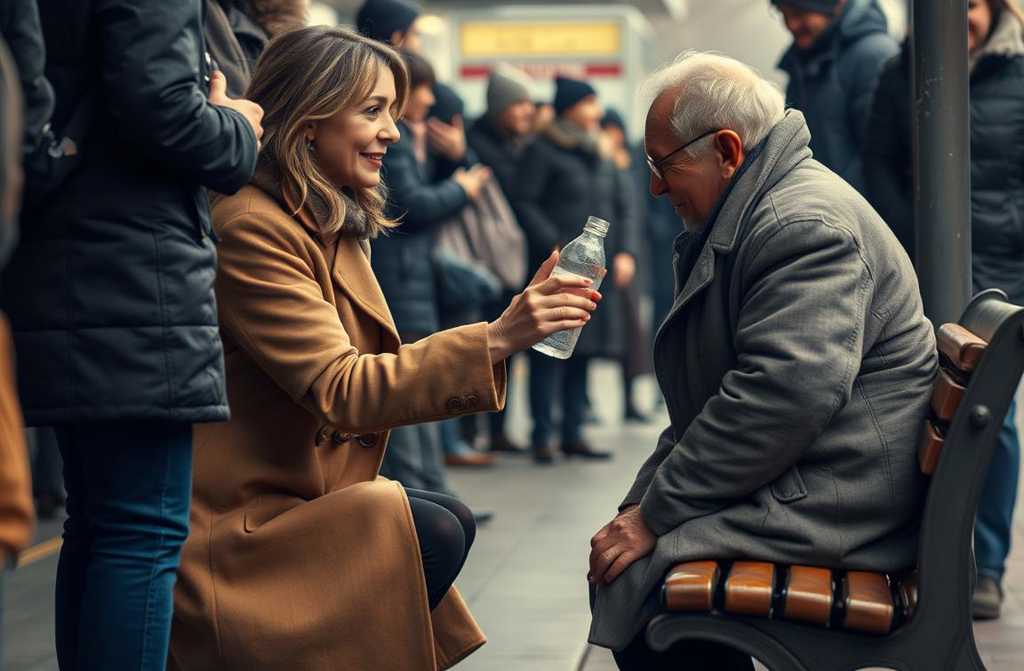
She gets him seated, then crouches in front at his knees, not caring in the least how she must look.

Lean back, just breathe. No rush.

A moment later, she hurries to the kiosk, returning quickly with a bottle of water and a plastic cup.

Heredrink. Small sips.

She rifles in her coat pocket for a tissue, using it without thinking to dab at his clammy forehead. Her entire being is tuned to him now: the rasp in his breathing, the faint pulse trembling at his wrist.

Help! she calls, her voice slicing through the stations indifferencean order, not a scream. This mans unwell! Someone ring for an ambulance!

The bus station, usually a limbo for those with nowhere to be, springs to life. The elderly woman from before is the first to respond, bustling over with her heart medication. The man whod been dozing in the corner leaps up, calling emergency services on his mobile. The kiosk attendant leaves her counter. People gatherthose background figures blending into the decor now step forward. They are not scenery; theyre a community united by sudden, urgent need.

Charlotte, kneeling at the bench, keeps speaking in quiet, reassuring tones, holding his cold fingers tightly. In that moment, she is neither a high-flying PR manager nor an outsider. She is just a human beingpresent, enough. More than enough.

Into that strange, concentrated hush bursts the sharp whine of sirens, dying away just outside as the door swings open with a bang. Two paramedics, coats emblazoned with red crosses, stride in trailed by gusts of December frost.

Ambulance arrival is a release; the circle of helpers melts away, making space. Everyone falls respectfully silent. Charlotte, still at the mans side, looks up to meet the eyes of the lead paramedicworld-weary but deeply attentive.

What happened? the woman asks, kneeling beside the patient with brisk, sure movements.

Charlotte relates, in the clipped tones shed use at board meetingsbut now theres no edge to her voice, just fatigue and relief.

He felt faint, dizzy, sweating heavily. Said its his blood pressure. We gave him water and his medication. He seems stable.

As she speaks, the second paramedic wraps a blood pressure cuff around the mans arm and shines a penlight into his pupils. The patient has rallied enough to whisper his name, age, the medicines he takes.

The paramedic nods at Charlotte.

Good response. The water was exactly right. Well take it from here. Get him checked over, probably a drip just in case.

They help him gently to his feet, supporting him firmly as he takes a few shaky steps. Then, with a searching look, he tries to find Charlotte in the thinning crowd. Their eyes meet.

Thank you, love, he croaks, and the raw gratitude in his face hits Charlottes throat like a stone. You you may have saved my life.

She cant summon a proper replyjust a nod, mute, drained. She watches as they lead him away, silhouetted against the bright ambulance outside. A blast of cold rushes in; someone behind her grumbles, Close the door, theres a draught.

The door slams. The siren fades into the distance. The bus station slowly retreats to its old rhythmlistless waiting. People drift back to their scattered benches, resuming their languor.

Charlotte remains where she is, staring down at her hands. Red lines mar her right palmthe imprint of her handbag, gripped too tight. Her perfect hair is undone, coat rumpled and dirtied where shed knelt on the floor.

Gathering herself, she heads for the ladies loo and splashes ice-cold water on her face. She gazes at her reflection in the cracked mirror: smudged mascara, tired eyes, hair in disarray. A face she hasnt truly seen in yearsnot burnished by success, but raw, expressing worry, empathy, exhaustion.

She wipes her face with a papery towel and, averting her gaze, wanders back into the waiting hall. Theres still more than an hour until her bus.

At the same kiosk, Charlotte buys a bottle of water for herself. She swallows a mouthfulthe taste is perfectly ordinary, but it feels, somehow, essential. Because now it isnt just water; its a symbola simple human connection, born when one stops seeing others as obstacles or background and starts seeing them as people.

None of the faces around herstressed, anxious, red with emotionare beautiful. But Charlotte has never seen more honest, more alive faces. They are vibrantly real.

And looking at herself in the stations tarnished windowcoat rumpled, brow furrowed, eyes still brimming with concernshe feels, perhaps for the first time in far too long, genuine. Not a polished photo, but a human being capable of hearing anothers silence and responding.

Charlotte returns to her bench, setting the bottle beside her. All around, the usual lethargy reigns anew. But something inside has shifted. Her eyes linger, noticing now that the same kiosk attendant is bringing hot tea to the elderly woman with a walking stick. A man helps a young mother carry her pram inside. These small gestures form a different picture nowone of quiet solidarity, silent rules of kindness.

Charlotte picks up her phone to find a work alerta discrepancy in the monthly reports. Just hours ago, it would have seemed urgent. Now, she types a quick message: Sort it tomorrow. Its fixable. She mutes the group chat.

Today, shes remembered a simple, nearly forgotten truth. Masks have their placethe mask of professionalism, the mask of composure, the mask of detachment. Sometimes you have to put them on. But its dangerous if you let the skin beneath them forget how to breathe, if you start believing you are just the mask.

Today in this gusty station, her mask cracked. And through the fissure, something real came outthe ability to feel fear for someone else, to drop to a grubby floor without considering what she looked like, to become, if just for a moment, simply a girl who helped, not Ms. Hargreaves, Head of PR.

To remain human isnt to throw away every mask. Its to always remember what lives underneath. And, sometimeslike todayto let that vulnerable, living, authentic part of us step into the light. If only to reach out a hand.

Click to comment

Leave a Reply

Ваша e-mail адреса не оприлюднюватиметься. Обов’язкові поля позначені *

4 + 1 =

Також цікаво:

З життя41 секунда ago

Recently, I Visited My Daughter-in-Law and Was Shocked to Find a Cleaner Hired for the House—Despite Always Telling My Son His Wife’s Finances Didn’t Matter, I Can’t Understand How They Afford a Housekeeper with Their Modest Means, Especially Since My Husband and I Bought and Renovated Their Home and Still Help Them Out—When I Found Out My Daughter-in-Law Became a ‘Blogger’ During Maternity Leave and Hired Help, I Felt Betrayed and Insisted If Anyone Should Be Paid to Clean, It Should Be Me—But My Son Sees Nothing Wrong—Am I in the Wrong for Feeling Upset?

The other day, I popped round to visit my daughter-in-law, only to find a complete stranger bustling about doing the...

З життя59 хвилин ago

To Remain Human: A December Evening at Bristol Coach Station and the Unexpected Power of Simple Kindness

Remaining Human Mid-December in the city of Nottingham is raw and blustery. A sprinkling of slushy snow only half-shields the...

З життя2 години ago

“Don’t You Dare Touch My Mother’s Things,” Said My Husband — “Those Clothes Belong to My Mum. Why Did You Pack Them Away?” My Husband’s Voice Was Strange, Almost Unfamiliar “We’re throwing them out. Why keep them, Steve? They take up half the wardrobe, and I need space for winter blankets and spare pillows—everything’s scattered everywhere,” I replied, continuing to briskly remove modest blouses, skirts, and light dresses that belonged to my late mother-in-law. Valentina always hung her clothes so neatly, and she managed to pass that habit on to her son. Unlike me—with my usual wardrobe chaos and desperate morning hunts for something presentable, ending up ironing crumpled tops that looked like they’d been chewed up and spat out by a cow. It had only been three weeks since Steve said a final goodbye to his mother. She needed treatment—mostly palliative—and peace and quiet. The cancer was merciless in its speed. So she came to stay with us, fading away within the month. Now, coming home after work, Steve saw her things strewn mid-corridor like worthless junk and just froze. Was this it? Is that all his mother deserved—tossed out and so quickly forgotten? “Why are you looking at me like I’m some enemy of the people?” I retorted, stepping aside. “Do not touch these things.” His words came through gritted teeth, his face darkening dangerously; he briefly lost sensation in his hands and feet as anger rushed to his head. “For goodness’ sake, they’re just old clothes!” I shot back, my patience thin. “What do you want, a museum? She isn’t here anymore, Steve. You have to accept that. Maybe if you’d cared for her this much when she was alive, maybe visited more, you’d have known how ill she really was!” Those words hit him, hard. “Leave, before I do something I regret,” Steve managed, his breathing ragged. I snorted. “Fine. Suit yourself.” Anyone who disagreed with me must be crazy—or so I’d decided. Steve didn’t even take off his shoes as he headed for the hallway cupboard, flinging open the very top doors and hauling down one of our old checkered bags from the move—there were about seven of them. He packed all of Valentina’s belongings inside—not just stuffing, but folding each one carefully. Her jacket and a bag of shoes went on top. Our three-year-old son whirled around his father, “helping” by throwing his toy tractor into the bag. Steve hunted out a key from a drawer and pocketed it. “Daddy, where are you going?” He managed a tight smile. “I’ll be back soon, mate. Go find Mummy.” “Wait!” I called. “Are you leaving? Where are you going? What about dinner?” “No need, I’ve lost my appetite for your attitude towards my mother.” “Oh come on, are you really upset over nothing? Where do you think you’re going this late?” Not looking back, Steve left with the bag. He drove around the ring road, letting the roar of tyres drown his thoughts—work, holidays, even his favourite Facebook jokes—everything faded away except the heavy ache of loss and the accusation that maybe he’d failed his mum when she needed him most. She’d never wanted to bother him, never wanted to be a burden, and he’d started calling less, visiting less, always busy, always something else to do. Halfway there, he stopped at a roadside café, grabbed a quick bite, and drove the remaining three hours in silence. He barely noticed the sunset, just the faint memory of his childhood home drawing nearer. He arrived late, fumbled at the garden gate with his phone torch, ignoring five missed calls from me. The scent of fading bird-cherry blossom hung thick in the dark. Inside, Valentina’s old slippers waited in the porch, her house shoes by the inner door—blue and worn, with little red bunnies, a present from Steve years ago. He stood, staring, and finally entered his mother’s world for one last time. Everything was just as she’d left it—neat, a little damp-smelling, the furniture faded. Her makeup and comb, a packet of pasta marked ‘basic price’, the newer settee and telly he’d bought her, and in her room the bed piled with pillows. Steve sank onto the edge. He remembered sharing the room with his late brother, the old table by the window, now replaced with Valentina’s cherished sewing machine; her wardrobe now holding her lifetime’s treasures. The house was silent. Steve pressed his face into his knees, shook, and sobbed—he’d never found the right words to thank her; he’d sat dumb as she squeezed his hand, thousands of things left unsaid. He wished he could thank her for his safe childhood, her sacrifices, the sense of home you could always come back to, where mistakes didn’t matter and love was unconditional. But nothing he could say now felt real—our modern world, he thought, was quick with sarcasm, but never had the words for gratitude or grief. He left everything just as it was and finally slept, waking at seven as always. The morning was cool and fresh, the birch trees glowing outside the old garden fence. Steve carried the bag of his mother’s things upstairs and put everything back in its place with gentle care. He called work: “Family emergency, I’ll be back tomorrow.” He even sent me a text—apologising for his temper. After picking early tulips, daffodils and lilies of the valley, he made three small bouquets—one for each of his loved ones at the cemetery. Stopping at the shop, the old shopkeeper fussed over him, offering cheese; Steve bought some, just as his mum once did. At the grave, Steve shared breakfast—with his father, his brother, and his mum—laying out chocolate and cheese in silent tribute. He spoke to them in his mind, remembered childhood mischief with his brother, early morning fishing trips with his dad, his mum’s echoing call for dinner that he’d once found so embarrassing. He stroked the fresh earth of his mum’s grave. “Mum, I’m sorry… It shouldn’t feel this empty without you. So much I wish I’d said. You were the best parents anyone could ask for. Thank you—for everything. We’re selfish, me and Olya; you were never like that. Thank you, Vasya, too, little brother.” It was time to go. On the way, Steve met old Serge, drunk as ever, declaring it World Turtle Day. Steve looked at him, weary. “Look after your mother, mate. She’s gold, and she won’t be around forever.” And so, with that, Steve walked on—leaving his friend in the dust, and carrying his mother’s memory home.

Dont you dare touch my mothers things, said her husband. These clothes belong to my mum. Why have you packed...

З життя3 години ago

Marrying a Disabled Man: A Story Thank you so much for your support, your likes, thoughtful feedback on my stories, for subscribing, and my sincerest gratitude for all donations from me and my five beloved cats. Please, if you enjoyed the story, share it on social media – authors appreciate it more than you’d think!

Marrying Outside the Lines Thank you all for your support, kind comments, and for following my stories. A special heartfelt...

З життя4 години ago

How to Set Your Husband Straight: A Heartfelt Story of Recovery, Five Feline Friends, and Finding Strength After Illness

Reining In My Husband. A Diary Entry Thank you for your kindness, for every like, comment, and thoughtful response to...

З життя5 години ago

A House Full of Uninvited Guests: Or, How My Husband’s Home Became a Never-Ending Refuge for Distant “Relatives,” Strangers, and the Occasional Professor, Complete With Volleyball Tournaments in December and Auntie Marsha’s Famous Pancakes

A House Overrun with Uninvited Guests – Cant these dear souls go and live somewhere else? asked Alice, raising her...

З життя6 години ago

How My Future Mother-in-Law Ruined Our Holiday: The Story of an English Family Vacation Gone Awkward, Complete with Last-Minute Substitutions, Reluctant Travel Partners, and Lessons Learned Before Saying ‘I Do’

Its just Being alone with my daughter on holiday, its frightening, you know? Margaret swept her hand through the air...

З життя7 години ago

“I Gave Birth to Your Son, But We Don’t Want Anything from You” – The Mistress Called Lera’s husband looked at her like a chastened dog. “That’s right, you didn’t mishear me, Lera. I… I had someone else, half a year ago. Just a few times—nothing serious, just a fling. And now, she’s given birth to my son. Recently…” Lera’s head was spinning. Talk about earth-shattering news! Her steady, loving husband, a child on the side! The meaning of what he said barely penetrated. For a moment, she simply stared. He sat across from her, shoulders hunched, hands squeezed tight between his knees. He seemed smaller than usual—deflated somehow. “A son, then,” repeated Lera. “So, you, a married man, now have a son. And it wasn’t your wife who gave birth. Not me…” “Lera, honestly, I didn’t even know. I swear.” “You didn’t know how babies are made? You’re forty, Nick.” “I didn’t know she’d… well, that she’d choose to keep it. We broke up long ago, she’s with her husband now. I thought that was it.” He fumbled with his words. “Then, yesterday, a call: ‘You’ve got a son. Seven pounds, healthy.’ And then she hung up…” Lera stood, legs unsteady, knees like jelly as if she’d just run a marathon. Outside, autumn raged. Lera found herself distracted by the view—beautiful, even now. “So what now?” she asked, her back to him. “I don’t know,” he whispered. “Oh, great answer. A real man’s answer. You don’t know.” She spun around. “Are you going over there? To see him?” Nick, panic in his eyes, managed to mumble, “Lera, she gave me the hospital’s address, said discharge is in two days. She said: ‘Come if you want, don’t if you don’t. We don’t want anything from you.’” “Very noble of her…” Lera echoed. “‘We don’t want anything.’ How naive…” The front door slammed—her two eldest had returned. Instantly, Lera slipped on a smile. Years in business had taught her to keep her head up, even when a deal was falling apart. Their older son poked his head into the kitchen—a tall, broad-shouldered lad, twenty. “Hey, Mum, Dad. You both look glum! Mum, is there any food? We’re starving after training.” “Manty in the fridge, heat it up,” she replied automatically. “Dad, you promised to look at the carburettor on my rust-bucket,” called out her younger son, clapping Nick’s shoulder. The family scene stabbed at Lera’s heart. They called him Dad. Their real father had faded into the background years ago—now just money transfers and the occasional postcard. Nick had raised them: taught them to drive, patched scraped knees, handled school issues. He was their real dad. “I’ll take a look, Alex,” Nick smiled. “Give Mum and me a minute.” They left, clattering plates. Lera turned to him. “They love you,” she whispered. “And yet you…” “Lera, stop it. I love them too. They’re my boys. And I’m not leaving. I’ve told you—it was a mistake, an error in judgment. Nothing serious.” “Nothing serious—just the kind of mistake that leads to changing nappies,” she shot back. Their six-year-old daughter, Maisie, then burst in, and Lera’s composure cracked. Maisie leapt into her dad’s lap. “Daddy! Why are you sad? Did Mum scold you?” Nick pulled her close, burying his face in her pale hair. For her, Lera knew, he would do anything. “No, princess. Just adult stuff. Go pop on cartoons, I’ll be in soon.” With Maisie gone, silence fell again. “Everything’s changed, you know,” Lera said quietly, sitting again. “There’s a son out there, and he needs a dad. That woman says ‘nothing now’, but give it time—when there’s winter coats to buy or doctor’s bills, she’ll ring. And you’ll go. You’re kind-hearted, Nick—you always have been.” He said nothing. “And the money, Nick? Where are you going to get that?” Lera’s words hit their mark. His business collapsed two years ago—their debts paid from her earnings. He scraped by now, but everything important—home, cars, holidays, the kids’ education—came from her. Even his bank card was one attached to her account. “I’ll figure it out,” he muttered. “Driving Ubers at night? Or dipping into my purse to support your lovechild? I bankroll us, and now you’ll bankroll them—with my money?” “She’s not my mistress!” Nick barked. “It was over six months ago!” “Children have a way of binding people closer than any marriage certificate. Will you go to the hospital when they discharge her?” The question hung in the air. Nick covered his face with his hands. “I don’t know, Lera. Human decency says I should—after all, it’s not the child’s fault.” “And what about human decency toward me? Toward Maisie and the boys? You’ll hold that child, and you’ll get attached. Soon it’ll be weekly visits… then weekends away. You’ll start lying—to me, to the kids.” Nick grimaced. “She’s eight years younger than me, Nick. Thirty-two. She gave you a son—your own, flesh and blood. My sons aren’t yours by blood, as much as you raised them. That boy out there—he is.” Nick protested: “Nonsense. The boys are mine. I raised them.” “Men always want a legacy. Their very own.” “We have Maisie!” “She’s a girl, Nick…” Nick stood abruptly. “Enough! Stop pushing me out the door. I said I’m staying. I can’t just ignore the fact that somewhere there’s my own son. If you want me gone, I’ll leave—right now, pack my things and be gone. But don’t try to blackmail me, Lera!” Lera froze. If she said “leave” now, he would go—foolish, prideful, and broke. But he’d go straight to them. There, he’d be a hero, a savior, father—albeit a penniless one, but theirs. And then she’d lose him for good. Despite the pain, she didn’t want that. The children loved him. She did, too. “SIT,” she whispered. “No one’s throwing you out.” He hesitated, breathing heavily, then sat. “Lera, I’m sorry. I’m such a fool…” “A fool,” she agreed. “But MY fool…” That evening, Lera helped Maisie with homework, checked work emails… but her thoughts kept drifting. She pictured the other woman, young and beautiful, probably feeling victorious. “We don’t want anything!”—the most damning move of all. No demands, no drama, just presenting the facts. That pricks a man’s pride—makes him want to be the hero. Nick tossed and turned at night; Lera lay awake, staring into the dark. She was forty-five: gorgeous, stylish, successful—but aware that youth was not forever. The future belonged to that other woman. * The next morning was harder still. The boys ate quickly and left. Maisie cornered her father: “Daddy, braid my hair? Mum doesn’t do it right!” Nick obliged, his large hands strangely gentle. Lera sipped her coffee and watched: here was her husband—warm, familiar, hers. And out there was another child, who had the same claim. How was this fair? “Nick,” she said, as Maisie rushed off to dress. “We need to decide—now.” He set the brush aside. “I thought about it all night.” “And?” “I’m not going to the hospital.” Lera felt something tighten in her chest, but hid it. “Why?” “Because if I go, I’ll give hope—to her, to myself, to that child. I can’t be a part-time dad, split between two homes. I don’t want to lie to you, Lera. I don’t want to steal time from Maisie or the boys.” He looked at her, exhausted. “I chose you eleven years ago. You’re my wife. This—this is my family.” “And the boy?” Even she was surprised to hear herself ask it. “I’ll pay support. Through the courts or with a bank account—whatever’s needed. But visits? No. Better he grows up never knowing me, than waiting for a father who’s just watching the clock, desperate to get home to his real family. That’s fairer.” Lera was silent, rolling her wedding ring around her finger. “You’re sure you won’t regret this?” “I probably will,” Nick admitted. “I’ll worry, I’m sure. But if I go, I lose you—and you won’t stand for that. You’re strong, but not made of stone. You’ll start to hate me, and I can’t let that happen.” He crossed the kitchen, resting his hands on her shoulders. “I don’t want another life. I want you—and the kids. The rest is the price for my mistake. I’ll pay in money, and only in money. No time. No attention. That’s all I’ve got to give.” She placed her hand over his. “Your own money?” she smirked. “I’ll earn it. I’ll find a way. I’ll never ask for your help with this.” And with that, she was at peace. Her husband may not have behaved honourably toward her, but these were exactly the words she had needed. No sharing. The other woman could deal with her choices. Nick never went to the hospital. The mistress soon flooded his phone with angry voicemails. He told her bluntly: she could expect financial support, nothing more. She hung up, and for half a year—there wasn’t another word from her. Lera was more than satisfied with that.

I’ve had a son by you, but we want nothing from you, rang the voice down the phone his mistress....