
EN
The Folder That Wasn’t Supposed to Exist

I’ve been a court reporter in Lancaster County for nineteen years. My job is to sit in the corner with my stenograph and disappear into the wallpaper while families tear themselves apart. You learn to stop listening after a while. But that Friday, the second one in April, I couldn’t stop hearing.
The first time I saw her—Laura, she was called—she had on a sweater with a missing button and held her car keys so tight the metal bit into her palm. Her husband, Brett Carlson, sat at the other table in a suit that cost more than my car. He had the kind of hair that stayed perfect even when the heat was on full blast, and a lawyer who kept passing him notes on a leather folio like they were exchanging golf scores. Laura’s attorney was the public defender type—young, nervous, flipping pages too fast. You could smell the outcome before the judge banged the gavel.
Brett got the kids, the house with the iron gates out on Old Philadelphia Pike, the BMW, and the investment accounts he’d managed since the day they married. Temporary custody to the father for “stability.” Laura got a suitcase, a Nissan with a cracked taillight, and a printout from the bank that wouldn’t cover three months in a studio apartment. I typed the judge’s words so many times in my career: “in the best interest of the minor children.” My fingers knew the strokes by heart.
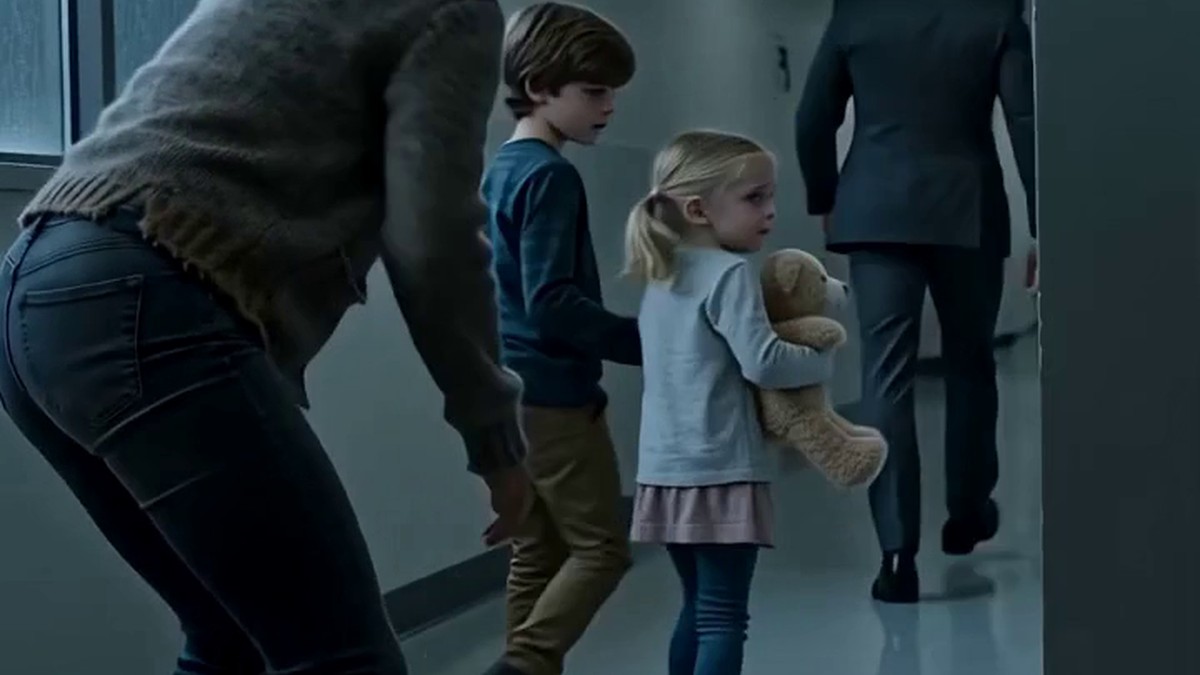
When they broke for recess, Laura stood in the hallway by the water fountain. Her daughter, maybe seven, was crying into a stuffed bunny. The son, older, stared at the floor tiles like he was trying to melt through them. Laura crouched down to hug them, and Brett put a hand on her shoulder—not to comfort, but to pull her back. I heard him say, quiet enough that the bailiff didn’t look up, “You wanted out. Now learn what it costs.” Then he strode off with the kids, a black folder under his arm, without turning around.
Laura stood there for a solid minute, face blank. I’d seen that look on defendants and defendants’ wives and daughters—the moment you realize the person you married is a stranger and you’re the only one who didn’t get the memo. Then she walked out into the rain. That was the end of it, I thought. Case number FC-2024-0192, closed.
Three weeks later, I got a call to cover an emergency hearing in the same division. Same judge, same docket number. I set up my machine and saw Brett in his usual seat, same arrogant tilt to his chin. Then the door opened and Laura walked in with a woman I recognized from the bar association dinner—Evelyn Shaw, a trust attorney who once dismantled a pharmaceutical company’s defense in four hours flat. Evelyn carried a brown accordion folder so thick the seams were straining. When Brett saw her, the color drained from his face like water from a sink. He actually pushed his chair back an inch.
The hearing started. Brett’s lawyer went first, talking about how Laura’s new job as a teller at the local credit union proved she couldn’t support a goldfish, let alone two children, while Brett provided “continuity of care.” He mentioned the five-bedroom house, the landscaping, the private tutoring. Evelyn let him finish. Then she stood, opened that folder, and handed the judge a sheaf of notarized documents. “Your Honor, before we discuss temporary support, the court should know two things. First, the house my client’s husband claims as his primary asset is actually collateral against a majority stake held by my client. Second—and this is critical—the person who legally controls fifty-one percent of the voting shares in Mr. Carlson’s company is sitting to my left.”
Brett’s lawyer objected so fast I nearly missed the word “hearsay.” But Evelyn had everything signed and sealed. She explained it, her voice carrying across the silent room. Laura’s mother, a woman named Irene who’d died three years ago, had been no ordinary retiree. She’d quietly built a family trust called Alderbrook Holdings, seeded with money she and her husband had saved over forty years—every dollar from his auto-body shop and her side business selling antiques online. When Brett’s development firm was about to go under eight years ago, Alderbrook had stepped in as the white-knight investor he’d always described as “some prickly private equity guy.” The prickly investor was his mother-in-law. And the terms she set? Ironclad. In exchange for the cash, Alderbrook got controlling interest, a lien on the house, and full audit rights to the company’s books. Brett had signed it himself, apparently not reading past the first page.
Then Evelyn held up a black flash drive. “This contains intercepted correspondence, Your Honor. Emails from Mr. Carlson to his accountant, discussing how to hide assets from his wife in the event of a divorce, dated six months before the filing. It was found in a wall safe in the late Mrs. O’Rourke’s farmhouse, along with a letter to her daughter explaining everything.”
The judge had the drive plugged into her own laptop on the bench. The screen faced away from me, but I didn’t need to see it. I saw Brett’s hands grip the table edge. I saw his lawyer’s mouth tighten into a thin line. I saw Laura sitting very still, hands folded over a key—a small metal safe-deposit-box key she’d pulled from her pocket. She didn’t look triumphant or vengeful. She looked the way my mother did the day she paid off the house: like a weight she’d been carrying for ten years had finally been set on the ground.
The judge read for seven minutes. Then she looked up and said, “I’m vacating the prior custody order pending a full review. Effective immediately, the children are to be placed with Mrs. Carlson in the family residence, and Mr. Carlson will vacate the property by noon tomorrow.”
Brett began to say something about “my house.” Evelyn cut him off without raising her voice. “It was never your house, Mr. Carlson. You were just renting it from your wife’s trust.”
I typed every word into the record. The last thing I heard as the bailiff escorted Brett out was Laura saying, barely above a whisper, “I’ll tell the kids you said goodbye.” She said it to his back, the same way he’d spoken to her in that hallway three weeks ago. Then she turned to Evelyn and finally let out a breath. The folder was closed. The key went back in her pocket. Outside the window, the spring rain had stopped, and the dripping maple branches cast small, sharp shadows across the bench.
I packed up my stenograph and walked past the empty seats where the kids had waited last time. Somebody had left a stuffed bunny under the third row. I handed it to the court clerk with a note that just said *FC-2024-0192*. Maybe it meant something. Maybe it was just another piece of a story I wasn’t supposed to finish.



Il contratto che Daniele non sapeva di aver già perso
Quella mattina ho fatto una cosa che Chiara non si aspettava: le ho lasciato il caffè pronto prima di uscire,...


Tėvo rankos sode Zarasų pakraštyje
Pro Petro Vilkausko namo langą matosi Zarasų ežeras — rudenį jis pilkas, kaip skalbinių vanduo. Gyventojai sako, kad spalį čia...


Жълто-зелената пътна чанта на Деми
Деси Вълчева остави телефона на плота с екрана надолу, сякаш искаше да му попречи да зазвъни отново. В кухнята на...


Nebylainis mokesčių skolininkas: ką Gabija man pasakė apie savo mamą ir pinigus
Mano uošvė sulaužė dantį pirmadienį, o ketvirtadienį jau nebeturėjau pinigų, kuriuos devynis metus siunčiau be klausimų. Taip tiksliai pasakyčiau, iš...


Dílna po Vladimírovi a mlčení, které Petr neslyšel
Ivana měla čtyřicet sedm let a dvacet tři z nich vedla účetnictví v autoservisu na Dobrovského ulici v Olomouci. Dílnu...


Il bagno delle nove e un quarto a Sabaudia
Faccio il bagnino allo stabilimento da sei stagioni, e di solito alle nove e un quarto del mattino la spiaggia...


Kréta a kapualjban
Pontosan két hete történt, szerda reggel, amikor hazaértem a műszakból, és ott álltam a lépcsőház előtt, mint egy idióta, mert...


Котката на Марин Петков
Тя драска, значи го мрази — така си мислех първите седмици. Казвам се Марин Петков, на четиридесет и три съм,...