
EN
The Coast Guard Never Found My Husband’s Body. I Saw Him on Chincoteague.

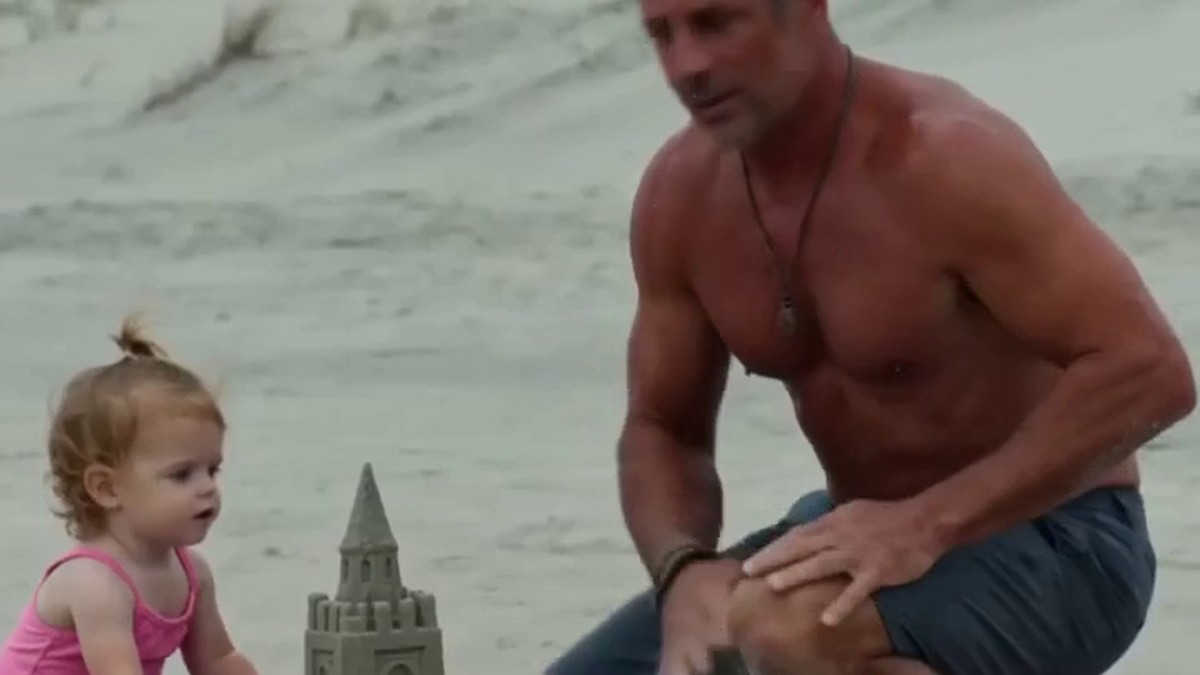
I knew him by the heel twist first. The man was forty yards down the beach, down on one knee in the wet sand, showing a little girl how to pack a castle turret. He shifted his weight and dug his left heel inward the way Dylan always did, that tiny sideways grind from the ladder fall. I had a rental umbrella over my shoulder, still rolled in its fabric. My fingers went numb around the pole.
The beach at Chincoteague in late April was mostly empty. A line of wild ponies stood behind the dune, and a few families spread towels near the water. I hadn't wanted to come. My sister sent me the rental listing three times. Dr. Okon, the counselor at the strip mall behind the Chick-fil-A, used the word exposure. Not the ocean as a cemetery, she said. The ocean as a place that keeps existing.
I called his name.
The man looked up. He had a rope bracelet on his left wrist, sunburned shoulders, more gray at the temples than Dylan had at thirty-four. He didn't react. The girl offered him a plastic sand crab. He took it from her hand. I called again.
This time he stood.
"Ma'am? You okay?"
His voice wasn't a perfect match. But the rhythm, the slight drop at the end of the sentence, the way his right hand stayed open like he still had an invisible tool in his palm. I knew.
"Dylan."
He shook his head. "My name's Garrett."
A woman came down from the dune with a diaper bag over one arm. She looked from him to me. The little girl pressed her face into the woman's hip and said, "Mama, I got a crab."
I should have made a speech. Instead, I said, "You look like somebody who drowned."
The woman put a bottle of water in my hand. "You need to sit down?"
I turned and walked off. My feet were wet. The kid at the rental stand said, "That'll be twelve dollars." I paid in wet ones.
Three years earlier, Dylan had taken a 31-foot cuddy cabin out of Ocean City, Maryland, on May 14. He was supposed to run it down to Chincoteague for a client, a straight shot with a good forecast. The storm came up at 4:45 p.m. The Coast Guard found the boat bottom-up near an inlet buoy. A red cooler, one boat shoe, a section of the console with the throttle still in gear. No body. They searched the ocean for six days. I was nineteen weeks pregnant.
The day they scaled back, an officer called while I was in the ShopRite parking lot with a bag of navel oranges. He said, "We're moving into recovery." The bag handle made a groove in my wrist.
That night I started bleeding. My mother drove me to the hospital in Wilmington. The ER nurse had on two different sneakers. The doctor said, "I'm sorry." I signed something. I don't remember the pen.
After the memorial, I moved to Middletown. I took a job in inventory for a farm equipment dealer on Route 13. I stopped answering the phone. I paid the mortgage on the little house near Ocean City for a while, then signed it over to Dylan's younger brother for a dollar. I kept the joint credit union account open. The savings for the boat repair shop we planned sat in a separate account: $36,840.32. Dylan wanted to call it Low Tide Engine Works. I didn't touch it.
I did the work, as the counselor said. I saw Dr. Okon in a room with a clock that ticked so loud I could hear it between our sentences. In March, she told me: "You haven't let the ocean be ordinary again. You treat it like a suspect. Try going somewhere you have no history with him. Not Ocean City. Not Lewes. Not Bethany. Go look at the wild ponies if you can't look at the water."
So I drove to Chincoteague.
At the motel on Maddox Boulevard, I sat on the floor with a towel around my shoulders. The air conditioner rattled. I played Dylan's last voicemail eleven times. He said, "The ocean's flat, babe. I'll be back before the bugs start." I clicked it off. The man on the beach had the same ear shape. The same thumb hooked into his belt loop when he stood up. The same little hitch in his heel.
I called my sister. "I think I saw Dylan."
"Maren. He's gone."
At 7:15, someone knocked. I looked through the peephole. The woman from the beach. She had twisted her hair into a low bun. No little girl.
"Can I tell you something?" she said.
We sat by the motel pool. The filter gurgled. She set two cans of strawberry soda on the concrete table. Her name was Caroline. Her husband was Garrett. The girl was Josie. Then she said, "Garrett isn't his born name."
I waited.
"He washed up near Oyster, Virginia, a month after a spring storm. A waterman found him tangled in a crab line. They thought he was dead until he coughed."
I picked at a crack in the concrete.
"He didn't remember his name. No wallet. No phone. The boat had sunk. The Coast Guard had a missing person file open, but the case was in Maryland. Oyster is in Virginia. The hospital didn't have his fingerprints in the system. The sheriff's office ran them against the criminal database, not the DMV. Nothing linked. They booked him as a John Doe. The nurse called him Garrett because it was the first name on the chart."
"How does that happen?" I asked.
She didn't flinch. "The ocean doesn't care about jurisdiction."
That was something Dylan would have said. I hated how true it was.
Caroline had been the nurse on the rehabilitation floor. He relearned how to walk. He learned to write with his right hand again. She fell in love with him. She didn't say it as an apology.
"He still doesn't remember?"
"He gets fragments. A song. A smell. He hums something sometimes. But he doesn't attach them to people. There's no story."
She showed me a photo on her phone. Garrett and Josie by a blue pickup, both holding ice cream cones. Josie was Caroline's daughter from a previous marriage. Garrett had his hand on the child's back. That was Dylan's exact gesture, the one he used on our neighbor's son years before. The back of my neck went cold.
"He never left you on purpose," Caroline said. "He didn't choose you or not choose you. He woke up empty."
I drank the warm soda. "You should bring him tomorrow," I said. "I have proof."
The next morning, I walked to a coffee shop called the Sea Cow. He sat at a picnic table under an oak that had been hit by lightning. He stood when I approached. Not like a husband. Like a man taught to stand for a stranger carrying a heavy folder.
I put the folder on the table. It had a coffee ring from the last time Dylan used it.
"This is our wedding," I said. "You kept repeating the word wife like it was a new shirt."
He studied the photo. I did not wear the ring now. He didn't touch it.
"We look happy," he said.
"We were."
I showed him the house, the boat, the receipts for Low Tide Engine Works. I told him how he left his socks on the shower rod and always added too much salt to the popcorn. He listened. Dylan could never sit through a story without tapping his foot. Garrett sat completely still.
Then I told him about the baby.
"I was nineteen weeks when you went out. After the search, I miscarried. I named her Piper. She would have been three in October."
He looked at the ground. When he looked back up, his eyes were wet. "I don't know how to carry that. I can't pretend it feels the way it should. But I can see you're telling the truth."
The gulls made their noise. A couple at the next table argued about whether pastrami came from cows. I wanted to throw my cup at them.
"You can't remember anything?" I asked.
"No. When I reach back, it's like hauling up a bucket with no rope."
I opened the last page of the folder. A savings bond with his name. Under it, the final statement from the credit union. I had carried it for three years.
"You're Garrett now. And you have a daughter."
He didn't answer.
"I need to stop being the person who keeps Dylan alive for you. That's my job. Not yours."
The sentence didn't come from anywhere. But after I said it, my chest felt like a window had been cracked.
"You were my husband," I said. "But you don't exist anymore. You exist for Josie."
I zipped the folder shut. "That has to be enough."
I asked Caroline to come over. She brought Garrett. He sat on the edge of the pool lounger, his hands between his knees, and he didn't say anything. I took out my phone and opened the credit union app. The screen glowed: Transfer $18,400 to Maryland 529 Plan. I pressed my thumb to the glass. It processed.
Garrett looked at the number. "That's a lot of money."
"It's half the savings from a business we were going to build. I'm giving it to your daughter's college fund. Not because I owe you anything. Because I need to close this account today."
Caroline tried to hand my phone back like I'd made a mistake. I didn't take it. "Put it in her 529. If anyone ever asks, tell them it came from a woman who loved him before the water."
I tore the receipt from the app and gave it to Garrett. He looked at it for a long moment, then folded it once and put it in his shirt pocket. "I don't know how to thank you," he said.
"You don't have to. This is not for you. It's for Josie."
I got in my car and drove north across the bay bridge. The sun was going down behind the marsh. I didn't turn the radio on. I didn't cry. At a gas station outside Onancock, I bought a bag of saltwater taffy, the cheap kind, and ate four pieces. The ocean was out the window, and I didn't flinch.
I just drove.



Il contratto che Daniele non sapeva di aver già perso
Quella mattina ho fatto una cosa che Chiara non si aspettava: le ho lasciato il caffè pronto prima di uscire,...


Tėvo rankos sode Zarasų pakraštyje
Pro Petro Vilkausko namo langą matosi Zarasų ežeras — rudenį jis pilkas, kaip skalbinių vanduo. Gyventojai sako, kad spalį čia...


Жълто-зелената пътна чанта на Деми
Деси Вълчева остави телефона на плота с екрана надолу, сякаш искаше да му попречи да зазвъни отново. В кухнята на...


Nebylainis mokesčių skolininkas: ką Gabija man pasakė apie savo mamą ir pinigus
Mano uošvė sulaužė dantį pirmadienį, o ketvirtadienį jau nebeturėjau pinigų, kuriuos devynis metus siunčiau be klausimų. Taip tiksliai pasakyčiau, iš...


Dílna po Vladimírovi a mlčení, které Petr neslyšel
Ivana měla čtyřicet sedm let a dvacet tři z nich vedla účetnictví v autoservisu na Dobrovského ulici v Olomouci. Dílnu...


Il bagno delle nove e un quarto a Sabaudia
Faccio il bagnino allo stabilimento da sei stagioni, e di solito alle nove e un quarto del mattino la spiaggia...


Kréta a kapualjban
Pontosan két hete történt, szerda reggel, amikor hazaértem a műszakból, és ott álltam a lépcsőház előtt, mint egy idióta, mert...


Котката на Марин Петков
Тя драска, значи го мрази — така си мислех първите седмици. Казвам се Марин Петков, на четиридесет и три съм,...