
EN
# The Lake House Key

The valet was shivering in a jacket two sizes too thin for a Cleveland January. He took my keys—my black Subaru Outback with 112,000 miles and a back seat still caked with mud from a site visit in Akron last week. I gave him three dollars because that's what was in my coat pocket. He said thanks like he wanted it to be five.
The Oakwood Club's front steps were dusted with rock salt. It crunched under my boots. The door swung open with that hush old money installs in the hinges. A hostess at the front desk said, "Bennett party?" and I said yes. She aimed a hand down the hall. The fluorescent light over the private dining room door flickered, buzzed, flickered again. It had been doing that since September. Nobody ever fixed it.
I was carrying a black folder. Inside: a loan document, a copy of a will, and a photograph of a safety deposit box key.
My mother was already seated. She had on the pearl earrings—the clip-ons with the loose clasp on the right side. She reached up and touched it twice before I even got my coat off. My father sat at the head, hands folded, looking like a man whose valet had just scratched the Escalade. My sister Mallory was beside him, halfway through a glass of Chardonnay, not meeting my eyes. Aunt Carol had shown up in a red sweater too loud for the room. She was the one who always said things like, "The law is just a suggestion in families."
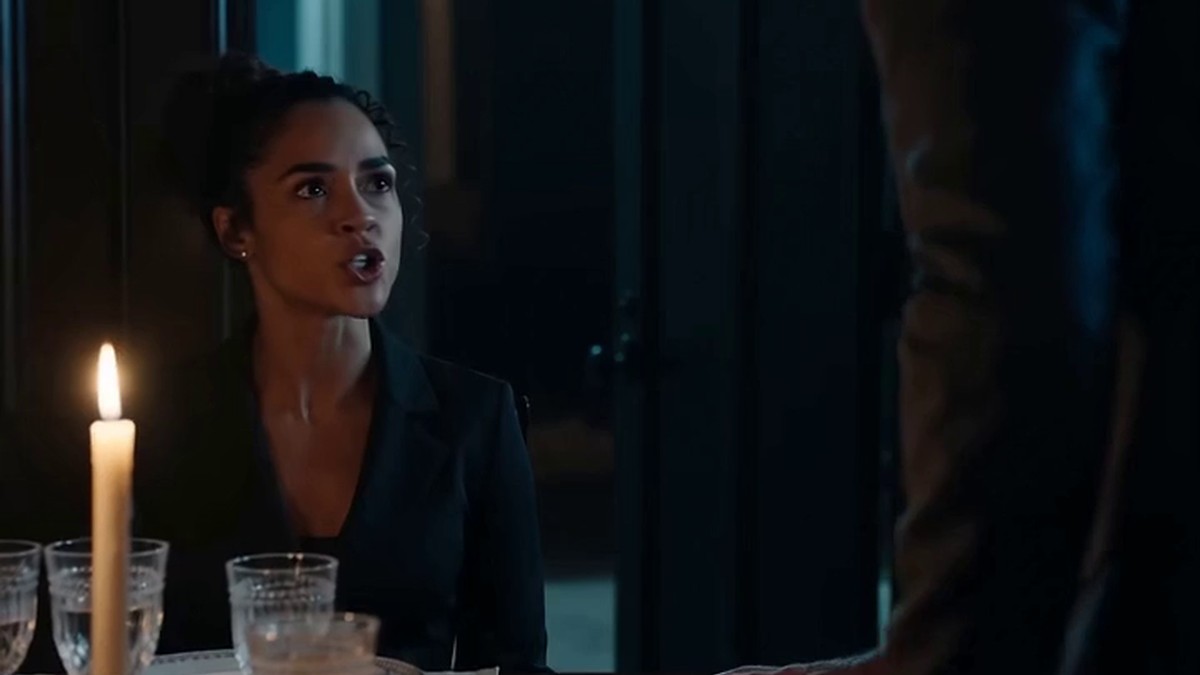
The table was set like a wedding rehearsal. White linen, candles, a centerpiece of white roses and eucalyptus. One rose had already gone soft, its head drooping toward the bread basket. Nobody had touched the bread.
"Dinner before business," my father said. It wasn't a question.
I set the folder on the table next to his salad fork. "Business before I lose my appetite."
My mother said, "Nora, please."
I opened the folder and took out the will.
"Do you know what this is?"
My father didn't look at it. He looked at me, the way he looked at a customer about to buy the extended warranty. "I assume it's the document your grandmother signed when she was eighty-nine and not entirely present."
"It's the original will of Marilyn Bennett," I said. "Notarized, filed, and—unlike the version you've been using—legally binding. It says the lake house in Vermilion goes to the two daughters of the bloodline. Me and Mallory."
Mallory's glass hit the table. *Clack.*
"The one you filed," I went on, "was a private waiver, signed by Mom and Aunt Carol, waiving my interest and directing the property to you, Dad. But here's the catch. That waiver required a second filing with the Lorain County Recorder. It was never filed."
Aunt Carol opened her mouth. Then she closed it.
My father leaned forward. "This is a family issue. We can sort it out after dinner."
I took out the second document. This one had a logo up top. KeyBank.
"This is a Home Equity Line of Credit," I said. "Taken against the lake house and the dealership. Amount: seven hundred and eighty thousand dollars. I found it in the county recorder's office, not in any family folder."
My mother's hand went to the earring again, and this time she just kept it there.
"Here's the part you won't like," I said. "I found the signature page. My signature."
Mallory said, "We needed the money for the dealership. You knew that."
"I didn't sign it."
The room went still. The candle flames bent toward the door, like they wanted out too.
"I didn't sign this document," I said again, slower. "My signature was forged. I have a forensic handwriting expert who'll testify. And I have copies of text messages between you, Mallory, and Dad, from March 2022, discussing how to make it look convincing."
Mallory picked up her wineglass. Her hand was shaking. She drained it in one swallow.
My father stood. The chair scraped the floor.
"Sit down," I said.
He didn't.
"Fine. Stand. This next part works better on your feet anyway."
I took out the third thing. A single sheet with a bank stamp.
"This is a transfer of the debt controller. Effective today, the primary creditor on the KeyBank loan is no longer the bank you've been sweet-talking. It's me. I bought the debt."
My mother said, "What?"
"I bought it. The bank was happy to sell. Apparently they don't like borrowers who stop making payments and start forging signatures. They sold me the note for six hundred ten thousand. I put up my own condo in Tremont as collateral. Now you owe me."
The silence was so complete I could hear the fluorescent light out in the hall. *Bzzzt. Bzzzt. Bzzzt.*
Aunt Carol said, under her breath, "That can't be legal."
"Every page is legal," I said. "That's what makes this so difficult for you."
My father sat back down. Then he did something I didn't expect. He laughed—high and cracked, like a windshield the moment before it shatters.
"You think the loan was for the dealership?" he said.
Mallory said, "Dad. Don't."
But he was already gone. The performance had split open, and underneath was something that looked almost like relief—like the weight of the lie had gotten heavier than the fear of telling it.
"It was for gambling," he said. "I owe a man in Youngstown two hundred forty thousand dollars. He doesn't accept late payments. He didn't want a signed loan document. He wanted the lake house. And I told him he could have it, because I thought the will was on my side."
My mother made a small animal noise. Mallory put her head in her hands.
"Two years," I said. "Two years you've been telling me we were helping the family. The dealership was struggling. Mallory needed help with the kids. And the whole time, you were feeding a gambling habit and using my name as collateral."
His face went red. "If you do this—"
"I've already done it."
He stood again and came around the table. He planted himself next to me, close enough that I could smell the Scotch on his breath.
"If you leave this room," he said, "you don't have a family anymore."
I picked up my folder. The latch clicked like a door locking.
"I haven't had a family since I was thirteen and you made me sign a birthday card for a grandmother who'd been dead for two weeks, just to keep the financial aid forms looking consistent."
That stopped him. He blinked.
"I don't know what you're talking about."
"Yes, you do. It was November. We sat at the kitchen table on Braeside Road. You told me to sign 'with love, Nora' in cursive. I was thirteen. I asked why. You said the school wanted proof we were a family. You didn't realize I already knew she was dead."
My mother said, "That was years ago."
"It was the first time I understood this family was a system for moving money and hiding it," I said. "And I've been the last one at the table ever since. Not anymore."
I turned to go.
"Wait," my father said. "One more thing."
I stopped. Didn't turn around.
"Your grandmother kept a second will," he said. "She put it in a safety deposit box. I never found it. But if you think you've won, ask yourself why an eighty-nine-year-old woman would keep two copies of her will."
I turned.
"She was protecting herself," I said. "From you."
"No," he said. "She was protecting you. From all of this."
I walked out.
The fluorescent light in the hallway was still flickering. The valet was still shivering. My Subaru was still muddy.
I drove back to my condo in Tremont, set the folder on the kitchen counter, and poured a glass of water. I didn't sleep. I sat in the dark and went over what he'd said.
At 8:12 the next morning, my phone rang. James Horvath, my lawyer.
"We've got them," he said. "The safety deposit boxes are formally blocked. Your father can't touch anything. But Nora—you need to come to the bank."
I met him at the KeyBank branch on Euclid Avenue. The manager took us down to the vault. Six boxes, all registered to Harry Bennett. The bank had never been asked to block them before.
The manager opened the first box. Gambling receipts. Dozens. Casinos in Columbus, Detroit, Las Vegas.
The second box: property deeds, old transcriptions, insurance policies.
The third box: a second will.
I didn't touch it right away. I stood in that cold vault, under humming lights, and thought about my grandmother. The summer trips to the lake. The way she taught me to swim off the dock when I was seven. How she never once called me "the difficult one," even when everyone else did.
James spread the will across the conference room table.
"Christ," he said.
The will was dated three weeks before she died. It named me—and only me—as sole heir to the lake house and the residual estate, "in the event of fraud or financial abuse within the family."
At the bottom, in her handwriting, in blue ink faded almost to gray, she'd written a single line:
*I always knew they'd choose the daughter who resists over the daughter who recites.*
I read that line twice. Then I folded the will, put it in my bag, and said to James, "Let's go file this."
We drove to the Cuyahoga County Probate Court. I filled out the forms. The filing fee was two hundred ten dollars. I paid in cash—twenties and a ten.
The clerk stamped the will. That stamp hitting paper was the loudest sound I'd heard in two years.
Then I drove west, out of the city, past the steel mills and the frozen fields, all the way to Vermilion. The lake house sat at the end of a dead-end road, right on the water. Windows dark. Porch light off. Snow untouched on the driveway.
I called a locksmith from the car. He showed up twenty minutes later, a red truck with a magnetic sign that said "Vermilion Lock & Key." He changed the front lock, the back lock, and the boathouse lock. Total: one hundred eighty-five dollars.
I paid him. He handed me three new keys.
I stood in the driveway. The wind off Lake Erie cut through my coat. The water was the color of slate. A red cardinal sat on a bare birch branch by the boathouse—the only bright thing in the whole gray landscape.
My phone buzzed. My father's name on the screen. Then again. And again.
I didn't answer.
I put the new keys in my pocket, walked to the car, and drove away.
Two days later, my father showed up. I know because I was there, sitting at the kitchen table my grandmother had bought at an estate sale in Huron thirty years ago. I was reading the original deed, the one with her signature—"Marilyn J. Bennett, a single woman, acting on her own behalf."
I heard his car turn into the driveway. I heard the door slam. I heard his footsteps on the porch.
Then I heard a key scraping against the lock. The wrong key. He tried it again. Again.
I sat still. The kitchen smelled like lemon oil and dust. Outside, the cardinal was back on the birch.
The scraping stopped.
His voice came through the door. "Nora? We need to talk about this. The family—"
I got up. Walked to the front door. Put my hand on the deadbolt.
"The family," I said through the wood, "is what paid for the new locks."
A long pause.
Then: "Your mother isn't well. This is killing her."
"She'll recover," I said. "She's had twenty-five years of practice."
I heard him walk down the porch steps. The car door slammed. The engine turned over.
I didn't look out the window.
Instead, I sat back down at the table and took out the will again. I read the line one more time. Then I did the only thing that made sense.
I folded it, put it in an envelope, and addressed it to the Lorain County Recorder. There was an additional form—a Certification of Residual Estate Claim—that James had said wasn't strictly necessary but would make everything airtight. I filled it out. Signed it. Dated it.
Then I walked out to the mailbox at the end of the driveway, put the envelope inside, and lifted the red flag.
The flag creaked as it went up. The wind off the lake pressed against my back. Snow was starting to fall.
I walked back to the house. The cardinal was still on the branch.
I gave the new key one turn in the lock and went inside.



Il contratto che Daniele non sapeva di aver già perso
Quella mattina ho fatto una cosa che Chiara non si aspettava: le ho lasciato il caffè pronto prima di uscire,...


Tėvo rankos sode Zarasų pakraštyje
Pro Petro Vilkausko namo langą matosi Zarasų ežeras — rudenį jis pilkas, kaip skalbinių vanduo. Gyventojai sako, kad spalį čia...


Жълто-зелената пътна чанта на Деми
Деси Вълчева остави телефона на плота с екрана надолу, сякаш искаше да му попречи да зазвъни отново. В кухнята на...


Nebylainis mokesčių skolininkas: ką Gabija man pasakė apie savo mamą ir pinigus
Mano uošvė sulaužė dantį pirmadienį, o ketvirtadienį jau nebeturėjau pinigų, kuriuos devynis metus siunčiau be klausimų. Taip tiksliai pasakyčiau, iš...


Dílna po Vladimírovi a mlčení, které Petr neslyšel
Ivana měla čtyřicet sedm let a dvacet tři z nich vedla účetnictví v autoservisu na Dobrovského ulici v Olomouci. Dílnu...


Il bagno delle nove e un quarto a Sabaudia
Faccio il bagnino allo stabilimento da sei stagioni, e di solito alle nove e un quarto del mattino la spiaggia...


Kréta a kapualjban
Pontosan két hete történt, szerda reggel, amikor hazaértem a műszakból, és ott álltam a lépcsőház előtt, mint egy idióta, mert...


Котката на Марин Петков
Тя драска, значи го мрази — така си мислех първите седмици. Казвам се Марин Петков, на четиридесет и три съм,...