
EN
Take What You Need

The first time I really noticed the board, my power had been off for two days. Not the kind of thing you announce to yourself, right? I just sat in the dark living room with my phone at 4 percent and listened to the rain hammer the fire escape.
I'd walked past that bakery on Division Street every morning for maybe six years. Benedict's Bakehouse—green awning, fogged window, chalkboard outside that read SOURDOUGH WEDNESDAY with a smiley face drawn in blue chalk. I knew the smell that escaped when the door swung open: warm yeast, caramelized sugar, a sharp kick like vinegar from the starter. What I'd never done was step inside and look at the wall next to the register.
That Tuesday in October, my left sneaker had a hole in the sole, and by the time I reached the corner of Alberta, my sock was soaked through. I had $12.47 in checking. Rent was three weeks overdue. The landlord had taped a note to my door that morning—CALL ME in capital letters—and I'd peeled it off, folded it into a tiny square, and stuffed it into my coat pocket without reading past the first two words.
I passed the bakery. Kept walking. Then stopped, right there on the sidewalk with the rain coming down, because the board in the window had a new sign above it that read: Take what you need. Someone already paid for the next loaf.
Under that sign, a cork board crowded with paper tags in different colors and different handwriting. White tags. Yellow tags. A pink one with a daisy drawn in ballpoint pen. Each tag had the same two words: one loaf.
I stood there long enough that a guy with a chow mix had to step around me. Then the door chimed, and I was inside before I'd decided to be.
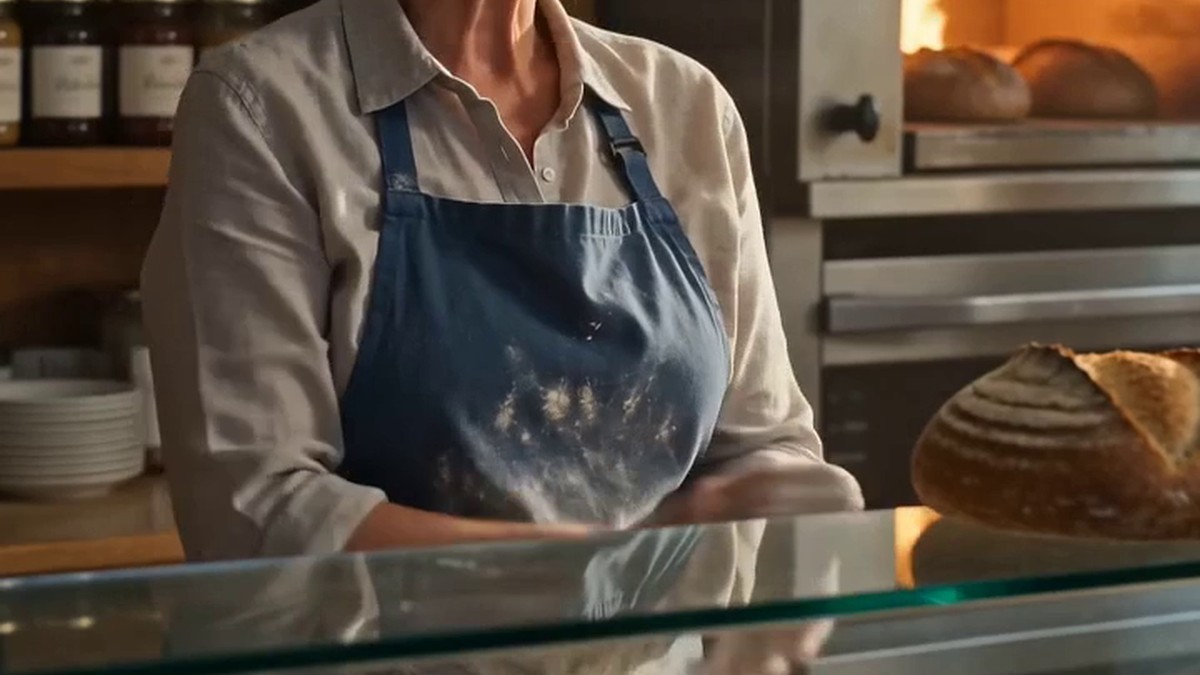
Behind the counter, a woman turned around. Gray hair pinned up, blue apron dusted with flour. Three white fingerprints on her left cheek, like someone had reached out and touched her face with powdered hands. Her name tag said Edie.
She followed my eyes to the board. "Pick one," she said. "Whichever you like."
My hand went to the yellow one. Legal pad paper, soft around the edges where other fingers had handled it. I held it like a museum ticket.
Edie took it from my palm, dropped it into a wooden cigar box by the register, and reached for a loaf on the shelf behind her. Still warm. The paper gave a crackle when she set it on the counter.
"That's mine, from this morning," she said. "It's good. Crust is still singing."
I opened my mouth to explain—nobody had told me how this worked, I didn't want to seem like a freeloader, I could maybe pay part of it—but Edie had already turned back to the oven, the way a good bartender leaves you alone after sliding your drink across the wood.
I carried that loaf home under my jacket, pressed flat against my chest. It was still giving off heat by the time I unlocked the door. The apartment was cold and without lights, so I sat on the kitchen floor by the window and tore off a piece with my fingers. No butter. Butter was $4.79 and I didn't have it. The crust snapped between my teeth, and the inside—soft, warm, faintly sour in the back of the throat—made me close my eyes for a second. I ate half the loaf and wrapped the rest in a dish towel.
What I remember most about that night isn't the bread. It's that Edie never once looked at me the way you look at someone you've just done a favor for. She looked at me the way a bus driver looks at a fare: like the transaction was normal, like I was normal, like I had every right to be there.
Three weeks later, the phone rang at 7:55 in the morning. A client I'd worked for two years earlier had a project. Three months, $4,000 a month, start Monday. I said yes before she finished the sentence. Then I sat on the edge of my bed and read the landlord's note, still folded in my coat pocket, and threw it in the trash.
On Tuesday morning, I walked back to Benedict's.
The board had changed. New tags, new handwriting. The yellow legal pad tag was gone. The daisy one too. In their place, a white tag with a child's drawing of a dog, and a blue one that said "one loaf + a smile" in loopy script.
I placed ten paper tags on the counter. Each one said one loaf in my handwriting. Ten of them, fresh from my coat pocket.
Edie looked at the tags. Then she looked at my face.
"The sourdough," she said. "Three weeks ago."
"Right."
"Ten loaves." She counted them with her finger. "That's $80."
I handed her a hundred-dollar bill. She dug in the cash register and came up with a twenty. I pushed it back across the counter.
"Put that toward the next person."
She didn't say anything. She picked up the tags, one by one, and pinned them to the board in a neat row along the left side, next to the one with the dog. Her thumb pressed each pushpin into the cork with a firm little click. That sound—door closing, door opening, I still can't decide—echoed off the tiled walls.
"The board's been up for two years," she said, not turning around. "You're the first one who came back."
I didn't know what to do with that. It was too big for the space between us. So I pointed at the shelf. "I'll take a loaf. Full price."
"Eight-fifty."
I paid with a new twenty and a five. Watched her make change: $11.50 came back to me. I dropped the coins into the tip jar without counting.
On my way out, the door chimed again. The rain had beaten down to a drizzle, and the street smelled like wet cedar and coffee from the roastery up the block.
"Those won't last the week," Edie called after me.
"Good," I said. "That's the idea."
I walked to the bus stop with the warm loaf under my arm and dry socks for a change. I had money for the fare. I had more than that. I got on the bus and counted the stops, not the coins.
The next Tuesday I went back, just to see.
The board was empty again.



Il contratto che Daniele non sapeva di aver già perso
Quella mattina ho fatto una cosa che Chiara non si aspettava: le ho lasciato il caffè pronto prima di uscire,...


Tėvo rankos sode Zarasų pakraštyje
Pro Petro Vilkausko namo langą matosi Zarasų ežeras — rudenį jis pilkas, kaip skalbinių vanduo. Gyventojai sako, kad spalį čia...


Жълто-зелената пътна чанта на Деми
Деси Вълчева остави телефона на плота с екрана надолу, сякаш искаше да му попречи да зазвъни отново. В кухнята на...


Nebylainis mokesčių skolininkas: ką Gabija man pasakė apie savo mamą ir pinigus
Mano uošvė sulaužė dantį pirmadienį, o ketvirtadienį jau nebeturėjau pinigų, kuriuos devynis metus siunčiau be klausimų. Taip tiksliai pasakyčiau, iš...


Dílna po Vladimírovi a mlčení, které Petr neslyšel
Ivana měla čtyřicet sedm let a dvacet tři z nich vedla účetnictví v autoservisu na Dobrovského ulici v Olomouci. Dílnu...


Il bagno delle nove e un quarto a Sabaudia
Faccio il bagnino allo stabilimento da sei stagioni, e di solito alle nove e un quarto del mattino la spiaggia...


Kréta a kapualjban
Pontosan két hete történt, szerda reggel, amikor hazaértem a műszakból, és ott álltam a lépcsőház előtt, mint egy idióta, mert...


Котката на Марин Петков
Тя драска, значи го мрази — така си мислех първите седмици. Казвам се Марин Петков, на четиридесет и три съм,...