
EN
The Van at Mercer Street

Dana Kowalczyk was three blocks from her apartment on Mercer Street when she heard the sound — not a crash exactly, more like a long metal groan followed by screaming that didn't stop. She worked the overnight shift at a twenty-four-hour pharmacy on Bleecker, and she'd just clocked out, still in her green polo with her name tag crooked on the collar.
It was the last Saturday in June. Pride weekend in Lower Manhattan, and Mercer Street was closed to traffic for the march — barricades, a police cruiser parked sideways at the intersection, a drum line somewhere up ahead that had gone silent all at once, like someone had cut a wire.
Dana didn't run toward it right away. She stood there for a second with her keys cutting into her palm, the way you do when your body hasn't caught up to what your ears just told you.
Then she moved.
A white cargo van — the kind a plumbing company or a catering outfit might rent — had jumped the barricade near the corner of Mercer and Spring and plowed into the edge of the crowd. It had come to rest against a scaffolding pole, front end crumpled, one headlight still weakly blinking though it was broad daylight. Rainbow flags were on the ground, some of them under the wheels. A woman in a sequined tank top lay near the curb, not moving, and two men knelt over her, one pressing his folded-up jacket against her side.
Dana had a first-aid card from a job she'd had four years ago, cleaning offices overnight, back before the pharmacy. She still remembered how to check a pulse. She dropped down next to a younger man — couldn't have been older than twenty-two, wearing rainbow suspenders that had been sliced clean through — and pressed two fingers to his neck.
That's when it stopped being a scene she was watching and became a thing she was inside of.
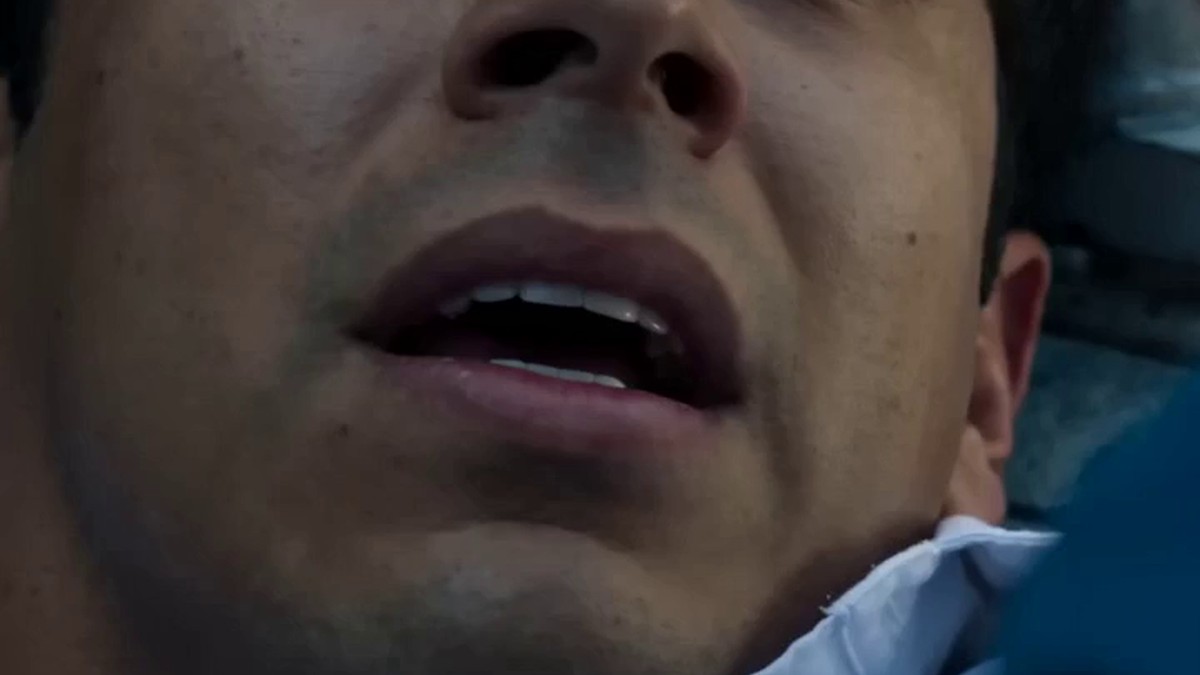
His name, she'd learn later, was Miguel. Right then he was just a weight going heavy against her knee, his good hand clawing at her wrist like he was trying to climb out of his own body. The other hand was wrong in a way she made herself not look at directly — she kept her eyes on his face instead, on the sweat cutting tracks through the dust on his forehead, on his lips moving without sound.
"Stay with me. Look at me. What's your name?"
He told her. Miguel. She said it back to him — Miguel, Miguel, you're doing great, Miguel — not because she'd read that saying a name helps, though she had, once, in a pamphlet at the cleaning job, but because it was the only word she had that meant anything. Everything else was just noise: the drum corps member somewhere behind her sobbing into a walkie-talkie, a siren rising and falling and rising again like it kept losing the street, someone shouting for a doctor, is there a doctor, in a voice that cracked on the second word.
His pulse under her fingers was quick and thin, a moth beating against glass. She pressed the flat of her palm above the wound at his forearm, hard, harder than felt right, because someone had once told her that bleeding doesn't stop on its own, it stops because you make it. Blood came up warm between her fingers anyway, and she thought, distantly, that she'd have to throw this uniform away, and then hated herself for thinking it.
"You called an ambulance? Somebody called?" His voice had gone thin and high, a kid's voice, though he wasn't a kid.
"They're coming. I can hear them." She couldn't, not yet. She said it anyway.
His grip on her wrist loosened once, terrifyingly, his eyes sliding sideways toward the scaffolding pole and the crumpled van beyond it, and something in her chest dropped straight through the sidewalk.
"No. Hey. Miguel. Look at me, not at that. Look at me."
He looked at her. His pupils were huge, black, drinking in the light. She kept talking — about nothing, about the weather, about how the fan she could hear a few feet away was Puerto Rican, wasn't that a good flag, didn't he think that was a good flag — because the words didn't matter, only the sound of her voice mattered, only staying louder than the sirens and the crying and the low metal tick of the van's engine cooling somewhere behind them.
A woman nearby, older, gripping a paper fan with a Puerto Rican flag on it, was telling anyone who'd listen that she'd seen two people jump from the side door of the van before it even finished rolling — that they'd had something in their hands, and had cut into the crowd on foot before disappearing down Spring Street. Dana heard the words without absorbing them. There was no room left in her for anything but the pulse under her palm and the sound of her own voice saying his name.
The ambulance took six minutes, maybe seven, though it felt like the length of a whole life folding and unfolding. When the paramedics finally pulled her back by the shoulders, gently, telling her good work, ma'am, we've got him now, Dana found she couldn't make her hand let go of his wrist. She had to look down at her own fingers and tell them, individually, to open.
She stood up. Her knees had gone numb on the pavement, and the world came back in pieces — the drum line's silence, the rainbow flags crushed under a tire, a paramedic's radio crackling a hospital name she didn't catch. One woman was dead at the curb. Sixteen people hurt badly enough to be hospitalized, eleven of them critical. Some of the wounds, she'd learn later, hadn't come from the van at all. Clean cuts. The kind a blade makes, not glass or bumper metal.
She gave a statement to an NYPD detective two hours later, sitting on the back bumper of a fire truck with a Red Cross blanket around her shoulders that she didn't remember accepting. Her hands, she noticed, hadn't stopped shaking long enough for her to sign her own name legibly. The detective wrote everything down on a small spiral pad, thanked her, and moved on to the next person in the folding chair.
By Sunday night, federal agents had a name: Aariz Kian Farhadi, twenty-six, an Iranian national on an expired student visa. He was picked up at a motel in New Jersey, and the criminal complaint said he'd been riding in the passenger seat, not driving. The driver was still out there — along with at least one of the two people the woman with the paper fan swore she'd seen jump from the van's side door. A grainy still from a deli security camera made the news: a man in a gray hoodie, face turned away, walking fast but not running, which somehow made it worse.
Dana went back to work Monday because the pharmacy needed her and because she didn't know what else to do with a Monday. Her manager, Priya, let her take the stockroom instead of the register so she wouldn't have to talk to customers about it. Half the neighborhood seemed to want to talk about it anyway.
On Wednesday, she went to see Miguel at NYU Langone. She hadn't planned to. She'd bought a get-well card at a CVS on Houston Street, the kind with a cartoon sunflower on it, because every card with rainbow colors had sold out that week — a small, strange tragedy all its own.
His hand was in a cast that ran past his elbow. His mother stood up when Dana walked in, like she already knew who she was, though they'd never met.
"You're the one who called out to him," she said. "He told me. Somebody kept saying his name so he wouldn't pass out."
Dana didn't remember saying his name, not exactly, not as a memory she could replay — only the shape of it, the fact of her own mouth moving. She sat with them for twenty minutes and didn't bring up the manhunt or the man they'd caught in New Jersey. At one point Miguel asked if she thought they'd catch the others. She said she didn't know. It was the only honest answer she had.
More arrests came in the following weeks — the driver, eventually, along with two more men picked up in Paterson after a tip came through. Prosecutors said the group had cased the parade route from a rented apartment with a clear sightline down Mercer. The trial wouldn't start for close to two years; a victim-services coordinator called in August to ask if Dana would testify. She said yes before she'd really thought about it. It felt less like a decision than something already settled back on the sidewalk, with Miguel's pulse still going under her fingers.
She still walks down Mercer sometimes on her way to the train, though she takes the long way around Spring now, out of habit more than fear. The city put up a small brass plaque near the scaffolding — a single name, Renata Ibarra-Solís, thirty-four, survived by a wife and a nine-year-old daughter in Sunset Park.
Dana doesn't stop at the plaque every time. But some days her feet just do it without asking her first, and she stands there until the ache behind her eyes finally breaks loose and she lets herself cry, right there on the sidewalk, for exactly as long as it takes.



Il contratto che Daniele non sapeva di aver già perso
Quella mattina ho fatto una cosa che Chiara non si aspettava: le ho lasciato il caffè pronto prima di uscire,...


Tėvo rankos sode Zarasų pakraštyje
Pro Petro Vilkausko namo langą matosi Zarasų ežeras — rudenį jis pilkas, kaip skalbinių vanduo. Gyventojai sako, kad spalį čia...


Жълто-зелената пътна чанта на Деми
Деси Вълчева остави телефона на плота с екрана надолу, сякаш искаше да му попречи да зазвъни отново. В кухнята на...


Nebylainis mokesčių skolininkas: ką Gabija man pasakė apie savo mamą ir pinigus
Mano uošvė sulaužė dantį pirmadienį, o ketvirtadienį jau nebeturėjau pinigų, kuriuos devynis metus siunčiau be klausimų. Taip tiksliai pasakyčiau, iš...


Dílna po Vladimírovi a mlčení, které Petr neslyšel
Ivana měla čtyřicet sedm let a dvacet tři z nich vedla účetnictví v autoservisu na Dobrovského ulici v Olomouci. Dílnu...


Il bagno delle nove e un quarto a Sabaudia
Faccio il bagnino allo stabilimento da sei stagioni, e di solito alle nove e un quarto del mattino la spiaggia...


Kréta a kapualjban
Pontosan két hete történt, szerda reggel, amikor hazaértem a műszakból, és ott álltam a lépcsőház előtt, mint egy idióta, mert...


Котката на Марин Петков
Тя драска, значи го мрази — така си мислех първите седмици. Казвам се Марин Петков, на четиридесет и три съм,...