
EN
The Long Way Home to Terre Haute

I've been running the snack cart on the Chicago-to-Indianapolis line for eleven years, and I remember that Tuesday because the air conditioning in car six was broken and I'd already fielded four complaints about it by Union Station.
The boy got on alone. Maybe eight, nine years old, wearing a backpack with a faded Cubs patch stitched crooked on the front pocket, like somebody's grandmother had sewn it on herself. A woman in a gray raincoat walked him to his seat, tugged his collar straight, and said something I couldn't hear over the boarding announcement. Then she stepped off, and the doors folded shut behind her.
I noticed him because kids traveling solo always sit the same way — spine straight, hands in their lap, eyes tracking every adult who walks past like they're grading a test only they can see.
His name was Caleb. I know because the conductor, a heavyset guy named Ruiz who'd worked this route almost as long as I had, checked the ticket and asked him straight out, "You riding all this way by yourself, buddy?"
"Yes, sir," Caleb said, though his voice cracked a little on the s.
For the first hour he had his face turned to the window, watching the cornfields go by, the grain silos, a water tower with someone's initials spray-painted on the side. I sold him a bag of pretzels and a ginger ale, and he counted out exact change from a Ziploc bag of quarters like he'd rehearsed it in the mirror at home.
Then the train filled up around Kankakee. A man in a Carhartt jacket sat across the aisle and kept looking over at him — not in a threatening way, just the way strangers look at kids traveling alone, half curious, half concerned. Two teenagers with a bluetooth speaker took the row behind him and started arguing about a football score loud enough to rattle the window glass. Somewhere near the back, a baby wouldn't stop crying.
I was pushing my cart through when he went still. Not scared-still like he'd seen something. Still like he was doing math in his head and the numbers weren't working out.
He pulled his knees up onto the seat, wrapped his arms around them, and his chin started to wobble. A woman two rows up offered him a tissue, which he waved off, embarrassed. Ruiz walked by and asked if he was doing okay, and Caleb nodded too fast, the kind of nod that means the opposite.
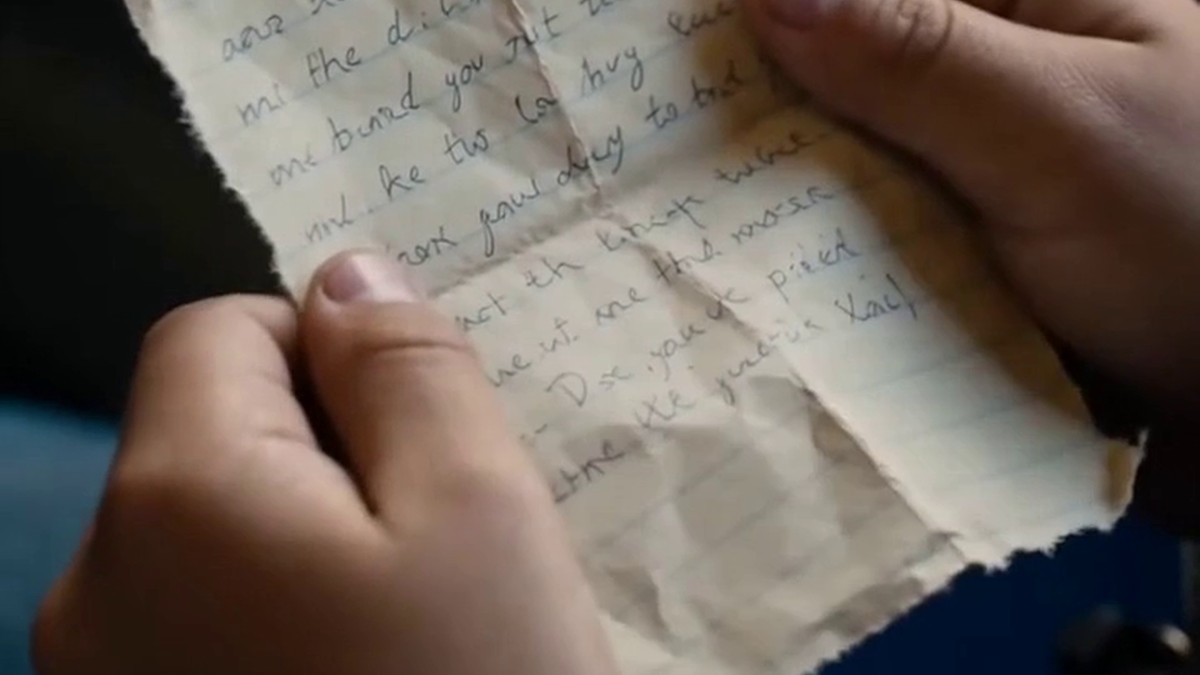
Then he unzipped the front pocket of that backpack — the one with the crooked Cubs patch — and pulled out a folded index card. I was close enough, restocking the shelf below the coffee station, to catch a few words as his lips moved along with them: *proud of you* and, lower down, something about *counting the stops with you, even from here.* He read it through twice, folded it along its worn crease, and pressed it flat against his knee like he was trying to iron the fear out of it.
His shoulders dropped about two inches, like somebody had let air out of a tire slowly instead of all at once. He tucked the card into his jacket pocket, not the backpack, like he wanted it somewhere he could reach fast, and after that he started mouthing numbers under his breath — counting the mile markers, I realized, same as somebody I'd later understand was doing the exact same thing four cars back.
About twenty minutes outside Terre Haute, I had a break in my rounds and walked the length of the train to check inventory in the last car. And there, in seat 2C, was a man in a gray-collared jacket, reading a paperback he never seemed to turn a page in, checking his watch every so often like he was counting stations without wanting to admit it.
I stopped by Ruiz's fold-down seat near the vestibule and asked if that fellow in back had boarded with the boy. Ruiz nodded this time, no shrug. "That's the dad. Ticket for 2C, booked same day as the boy's, same station. Mother's idea — she wanted Caleb to think he was riding solo. Character-building, she called it. Dad about wore a hole in the platform arguing against it, but he went along. Sat clear at the other end so the boy wouldn't spot him and lose his nerve." He said it like it was old news, like half the crew already knew, and for me it rearranged the whole ride backward — every one of those long silences the man had kept to himself suddenly had a reason behind it.
I didn't say anything to him myself. Figured it wasn't my place. But when we pulled into the station and Caleb stepped off onto the platform, that same man came down the steps from the last car maybe ten seconds later, walking fast now, no more pretending to read.
The mother was waiting by the ticket booth. Caleb saw her and broke into a run, and that was when the father called out — not loud, but it carried down the whole platform in the gap between announcements: "Hey — did you read it?"
Caleb turned, backpack bouncing, and dug the card out of his jacket pocket right there in front of everybody, holding it up like proof. "Six times," he said. "I read it six times."
The father crossed the last twenty feet in about four strides and dropped to one knee on the concrete, not caring about his slacks, and pulled the boy in so hard the backpack rode up over both their shoulders. "I counted every stop," he said, muffled against Caleb's hair. "Kankakee, Rensselaer, all of them. Same as you."
The mother reached them a beat later, checked the backpack zipper out of habit, and started in with her string of questions — did you eat, were you scared, did anyone bother you — but Caleb wasn't really listening to her yet. He was still holding that card out at arm's length, like he needed his father to see that he'd kept it safe the whole way.
I never got a clean look at what was written on it, and I still don't know the exact words. Don't need to. I know it was the kind of thing a father writes when he can't ride next to his son but can't stand the idea of him riding scared, either — something short enough to fit in a jacket pocket and true enough to read six times over two hundred miles of cornfields.
The three of them started off toward the parking garage — the mother still talking, the boy between them now instead of trailing behind, the father carrying the backpack, the crooked Cubs patch turned out toward the platform lights, getting smaller as they walked.



Pavel a plot u Chomutova
Jmenuju se Pavel, mám třicet osm a vlastním autoservis na okraji Chomutova, kousek od řeky Chomutovky. S Danou jsme manželé...


Svatba v Kroměříži
Catering jsem dělala přes patnáct let a myslela jsem si, že mě už nic nepřekvapí. Pak přišla ta zakázka na...


Le bracelet de la salle 114
Le tapis rouge du Grand Rex scintillait sous les flashs. Ce soir-là, Clémence Auvray présentait son dernier film, et les...


Byt na Košířské: co zbylo, když se rata splácí sama
Taška s nákupem se roztrhla hned u vchodu. Jedna mandarinka se odkoulela pod botník a zůstala ležet v koutě, oranžová...


Bikiny za 2990 korun a faktura, kterou nikdo nečekal
Na téhle fotce jsem na sebe byla pořádně hrdá. Písek na Vracovské pláži u Nechranické přehrady, slunce nízko nad hladinou,...


Das rote Kleid in der Maximilianstraße
Lina Brandt hatte nur die Stoffkante zwischen zwei Fingern reiben wollen. Eine Sekunde, nicht mehr. Das Kleid hing im Schaufenster...


Zdrada Grzegorza na lotnisku w Modlinie
Przez jedenaście lat byłam tą, która trzymała tę rodzinę w jednym kawałku. Pamiętałam urodziny, płaciłam faktury za warsztat, zanosiłam kwiaty...


Dětský koutek v Jihlavě, čtvrtek, devět ráno
Dětský koutek v Jihlavě měl skončit ve čtvrtek. To jsem se dozvěděla v úterý, od paní knihovnice Hany, s hlasem...