Connect with us

З життя

A Dog’s Eyes Filled With Tears Upon Recognizing Its Former Owner in a Heartwarming 6-Minute Read

Published

on

In the darkest, most remote corner of the municipal animal shelter, where even the flickering fluorescent lights refused to reach, lay a dog curled upon a thin, threadbare blanket. A German shepherd who must have once been strong and majestic now resembled nothing more than a ghost of his former self. His coat, once the pride of his breed, was tangled and scarred, faded to an ashen hue. Every rib pressed against his skin like a silent testament to hunger and neglect. The volunteers, their hearts hardened by years of thankless work but not entirely numb, had named him Shadow.

The name wasnt just for his dark fur or his habit of retreating into the gloom. He was like a shadowsilent, nearly invisible, wilfully withdrawn. He didnt lunge at the bars when people passed, didnt join the chorus of barks, didnt wag his tail for fleeting affection. He only lifted his noble, greying muzzle and watched. He studied the feet that shuffled past his cage, listened to the unfamiliar voices, and in his dull, deep eyeslike an autumn sky heavy with rainthere remained one flickering ember: a painful, exhausting wait.

Day after day, the shelter bustled with noisy familiesshrieking children, adults eyeing younger, prettier, “smarter” pets. But in front of Shadows cage, the cheer always died. Parents hurried past, casting pitying or disdainful glances at his skeletal frame. Children fell silent, instinctively sensing the ancient sorrow clinging to him. He was a living reproach, a reminder of a betrayal he seemed to have forgotten, yet one etched deep into his soul.

The nights were the worst. When the shelter settled into its uneasy slumber, filled with whimpers and claws scraping concrete, Shadow rested his head on his paws and made a sound that tightened the chests of even the most hardened keepers. Not a whine, not a howl of loneliness, but a sighlong, deep, almost human. The sound of an emptiness so vast, of a soul that had once loved unconditionally and now faded under the weight of that love. He was waiting. Everyone who looked into his eyes knew it. Waiting for someone he no longer believed would return, yet couldnt stop waiting for.

That fateful morning, autumn rain hammered down without mercy, drumming against the tin roof in a relentless rhythm, washing what little colour remained from the grey day. Closing time was near when the door creaked open, letting in a gust of damp air. On the threshold stood a mantall, slightly stooped, wearing a sodden flannel jacket from which rainwater dripped onto the worn floor. His face was wet, the lines around his eyes deepened by exhaustion. He stood frozen, as though afraid to disturb the fragile sorrow of the place.

The shelter manager, a woman named Grace, spotted him. Years of work had given her an almost supernatural ability to read visitorswhether they were just looking, searching for a lost pet, or hoping for a new friend.

“Can I help you?” she asked, her voice barely above a whisper, careful not to shatter the quiet.

The man startled as if waking from a dream. He turned slowly. His eyes were the red-ochre of exhaustionand perhaps unshed tears.

“I’m looking” His voice was rough, like a rusted hinge, the sound of someone whod forgotten how to speak aloud. He hesitated, then reached into his pocket and pulled out a small, laminated scrap of paper, yellowed with age. His hands trembled as he unfolded it. In the faded photo stood a younger version of himselfno lines around his eyesand beside him, a proud, gleaming German shepherd with intelligent, loyal eyes. Both smiled under a summer sun.

“His name was Rex,” the man whispered, fingertips brushing the dogs image with aching tenderness. “I lost him years ago. He was everything to me.”

Grace felt a painful knot tighten in her throat. She nodded, not trusting her voice, and motioned for him to follow.

They walked down the endless corridor, deafened by barks and scratching claws. Dogs leapt against their cages, tails wagging, desperate for attention. But the manwho gave his name as William Carterseemed not to see or hear them. His sharp, searching gaze swept over each kennel, each huddled shape, until they reached the very end. There, in his usual gloom, lay Shadow.

William stopped dead. The breath left his lungs in a rush. His face drained of colour. Without caring for the puddle at his feet or the grime on the floor, he dropped to his knees. His fingers, white with strain, gripped the cold bars. The shelter fell into an unnatural silence. Even the dogs seemed to hold their breath.

For seconds that stretched into eternity, neither man nor dog moved. They only stared at one another through the bars, struggling to recognise in each others worn features the being they remembered as bright and full of life.

“Rex” The name escaped Williams lips in a broken whisper, thick with desperate hope that made Graces chest tighten. “Old boy its me.”

The dogs ears, stiff with age, twitched. Slowly, so slowly it seemed to take all his strength, he lifted his head. His clouded, cataract-veiled eyes fixed on the manand in them, through years of pain, a spark of recognition flared.

Shadowno, Rexshuddered. The tip of his tail gave one hesitant wag, as if recalling a forgotten gesture. Then, from his chest came a soundnot a bark, not a howl, but something in between: a heart-wrenching whine, high and trembling, carrying years of longing, the agony of separation, doubt, and a blinding joy. Thick tears spilled from his eyes, rolling down his greying muzzle.

Grace clamped a hand over her mouth, her own cheeks wet. Other keepers, drawn by the unearthly sound, gathered in silence, frozen by the scene.

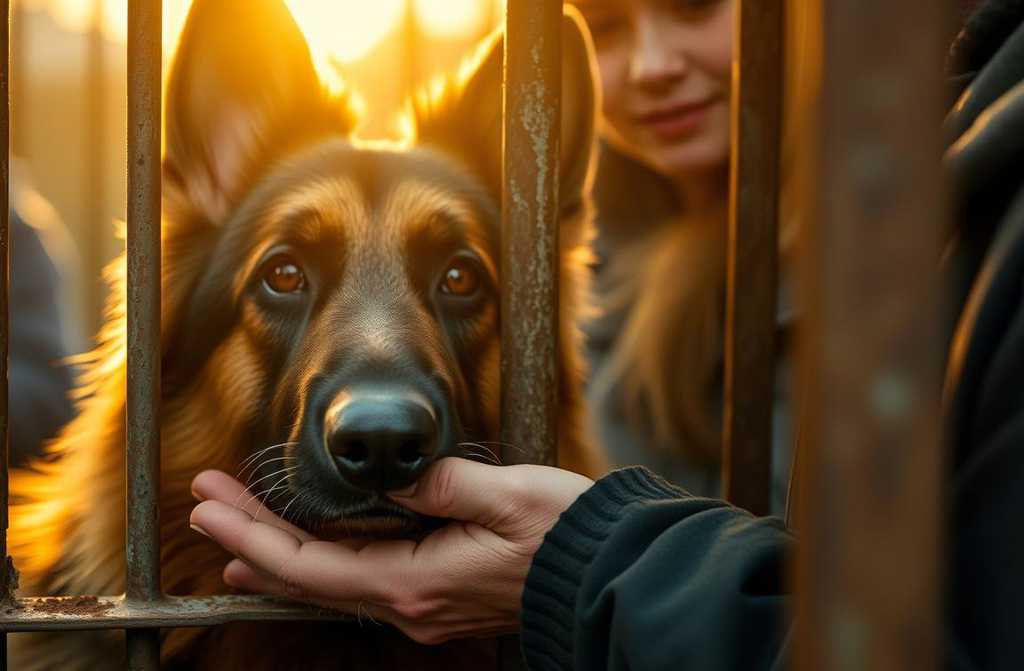
William, weeping, slid his fingers between the bars, touched the rough fur at the dogs neck, scratched that spot behind the ear no one had touched in years.

“Forgive me, old boy,” he choked out. “I looked all these years never stopped looking.”

Rex, forgetting his age and the ache in his bones, pressed closer, burying his cold nose into the mans palm and whimpering againplaintive, childlike, as if releasing years of stored grief.

And as the setting sun gilded the rain-soaked streets outside, the two walked away from the shelter, step by step, toward a home that was finally whole again.

Click to comment

Leave a Reply

Ваша e-mail адреса не оприлюднюватиметься. Обов’язкові поля позначені *

15 + три =

Також цікаво:

З життя58 хвилин ago

“My Grandchildren Only See Fresh Fruit Once a Month, But She Buys Expensive Food for Her Cats!”: My Daughter-in-Law Accuses Me of Being Cold-Hearted for Putting My Pets First, but I Won’t Let Her Guilt Me into Supporting Their Growing Family

My grandchildren only see fresh fruit once a month, yet she spends a fortune on fancy cat food, my daughter-in-law...

З життя59 хвилин ago

Oxana, Are You Busy? – A Festive New Year’s Eve Tale of Family, Holiday Hustle, a Mishap in the Snow, and an Unexpected Encounter with a Doctor That Changed Everything

Annie, are you busy? her mum calls, poking her head through the door to her daughters room. Just a second,...

З життя2 години ago

Vitaly Settles in with Coffee and His Laptop to Finish Work—Until an Unexpected Call from the Maternity Ward Changes Everything: A Stranger’s Baby, a Past Affair in Brighton, and the Decision That Will Change His Life Forever

Edward settled himself at his mahogany desk, laptop open and a steaming mug of tea beside him. He had a...

З життя2 години ago

Igor Never Came Back from Holiday: “Why hasn’t your husband written or called?” “No word, Vera—not after nine days, not after forty,” Lyuda would joke, adjusting her work apron over her broad waist. “So he’s gone off the rails, or worse, then,” her neighbour nodded sympathetically. “Well, wait and see. Have the police said anything?” “Everyone’s silent, Vera—quiet as fish in that sea of his.” “Life, eh… fate.” That conversation weighed heavy on Lyudmila as she swept the autumn leaves from her doorstep in the dreary fall of 1988. Three years into her well-earned retirement, she’d had to take up work as a council cleaner to make ends meet. Life had always been simple—she and her husband, both dutiful workers, had raised a son, no scandal, no sorrow. Then Igor went on a seaside holiday and never returned. She’d phoned every hospital, every police station, even the morgue. Her son, stationed with the military, helped with inquiries—it was discovered Igor checked out of his hotel but never boarded the train home. Lyudmila wanted to go search for her husband, but her son insisted he’d handle it. Weeks passed, and she kept herself busy to stifle her fears. Then, as suddenly as he’d vanished, Igor reappeared—no suitcase, just the same navy suit and a weary silence. As she fussed to feed him and her son, the truth unravelled: Igor had been living with another woman by the sea, seeking “freedom.” The shock, the ache of betrayal—Lyudmila couldn’t bear it. Igor, shamed and lost, tried to return weeks later, but Lyudmila stood firm. It wasn’t just heartbreak—it was the pain of not knowing, of years shared and suddenly made strange. She swept her pathway, watching leaves collect and blow away, knowing sometimes those who hurt us most have already gone with the wind. (Original Title Adapted for English Culture: Igor Never Came Back from Holiday: The Disappearance, the Heartbreak, and the Road Swept Clean)

Yours hasnt written or rung you yet? No, Vera, not a word after nine days, not after forty either, Lydia...

З життя3 години ago

You Drive Me Up the Wall!… I Can’t Eat Right, Can’t Dress Right, Can’t Do Anything Right! — Pavel’s voice broke into a shout. — You can’t do anything!… Can’t even earn proper money!… We never get any help from you around the house!… — Marina burst into tears, — …And there are no children…, — she whispered. Belka — a white-and-ginger cat of about ten, perched atop the wardrobe, silently witnessed yet another “family tragedy”. She knew, she could sense, that Mum and Dad truly loved each other… But she didn’t understand why they said such cruel words that hurt everyone. Mum, sobbing, locked herself in the bedroom as Dad lit one cigarette after another. Belka, seeing her family falling apart, thought, “There must be happiness in this house… and happiness means children… we need to find some children…” Belka couldn’t have kittens herself — she’d been spayed years ago, and as for Mum… the doctors said she could, but something just wouldn’t work out… The next morning, after her humans left for work, Belka, for the very first time, slipped out the window to visit her neighbour Pawsy — for advice. — Why would you want kids? — scoffed Pawsy. — Ours come with children, and I have to hide from them… they smear lipstick on your face or squeeze you until you can’t breathe! Belka sighed: — We just need normal children… If only we could find some… — Hmmm… That street cat Molly’s had a litter… five of them… — mused Pawsy. — Take your pick… Taking her chances, Belka leapt balcony to balcony to the street. Shivering nervously, she squeezed through the railings of a basement window and called out: — Molly, could you come out for a minute, please… From deep within came desperate squeaks. Carefully crawling through, eyes darting in fear, Belka began to cry. Under the radiator, on the hard gravel, lay five tiny, sightless kittens, nudging the air and wailing for their mum. One sniff told her: Molly hadn’t been back for at least three days. The babies were starving. Fighting tears, Belka gently carried each kitten to the entrance. Trying to calm her hungry, squeaking brood, Belka lay down beside them, anxiously watching the end of the yard, waiting for Mum and Dad. Pavel, silent as he met Marina after work, brought them home. As they reached the doorway, they froze — there was their Belka, (who had never set paw on the street alone), and five multicoloured kittens clambering to nurse from her. — What on earth? — Pavel was stunned. — A miracle…, — echoed Marina, and together they scooped up the cat and kittens and rushed inside… Watching Belka purr happily in a box with her new babies, Pavel asked: — But what do we do with them? — I’ll feed them with a dropper… once they’re bigger, we’ll find them homes… I’ll call my friends…, — Marina whispered. Three months later, still stunned by the turn of events, Marina sat stroking her “cat pack” and murmured, over and over: — Things like this just don’t happen… this just doesn’t happen… Then, she and Pavel broke down in happy tears; he swept her into his arms, and they both laughed and chattered at once: — I’m glad I finished building the house! — Perfect for a child to get some fresh air! — And let the kittens run in the garden! — There’ll be room for everyone! — I love you! — And I love you even more! Wise Belka brushed away a tear — life, it seemed, was finally coming together…

How you get on my nerves! Nothing I do is right not even how I eat, not even what I...

З життя3 години ago

I Called Out the Window: “Mum, Why Are You Up So Early? You’ll Catch Your Death!” — She Turned and Waved Her Shovel Cheerfully: “I’m Doing This for You Lazybones!” — And the Next Day, My Mum Was Gone… I Still Can’t Walk Past Our Garden Gate Without Tears
 Every Time I See That Pathway, My Heart Clenches Like Someone’s Gripped It in Their Fist. I Took That Photo on the Second of January… I Only Stopped When I Noticed Her Footprints in the Snow—Now That Photo Is All I Have Left of Those Days… We’d Spent New Year Together, Just as Always: Mum in Her Favourite Apron I Gave Her at School, the Smell of Fried Burgers, Family Jokes, Dad Arriving with an Enormous Tree, All of Us Decorating, Singing Old Christmas Songs, Laughing Until We Cried… On 2nd January, I Looked Out to See Mum Clearing a Perfect Pathway from the Gate to Our Door, Her Scarf Tied Up, Red-cheeked, Shovelling Snow So We Wouldn’t Have to Struggle Through the Drifts. “It’s for You, My Lazy Lot—Go Put the Kettle On,” She Called, Smiling. That Was the Last Time I Heard Her Voice So Cheerful. The Next Day She Was Gone, So Suddenly It Didn’t Seem Real. Only Her Little Footprints Remain—Marks in the Snow, and In My Heart.

I remember shouting out the window, Mum, what are you doing out there so early? Youll freeze! She turned around,...

З життя4 години ago

THE MOTHER-IN-LAW Anna Petrovna sat in the kitchen, watching the milk quietly simmer on the stove. Three times she’d forgotten to stir it, and each time she remembered too late: the froth would rise and spill over, and she’d wipe the stovetop in irritation. In those moments, she realized: it wasn’t about the milk. Ever since her second grandchild was born, it was as if everything in the family had gone off the rails. Her daughter grew weary, lost weight, and spoke less. Her son-in-law came home late, ate in silence, and sometimes retreated straight to the bedroom. Anna Petrovna noticed all this and thought: how could anyone leave a woman alone like this? She spoke up—first gently, then with more edge. At first to her daughter, then to her son-in-law. But she began to notice a strange thing: after her words, things in the house didn’t get lighter—they got heavier. Her daughter defended her husband, her son-in-law grew more withdrawn, and she herself went home with the feeling she’d once again done the wrong thing. That day, she went to the vicar not for advice, but because she simply had nowhere else to go with these feelings. ‘I suppose I’m just a bad person,’ she said, not looking at him. ‘I do everything wrong.’ The vicar was sitting at his desk, writing. He put down his pen. ‘Why do you think that?’ Anna Petrovna shrugged. ‘I wanted to help. But it seems all I do is make everyone angry.’ He looked at her kindly, without judgment. ‘You’re not a bad person. You’re tired. And very anxious.’ She sighed. That felt like the truth. ‘I’m scared for my daughter,’ she said. ‘She’s so different after giving birth. And him…’ she waved a hand. ‘It’s like he doesn’t even notice.’ ‘And do you notice what he does?’ asked the vicar. Anna Petrovna thought. She remembered last week, when he quietly washed the dishes late at night, thinking no one noticed. Or on Sunday, when he took the pram out for a walk, even though it was clear he just wanted to lie down and sleep. ‘He does things… I think,’ she said uncertainly. ‘But not the way he should.’ ‘And what is “the way he should”?’ asked the vicar calmly. Anna Petrovna wanted to answer right away, but suddenly realized she didn’t know. In her head: more, more often, more attentively. But specifically what, she couldn’t say. ‘I just want it to be easier for her,’ she said. ‘Then say that,’ the vicar responded gently. ‘But say it to yourself, not to him.’ She looked up at him. ‘What do you mean?’ ‘I mean that right now, you aren’t fighting for your daughter—you’re fighting with her husband. And fighting means tension. Everyone gets tired of that. You. Them.’ Anna Petrovna was silent for a long time. Then she asked: ‘So what should I do? Pretend everything’s fine?’ ‘No,’ he said. ‘Just do what helps. Not words, but actions. And not against anyone, but for someone.’ On the way home, she thought about this. Remembered how, when her daughter was little, she didn’t lecture her but just sat beside her when she cried. Why was it different now? The next day she showed up without warning. Brought soup. Her daughter was surprised, her son-in-law awkward. ‘I won’t stay long,’ Anna Petrovna said. ‘Just came to help.’ She watched the children while her daughter slept. Left quietly, without saying a word about how hard things must be or how they ought to live. A week later, she came again. And a week after that. She still saw her son-in-law wasn’t perfect. But she began to notice other things too: how carefully he lifted the youngest, how he tucked a blanket around her daughter at night, thinking no one saw. One day, she couldn’t help herself and asked him in the kitchen: ‘Is it hard for you right now?’ He looked surprised, as if no one had ever asked him that. ‘It’s hard,’ he said after a pause. ‘Really hard.’ And that was it. But after that, something sharp disappeared from the air between them. Anna Petrovna realized: she’d been waiting for him to change. But what needed to change was herself. She stopped discussing him with her daughter. When her daughter complained, she didn’t say, ‘I told you so.’ Just listened. Sometimes she took the children so her daughter could rest. Sometimes she called her son-in-law to ask how he was. It wasn’t easy. It was much easier to get angry. But slowly, the house grew quieter. Not better, not perfect—just quieter. Without the constant strain. One day her daughter said: ‘Mum, thank you for being with us now, not against us.’ Anna Petrovna thought about those words for a long time. She realized something simple: peace isn’t when someone admits they’re wrong. It’s when someone is the first to stop fighting. She still wished her son-in-law was more attentive. That wish didn’t go away. But living alongside it was something more important: wanting peace in the family. And every time the old feelings came up—indignation, bitterness, the urge to say something sharp—she asked herself: Do I want to be right, or do I want life to be easier for them? The answer almost always told her what to do next.

MOTHER-IN-LAW Margaret Brown sat in her kitchen, watching as the milk quietly simmered on the hob. She’d forgotten to stir...

З життя4 години ago

Foolish Anna: For 15 Years Everyone Called Her Simple – Her Husband Cheated Openly Since Their Wedding Day, While She Endured With a Smile. Little Did He Know, the Quiet Toy Factory Accountant Had a Master Plan That Would Turn His World Upside Down on Their Son’s Tenth Birthday

Everyone always said Emma was a simpleton. Shed been married to Tom for fifteen years and they had two kidsEmily...