
З життя
At my husband’s funeral, a silver‑haired stranger leaned in and whispered, “Now we’re free.” It was the man I loved at twenty, the one destiny had torn apart.

The earth reeked of grief and dampness. Every stone I tossed onto the lid of a coffin seemed to thud somewhere beneath my ribs.
Fifty years. A whole lifetime spent with David. A life built on quiet respect, routine that had slowly softened into tenderness.
I didnt weep. My tears had dried the night before, when I sat beside his bedside and held his cooling hand, listening to his breath grow ever more shallow until it finally slipped away.
Through the black veil I caught glimpses of sympathetic facesrelatives, acquaintancesoffering empty words and perfunctory embraces. My children, Christopher and Emily, clutched at my shoulders, but I barely felt their touch.
Then he stepped forward. Greyhaired, deeplined around the eyes, yet with the same straight back I remembered. He leaned in close enough for his whisper, familiar to a tremor, to cut through the shroud of loss.
Lizzie, now were free.
For a heartbeat I stopped breathing. The scent of his colognesandalwood mingled with pine and forest earthhit my temples like a blow.
In that smell lay everything: arrogance and hurt, past and an illfitting present. I lifted my eyes. Andrew. My Andrew.
The world swayed. The thick incense of the chapel gave way to the fresh aroma of hay and a summer thunderstorm. I was twenty again.
We ran, hand in hand. His palm was warm and strong. The wind teased my hair while his laughter dissolved into the chirping of crickets. We fled my house, fled the future that had been mapped out for us in neat rows.
That Sykes wont suit you! boomed my father, Charles Matthews. Hes got no penny in his pocket, no standing in society!
My mother, Susan Anderson, crossed her arms, her voice sharp.
Think it over, Elizabeth! Hell ruin you.
I remember my reply, quiet but as firm as steel.
My disgrace would be living without love. Your honour feels like a cage.
We found it by accidentan abandoned foresters hut, its walls halfgrown into the earth, windows jutting like eyes. It became our world.
Six months. One hundred eightythree days of absolute, desperate happiness. We chopped wood, fetched water from a well, read a single book by the flicker of a kerosene lamp, sharing the pages. It was hard, we were hungry, we were cold.
But we breathed the same air.
One winter, Andrew fell seriously ill. He lay delirious, feverish as a furnace. I brewed bitter herbs, swapped icy compresses on his forehead, and prayed to every saint I could recall.
Staring at his pallid face, I realised that thisthis simple, relentless caringwas the life I had chosen for myself.
They found us in spring, when the snowdrops were pushing through the meltwater.
There were no screams. No struggle. Just three stern men in identical overcoats and my father.
The games are over, Elizabeth, he said, as if we were finishing a lost round of chess.
Two men held Andrew. He didnt fight, didnt shout. He simply looked at me, and the pain in his eyes was so great I almost choked. It promised, in its own way: I will find you.
They took me away. The bright, living forest gave way to the dim, dusty rooms of my parents house, smelling of mothballs and unfulfilled hopes.
Silence became the chief punishment. No one raised their voice at me. I was ignored, as if I were a piece of furniture destined for the attic.
A month later my father entered my room. He stared out the window, not at me.
On Saturday David Armitage will arrive with his son. Make yourself presentable.
I said nothing. What was the point?
David Armitage was the opposite of Andrewcalm, laconic, eyes kind but weary. He talked about books, his work at an engineering firm, his plans for the future. There was no room in those plans for madness or escape.
Our wedding took place in autumn. I stood in a white dress that felt more like a shroud, mechanically answering I do. My father was pleased; he had secured the proper soninlaw, the proper match.
The early years with David were a thick fog. I lived, breathed, went through the motions, never quite waking up. I was a dutiful wifecooking, cleaning, welcoming him home from work. He never demanded anything; he was patient.
Sometimes, when he thought I was asleep, I felt his gaze. There was no passion, only an endless, deep pity. That pity hurt more than my fathers anger ever had.
One evening he brought a sprig of lilac into the room, simply handing it to me.
Spring is out there, he whispered.
I took the flowers, and their faint, bittersweet scent filled the room. That night I wept for the first time in months.
David sat beside me, not hugging, not consolingjust there. His silent support felt stronger than a thousand words.
Life moved on. Our son, Christopher, was born, followed by our daughter, Emily. Their tiny fingers, their laughter, melted the ice in my heart.
I learned to value Davids reliability, his steady strength, his kindness. He became my friend, my rock. I loved himnot the fierce, burning love of youth, but a quieter, mature, hardwon affection.
Yet Andrew never truly left. He visited me in dreams; we ran across fields, lived again in that derelict hut.
I would wake with tears on my cheeks, and David, without a word, would squeeze my hand tighter. He knew everything. He forgave everything.
I wrote to Andrewdozens of letters that never left my desk. I burned them in the fireplace, watching the flames devour words meant for another.
Did I ever ask about him? Did I try to learn? No. I was terrified of shattering the fragile world I had built, of discovering he had moved on, married, forgotten me. Fear outweighed hope.
Now he stood at my husbands funeral. Time had smoothed the youthful features of his face, but his eyes remained as piercing as ever.
The service passed in a hazy blur. I mechanically accepted condolences, nodded, gave halfhearted replies. My whole being was taut like a string, feeling his presence behind me.
When everyone had left, he lingered by the window, watching the garden darken.
Ive been looking for you, Lizzie, he said, voice low, hoarse.
I wrote to you every month for five years, he continued. My father returned every letter unopened.
He turned toward me.
And then I learned youd married.
The room grew heavy, each of his words settling like dust on the portrait of David that sat above the mantel. Fifty years. Sixty letters that might have changed everything.
My father I began, but my voice failed. What could I say? That he had broken not one, but two lives, acting from what he thought were noble motives?
He came to me a week after we were separated. He gave me a condition: I would leave town forever and never try to contact you.
Instead of filing a report for for kidnapping my daughter he laughed bitterly, I was scared, not for myself, but for you.
I imagined my father, Charles Matthews, jaw set, eyes hard, and a twentyyearold Andrew, bewildered, humiliated, trying to keep his dignity.
I went north, worked in geological surveys. Communication was scarce; letters took months. I thought I could run away from everything. You cant run from yourself, he said, running a hand through his grey hair. I sent letters to your aunts address, hoping it would be safer. My father must have anticipated that. I couldnt returnexpeditions lasted two or three years. When I finally came back after five years, it was too late.
The house where Id spent fifty years with David suddenly felt foreign. The walls, steeped in our shared life, stared back at me in mute witness. The armchair where David liked to read, the table where we played chessthese were real, warm, mine. Yet a ghost from the past had intruded, shaking the foundation.
Are you still here? I asked softly, fearing the answer.
I lived, Lizzie. I worked, drifted through the taiga, tried to forget and failed. Then I met a woman, a doctor on the expedition. We married, had two sons, Peter and Alex. His tone was plain, devoid of flourish. That plainness cut deeper than any blade. My dream of him forever waiting for me shattered into a thousand shards.
He had a family. A life in which there was no room for me.
A strange, misplaced jealousy rosejealousy of a past that I never truly possessed.
Her name was Katie. She died seven years ago, illness. He stared past me, through the wall. The boys grew up, moved away. I came back to this town a year ago.
A whole year? I blurted. Why now?
What else could I have done, Lizzie? Come here, to your home? He met my gaze squarely. I saw your husbands obituary in the paper. I remembered his name. I knew I had to comenot to demand anything, but to close that door, perhaps open it. I wasnt sure.
He took a step toward me.
Lizzie, Im not asking you to erase your life. From this house, from the photographs, I can see you were happy.
Your husband he was a good man. He paused, eyes softening. I just want to know if any ember of that fire still smolders in you, in that hut in the woods.
I looked at himthe grey, tired man, barely a shadow of the reckless youth. I looked at Davids portrait, his calm, familiar face.
One man gave me half a year of reckless fire; I paid for it all my life. The other gave me fifty years of steady warmth that I only learned to value too late.
I dont know, I said honestly. All I know is that today I buried my husband, and I loved him.
He nodded, understanding flickering in his eyesno resentment, just comprehension.
I understand. Ill return in forty days, if youll let me.
He left. The click of the front door offered no relief; instead the empty house after the funeral filled with loud questions.
Forty days. In Anglican tradition that span is meant for the soul to reckon with the world before moving on. For me, it was a period to sort the worlds inside me.
The first week I sorted Davids things. It was torture and medicine at once. His favourite sweater still clung to the faint scent of his tobacco. His spectacles lay on the desk beside an unfinished novel. Each object shouted his name, our quiet, measured life.
In a drawer I found an old tin box. Inside were not documents or medals, but wilted flowers I once tucked into my hair, a cinema ticket from our first date, and a faded photograph of me at twentyone.
I stare at the image, serious, almost hostile. No hint of a smile. He kept that photo for fifty yearskept me, the woman hed received, not the one hed imagined. In that silent adoration lay more love than any passionate vows.
Days passed. Children called, visited, brought groceries. Their care wrapped around me, yet also deepened my guilt.
One afternoon Emily hugged me and said, Mum, we know its hard. Dad loved you so much. He always said you were the best part of his life.
Her words were sincere, and they cut even deeper. I felt I was betraying his memory with every recollection of Andrew.
Sleep fled me. At night I sat in the garden chair, staring into the dark. Two images stood before me: the wild, scorching passion of youth and the deep, tranquil river of my maturity. Could they be compared? Could I choose? It felt like choosing between sun and airboth essential to life.
I realised Andrew had been wrong about the ember. Yes, a piece of coal remained, but for fifty years David had built a warm, reliable home around that coal. To tear it down would be to tear myself apart.
On the fortieth day I woke with a clear sense of rightness. I made the traditional funeral pancakes, laid them on the table as my mother had taught me, and placed Davids portrait at the centre.
I didnt know whether Andrew would come, nor what I would say.
After lunch I stepped into the garden to prune the roses David loved. The crisp autumn air sobered me.
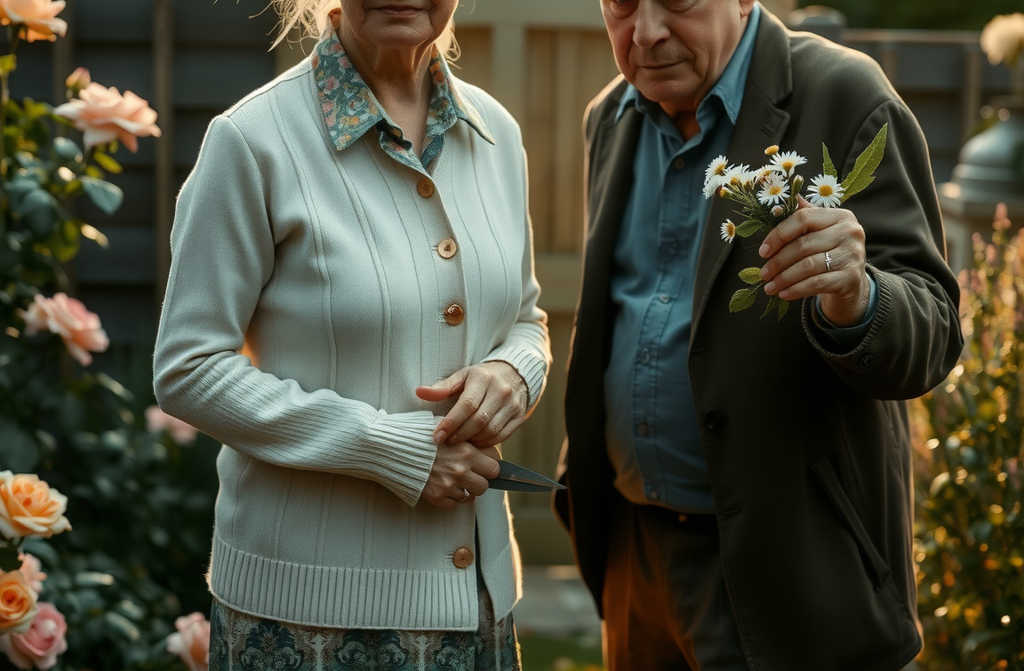
The gate creaked. He stood on the path, hesitant, a small bouquet of wild daisiesjust like the ones he had given me at the foresters hutclutched in his hands.
He took a step, then another. I didnt move, only tightened my grip on the garden shears.
Good morning, Lizzie, he said.
Good morning, Andrew.
He offered the flowers. I didnt take them.
Thank you, theyre lovely, but you dont need them. Pain flickered in his eyesthe same that had haunted him fifty years ago.
I loved my husband, I said, quietly but firmly, each word forged in sleepless nights. He was my life. I wont betray his memory. The path you spoke of has long overgrown. A different garden now thrives there, and Ill tend it.
I turned and walked back to the house, not looking back. I heard his footsteps behind me, waiting for a word that never came.
At the doorway I finally glanced back. He still stood there. Slowly he placed the daisies on the garden bench, turned, and walked toward the gate.
I shut the door, approached Davids portrait, and lingered on his kind, allunderstanding eyes. For the first time in forty days I smiled. The road wasnt newly opened; it had been walked. I was finally home.
Five years later.
The bench where Andrew left his daisies is now a playground for my grandchildren. They leave toys, halfread books, secret notes upon it. I no longer sit there alone.
Time is a remarkable healer. It does not erase scars, but it smooths them into thin silver threads woven into the fabric of life.
The sorrow of losing David settled into a gentle, bright melancholy and a profound gratitude.
The house ceased to be a place of mourning. It buzzed again with the laughter of greatgrandchildren, the scent of apple cake on Sundays.
Andrews name has faded from my thoughts. When I am alone, I think of him not with longing or regret but with a mature, detached curiosity. How did his life turn out after our last meeting? Did he ever find peace? I sincerely wish him that. He was a chapter from my youthful bookbright, burning, importantbut the book has long been read to completion, and I know it by heart. Rereading serves no purpose.
My days now consist of small rituals: morning tea on the veranda, tending Davids roses that have swelled into a fragrant wall, evening calls to my children, bedtime stories for my greatgrandchildren over video chat.
One day my eldest greatgranddaughter, Kat, came to visit alone. We sat in the garden, and she, her serious eyes locked on mine, asked, Gran, were you truly happy with Granddad? Really?
She was at the age when love still feels like a storm, a blaze, something extraordinary. I looked at her searching face and knew I could not answer with a simple sentence.
I stood, invited her inside, and took from Davids tin box the faded photograph of my twentyoneyearold self. I placed it beside a recent picture from my eightieth birthday, where I sit surrounded by a sprawling family, my face lined yet lit with a smile.
Look, I said. In this picture is the girl who thought happiness meant running away. In this one is the woman who learned happiness is building something solid, not on ashes but on firm ground.
I took her hand.
Your grandfather didnt give me a blaze, Kat. He taught me how to keep a fire going and to protect the hearth.
He gave me not half a year of madness, but half a century of lifereal, with all its joys and hardships. That turned out to be the greatest happiness.
She stared at the photos in quiet reverence, and I think she understood.
That evening, when the house fell quiet, I slipped back into the garden. The stars shone bright and cold.
I thought about the roads we choose: those that lure us with mystery and those we pave ourselves, step by step.
Andrew once said the path was open. He missed the point. Freedom isnt having every road before you; its choosing one road and walking it to the end without regret.
In my garden, with the memory of my husband and the love of my family surrounding me, I was truly free.



A jászberényi diófa, amelyik hatszázezer forintot ért meg egy családnak
A jászberényi diófa, amelyik örökre megmentett egy udvart Negyedik éve dolgozom a jászberényi piacon zöldséges standnál, pont szemben azzal a...


Žentas, kuris liko: Birutės akys devynerius metus
Mane vadina nedėkingu žentu. Taip sako uošvienės draugės prie bažnyčios Pasvalyje, kai aš parvežu ją iš poliklinikos ir padedu išlipti...


האלמנה מרחוב הדקלים
היה סוף אוקטובר, בבאר שבע עוד נשבה החמסין המאוחר שחודר דרך כל בד, לא משנה מה לובשים מתחתיו. אני לבשתי...


Свекървата ми изхвърли дрехите, а мъжът ми мълчеше
Стоях във всекидневната с разкъсан найлонов плик до краката и гледах празния рафт в гардероба. — Къде е ризата ми...


Dvě stě padesát hodin, matko
Tereza seděla v kuchyni na sídlišti Lesná v Brně, byla půl čtvrté ráno, a za oknem svítila jediná rozsvícená lampa...


Konvice, co nikdy nevystydla
Jmenuji se Radka Bartošová, bydlím na sídlišti v Pardubicích, ve stejném paneláku už osmadvacet let, a naproti přes chodbu, ve...


מאה חמישים מטר על מגרש הכדורגל של בית הספר בעפולה
אני עובדת בבית הספר התיכון כבר שתים עשרה שנה, מזכירה במשרד המנהלת, ורואה הרבה דברים שהורים לא רואים. אבל את...


Il quaderno di ricette di mia suocera
Mi chiamo Massimo, ho quarantatré anni e faccio il ragioniere a Bergamo. Per dodici anni ho vissuto nella stessa palazzina...