
EN
Get out of my party. You ruin everything, Charlotte.

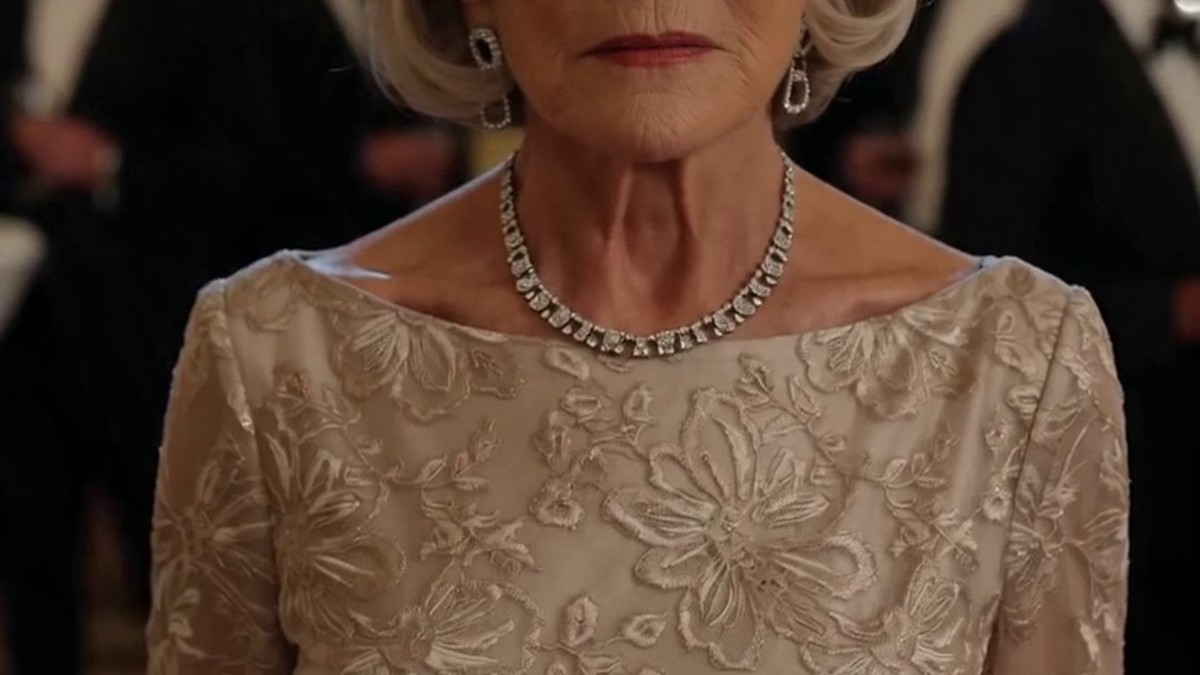
The words cut through the crystal-lit banquet hall like a blade. He stood there — finger raised, voice booming — playing king in a room full of witnesses. Beside him, she smiled. Not warmly. The kind of smile that wants you to feel small.
"Old woman," she said, her tone dripping with venom, "your money belongs to us now."
They believed it. Both of them, completely, absolutely — they believed they had finally finished her.
Charlotte said nothing. Her eyes swept the room once, taking in the chandeliers, the champagne flutes, the faces turning away. Then she turned and walked out of that glittering hall alone, her heels steady against the marble floor.
No tears. Not a single one.
—
Hours later, the bar was quiet and low-lit, the kind of place where serious decisions get made without witnesses. The fragile old woman they thought they'd humiliated? She wasn't there anymore.
In her right hand — a glass of something expensive, unhurried.
In her left — a phone pressed to her ear.
And across her face, slow as a sunrise and twice as inevitable, spread a smile. Cold. Precise. The smile of someone who has been ten steps ahead this entire time and was simply waiting for them to catch up.
She wasn't broken.
She was *ready.*
"Want to watch them lose everything tomorrow?" she murmured into the receiver.
Not a question, really.
A promise.
The call lasted four minutes.
That was all it took.
She set the phone face-down on the mahogany bar, finished her drink in one unhurried swallow, and signaled the bartender for another. Around her, the city hummed behind plate glass — indifferent, enormous, alive with the kind of ambition that never sleeps. Charlotte had always loved cities at night. They reminded her of herself.
Patient. Relentless. Never quite dark.
—
His name was David. Her son-in-law, technically, though she'd stopped honoring that word about eighteen months ago when she first noticed the transfers.
Small ones, initially. The kind a careless accountant might miss. But Charlotte had not built a logistics empire across four decades by employing careless accountants. She'd noticed. She'd said nothing. She'd waited, the way a surgeon waits — hands still, eyes sharper than the instrument, watching for the exact moment when intervention becomes art.
The woman beside him — Diana, her own daughter, flesh and blood, champagne-smiling Diana — had looked Charlotte in the face tonight and said *your money belongs to us now.*
Past tense. Already accomplished. Already done.
That was the tell. That was the moment Charlotte knew they'd moved.
She'd been counting on it.
—
The documents had been filed at 11:47 p.m. — her attorney worked the kind of hours that justified his fee. By the time David was sleeping off the champagne in the master bedroom of the Malibu house that Charlotte's company still, quietly, technically owned, three separate legal instruments had entered the public record.
The first: a revocation of the trust amendment Diana had convinced her to sign fourteen months ago. Coercion, the filing noted. With evidence attached. Forty-one pages of it.
The second: a forensic accounting summary submitted to the state attorney's office. Eighteen months of wire transfers. A pattern so clean it practically signed David's name for him.
The third was the simplest, and in many ways the cruelest.
A letter to the board of Hargrove Meridian — the company David had spent two years positioning himself to control through Diana's inheritance — informing them that Charlotte Hargrove-Reed remained sole voting trustee, that no succession had been enacted, and that she would be present at tomorrow morning's quarterly meeting.
Nine a.m. Sharp.
"Want to watch them lose everything tomorrow?" she'd said into the phone.
She hadn't been speaking to her attorney.
—
Marcus Tate had been a journalist for twenty-two years, which was long enough to know when someone was handing him a story versus when someone was handing him a weapon. Charlotte had always been generous with both, and she'd always been honest about which was which.
"This is a weapon," she'd told him when she first called, three months ago, laying out what she'd found.
"What do you want me to do with it?" he'd asked.
"Hold it. Until I tell you."
He'd held it. Tonight, she'd told him.
By six a.m., the piece was live — not the full forensic accounting, not yet, but enough. *Questions Surround Hargrove Meridian Succession Plan. Sources Close to Founder Allege Internal Transfers.* Clean, sourced, devastating in its restraint. The kind of article that makes board members clear their schedules and call their lawyers before their first cup of coffee.
—
She arrived at the building at eight forty-five.
The lobby security guard — a young man named Felix who had worked the desk for three years and always remembered that she took her coffee black — saw her first. He straightened. Then he smiled, the way people smile when something they feared would never return has walked back through the door.
"Ms. Hargrove-Reed."
"Good morning, Felix."
She wore charcoal. No jewelry except the single watch she always wore, the one her late husband had given her the year they took the company public. Her hair was set precisely. Her expression was the temperature of early March — not winter, not spring, but the specific cold that reminds you winter hasn't actually released its claim yet.
The elevator opened on the fourteenth floor at eight fifty-three.
David was already in the boardroom.
She knew he would be. He'd been positioning for this seat for two years. Of course he'd arrived early. Of course he'd set his coffee at the head of the table.
He looked up when she entered, and something moved across his face — not fear, not yet, something more like the vertigo of a man who has stepped off a curb he thought wasn't there. Beside him, the general counsel. Two board members she recognized. An empty chair where Diana always sat late, because Diana had always been comfortable arriving after the room was already shaped around her absence.
"Charlotte." David said her name like a statement he wasn't sure was accurate anymore.
"David." She pulled out a chair — not the head, deliberately, not yet — and set her portfolio on the table. "I believe we have a nine o'clock."
"You weren't—" He stopped himself. Reset. "We weren't expecting you."
"I know."
The general counsel, Eleanor Park, was already looking at her phone. Charlotte watched the woman's expression shift in real time — the article, almost certainly, or perhaps the filing notifications. Eleanor was thorough. Eleanor had probably already received three texts.
Eleanor looked up. "Charlotte. Should we — perhaps we should delay the meeting by—"
"We'll start on time," Charlotte said. "I have all the time in the world, but I don't like wasting it."
Diana arrived at nine-oh-four, flushed and quick-heeled, and stopped in the doorway when she saw her mother seated at the table.
For a long moment, the room held its breath.
Diana had her father's jaw and her mother's eyes, and right now both were working against her — the jaw set in something that wanted to be defiance, the eyes reading the room with a speed and accuracy she'd inherited and then, somewhere along the way, chosen not to respect.
"Mom—"
"Sit down, Diana."
The voice wasn't loud. It didn't need to be.
Diana sat.
—
The meeting ran forty minutes.
Charlotte spoke for most of it, methodically, without theater. She laid the documents on the table — physical copies, because she'd learned long ago that paper in hand is harder to minimize than a screen. She walked the board through the timeline. The amendments. The transfers. The pattern. She did it the way she'd done every difficult thing in forty years of business — with complete information, perfect composure, and the specific mercy of not making anyone watch her enjoy it.
That mercy did not extend to David.
He tried twice. The first time, he interrupted, voice finding its banquet-hall register — *this is a mischaracterization, these were authorized, if you'll just let me—* and she stopped him with a look that was not angry. That was the thing about Charlotte's authority, the thing Diana had always hated and could never quite articulate. It wasn't anger. It was something quieter and more absolute. The look of someone who is not arguing with you because the argument is already over.
The second time he tried, Eleanor put a hand on his arm. He stopped.
When Charlotte finished speaking, she set her pen parallel to the edge of the portfolio — a habit she'd had since her twenties, the small geometry of self-possession — and looked around the table.
"Any questions?"
Eleanor had questions. Good ones. Charlotte answered each of them fully. The two board members asked nothing, which was itself an answer.
David stared at the surface of the table.
Diana stared at her mother.
Charlotte looked back at her daughter, and for just a moment — one unguarded second in an otherwise armored morning — something moved through her that was neither triumph nor vindication. It was older than both. It was grief, dressed up in everything it had to be to survive this room.
Then it was gone.
"I'll expect David's resignation by end of business," Charlotte said. "The forensic summary has already been received by the attorney general's office. Whether that goes further is not my decision to make — that's the province of the law, and I have always respected the province of the law." She closed her portfolio. "The trust amendment revocation is already on record. Eleanor will walk you through what that means for the succession structure."
She stood.
"Diana."
Her daughter looked up. The defiance was gone. In its place was something raw and young that Charlotte hadn't seen on that face in a long time — the face beneath the face, the one that used to appear in doorways during thunderstorms.
Charlotte's voice, when she spoke, was not soft exactly. But it was unguarded.
"What you said to me last night. That my money belongs to you now." She paused, not for effect, just to be accurate. "I built every dollar of it. Not for you. For us. And when you turned it into a weapon against me, you didn't take anything." She picked up her portfolio. "You just showed me what it was worth to you."
She walked to the door.
Stopped once, without turning.
"I love you," she said. "That's not something I'm withdrawing. I want you to know that."
Then she walked out.
—
The lobby was bright by the time she reached it.
Felix looked up. Saw her face — composed, unhurried, carrying something invisible but heavy — and said nothing, because he was perceptive enough to know that some exits don't need commentary.
She pushed through the glass doors into the white morning air.
The city was fully awake now, loud and indifferent and gloriously, mechanically alive. She stood on the sidewalk and let it wash over her — the diesel smell, the crowd noise, the specific energy of a world that does not pause for anyone's reckoning.
Her phone buzzed.
Marcus. *Piece is running strong. Three outlets picked it up already. You okay?*
She typed back: *Ask me in a year.*
She meant it. She didn't know yet what okay would look like from here, what shape the next chapter had, whether Diana would call or not call, whether the silence between them would close or calcify into something permanent. She didn't know if she'd feel this — whatever this was, this cold-aired, hollow-chested, non-victorious thing — for a week or a decade.
She knew she had survived it.
She knew she had not become what it tried to make her.
And she knew that on a marble floor in a chandelier-lit hall, surrounded by a room full of witnesses, she had walked out steady.
That, she thought, tucking her phone away and stepping into the current of the morning crowd, was hers.
Whatever they had tried to take, whatever had been threatened, whatever had been said in that glittering hall with that practiced smile — they had taken nothing.
She was still here.
Still Charlotte.
Still, in every way that mattered, whole.



A hűséges kutya titka – Mire bukkant Fehér Zsófia a nyíregyházi sírkertben
A nyíregyházi köztemető ősszel reggelente ezüstös párába burkolózik, és Fehér Zsófia már messziről ismerte az utat a 14-es parcellához: harmadik...


Most, který se stal čtvrtí
Jmenuju se Jarmila Brabcová, jezdím po Jizeře na výletní loď už devatenáct let, a tahle trasa mezi Turnovem a Malou...


Aaron Pap és a hatezer eurós szívességem
Pap Áron és az örökség, amiről senki sem beszélt Nem akartam ott lenni azon az estén, de valahogy mindig én...


בת מהנדס, בלי בעל, ובלי שום בושה
הניילונים מהפארם של רמת-גן עדיין היו על השידה כשאמא שלי פתחה את דלת החדר בבי"ח "איכילוב" ועצרה במקום, כאילו מישהו...


Dopis, který jsem nestihla napsat včas
Mami, nemám pro to žádné hezké ani správné slovo. Jen vím, že mi po tobě chybí – a ta bolest...


Myčka na Rokycanské
Jarmila Dvořáková si otírala ruce o zástěru a dívala se přes sklo mycího boxu, jak její zeť Radek zapojuje nový...


De beton van Han Feenstra
Ik ben al negenentwintig jaar huismeester van een flat aan de Van Oldenbarneveltlaan in Zoetermeer. Loodgieter van opleiding, maar in...


Aaronas sakė: „Mama tave mėgsta, tik dar nepažįsta.
Nuo ketvirto aukšto laiptinės, kur stoviu su šluota rankoje, girdžiu beveik visą pokalbį per ventiliacijos groteles – akustika šiame name...