
З життя
— Mrs. Jane, the girl must keep studying. Bright minds like hers are rare. She has a special gift for languages and literature. You should see her works!

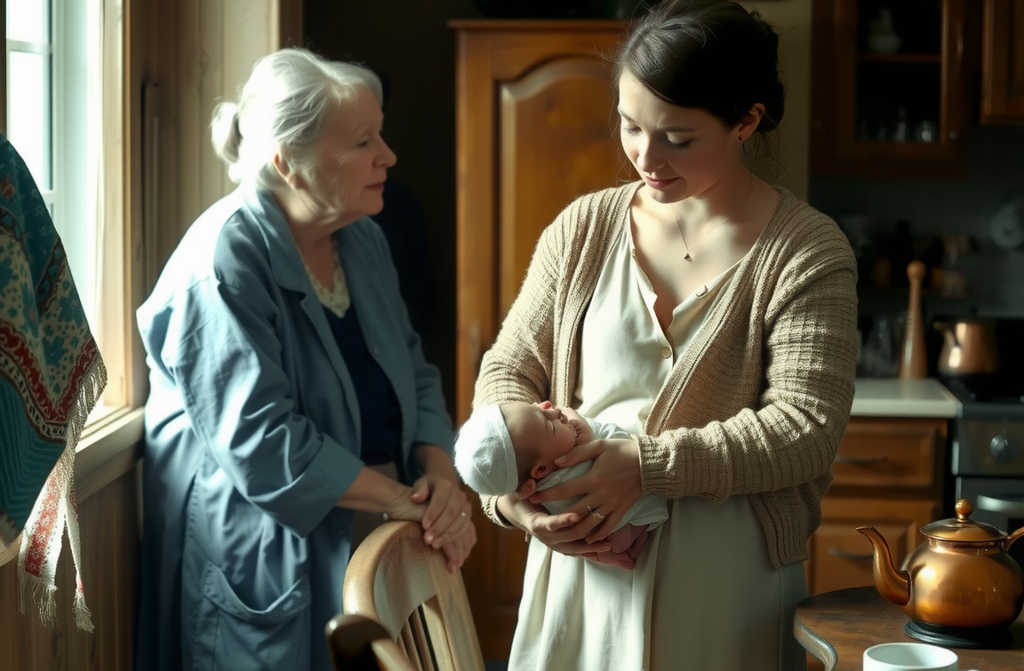
Mrs. Agnes Whitaker, the girl must keep her schooling. Bright minds like hers are a rarity. She has a special gift for languages and literatureimagine the works she could produce!
My own daughter was only three when I found her, abandoned in the mud beneath the old stone bridge over the Avon. I raised her as my own, despite the whispered gossip that followed me. Now she teaches in the town, while I remain in my modest cottage, raking my memories together like precious beads.
The floor creaks under my footonce more I think I should repair it, but my hands never seem to find the time. I settle at the table and pull out my worn diary. Its pages have yellowed like autumn leaves, yet the ink still holds my thoughts. Outside, the wind howls and a birch taps its branches against the window as if asking for a visit.
Why are you rustling about? I say to the house. Wait a little; spring will come.
It sounds absurd to converse with a tree, yet when you live alone everything around you feels alive. After those terrible years I was left a widowmy husband Thomas died in the war. I still keep his last letter, faded and frayed at the folds, rereading it countless times. He wrote that he would return, that he loved me, that we would be happy A week later I learned the truth.
God denied me children, perhaps for the bestthose were hard times to feed anyone. The head of the village cooperative, Mr. Nicholas Irving, tried to console me:
Dont be sorrowful, Agnes. Youre still young; youll marry again.
I wont marry another, I answered firmly. I loved once, and that was enough.
At the cooperative I worked from dawn till dusk. The foreman, Mr. Pritchard, would sometimes shout:
Mrs. Whitaker, you should head home; its getting late!
Ill finish while I can, Id reply, as long as my hands work, my spirit stays young.
My small farm kept a goat, Bessie, stubborn as I am. Five chickens woke me each morning louder than any rooster. Our neighbour, Mrs. Clara, often teased:
Are you a duck? Why do your hens crow before sunrise?
The garden yielded potatoes, carrots and beetrooteverything from the earth. In autumn I made preservessalty cucumbers, pickled tomatoes, marinated mushrooms. In winter, opening a jar felt like bringing summer back into the house.
I remember that day clearly. March was damp and cold. Rain fell in the morning and by evening the ground was frozen. I went into the woods for firewoodthere were piles of winterbroke branches to be gathered. I collected a hefty bundle and, crossing the old bridge, heard someone sobbing. At first I thought it was the wind playing tricks, but the sound was unmistakable, a childs whimper.
I knelt under the bridge and saw a tiny girl, mudsplashed, her dress torn, eyes wide with terror. When she saw me she fell silent, trembling like a trembling leaf.
Who are you, little one? I whispered, trying not to frighten her more.
She stayed mute, only blinking. Her lips were blue from the cold, her hands swollen and red.
Shes frozen solid, I muttered to myself. Let me take you home; youll warm up.
I lifted her; she was as light as a feather. I wrapped her in my own scarf and pressed her against my chest. I wondered what kind of mother would leave a child under a bridge. It didnt make sense.
The firewood could wait; it was no longer urgent. She clutched my neck with frozen fingers the whole way home, silent and shivering.
When I arrived, the villages news spread faster than a sparrows flight. Mrs. Clara was the first to appear:
Good heavens, Agnes, where did you get her?
I found her under the bridge, I said. She seemed abandoned.
Oh, such tragedy Clara clapped her hands. What will you do with her?
What else? Ill keep her.
Have you lost your mind? grumbled Mrs. Martha, the old spinster from the lane. Where will you feed a child?
Ill make do with whatever God provides, I replied.
First, I stoked the stove as hot as I could and heated water. The girlthin, ribs showingwas bathed in warm water, then swaddled in my old coat; I had no other childrens clothing.
Want something to eat? I asked.
She nodded shyly.
I ladled yesterdays stew, cut a piece of bread, and she ate greedily but carefullyclearly not a street child.
Whats your name? I asked.
She stayed mute, perhaps frightened or simply unable to speak.
I laid her on my own bed and rested on a bench. Throughout the night I woke several times to check on her; she slept curled up, occasionally sighing in her sleep.
At dawn I went straight to the parish council to report the find. The chairman, Mr. Edward Stokes, waved his hands dismissively:
Theres been no report of a missing child. Perhaps someone from the town left her there
What now?
By law she should go to the childrens home. Ill call the district today.
My heart clenched:
Wait, Mr. Stokes. Give me timeperhaps her parents will appear. Until then Ill keep her here.
Think it over, Mrs. Whitaker
Theres no need to think. Its decided.
I named her Eleanor, after my own mother. I hoped the parents might show up, but they never did. Thank God I grew attached to her with all my heart.
At first it was hardshe didnt speak, only scanned the cottage with her eyes as if searching for something. At night she would awaken screaming, trembling. I would hold her, stroke her head and whisper:
Its all right, dear child, itll be okay.
From old fabrics I sewed her simple dresses, dyeing them blue, green and red. They were basic but bright. Mrs. Clara, upon seeing them, exclaimed:
Oh, Agnes, you have golden hands! I thought you could only handle a spade.
Life teaches you to be both seamstress and nanny, I replied, pleased by the praise.
Not everyone in the village was kind. Mrs. Martha, whenever she saw us, crossed herself:
This is no good, Agnes. Taking a stray child will bring misfortune. The mother must have been unfitan apple falls from a rotten tree.
Shut up, Martha! I snapped. It isnt your place to judge anothers sins. This child is mine, period.
Even Mr. Irving frowned at first:
Perhaps the childrens home would be better. Theyll feed and clothe her properly.
And who will love her? I countered. The home is full of orphans already.
He waved his hand away, then began to helpbringing milk, bringing porridge.
Eleanor gradually thawed. Words emerged one by one, then whole sentences. I remember the first time she laughed; I had been pulling down curtains and the chair gave way. I lay on the floor, wincing, and she burst into a bright, childlike giggle. My own ache vanished with her mirth.
She tried to help in the garden, toddling with a tiny spade, mimicking me. She would dig more weeds than she pulled, but I never scolded her; I was happy to see life awakening in her.
Then illness struckEleanor fell with a high fever, her cheeks flushed scarlet. I ran to the village doctor, Samuel Peters:
By Gods grace, help her!
He waved his hands dismissively:
What medicine, Agnes? I have only three aspirin tablets for the whole village. Wait, maybe a supply will arrive in a week.
In a week? I shouted. She may not live until tomorrow!
I ran to the district, nine miles through mud, my boots shredded, my feet blistered, but I reached the infirmary. A young doctor, Alex Morgan, looked at my mudcaked form:
Stay right here.
He fetched the medicines and explained the dosage:
No charge, just give her the medicine.
For three days I never left her bedside, whispering prayers I remembered, changing dressings. On the fourth day the fever broke; she opened her eyes and whispered:
Mother, Im thirsty.
Mother she called, for the first time, and tears burst from my eyesjoy, exhaustion, everything at once. She wiped my cheeks with her tiny hands:
Mother, are you alright? It hurts?
No, I said, smiling through tears Im just happy.
After that sickness she became a different childaffectionate, talkative. She later entered school, where the headmistress praised her:
What a capable girl! She grasps everything at a glance.
The villagers stopped whispering behind my back. Even Mrs. Martha softened, offering me pies. She especially liked Eleanor after the night Eleanor helped melt the furnace during a fierce freeze. Mrs. Martha had fallen ill with rheumatism and couldnt gather firewood; Eleanor suggested:
Mother, lets visit Mrs. Martha; shes cold alone.
Thus the old crone and my little girl became friends. Martha taught her how to knit and never again cursed the childs origin.
Time passed. Eleanor turned nine when she first spoke of the bridge. We sat together one evening; I was darning socks, she cradled a handmade cloth doll.
Mother, do you remember how you found me? she asked.
My heart leapt, but I kept my composure:
I remember, dear.
I remember a little too. It was cold and frightening. A woman was crying, then she left.
My hands trembled. She continued:
I cant picture her face, only the blue scarf. She kept repeating, Forgive me, forgive me
Eleanor
Dont think Im sad, Mother. I just think sometimes. You know what? she smiled suddenly. Im glad you found me.
I hugged her tight, a knot of emotion in my throat. How many times I wondered about the woman in the blue scarfwhy she left a child beneath the bridge? Perhaps she starved, perhaps her husband drank. Life throws many hardships; it isnt my place to judge.
That night I lay awake, pondering how fate turns. I had lived alone, feeling empty and punished by solitude. Yet perhaps that emptiness prepared me to welcome and nurture a forsaken child.
From then on Eleanor asked more about her past. I answered gently, careful not to wound:
You know, love, sometimes people are forced into choices they dread. Perhaps your mother suffered greatly.
Would you ever do that? she asked, eyes searching.
Never, I said firmly. You are my joy, my pride.
Years slipped by unnoticed. Eleanor excelled at school, often the first to answer. She would burst through the door one day:
Mother! My teacher, Miss Harper, said I have talent!
Miss Harper, her schoolmistress, often visited:
Mrs. Whitaker, this girl must continue her education. Such bright heads are scarce. She has a remarkable gift for language and literatureimagine the verses she could write!
Where will we afford school? I sighed. We have little money
Ill help her prepare, free of charge, Miss Harper replied. It would be a sin to let such talent go to waste.
Miss Harper tutored Eleanor further. In the evenings they sat in my cottage, heads bent over books. I served them tea with raspberry jam, listening as they discussed Shakespeare, Wordsworth, and Austen. My heart swelled; my girl absorbed everything.
In the ninth year, Eleanor fell in love for the first timewith a boy from the neighbouring town who had moved to our village with his parents. She wrote secret poems in a notebook hidden under her pillow. I pretended not to notice, though my heart ached with the pangs of first love.
When she finished school, she applied to a teachertraining college. I gave her every penny I owned, even selling our last cow, Bessie. I pleaded with her:
You dont have to, Mother. How will we survive without the cow?
Its alright, she protested. Ill manage.
We have potatoes, chickens lay eggs; Ill get by.
The acceptance letter arrived, and the whole village celebrated. Even Mr. Irving came to congratulate:
Well done, Agnes! Youve raised a daughter, educated her. Now our village has its own scholar.
I remember the day she left. We stood at the bus stop, she hugged me, tears streaming.
Ill write you every week, Mother, and visit on holidays.
Of course you will, I said, though my heart cracked.
The bus vanished around the bend, and I stood there, rooted. Mrs. Clara came over, embracing my shoulder:
Lets go, Agnes. Theres work to be done at home.
You know, Clara, I said, Im happy. Other children have families; mine was a gift from God.
I kept my promise and wrote often. Each letter felt like a celebration; I read them over and over, memorising every line. She wrote about her studies, new friends, the city, yet between the lines was a longing for home.
In her second year she met a fellow student, James, studying history. I began mentioning him in my letters, and my motherheart realized I was falling in love too. When the summer holidays came, I brought him to the village.
He proved reliable, helping repair the roof, mend the fence, and quickly befriending the neighbours. In the evenings we sat on the porch, and he recounted historical taleshis eyes never leaving Eleanor.
When he arrived for the holidays, the whole village gathered to see how shed grown. Even Mrs. Martha, now very old, crossed herself:
Lord, I was against you taking her, but look at the happiness shes found!
Eleanor later became a teacher herself, working in the town school, passing on knowledge just as Miss Harper once did. She married James, and they lived as one soul. They gave me a granddaughter, named Hannah, in my honour.
Hannah inherited Eleanors brave spirit, constantly exploring, touching everything, climbing wherever she could. I welcomed her noise, her endless curiositywithout a childs laughter, a house feels like a church without bells.
Now I sit, writing in my diary, while the wind still rattles outside. The floor still creaks, the birch still knocks on the window. Yet this silence no longer feels oppressive; it holds peace and gratitudefor every day lived, for every smile of my Eleanor, for the fate that led me to that old bridge.
On the table rests a photographEleanor with James and little Hannahnext to the blue scarf I once wrapped her in. I keep it as a memory, smoothing the fabric now worn. Sometimes I run my fingers over it, and the warmth of those days returns.
Just yesterday a letter arrived: Eleanor is expecting a baby boy. James has already chosen the nameStewart, after my late husband Thomas. Our family line will continue, keeping the memory alive.
The old stone bridge has long since been replaced by a sturdy concrete span. I rarely pass it now, but each time I do, I pause for a moment and think how a single day, a single cry on a dreary March evening, can alter a whole life.
They say fate tests us with loneliness so we learn to cherish those we love. I think otherwisefate prepares us for the moment when someone needs us most. Blood matters little; the hearts guidance is what truly counts. And that night, under the old bridge, my heart chose correctly.
*The greatest lesson Ive learned is that a single act of compassion can echo through generations, turning loss into love and emptiness into a home filled with laughter.*Tonight, as the lantern flickers low and the wind sighs through the eaves, the old diary lies open on the table, its pages yellowed but still eager to receive one more thought. I trace the faint outline of the blue scarf that once cradled a shivering child, now sewn into a small quilt that rests on Hannahs lap as she hums a lullaby to the baby she has yet to meet. The scent of fresh pine drifts from the garden, where James has planted a sapling beside the new bridgea living reminder of the place where everything began.
When the carriage door creaks open and the tiny cry of my grandson fills the room, I feel a warmth surge through my bones, as if Thomass hand rests briefly on my shoulder. He never returned from the war, yet his name lives on in the boys future, a bridge between past and present. I watch Eleanors eyes shine, her smile a quiet echo of the day we first held each other under the rainsoaked stones, and I know the love that grew from that moment will now ripple outward, carried in the laughter of the children who will follow.
The birch outside still taps its boughs against the glass, a soft percussion that has become my nightly hymn. I close the diary, lay my pen down, and whisper a simple thanks to the night, to the wind, to the stone that once bore a childs sorrow. In the hush that follows, the house feels fullno longer a solitary cottage but a home threaded with generations, each heartbeat a promise that the kindness we sow today will bloom forever.



A jászberényi diófa, amelyik hatszázezer forintot ért meg egy családnak
A jászberényi diófa, amelyik örökre megmentett egy udvart Negyedik éve dolgozom a jászberényi piacon zöldséges standnál, pont szemben azzal a...


Žentas, kuris liko: Birutės akys devynerius metus
Mane vadina nedėkingu žentu. Taip sako uošvienės draugės prie bažnyčios Pasvalyje, kai aš parvežu ją iš poliklinikos ir padedu išlipti...


האלמנה מרחוב הדקלים
היה סוף אוקטובר, בבאר שבע עוד נשבה החמסין המאוחר שחודר דרך כל בד, לא משנה מה לובשים מתחתיו. אני לבשתי...


Свекървата ми изхвърли дрехите, а мъжът ми мълчеше
Стоях във всекидневната с разкъсан найлонов плик до краката и гледах празния рафт в гардероба. — Къде е ризата ми...


Dvě stě padesát hodin, matko
Tereza seděla v kuchyni na sídlišti Lesná v Brně, byla půl čtvrté ráno, a za oknem svítila jediná rozsvícená lampa...


Konvice, co nikdy nevystydla
Jmenuji se Radka Bartošová, bydlím na sídlišti v Pardubicích, ve stejném paneláku už osmadvacet let, a naproti přes chodbu, ve...


מאה חמישים מטר על מגרש הכדורגל של בית הספר בעפולה
אני עובדת בבית הספר התיכון כבר שתים עשרה שנה, מזכירה במשרד המנהלת, ורואה הרבה דברים שהורים לא רואים. אבל את...


Il quaderno di ricette di mia suocera
Mi chiamo Massimo, ho quarantatré anni e faccio il ragioniere a Bergamo. Per dodici anni ho vissuto nella stessa palazzina...