
EN
The Shoes That Came Home

The water in Coldwater Creek was low that September, muttering over gray stones beneath a sky the color of bleached denim. On the wide gravel bank just north of Millbrook, Oregon, a crowd of sixty people sat in folding chairs draped with cream‑colored linen. They were dressed in black wool and muted silk, and they held programs printed on heavy cardstock that said *In Loving Memory of Caleb Michael Harlow*.
Maggie Harlow sat rigid in the front row, her eighty-year-old fingers knotted in her lap, her eyes fixed on the enormous easel overflowing with white lilies and evergreen boughs. A bronze plaque waited under a piece of black velvet, ready to be unveiled for the cameras.
Seven years. Seven years since that March afternoon at 2:45 when her six‑year‑old grandson had chased a frog through the wet grass and disappeared into the creek. The search crews had dredged every pool, the dive teams had prodded every logjam. They’d found a single blue mitten snagged on a branch fifty yards downstream, but nothing else. No body, no shoes, no child. Sheriff’s investigators and three separate private agencies — all hired and fired by Richard — had eventually closed the case. The creek had taken him. Maggie hadn’t talked about Caleb in years, not really; Richard had handled everything, and she’d let him, because after a while the pain just sat there like a stone you didn’t want to touch.
Richard Harlow, her nephew, stood near the podium now, scanning the guests like a caterer checking place settings. He was forty‑six, lean, handsome in a sharp, perpetually‑dissatisfied way, wearing a bespoke charcoal suit that had cost him six thousand dollars. He’d orchestrated the whole afternoon: the press, the pastor, the cello music drifting from hidden speakers. He’d spent twenty‑three thousand dollars on the lilies, the chairs, the plaque — exactly the kind of tidy, expensive closure he craved. Closure, he called it. Finality. Once the plaque was mounted and the ceremony made the papers, a probate judge in Portland would finally declare Caleb legally dead, and the Harlow family trust — nearly ten million dollars — would flow straight into Richard’s control. He’d been pushing for it since year five.
Maggie didn’t hear the pastor’s words about peace and eternal rest. She just stared at the water, tracing the slow current with her eyes, pressing a knuckle hard against her breastbone where the old pressure sat.
Then she heard the gravel crunch.
At first, only the back row turned. A ripple of murmuring worked its way forward, a disturbance in the heavy air. Richard’s head snapped around, his jaw clamping down in immediate irritation.
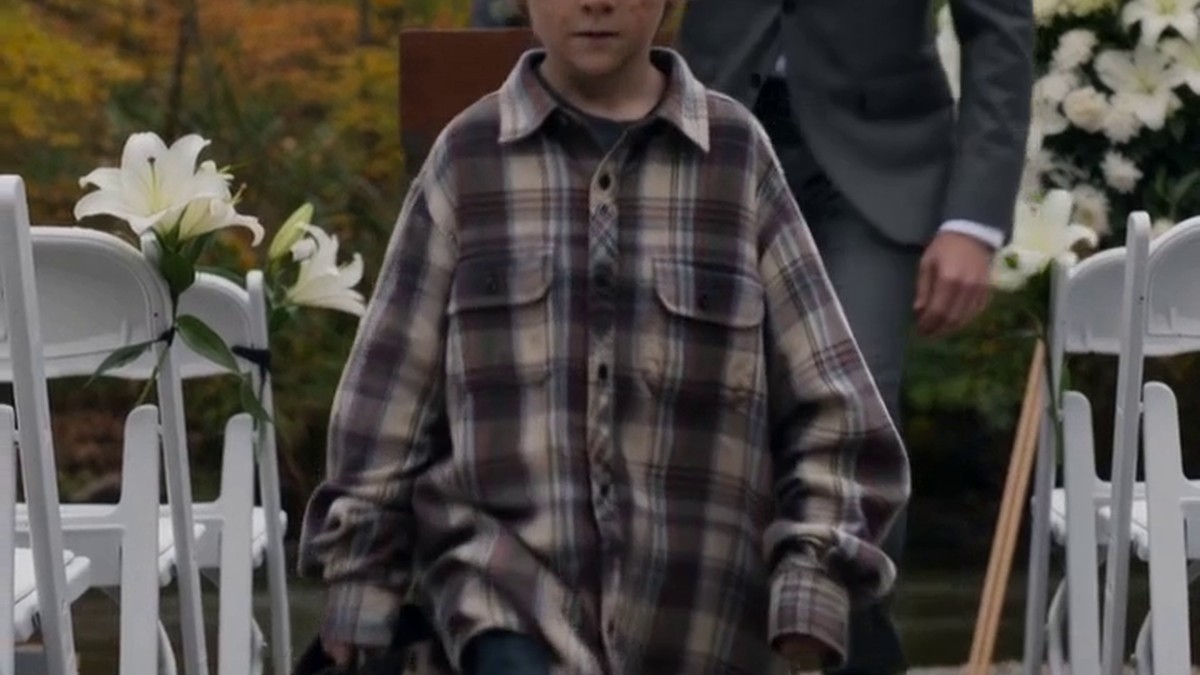
A boy was walking down the center aisle.
He looked about nine, maybe ten. Skinny, with a shock of sandy hair that needed cutting, a smudge of reddish dirt across his left cheek. He wore faded jeans with a tear at the knee and a worn flannel shirt two sizes too big, the sleeves rolled up to his elbows. He wasn’t a guest. He didn’t belong in this gathering of polished grief.
But what stilled every tongue was the thing he carried.
The boy held a pair of small, beat‑up sneakers — children’s sneakers — cupped in his palms like they were a living thing. Canvas, once navy blue but now bleached almost gray. The soles were caked with dried mud. One frayed lace trailed a long, brittle pine needle and a crust of orange clay.
Richard stepped into the aisle, one hand raised. “Hey. Excuse me. You can’t be here. This is a private service.”
The boy didn’t slow. He didn’t even glance at Richard.
Richard’s face went tight and red. He tried again, louder, moving to block the path. “I said stop. Security—”
The boy sidestepped him with a fluid, unhurried movement, never breaking stride. He walked straight to the flower easel, right in front of Maggie, and knelt in the damp gravel as if it were a church altar.
He set the shoes down at the base of the wooden stand.
Maggie’s breath stopped. Her hands went cold, then hot.
Richard rushed forward, furious. “Get up! Get this trash out of here right now!”
Maggie didn’t hear him. She was already leaning forward, her body moving of its own accord, stiff knees cracking as she lowered herself onto the gravel beside the boy. The damp soaked into the hem of her best black coat, but she didn’t feel it.
The shoes were ruined, misshapen, the canvas worn almost to threads. But inside the right one, stitched into the inner arch in bright scarlet thread, were three letters.
*C. M. H.*
Maggie’s vision swam. Her hand reached out, trembling so badly she could barely control it, and her fingertip traced the red embroidery.
She’d sewn those letters herself.
The memory flooded back with the smell of old cedar and rain. A wet afternoon in the sunroom when Caleb was two, waddling barefoot across the braided rug. She’d sat in the wicker rocking chair with a spool of red thread, laughing because he kept losing his shoes at the park, and she wanted something bold so the staff could identify them. She remembered the stubborn leather tongue, the way she’d pricked her thumb, the little boy grabbing the finished shoe and chewing on the laces.
Caleb was six when he vanished. He’d been wearing these exact sneakers.
But these shoes hadn’t spent seven years underwater. The heels were worn down at an angle — slanted from years of a child’s stride. The insoles were compressed from use. A child had walked in them for a long, long time after that day.
Maggie’s head lifted, and she looked at the kneeling boy. He met her eyes, perfectly calm.
“Don’t touch them!” Her voice cracked out, stopping Richard mid‑lunge. He stood there, one hand frozen over the boy’s collar.
“Aunt Maggie, please. This is obviously some sick prank. Who knows what kind of family latched onto the news story—”
Maggie ignored him. She stared at the shoes, at the pine needle tangled in the lace, at the red thread, at the worn‑down heels. Her whole body was shaking.
“They’re his,” she whispered. “These are Caleb’s.”
Richard laughed, a high, nervous sound. “That’s impossible.”
But the color was draining from his face. He looked down at the shoes, at the boy, at the crowd of stunned, silent witnesses holding up cell phones. His polished composure cracked like a sheet of ice.
The boy reached into the pocket of his oversized flannel shirt and pulled out a folded square of notebook paper. He held it up to Maggie, small fingers stained with dirt.
“He said you’d know these,” the boy said, his voice quiet but clear.
Maggie took the paper. Her eyes couldn’t focus at first, the words blurring behind tears. But she forced herself to read. The handwriting was deliberate, but a little crooked, each letter pressed into the page like the boy had traced them slowly, over and over.
*Grandma, I’m sorry I didn’t come back. Uncle Richard told me if I ever talked, he would hurt you like he hurt me. He pushed me in the water and I grabbed a log. A man named Dan Moretti pulled me out at the big bend. He kept me safe but I was too scared to come home. I was hiding until I saw the memorial in the Millbrook Gazette. I’m ready now. Noah is Dan’s son. He knows where I am. I kept the shoes because they had your letters. I love you. — Caleb*
Maggie’s hand clamped over her mouth. A raw, animal sound tore out of her throat.
Richard saw the paper. He saw her face. He lunged, trying to snatch it. “That’s a fabrication— give me that.”
But Maggie pulled the note against her chest, and the crowd surged forward. A woman in the third row shouted, “Someone call the cops— again!” A man in a gray suit was already on his phone.
Richard spun toward the two private security guards he’d hired, his voice cracking with command. “Get that letter! She’s confused!”
The guards hesitated. The bigger one, a former trucker named Earl, glanced at the note in Maggie’s hand, then at Richard’s crimson face, then at the shoes on the gravel. He looked uneasy. The other guard, a young guy with a military haircut, shifted his weight but didn’t move.
“I’m paying you!” Richard screamed.
Before Earl could decide, a sheriff’s cruiser crested the rise beside the creek, rolling slow over the grass with its lights off. Deputy Tara Kim stepped out, one hand on her belt, scanning the crowd. She’d been called twenty minutes earlier by a man named Dan Moretti, reporting a situation up at Crescent Hill. Now she took in the frozen scene — the easel, the old woman clutching a paper, the enraged man in the suit, the kid in the flannel shirt.
Richard saw the deputy and his face went slack. He raised both hands in an exaggerated, innocent gesture. “Finally, thank God. I need you to remove these trespassers—”
But Maggie pointed a shaking finger directly at him. “This man tried to murder my grandson. The boy has been hiding for seven years because of him.”
Deputy Kim’s eyes narrowed. She walked over, picked up the muddy sneakers, looked at the initials, then at the note Maggie held out with trembling hands. The crowd fell silent.
“Sir, I’m going to ask you to step over here and have a seat on that chair,” Kim said to Richard, her voice flat. “You and me are going to have a conversation.”
Richard sputtered, but Earl the guard took a half‑step toward him, blocking his path. “Just do what she says, man,” Earl muttered. “I ain’t getting involved in this.”
A second cruiser pulled up. Within two minutes, Richard was in handcuffs, his face the color of old milk, babbling about lawyers while half a dozen cell‑phone videos caught every syllable. The bronze plaque stayed shrouded.
Maggie turned back to the boy — Noah. “Where is he?” she demanded, her voice cracking. “Where’s my grandson?”
Noah stood up, brushing damp gravel from his knees. “At my dad’s cabin. Upstream, off Old Mill Road. It’s about twenty minutes in your truck. Dad already called the sheriff himself. He said to bring you.”
Maggie didn’t wait for a car. She started walking up the gravel path, her ruined coat dragging, her hand clutching the letter. Noah fell into step beside her, and before anyone could say another word, she had climbed into the cab of Dan Moretti’s old green 1998 Dodge Ram, the one with the cracked dash and a bag of sunflower seeds on the seat. Noah slammed the door, and they rattled up the logging road with the heater blowing dust.
The cabin sat at the end of a rutted track, a low structure with a tin roof and a stack of firewood taller than a man. The door opened before Maggie could knock.
A lanky boy stood in the doorway. Thirteen years old, sun‑bleached hair, eyes the exact shade of spring clover — her daughter’s eyes. He was wearing borrowed jeans and a sweatshirt too big for him, and he was trembling.
For a split second, nobody moved.
Then the boy said, in a voice that was hoarse and disbelieving, “Grandma, I kept your shoes.”
Maggie dropped to her knees in the pine needles, pulled him into her arms, and the sound she made was something between a sob and a laugh. Behind the boy, a lean man with a gray ponytail stepped out of the shadows — Dan Moretti. He rubbed a hand over his face and spoke before she could ask.
“I pulled him out of the creek by the old bridge,” Dan said, his voice gravel‑rough. “He was half‑drowned, crying about an uncle who pushed him and said if he ever talked, someone bad would hurt you. I had my own history with the system — couple of old felonies, nothing like that — but I didn’t trust calling it in would keep him safe. The kid begged me not to send him back. I thought I’d keep him a few days, figure something out, and then . . . days turned into years. He was too scared to let me go to the law. I know I did wrong, but I swear I never hurt him.”
Maggie’s arms tightened around Caleb. She didn’t let go. The truck door creaked in the breeze, the creek murmured over the stones, and up on the highway a siren whooped faintly, carrying Richard’s lies away.
She pressed her wet cheek to the boy’s hair, breathed in the scent of woodsmoke and cheap soap, and whispered something into the silence that nobody else needed to hear.



Вінстон і хлопчик, що навчив собаку довіряти знову
Собака-бульдог лежить у самому кутку вольєра, на сірій ковдрі, притиснувши голову до бетонної підлоги, і слухає кроки в коридорі притулку...


Коробка з книжками на Раневській, або чому батько мовчав три роки
Мене звати Тарас Коваленко, мені сорок два, і я керую мережею автосервісів у Дніпрі. Того четверга мені скасували переговори з...


Автомийка на Богунській, три роки мовчання
Мене звати Максим Ковальчук, мені тридцять шість, і я власник автомийки на Богунській у Житомирі. П'ять постів, компресорна станція, яку...


Колесо від воза
Пам'ятаю той звук ще до того, як розплющила очі, — метал, що б'ється об тверду глину подвір'я, рівний, ніби хтось...


Тато продав овець, щоб я мав диплом
Мар'ян Ковальчук приїхав до Залісся в середу вранці, двадцять другого липня. Вийшов з "Тойоти" на краю ґрунтової дороги, там, де...


Ранкова зміна в кав’ярні на розі Дерибасівської
Мене звати Оксана Гриценко, я двадцять третій рік працюю в невеликій кав'ярні "Затишок" неподалік Привозу в Одесі. Бачила за цей...


Записка на нашийнику рудої кицьки з Обухова
Мене звати Оксана, я тринадцять років приймаю замовлення у вікні видачі на заправці біля траси Обухів—Київ. Здавалося б, за такий...


Міра з Малинівки, зупинені сходи та крісло, що стало моєю долею
Усе почалося в сьомому класі, у школі №12 в Малинівці, на околиці Дніпра. Я сиділа за третьою партою і не...