
EN
They had barely reached the church steps — the bride’s veil catching the afternoon light, the groom’s hand warm at her waist — when a woman appeared from nowhere and planted herself directly in their path.

Her coat was filthy. Her shoes had given up long before she had. Her hands trembled at her sides like something inside her was barely held together.
A hundred guests watched in silence.
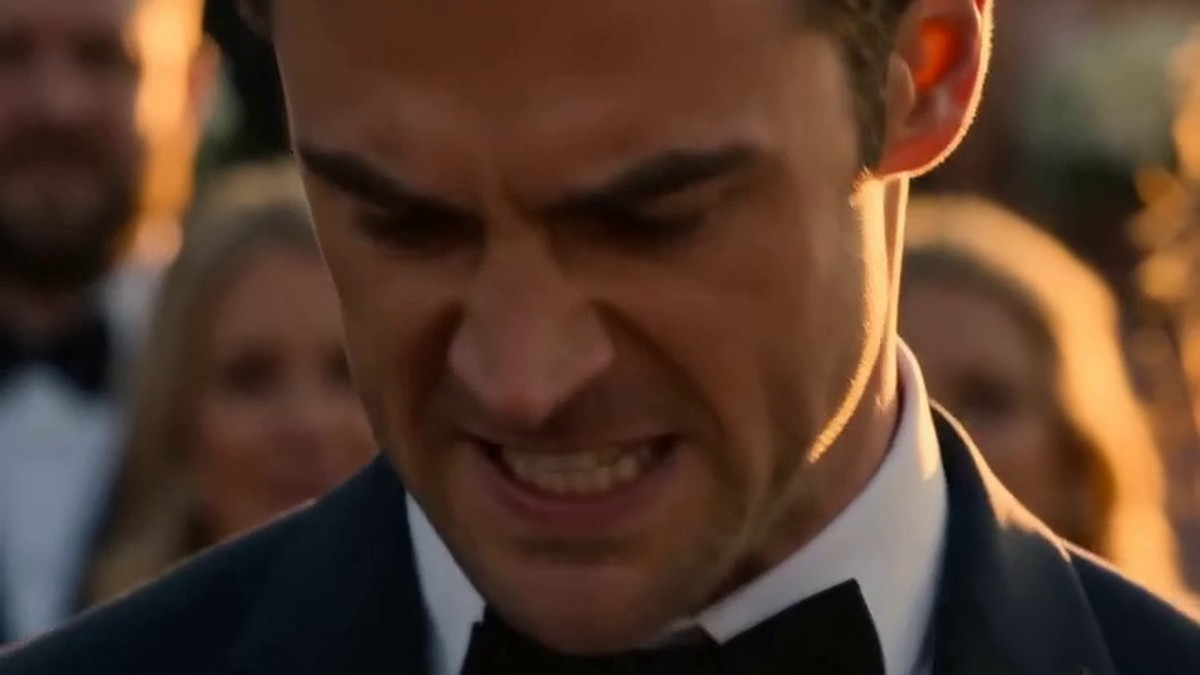
The groom's smile didn't fade — it vanished. Clean gone.
"You weren't invited." His voice dropped to something flat and final. "Leave."
The woman absorbed those words the way someone absorbs them when worse things have already been said. She didn't flinch. She just looked at him — long and steady — like she'd been rehearsing this moment for years.
"That's alright, son," she said quietly. "But look at your phone."
The word landed like a stone dropped into still water.
*Son.*
The bride turned to him. "What did she just call you?"
The groom's jaw tightened. He pulled out his phone — more to end the scene than anything else — and unlocked the screen.
One unread message. Unknown number.
He opened it.
The first photo stopped him cold.
The same woman. Years younger. Sitting upright in a hospital bed, hair damp against her forehead, cradling a newborn wrapped in a striped hospital blanket. The way she was looking at that baby — like it was the only thing in the world that had ever mattered.
The second photo was a document. Official. Stamped.
A birth certificate.
His name printed in the designated field.
Her name printed just below it.
And in the line marked *Mother* — her name again.
The phone began to shake in his grip.
The bride leaned in and looked over his shoulder. The sound she made wasn't quite a word — just breath, cut short, her hand flying up to cover her mouth.
The woman moved one step closer. Her eyes were wet, but her voice held.
"I didn't come here to destroy your day," she said. "I came because the man who raised you built your whole life on a lie."
The silence that followed was the kind that has weight.
Not the polite quiet of held breath. The crushing kind. The kind that presses down on a crowd of a hundred people who all suddenly understand they are witnessing something that cannot be unwed.
The groom — Daniel, though in that moment he felt like a stranger wearing Daniel's suit — stared at the phone. His thumb hovered over the screen. He didn't scroll. He didn't need to. The birth certificate was right there, crisp and merciless, the ink as black and permanent as anything he'd ever seen.
Mother: Ruth Elaine Cavanaugh.
He knew that name.
He didn't know how he knew it. But he did — the way you know the shape of a word you read once, a long time ago, in a place you weren't supposed to be.
"Daniel." His bride, Mara, said his name softly. Like she was offering it back to him.
He couldn't look at her yet.
He looked at the woman instead. Ruth. The woman in the filthy coat with the trembling hands and the thirty-year stare. He searched her face the way you search a map when you're already lost — not looking for direction, just looking for something familiar. Some landmark. Some proof.
He found it in the line of her jaw.
It was his jaw.
He'd spent thirty-one years looking at that jaw in the mirror.
—
"Daniel." This time the voice came from behind him.
Different voice. Lower. Controlled.
The crowd parted — not dramatically, not all at once, but the way crowds part when someone moves through them with the certainty of a man who has always expected the world to make room.
His father.
Gerald Marsh. Sixty-three years old, silver-haired, a man who wore confidence like a second skin. He had been standing near the back with Daniel's mother — with the woman Daniel had always called his mother, who was now gripping her clutch purse with both hands and staring at the ground.
Gerald walked forward alone.
He stopped between Daniel and Ruth. Not beside his son. Between them. A wall, not a comfort.
He looked at Ruth the way you look at something you thought you'd buried.
"You need to leave," he said.
Ruth didn't move. "You said that to me once before," she replied. "At the hospital. The morning after he was born. You said *leave* and you had two men with you and I was twenty-two years old and I didn't know that I could say no."
Mara made a small sound beside Daniel.
A guest near the front started filming on their phone. Someone else put a hand on that person's arm. The phone went down.
"Don't do this." Gerald's voice dropped further. Private, now. A conversation he wanted to have behind a closed door, not on these steps, not in the June light, not in front of the priest and the florist and the caterer and a hundred witnesses who would carry this story to their graves. "Don't do this to him on his wedding day."
"Don't." Ruth's voice finally cracked — just once, just at the edges — and then it came back harder. "Don't you speak to me about what to do to him. You did what you did to him before he could speak. Before he could ask a single question."
"Ruth—"
"You told me he died."
The crowd inhaled as one.
"You told me there were complications. You told me he didn't make it through the first night." The tears were falling now but her voice was iron beneath them. "And then you walked out of that hospital with my son and you raised him and I spent thirty-one years—" She stopped. Steadied. "I spent thirty-one years with a grave. A little stone in Millhaven Cemetery with a name on it that wasn't even real."
Daniel heard himself speak before he decided to.
"What name?"
Ruth turned to him. "Thomas," she said. "I named you Thomas."
Something in his chest cracked open like river ice in spring.
His father — Gerald — turned then too. Turned to Daniel. And Daniel saw it. Saw the thing he'd never had a name for, the thing that had always lived in the space between them. The slight held distance. The overcompensation. The gifts that were too big and the praise that never quite fit the accomplishment. The way Gerald had always looked at him like a man maintaining something rather than loving someone.
"Son," Gerald started.
Daniel held up one hand.
That one gesture — quiet, flat, barely a motion at all — silenced Gerald Marsh for the first time in Daniel's living memory.
—
"How," Daniel said.
Not to Ruth. To Gerald.
"How did you find her?" The question wasn't what he meant. He meant: *How do I live inside this information. How do I stand on these steps in these shoes with these vows not yet spoken and hold all of this at the same time.* But *how did you find her* was what came out.
Gerald said nothing.
The woman Daniel had always called his mother — Patricia — moved forward then. She'd been standing at the edge of the crowd, small and pale, and now she came forward with her clutch purse pressed to her sternum like a shield.
"She called the house," Patricia said. Her voice was barely sound. "Three weeks ago. I didn't tell you."
"Patricia—" Gerald started.
"I'm not doing this anymore." The words came out of her quiet as a door closing. "I am not doing this for one more minute."
She looked at Daniel. Her eyes were red-rimmed and specific — the look of a woman who has been rehearsing her own version of this moment for three weeks, or maybe thirty-one years. "I knew," she said. "I knew from the beginning. Your father — Gerald came to me with a baby and a story and I chose to believe the story because I wanted a child and because I loved him and because it was easier." She breathed. "There is no version of that where I'm not guilty too. I know that."
Mara reached over and took Daniel's hand.
He let her.
—
Ruth stood in the middle of all of it — the wedding guests and the accusations and the fractured family — and she waited. The way she had been waiting, he understood now, for thirty-one years. She had run out of urgency. What remained was simply presence.
Daniel stepped around his father. Around Gerald, who reached out and touched his arm and then let his hand fall when Daniel didn't stop.
He stood in front of Ruth.
This close he could see the grey coming in at her temples and the deep lines beside her mouth and the way her hands had finally stopped trembling — now that she was here, now that she'd done the thing, now that the secret had met the air and hadn't killed her.
"Where do you live?" he asked.
She blinked. "What?"
"Right now. Where do you live."
"I'm at a shelter on Clement Street." She said it plainly. No shame, no apology — just a fact, the same way she'd said everything else.
He nodded slowly. He didn't know what he was going to do with that information yet. He didn't know what he was going to do with any of this. He was holding it all — the birth certificate, the grave with the wrong name, Gerald's silence, Patricia's guilt, Mara's hand in his, the priest waiting at the top of these steps — and it was heavy enough to put him on his knees.
But he was still standing.
He looked back at Mara.
She was watching him. Her veil moved softly in the afternoon wind. Her face was open and frightened and absolutely present, and it was the most honest thing he had looked at all day.
"Give me a minute," he said.
"Take whatever you need," she said.
He turned back to Ruth.
"I don't know you," he said. "That's the truth. I don't know anything about you except what I just read on a phone in the last four minutes."
She nodded. "That's fair."
"But I know that you came here." He paused. "You found a shelter address for me to send something to. You sent that message and you put on your coat and you came here knowing what was going to happen. Knowing what it was going to look like." He glanced at the crowd, at the phones that had mostly stayed down, at the flower arrangements and the photographer who had stopped photographing and the caterer's assistant peeking from behind a column. "Knowing all of this."
"Yes."
"Why today? Why not — why not a letter, why not—"
"I sent letters." Her voice was soft. "Gerald has a very efficient assistant."
Of course he did.
Daniel looked at his father. Gerald was standing at the edge of the cleared space, alone now, Patricia several feet away from him. He was the most alone Daniel had ever seen him — the authority stripped, the narrative stripped, just a man of sixty-three standing in expensive shoes with nothing left to manage.
Daniel felt grief move through him — not for himself, not yet, but for the image of his father. The man he had believed in. That man was gone now and he hadn't even gotten to say goodbye to him, hadn't gotten a proper burial, just this: a sudden vacancy where a father used to be.
He'd mourn that later. He'd fall apart later, privately, in the way that men who've held themselves together in public always eventually fall apart — sudden and complete, like a controlled demolition.
But not here. Not now.
"I want to know," he said to Ruth. "Everything. Not today. But — I want to know."
Ruth pressed her lips together. She nodded once, and the motion was the most restrained thing he'd ever seen, the compression of thirty-one years of wanting into a single inclination of the head.
"Okay," she said.
"Okay." He reached into his jacket pocket, found a business card — his own, from the firm, slightly bent at the corner — and held it out to her. "Call me. Not today. This week."
She took it with both hands.
—
He turned back to the steps. To the priest. To the white flowers and the ribbon-wrapped chairs and the afternoon light that had continued, indifferently, to be beautiful.
Mara was waiting where he'd left her.
"I don't know who I am today," he said quietly, reaching her. "I mean that literally. I don't know what name I have or what story I have or—"
"I know who you are," she said.
"Mara—"
"You're the person who didn't have her removed." She glanced back at Ruth, who was standing at the edge of the path now, not leaving, not intruding — just existing, like someone who has been given permission to exist. "You're the person who stood there and held all of that and didn't break." She looked up at him. "That's who I'm marrying. That's who I've always been marrying."
He breathed.
For the first time since the veil and the afternoon light and the hand at the waist, he truly breathed.
"We don't have to do this today," she said. "The priest will understand. Everyone will—"
"I want to," he said. "I want to marry you today. Right now. Before one more thing in the world changes."
She studied him. Searching, as he had searched Ruth's face, for the familiar thing. She found it.
"Okay," she said. And held out her hand.
He took it.
They walked up the steps together — past the priest, who said nothing and simply opened the door, past the flower arrangements and the slightly shell-shocked photographer who quietly raised the camera again, into the cool dark of the church that smelled like candle wax and old wood and something that had endured.
—
Behind them, the guests followed slowly, in ones and twos.
Gerald did not go in. He stood on the steps for a long time and then walked to his car alone. Patricia went inside and sat in the second row on the bride's side and cried quietly through the entire ceremony — not for the wedding, but for the thirty-one years, and for the relief, which is sometimes the heaviest thing of all.
Ruth Cavanaugh stood at the bottom of the steps until the doors closed.
Then she took the business card from her coat pocket and looked at it.
*Daniel Marsh. Associate Partner.*
She read the name twice. Folded the card carefully. Put it back.
She didn't know yet what would come from the phone call, from the week, from any of it. She didn't know if she'd get a son or a stranger or something complicated and unnameable in between. She had spent thirty-one years not knowing things and she had learned, slowly and at great cost, that not-knowing was survivable.
She knew one thing.
He had taken the card.
She turned and walked down the path, her coat catching the June wind, her shoes still worn through at the left heel, her hands — finally, completely — still.



A hűséges kutya titka – Mire bukkant Fehér Zsófia a nyíregyházi sírkertben
A nyíregyházi köztemető ősszel reggelente ezüstös párába burkolózik, és Fehér Zsófia már messziről ismerte az utat a 14-es parcellához: harmadik...


Most, který se stal čtvrtí
Jmenuju se Jarmila Brabcová, jezdím po Jizeře na výletní loď už devatenáct let, a tahle trasa mezi Turnovem a Malou...


Aaron Pap és a hatezer eurós szívességem
Pap Áron és az örökség, amiről senki sem beszélt Nem akartam ott lenni azon az estén, de valahogy mindig én...


בת מהנדס, בלי בעל, ובלי שום בושה
הניילונים מהפארם של רמת-גן עדיין היו על השידה כשאמא שלי פתחה את דלת החדר בבי"ח "איכילוב" ועצרה במקום, כאילו מישהו...


Dopis, který jsem nestihla napsat včas
Mami, nemám pro to žádné hezké ani správné slovo. Jen vím, že mi po tobě chybí – a ta bolest...


Myčka na Rokycanské
Jarmila Dvořáková si otírala ruce o zástěru a dívala se přes sklo mycího boxu, jak její zeť Radek zapojuje nový...


De beton van Han Feenstra
Ik ben al negenentwintig jaar huismeester van een flat aan de Van Oldenbarneveltlaan in Zoetermeer. Loodgieter van opleiding, maar in...


Aaronas sakė: „Mama tave mėgsta, tik dar nepažįsta.
Nuo ketvirto aukšto laiptinės, kur stoviu su šluota rankoje, girdžiu beveik visą pokalbį per ventiliacijos groteles – akustika šiame name...