
EN
The lobby glows amber — chandeliers dripping light across cold marble floors, a piano threading silk through murmured conversations — until something tears it open.

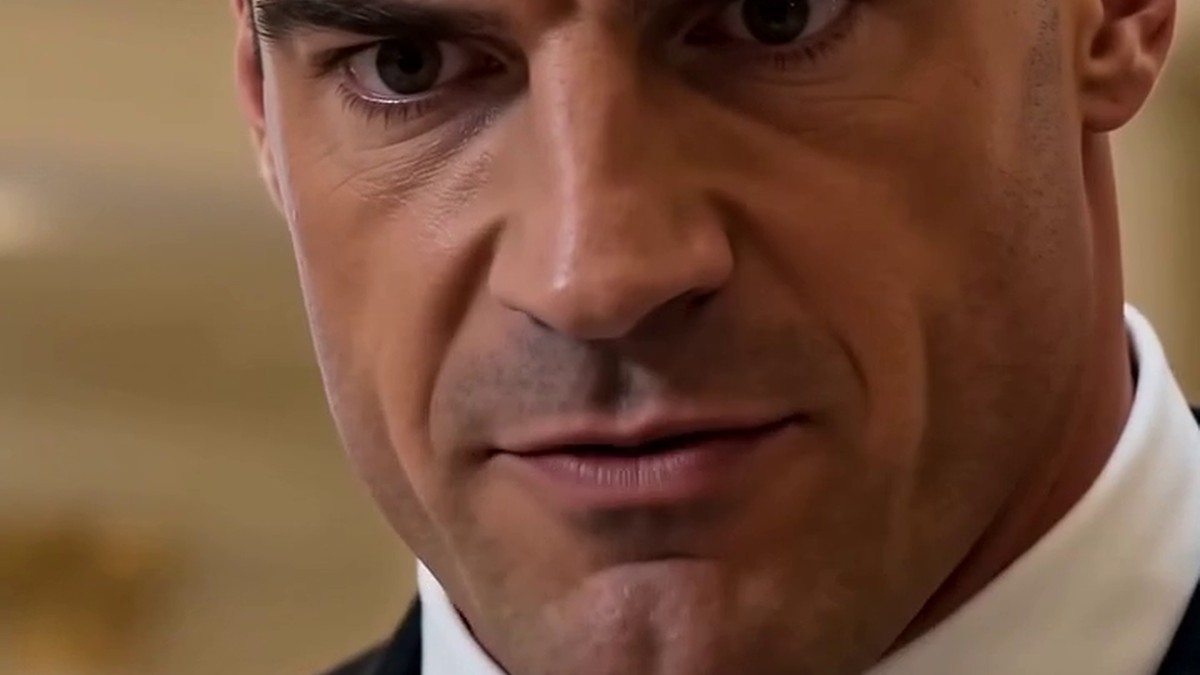
A laugh. Loud. Cruel. Built to wound.
"Play something, boy… or crawl back to wherever you came from."
Every head swings.
A few mouths curl into smiles.
Cameras lift.
At the grand piano, a small boy stands like he's been carved from stone.
Worn clothes.
Steady eyes.
Not a word.
Not a flinch.
He just moves forward.
Sits down.
The camera closes in —
his hands settle over the keys.
Then —
one note.
Quiet.
Bare.
The laughter dies on the spot.
Another note follows.
Then another.
A melody rises from nothing —
slow…
aching…
wrong for a room like this.
Guests go still.
Glass halfway to lips.
Mid-stride.
The sound spreads through the air like something being pulled loose from inside it.
The wealthy man's grin dissolves.
His stare locks onto the boy's fingers.
The melody thickens.
Recognizable.
Dangerously recognizable.
He moves toward the piano — one uncertain step —
"That's… impossible…"
His voice cracks at the edges.
The camera pushes harder, closer —
the blood leaving his face in real time.
"That song was never recorded. Never shared."
The boy plays on.
Unhurried.
Precise.
As if this melody lives inside his bones.
The final note dies slowly —
reverberating off glass and stone.
Then nothing.
Total silence.
The rich man is barely breathing.
"Only my missing child ever knew that song…"
The boy lifts his gaze.
Holds it.
No trembling. No doubt.
"Then ask your wife…"
A beat.
Dense as concrete.
"…why my mother was buried wearing your family ring."
The camera cuts —
to her.
Her face doesn't fall. It collapses.
Terror.
Naked.
Uncontainable.
The man turns toward her — inch by inch —
like the floor beneath him has started to give way.
His voice comes out barely assembled.
"…what did you do…?"
And just before an answer surfaces —
the screen goes dark.
Black.
—
The silence doesn't break — it splinters.
The wife's name is Margaux. Everyone in the lobby knows it. Her face has been in society columns, charity galas, the kind of glossy magazines that smell like money and expire in a week. She is composed at every event. Every dinner. Every moment the cameras point her way.
Not now.
Now she looks like someone who has just watched the locked door swing open.
"Robert—"
"Don't."
His voice isn't loud. That's the terrifying part. The man who laughed at a small boy five minutes ago — loud enough to shake crystal — can now barely push air through his throat.
"Don't say my name. Not yet."
He is still facing the boy.
The boy hasn't moved from the bench. His hands rest in his lap, perfectly still, like the music has settled into them and gone to sleep. He watches the man the way old things watch — rivers, mountains, things that have waited a long time and have learned that patience is its own kind of power.
"How old are you," Robert asks.
Not a question. A calculation.
"Twelve."
Robert closes his eyes.
Opens them.
Does the arithmetic no man wants to do in public.
—
Someone in the back of the lobby whispers something. Someone else shushes them. The pianist at the bar has stopped playing. The staff stands along the walls like furniture that has suddenly learned to feel.
Margaux moves.
Small steps. Controlled. Her heels clicking once, twice — a sound like the second hand of a clock in an empty house.
"He's confused," she says. Her voice is marble. Polished. "Robert, look at him. He's a child. Someone put him up to this."
"What song did he play?"
She stops clicking.
"What?"
"You heard me." Robert still won't look at her. His eyes are on the boy. "I want you to tell me what song he played."
A beat passes.
A very long beat.
"I don't—"
"Because I only played it once." His voice finally cracks — one sharp split down the center, like wood giving under pressure. "In this hotel. In this lobby. Thirteen years ago. On a night you said you were upstairs sleeping."
Margaux's jaw tightens.
The boy watches her like he's read this chapter before.
"I played it for a woman I thought I'd never see again." Robert's words come slow now, pulled up from somewhere deep, somewhere he sealed off and built over with money and events and a second marriage and a life that looked correct from the outside. "And she told me she was pregnant. And I gave her—"
He stops.
Stares at the boy's hands.
At the right thumb, specifically.
At a small crescent-shaped scar below the knuckle.
He takes one step forward. Then another. His shoes are expensive. They make no sound on the marble.
He crouches down in front of the piano bench until he is eye level with the boy.
Up close, the boy's face is a map of someone Robert used to know. The slope of the nose. The particular angle of stillness in the jaw. Something in the eyes that isn't quite grief and isn't quite accusation but is in that exact neighborhood.
"What's your name," Robert whispers.
"Daniel."
Robert's hand lifts — hesitates — presses flat against his own mouth.
"She named you Daniel."
"She named me after my father." A pause. Careful. Measured. "She said he was a good man who made a terrible choice."
—
Margaux's composure doesn't shatter all at once.
It goes piece by piece.
First the hands — she grips her clutch so hard the clasp bites her palm.
Then the shoulders — they pull inward like she's bracing for impact.
Then the voice — when she speaks again, it has lost its marble. What's underneath is something older and sharper and very afraid.
"This is absurd," she says. "Robert. Robert, get up. We're not doing this here."
"Where?" He doesn't stand. "Where should we do it, Margaux?"
"In private. Like adults."
"She's buried in an unmarked grave in private." His voice is not loud. It is worse than loud. It is cold and exact and each word lands like something being dropped from a height. "Someone decided that was private enough."
A sound moves through the lobby. Not words. Just breath. Collective and sharp.
The boy reaches into his jacket — a jacket too large for him, probably secondhand, definitely worn — and removes an envelope. He holds it out to Robert without ceremony. No performance. The way you hand someone a bill.
Robert takes it.
Inside: a photograph.
A woman, young, laughing, standing in front of a door painted red.
On her finger, a ring. A signet ring. Gold. A crest that belongs to exactly one family in this city.
On the back of the photograph, in handwriting so careful it looks like someone made each letter twice:
*If something happens to me — find his father. Play him the song. He'll know.*
Robert makes a sound that isn't a word.
It isn't anything, really.
It's just what grief sounds like when it finally gets a body.
—
Margaux moves fast.
People like her always do, at the end. They spend years being measured and composed and immovable, and then the moment the ground gives they are already calculating the exit. She turns on her heel. She is three steps from the elevator when the hotel manager — a small, precise man who has been standing motionless by the front desk and who has, apparently, been on the phone for the past four minutes — steps forward.
"Mrs. Ashworth."
She doesn't stop.
"The police are already in the building."
She stops.
Two detectives come through the side door — the service entrance, the one the guests aren't meant to see — and they are not hurrying, because they don't need to. The lobby has no other exits that Margaux hasn't already looked at and calculated and dismissed.
She turns around.
Her face goes through five expressions in two seconds.
The sixth one she keeps. Sets it like concrete.
"I want my attorney."
"Yes, ma'am," the detective says. "You'll have that opportunity."
She doesn't look at Robert.
She doesn't look at the boy.
She walks toward the detectives with her chin level and her back straight and her knuckles white on the clasp of a handbag that costs more than some people's cars.
At the last moment — at the precise threshold of the side door — she stops.
She turns.
And she does look at the boy.
Something moves behind her eyes. Something that is maybe — maybe — not entirely calculation.
"He has her mouth," she says.
No one answers.
She walks through the door.
—
For a long time, Robert Ashworth kneels on the cold marble floor of his own hotel, holding a photograph of a woman he loved badly and too briefly, while his guests stand like figures in a painting no one commissioned.
The boy — Daniel — doesn't reach for him. Doesn't lean in. He sits on the piano bench with his hands folded and waits, because waiting is something he has had twelve years to learn.
Finally, Robert looks up.
"Where have you been living."
"With my aunt. My mother's sister." A small pause. "She's outside."
Something in Robert's face shifts. Rearranges.
"She knew where you were this whole time."
"She knew what she could prove and what she couldn't." Daniel's voice is quiet and precise, no heat in it, just fact. "She waited until I was old enough to walk in here myself."
Robert looks at his son.
His son looks back at him.
Neither of them is ready for this. Neither of them has the language yet. The air between them is full of everything that will take years to say — the holidays, the dinners, the school plays, the mornings, the thousand ordinary moments that were stolen and cannot be given back — and right now none of it has words.
But the boy is here.
Sitting at the piano, in the amber light, in the lobby of a hotel that tried to swallow him whole tonight.
Still here.
"Will you play it again?" Robert asks.
He doesn't need to say which song.
Daniel turns back to the keys.
He finds the first note.
Quiet.
Bare.
And this time, when the melody rises, it doesn't sound like something being pulled loose.
It sounds like something coming home.



**Gdynia, lotnisko Chopina w Warszawie, wtorkowa noc przed Wszystkimi Świętymi**
**Warszawa, lotnisko Chopina, wtorkowa noc przed Wszystkimi Świętymi** Myślałam, że mój mąż ratuje ludziom życie na sali operacyjnej. Zamiast tego...


**Gdynia, lotnisko Chopina w Warszawie, wtorkowa noc przed Wszystkimi Świętymi**
**Warszawa, lotnisko Chopina, wtorkowa noc przed Wszystkimi Świętymi** Myślałam, że mój mąż ratuje ludziom życie na sali operacyjnej. Zamiast tego...


The Night My Mother Tapped Morse Code Through a Garden Wall
# The Night My Mother Tapped Morse Code Through a Garden Wall The taxi dropped me at the main gate...


# The Kid Who Didn’t Eat
I never thought I'd be the one telling this, but somebody has to explain why I did what I did...


Le Cri dans les Roses
Je travaille au manoir depuis neuf ans. J’ai vu des mariages, des anniversaires, des veillées funèbres, des réconciliations à deux...


# La feuille au fond du classeur
Le jour où ma fille a accouché, j'aurais dû être l'homme le plus heureux de Lyon. Au lieu de ça,...


Bonjour et le paquet de Mayence
Je suis facteur à Clermont-Ferrand depuis dix-neuf ans, secteur des Vergnes, et je connais mes tournées mieux que ma propre...


Fue el silencio antes de los golpes en la puerta lo que se quedó grabado en la memoria de Rogelio Villaseñor —así, sin adornos, así de simple— y por eso, aunque han pasado tres años, todavía puede contar la historia entera sin saltarse un solo detalle, porque fue él quien la vivió desde el otro lado del cuchillo.
Voy a empezar por donde de verdad empieza todo esto para mí: no en el río, sino dos semanas antes,...