
EN
The chandeliers blazed like captured stars above the marble floor.

Champagne sparkled in crystal flutes.
The wealthy gathered, laughed, clinked glasses.
The bride-to-be stood radiant at the billionaire's side, her smile rehearsed and flawless.
Every detail had been planned. Every detail was perfect.
Then a single word tore it all apart.
"Mommy!"
A little girl burst free from her nanny's grip and bolted across the ballroom floor.
She blew past the guests.
Past the string quartet.
Past the woman who was days away from becoming her stepmother.
Her feet carried her to the far end of the room — to a woman who'd been invisible all evening, quietly circling with a tray of drinks.
A maid.
No one had spared her a second glance.
The silver tray slipped. Her hands couldn't hold it.
CRASH.
The sound cracked through the room like a gunshot. The music died. Every conversation stopped.
Two hundred heads turned.
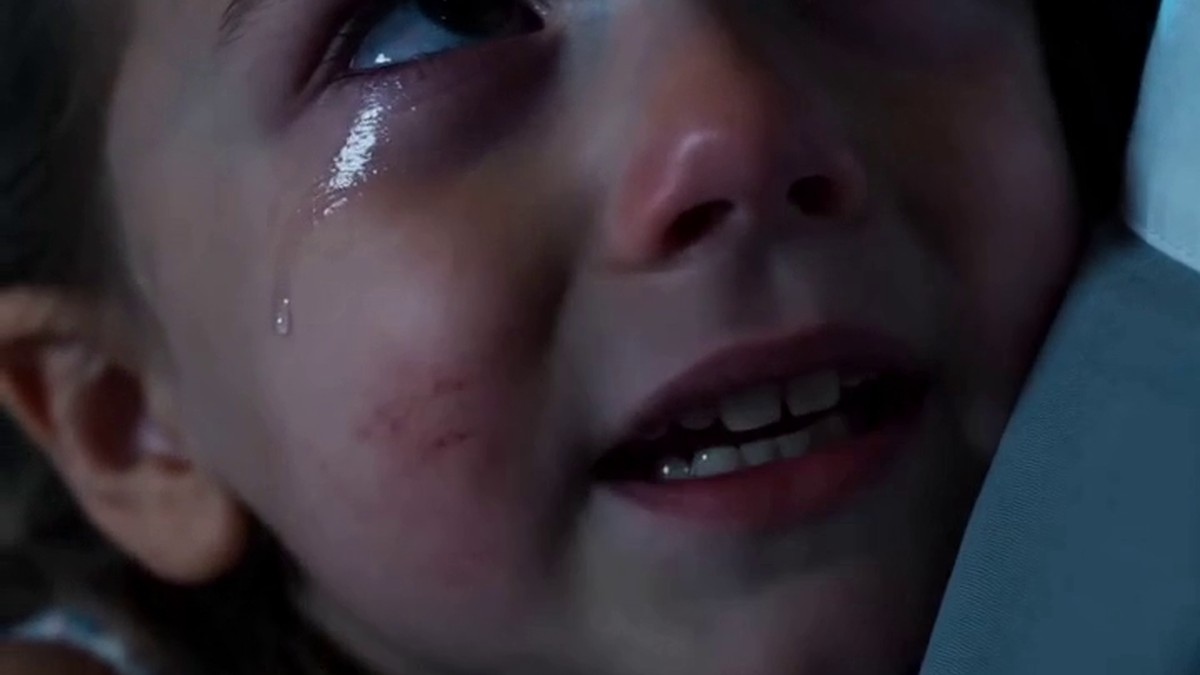
The little girl locked her arms around the woman and pressed her face into her chest, sobbing.
"You came back. You actually came back."
The woman went completely still.
Tears broke free and rolled down her face.
Across the ballroom, the billionaire stood motionless.
He forgot how to breathe.
He forgot how to move.
Because the face staring back at him from behind tear-filled eyes was one he had memorized in grief.
His wife's face.
The woman he had loved more than anything in the world.
The woman he had buried on a gray Tuesday morning two years ago, with his daughter pressed against his leg, too young to understand what forever meant.
The color drained from the future bride's face in an instant.
Guests leaned toward each other, whispering, uneasy.
Something was profoundly, irreversibly wrong.
Then the little girl lifted her head and looked across the room at her father.
Cheeks wet. Eyes certain.
And she asked the question that turned the entire night to ash.
"Daddy… why is everybody calling Mommy the maid?"
Nothing.
Not a sound. Not a breath.
The billionaire felt his heartbeat vanish.
The woman in the uniform dropped her gaze to the floor.
The future bride stumbled back a step — like something invisible had struck her.
And for the first time all evening, her composure cracked.
Because if the child was right — if that woman was who she appeared to be — then a lie had been living inside this family for two full years.
Someone had buried a secret alongside a woman who never actually died.
And somewhere in that glittering, champagne-soaked room stood the person who knew exactly why she had come back wearing a servant's uniform instead of her own name.
The first person to move was the little girl.
She tightened her grip around her mother's waist — not asking, not waiting — just holding on with the absolute certainty that only a four-year-old can possess. The certainty that says: *I know what I know. I don't care what you told me.*
Then the billionaire moved.
One step. Two.
His glass hit the floor and shattered, but he didn't hear it.
His name was Gabriel Mercer. He had built three companies from nothing, survived two hostile takeovers, and stared down a room full of lawyers who wanted to bury him. He had never once broken stride.
He broke now.
—
He stopped six feet away from her.
Close enough to see the fine scar above her left eyebrow — the one she got falling off a bicycle at age nine, long before he'd ever known her. Close enough to see her chest rising and falling too fast. Close enough to know.
"Elena."
One word. Barely a sound. More like breath finding a shape it had forgotten.
The woman in the servant's uniform finally looked up.
Her eyes were the same. Dark amber. Quiet and deep and terrible with guilt.
"Gabriel." Her voice cracked on the second syllable.
"You're dead." He said it flatly. A fact. A record. Something engraved in stone on a hillside in Westchester. "I put you in the ground. I watched them —" He stopped. Started again. "Emma stopped speaking for six weeks."
The little girl, Emma, pressed her face harder into her mother's ribs.
"I know." Elena's voice came out barely above a whisper. "I know what I did to her. I know what I did to you."
"Then explain it."
Not a request. Not a plea.
An order from a man who had waited two years without knowing he was waiting.
—
From the far end of the ballroom, the future bride hadn't moved.
Her name was Vivienne Cole. She was thirty-one, brilliant, precise, and in possession of a beauty that photographers begged to capture and men mistook for warmth. She had met Gabriel nine months after the funeral, at a charity gala not unlike this one. She had offered condolences. Then coffee. Then time.
She had been patient. Carefully, methodically patient.
Now she stood perfectly still among two hundred witnesses and said nothing.
Which was, in itself, a very loud answer.
Elena looked past Gabriel.
Her eyes found Vivienne's.
And something shifted in the room — something electric and ugly, like the pressure drop before a summer storm.
"She doesn't know how to explain it," Vivienne said finally, her voice carrying across the marble floor with the practiced ease of a woman accustomed to being heard. "Because there is no explanation that makes what she did acceptable."
A few guests nodded, relieved someone was speaking.
Gabriel turned to look at her.
Vivienne walked forward slowly, her gown trailing behind her, her composure reconstructed now into something that almost passed for dignity.
"She left, Gabriel. She chose to leave. And now that she sees what you've built without her —" A small, sad smile. "Now she's come back to reclaim it."
It was a beautiful speech. Targeted. Sympathetic.
Elena let it land.
Then she said, very quietly: "Tell him about the car."
—
Silence swallowed the room whole.
Vivienne stopped walking.
Just one beat — half a second — but it was enough.
It was the kind of pause that answers a question before words ever arrive.
"Tell him," Elena said again, louder now, something solid returning to her voice. "Tell him about the brake line. Tell him what your brother found when he inspected the wreck."
Gabriel's face changed.
"The accident was ruled mechanical failure," he said slowly. The words felt like they belonged to someone else.
"It was mechanical," Elena said. "Just not accidental."
She reached into the front pocket of her uniform — the place where maids keep order pads and pens — and pulled out a folded photograph. She held it out toward Gabriel without looking away from Vivienne.
He took it.
His hands weren't steady.
The photograph showed a car. His car. The one Elena had been driving the night she supposedly died on Route 9 in a rainstorm. It showed the undercarriage. And it showed a cut — clean, precise, the kind that doesn't happen from impact — in the brake line.
Below the photograph was a repair invoice. Below that, a name.
Cole Automotive Services. A company owned quietly, at two removes of shell companies, by the family of Vivienne Cole.
—
"That could mean anything," Vivienne said.
Her voice was steady. Gabriel had always admired her steadiness.
Now it made his stomach turn.
"I didn't die," Elena said. "I walked away from the wreck with a concussion and two broken ribs and no memory of the impact. A woman named Rosa Fuentes pulled me out of that ditch. She drove me to a hospital in a county where no one knew my name." She paused. "By the time I found out I'd been declared dead — by the time I understood what had happened — I was terrified. Because whoever cut that brake line thought I was dead. And if they found out I wasn't —"
She looked down at Emma.
She didn't finish the sentence.
She didn't have to.
Gabriel understood. He understood the way you understand something that rewrites every memory you have — all at once, the whole library reshuffled.
She had stayed away to protect Emma.
She had spent two years working jobs that paid in cash and didn't require her name. She had tracked Gabriel's life from a distance, on public computers in public libraries, watching his grief and his recovery and then — finally — this engagement, announced in a press release she'd found on a Tuesday afternoon that dropped her to her knees on a library floor in Queens.
She had come back the only way she could think to come back.
Without warning. Without a name on a guest list. Without a way to be stopped before she was in the same room as her daughter.
As a maid.
—
"You have no proof," Vivienne said.
"I have the invoice," Elena said. "I have Rosa Fuentes, who is currently sitting in a car outside this building with a copy of her statement notarized and witnessed. I have two years of documentation." She let that breathe. "And I have the fact that you just told me to explain something you couldn't possibly have known I needed to explain — unless you already knew exactly what happened on that road."
Vivienne's mouth opened.
Closed.
A murmur moved through the crowd like a wave.
Gabriel turned to look at his fiancée — really look at her, maybe for the first time — and he searched her face for the woman he'd believed she was.
He didn't find her.
What he found instead was calculation. Behind the grief-stricken expression, behind the assembled dignity, there was a mind working through options. Escape routes. Narratives. Counter-moves.
He had built three companies. He knew how to read a board meeting.
He knew when someone was managing a room instead of living in it.
"Vivienne." His voice was quiet. Almost gentle. "Don't."
Something in the way he said it — like a door closing — broke whatever was left of her composure.
"You were grieving," she said, and now her voice had an edge he'd never heard before. "You were destroyed. I was there. I put you back together. I gave you two years —"
"You gave me a lie that cost me two years."
"I gave you a clean start. She left you, Gabriel. She was going to leave you. I knew because she told me —"
"We had a fight." Elena's voice was flat. "I called you because I didn't know who else to call. I was upset. I said I needed space. That's what I told you. That's all I told you."
"You said you were done."
"I said I needed a week."
The distinction landed in the room like an axe.
Vivienne looked at the faces around her — two hundred people, crystal flutes going warm in their hands, phones coming up — and she seemed to understand, perhaps for the first time, that the narrative had already slipped away from her.
"I loved him," she said.
And maybe that was even true.
But it wasn't what she was on trial for.
—
Security escorted Vivienne Cole from the Mercer Grand Ballroom at 9:47 p.m.
She walked with her chin level. She didn't cry. She would have lawyers by midnight and a publicist by morning and she would spend years trying to manage what this evening had made her.
Gabriel didn't watch her go.
He was on his knees.
Not because he'd fallen — because he'd chosen it. He had crossed the six feet between himself and Elena and then simply folded down to the marble floor so he could be at Emma's eye level, and Emma immediately transferred her grip from her mother to her father, and he held his daughter with both arms and pressed his face into her hair and let himself shake.
Elena stood above them.
Her hand found the top of his head.
Neither of them spoke.
There were two hundred people in the room. The string quartet had packed their instruments. The champagne had gone flat. The chandeliers still blazed.
None of it existed.
—
Later — much later, after the guests had left and the ballroom staff had quietly begun dismantling the perfect evening — Gabriel and Elena sat in the kitchen of the catering area, the only two adults in a room of industrial ovens and stacked plates, drinking bad coffee from paper cups while Emma slept across two chairs between them with her head in her mother's lap.
"I looked for you," he said.
"I know."
"I hired people."
"I know. I had to move twice."
He stared at his coffee. "I'm going to need time to be angry about that."
"Take it."
"I'm also going to need —" He stopped. "I don't know what I need. I need a year just to catch up to tonight."
Elena looked down at Emma. The little girl's face in sleep was still and certain, the same face she'd had since the day she was born — like she'd arrived in the world already knowing exactly who she was.
"She didn't forget me," Elena said softly.
"She never forgot anything." He watched his daughter breathe. "She used to correct me when I told stories about you. She'd say, 'No, Daddy. That's not how Mommy tells it.'" His voice broke at the edges. "I thought it was just grief. The way children hold on."
"It wasn't."
"No." He finally looked up. "It wasn't."
Outside, the city moved the way it always moved — indifferent and relentless, its ten thousand lit windows asking nothing and offering nothing. But in this kitchen, under the fluorescent hum, something that had been severed was trying to find its way back to itself.
Not fixed. Not restored.
Just alive.
Which was, Gabriel Mercer decided, more than enough to start with.
He reached across the sleeping child and set his hand over Elena's.
She turned her palm up and held on.
The paper cups went cold.
Neither of them moved.



A hűséges kutya titka – Mire bukkant Fehér Zsófia a nyíregyházi sírkertben
A nyíregyházi köztemető ősszel reggelente ezüstös párába burkolózik, és Fehér Zsófia már messziről ismerte az utat a 14-es parcellához: harmadik...


Most, který se stal čtvrtí
Jmenuju se Jarmila Brabcová, jezdím po Jizeře na výletní loď už devatenáct let, a tahle trasa mezi Turnovem a Malou...


Aaron Pap és a hatezer eurós szívességem
Pap Áron és az örökség, amiről senki sem beszélt Nem akartam ott lenni azon az estén, de valahogy mindig én...


בת מהנדס, בלי בעל, ובלי שום בושה
הניילונים מהפארם של רמת-גן עדיין היו על השידה כשאמא שלי פתחה את דלת החדר בבי"ח "איכילוב" ועצרה במקום, כאילו מישהו...


Dopis, který jsem nestihla napsat včas
Mami, nemám pro to žádné hezké ani správné slovo. Jen vím, že mi po tobě chybí – a ta bolest...


Myčka na Rokycanské
Jarmila Dvořáková si otírala ruce o zástěru a dívala se přes sklo mycího boxu, jak její zeť Radek zapojuje nový...


De beton van Han Feenstra
Ik ben al negenentwintig jaar huismeester van een flat aan de Van Oldenbarneveltlaan in Zoetermeer. Loodgieter van opleiding, maar in...


Aaronas sakė: „Mama tave mėgsta, tik dar nepažįsta.
Nuo ketvirto aukšto laiptinės, kur stoviu su šluota rankoje, girdžiu beveik visą pokalbį per ventiliacijos groteles – akustika šiame name...