
EN
The Silk Inside Grandma Dot’s Dress

The scissors had already gone through the hem by the time Vanessa's shriek reached the DJ booth.
I'm Marianne Teague, seventeen, and I'd spent four months turning my grandmother's 1987 bridesmaid dress into something I could wear to the Westbrook High senior prom without anyone guessing it came from a church donation bin in Scranton, Pennsylvania. Four months of hand-sewing seed pearls over bleach stains, letting out the waist with fabric scraps from my after-school job at the fabric outlet on Route 6. Every patch was a Tuesday night I should've been doing calculus homework instead.
Brielle Cassano cut the first strip anyway, right there on the dance floor of the Scranton Cultural Center, under lights we'd rented for eleven thousand dollars as a senior class.
"Hold still," she said, like she was doing me a favor. "Everyone already knows it's a hand-me-down. Might as well show them the ugly part."
I didn't hold still. I also didn't move. My feet wouldn't do either one. The lining split open with a sound like paper tearing, and something small and folded slid out of the seam and dropped to the floor between us.
Brielle actually stepped back from it. That's the part nobody believed later — that the girl holding the scissors was the first one scared.
It landed by my shoe, a square of silk no bigger than a sandwich, yellowed at the folds, with gold thread stitched into it in a pattern that caught the disco lights like it was lit from inside. Someone's phone flash went off. Then another. The laughter that had been building since the hem tore just stopped, mid-breath, like someone had cut the sound.
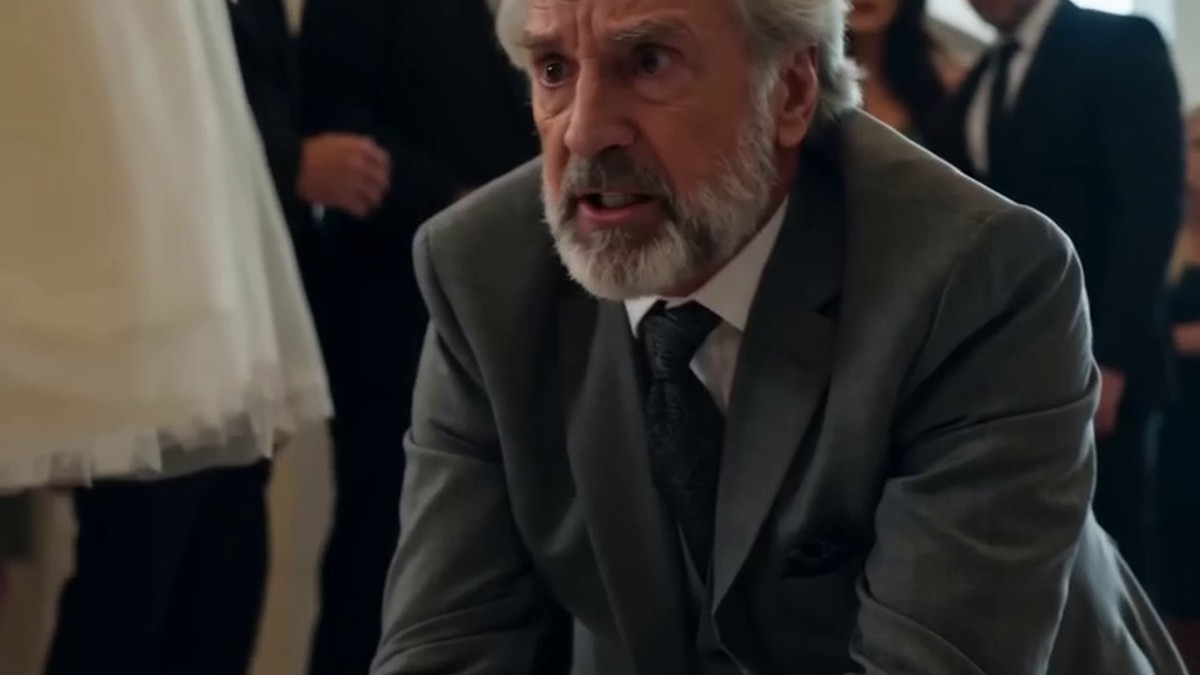
That's when Mr. Novak, who teaches AP U.S. History and chaperones every prom because he hates staying home, pushed through the crowd so fast he knocked over a chair. He didn't look at Brielle. He didn't look at the scissors still open in her hand. He got down on one knee on the dance floor in his corduroy blazer and picked up the silk like it might crumble if he breathed wrong.
"Marianne." His voice cracked on my name. "Where did this come from?"
"It was inside the dress," I said. "It's my grandmother's dress. I don't know what that is."
He turned it over, and I saw his hands were actually shaking. Gold thread formed a shape — a bird with its wings spread over a crown, stitched so fine it looked machine-made, except nobody could tell me later how anyone had done that by hand in whatever century it came from. "Do you know what this crest is?"
I didn't. Nobody in that ballroom did, except apparently him.
My grandmother, Dorothy Teague — everyone called her Dot — had died eighteen months earlier at eighty-three, in a rented room above a laundromat on Pittston Avenue, with the bridesmaid dress folded in a cedar chest at the foot of her bed. She never explained where she got it. She never explained a lot of things. She came to Scranton in 1961 from somewhere she never named, worked forty years at a dry cleaner's, and raised my father alone after his dad left. I grew up thinking her silence was just how some old people are.
Mr. Novak drove the silk square to a textile conservator at the University of Scranton that same night, still wearing his blazer, with me and my dad in the back seat of his Honda Civic because nobody could figure out who else to call. It took three weeks to get an answer. The thread was real gold, pulled thin and wound around silk fiber, a technique the conservator said had mostly died out by the 1920s. The crest matched — not approximately, exactly — a royal house that had been stripped of its titles and most of its property in a European restructuring almost a century ago. One branch of that family had quietly placed heirlooms with people they trusted before fleeing, and most of those pieces were assumed lost, sold off piece by piece through decades of war and relocation, or simply forgotten in attics by families who never knew what they were holding.
My grandmother, it turned out, had been one of those trusted people — or more precisely, her mother had been, a seamstress who'd worked for the family before the war and who'd sewn the silk into a lining "for safekeeping" when she fled with an infant daughter who grew up to become Dorothy Teague, dry cleaner's assistant, keeper of a secret she apparently never once spoke aloud in eighty-three years.
There was a foundation — the kind that tracks displaced family property across borders, run out of a law office in Washington, D.C. — and once the conservator's report reached them, things moved fast in a way four months of hand-sewing never had. A representative named Diane Okafor flew out to meet with my father in March. The appraisal, done conservatively, put the silk panel's historical and material value at just over four hundred thousand dollars, with the family willing to pay a finder's fee rather than contest ownership, since my great-grandmother had been owed decades of unpaid wages for the risk she'd taken.
Brielle Cassano's mother called our house twice that spring. I know because I answered the second time.
"We just think," she said, in the kind of voice people use when they've rehearsed being reasonable, "that given everything, maybe there's room for the girls to put this behind them. Brielle's been under a lot of stress with college applications."
"The dress is at the conservator's lab," I told her. "It's not coming back."
"That's not really what I meant."
"I know what you meant." I hung up.
Brielle never apologized to my face, not really — she sent a two-line text in April that read like it was drafted by a parent, something about "how things got out of hand that night," no mention of scissors, no mention of the four months, no mention of my grandmother. I didn't answer it.
What I did instead was simpler than anything the video clips ever showed, since none of them caught this part: six weeks after prom, sitting at my dad's kitchen table on Olive Street with Diane Okafor's folder open in front of me, I signed the paperwork transferring the silk panel into the foundation's custody for conservation and eventual display, and I endorsed the finder's fee check — $42,000 of it, my share after my father's — straight into a savings account I opened the same afternoon at the credit union on Wyoming Avenue, earmarked for Penn State tuition in the fall.
I kept the dress. What's left of it, anyway — the conservator let me have it back once the silk was removed and documented, hem still torn, pearls still crooked in places. It hangs in a garment bag in my closet, not because I forgive anyone for what happened under those chandeliers, but because I made it, every stitch of it, long before anyone decided it was something to destroy. My grandmother carried a secret sewn into cloth for eighty-three years and never once needed anyone's apology to know what she was holding was worth something. I figured I didn't need one either.



Servis na okraji Jihlavy, kde to celé začalo
Jmenuji se Radek Dvořák, mám čtyřiačtyřicet let a autoservis po tátovi jsem převzal v roce 2009 — jedenáct let předtím,...


**Broskve dědy Františka**
Vždycky jsem poznal, že léto doopravdy začíná, až se k vůni rozpálené silnice přidal pach mokré hlíny a koňského hnoje....


The Silk Inside Grandma Dot’s Dress
The scissors had already gone through the hem by the time Vanessa's shriek reached the DJ booth. I'm Marianne Teague,...


Poslední léto u bábovky
Jmenuji se Radek Dvořák, je mi sedmačtyřicet a dvacet let jezdím s kamionem po celé republice. Tohle vyprávění vlastně nemá...


Marie Nováková a čtyřicet kilogramů
Marie Nováková hodila svetr zpátky na ramínko tak zlostně, že ramínko zarachotilo o tyč. Extra velká velikost. Před rokem by...


Klíče od žlutého domu
Nikdy bych neřekl, že obyčejný studentský projekt Vojty obrátí náš život naruby. Odjel na praxi do Brna — natáčet reportáž...


Modrý porcelán paní Věry
Paní Věře bylo šedesát sedm, když v obyčejné úterý otevřela vitrínu v obýváku a vytáhla modrou porcelánovou mísu, aby do...


Osm set na dceřinu hypotéku
Jmenuju se Radek, je mi čtyřicet dva a tu historku vyprávím ze svojí strany, protože ze strany mojí ženy to...