
EN
Nobody saw her coming.

The room glittered with chandelier light, polished silverware, and the soft murmur of people who had never once gone without. She stood at the edge of all of it — barefoot, shaking, one small hand curled around the hem of a dress that had seen better days — moving toward a table she had absolutely no business approaching.
The man sitting there was older, unhurried. He cut his food with the kind of quiet authority that comes from a lifetime of never being rushed.
Then something made him stop.
A feeling. A presence.
He looked up.
She was right there.
"I'm hungry," the little girl said. Her voice was barely a sound — swallowed almost whole by the clink of glasses around her. "Can I eat?"
It didn't come out like a plea.
It came out like someone who had already stopped expecting the answer to be yes.
Before the man could speak, a security guard moved in — fast, decisive, one hand already angling toward her shoulder.
"You have to go. Now."
At a nearby table, a woman in pearls drew back sharply, her expression curdling into something ugly.
"Revolting," she said under her breath, turning away as if the child were something she might catch.
The girl flinched. Her whole body pulled inward on instinct. But she didn't move. Didn't run.
She just kept her eyes on the man.
Waiting.
Something inside him shifted.
He raised one hand.
"Stop."
The guard went still.
The conversation around them died.
The man leaned in — slowly, deliberately — and looked at her. Not at her bare feet or the grime on her skin. At her face.
That's when it happened.
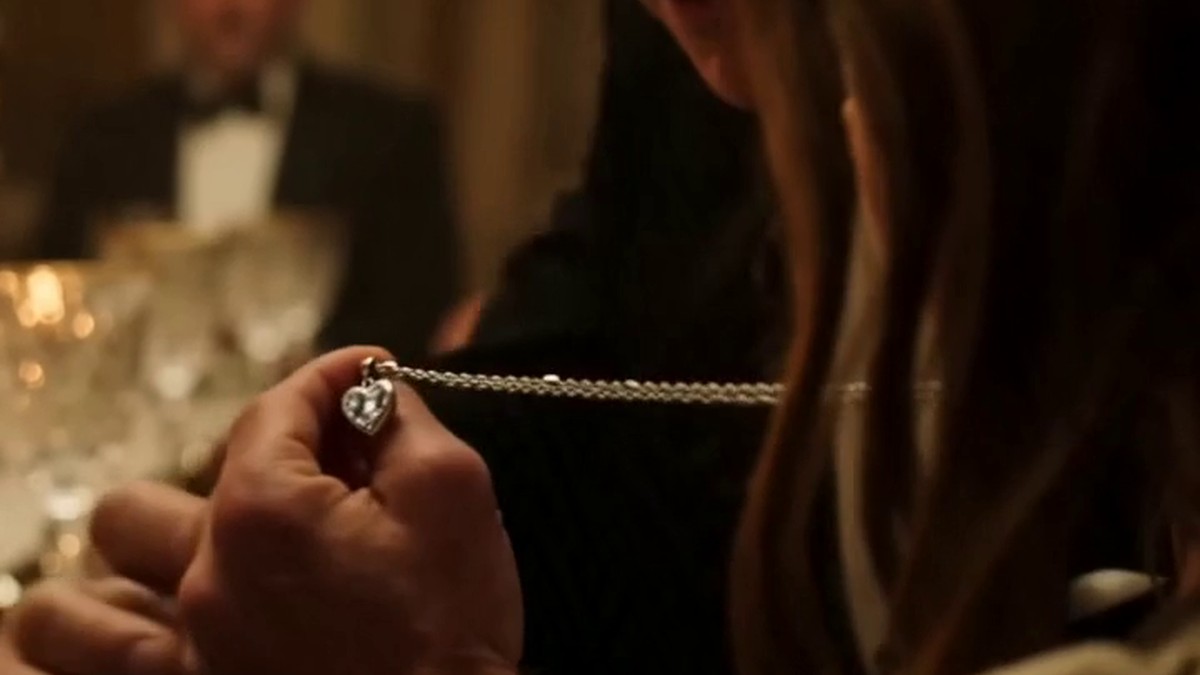
She reached up nervously to adjust her collar — and a necklace slipped free. Small. Silver. Heart-shaped.
His eyes caught it and didn't let go.
The rest of the room ceased to exist.
He reached out with careful fingers, the way you touch something you're afraid might dissolve, and lifted the pendant from her chest.
A soft metallic chime.
His breath stopped.
"Where did you get this?" The steadiness had gone out of his voice entirely.
"My mom gave it to me," the girl said, guileless, uncertain why the question mattered.
The man's hand began to shake.
His eyes went wide — not with curiosity.
With recognition.
He leaned closer. His voice dropped to something urgent, almost desperate.
"What is your mother's name?"
The girl drew a small breath.
"Elena," she said. "Her name is Elena."
The word hit him like something physical.
He set down his fork. His hands — the same hands that had never trembled through forty years of boardrooms and back rooms and hard decisions — were shaking now.
"Elena what?" His voice was barely a whisper.
"Elena Marsh."
The room around them — the chandeliers, the silverware, the woman in pearls who had already turned her disgust back to her soup — all of it became thin. Decorative. Beside the point.
He hadn't heard that name in eleven years.
—
He had given that necklace to his daughter the morning she left for college. A silver heart. Small. Cheaper than anything else he owned, which was exactly why she'd loved it. *It's not about the price, Dad. It's about the shape.*
She had worn it every day until she stopped coming home.
Until the calls grew shorter.
Until they stopped.
—
"Where is she?" he asked the girl. "Where is your mother right now?"
The child's eyes shifted — the instinctive sideways glance of someone who had learned how much truth is safe to give a stranger.
"Outside," she said quietly. "She's sick. She didn't want to come in." A pause. "She told me to just ask for bread. That rich people sometimes give bread."
Something broke open behind his ribs.
He stood up.
The guard took a half-step forward — reflexive, confused by the shift in the air. The man stopped him with a look that required no words.
"Bring a chair," he said to the nearest waiter. "And something warm. Soup. Whatever you have." Then he crouched down — a man in a two-thousand-dollar suit bending his knees on a marble floor — so he was eye level with the girl.
"I need you to take me to her," he said. "Can you do that?"
She studied him with the particular seriousness that belongs only to children who have learned too young not to trust quickly.
Then she nodded.
—
They went through the side door — the girl's small hand not quite in his, but close, leading the way with the certainty of someone who had mapped every inch of a world the rest of them had never bothered to look at.
The alley behind the restaurant was cold. November had no mercy here. A sodium light buzzed overhead, casting everything in a thin yellow wash.
She was huddled against the far wall.
Thin. Too thin. A coat that wasn't enough coat. Her head was tipped back against the brick, eyes closed, breath rising and falling in the cold air — shallow, visible, like each one cost her something.
But it was her face.
Her face.
He stopped walking.
Eleven years had changed her. Of course they had. But there — the line of her jaw, the curve of her mouth — she was still unmistakably *his*.
"Elena."
Her eyes opened slowly. Unfocused at first. Then they found him.
The sound she made wasn't a word.
She pulled herself upright against the wall. Her expression cycled through things too fast to name — shock, shame, something raw and old and unresolved. She looked at her daughter. At the necklace resting against the girl's chest. Closed her eyes.
"Lily."
"Mama, I found someone," the girl said simply. "He was nice. He stopped the mean man."
Elena looked at him again. She was bracing for something. He could see it in the set of her shoulders, the way she'd already begun rebuilding the wall in real time.
"I don't need—"
"Stop," he said. Quietly. Without judgment. "Just stop."
She stopped.
He sat down next to her on the cold ground. Right there. No hesitation. The suit be damned.
"I looked for you," he said. "For three years, I looked. And then I—" He stopped. Forced himself to say it. "I convinced myself you didn't want to be found. That you'd made your choice and I should respect it."
Her jaw tightened. "You never approved of—"
"I know what I never approved of. I know exactly what I said." He didn't look away. "I also know I was wrong. And I know that doesn't fix eleven years."
The alley was quiet except for the distant clink of the restaurant — some other world behind the door.
Lily had pressed herself against her mother's side, watching her grandfather with those old, careful eyes. She would have been born not long after the silence began — too young to remember anything before cold alleys and careful truths — which meant she had never known him at all. That thought settled on him like a second weight.
"She's sick," the girl said. Looking at him. Trusting him — just barely — with the thing that mattered most.
He looked at his daughter. Her skin was pale in ways that had nothing to do with the cold.
"How long?" he asked.
Elena let out a breath. A long, exhausted breath. "A while."
"Why didn't you call me?"
"Because I didn't know if you'd want to hear from me." She said it flatly, without drama. Then, quieter: "And because I was afraid. I was afraid you'd say no. And I couldn't—" She glanced down at Lily. "I couldn't let her see that."
He sat with that.
With the full weight of it.
The things we do to protect our children from the truth. The ways we fail them anyway.
—
He got to his feet. Offered her his hand.
She looked at it for a long moment — longer than was comfortable, long enough that he felt every one of those eleven years stacked between his palm and hers.
Then she took it.
—
Inside, the woman in pearls watched them come through the door — the little girl leading, the thin pale woman leaning slightly on the older man's arm, his suit now marked with brick dust and cold ground — and her expression reset itself toward something sharp and prepared.
The man met her eyes.
Just once.
She looked away first.
The guard who had reached for Lily stood to the side, quiet now. Neither blocking nor invisible. Just a man in a uniform who had learned, in the last twenty minutes, that he hadn't known what he was looking at.
The man guided his daughter to a chair. She sat carefully, like someone who had forgotten what it felt like to be somewhere warm. Like she was waiting for it to be taken away.
Lily climbed up beside her without being asked and took her hand.
—
They didn't talk about all of it that night.
There was too much. There would be time — messy, imperfect time — for the rest of it. For the questions and the apologies and the arguments that would still come, because love does not fix everything, and neither does showing up eleven years late. He knew that.
But he sat across from his daughter and his granddaughter at a table in the restaurant where an hour ago nobody had seen a little girl coming, and he watched Lily eat — really eat, with the focused, private joy of a child who has been genuinely hungry — and something in his chest that had been bolted shut for eleven years began, quietly and carefully, to loosen.
Elena watched her daughter too.
After a while, without looking up, she said: "She kept the necklace for me. Wore it because I couldn't." Her voice was almost steady. "I was afraid I'd lose it."
"She wore it well," he said.
Elena finally looked at him.
For the first time all night, she didn't look braced.
She looked — just slightly, carefully — like someone who might, eventually, be okay.
—
Later, when Lily had eaten everything on the table and fallen asleep against her mother's shoulder, the man stepped outside. The alley was still cold, the sodium light still buzzing. He stood in the exact spot where he'd found them and let the full weight of eleven years press down on him at once.
He had been a man who cut his food with quiet authority.
A man who had never been rushed.
It turned out that was not the same thing as a man who was present.
He looked up at the sky above the alley — a thin strip of city night, no stars, just the orange glow of a place that never went dark — and he stood there long enough to feel it. All of it. The years. The silence. The small barefoot girl walking into a room full of people who hadn't seen her.
He'd seen her.
He hadn't known why, at first.
Now he did.
He went back inside.
His daughter was still there, her hand resting over her sleeping child's, her eyes finding him the moment he came through the door — not with warmth, not yet, but with something that was at least the beginning of not looking away.
That was enough.
That was exactly enough to start.



A hűséges kutya titka – Mire bukkant Fehér Zsófia a nyíregyházi sírkertben
A nyíregyházi köztemető ősszel reggelente ezüstös párába burkolózik, és Fehér Zsófia már messziről ismerte az utat a 14-es parcellához: harmadik...


Most, který se stal čtvrtí
Jmenuju se Jarmila Brabcová, jezdím po Jizeře na výletní loď už devatenáct let, a tahle trasa mezi Turnovem a Malou...


Aaron Pap és a hatezer eurós szívességem
Pap Áron és az örökség, amiről senki sem beszélt Nem akartam ott lenni azon az estén, de valahogy mindig én...


בת מהנדס, בלי בעל, ובלי שום בושה
הניילונים מהפארם של רמת-גן עדיין היו על השידה כשאמא שלי פתחה את דלת החדר בבי"ח "איכילוב" ועצרה במקום, כאילו מישהו...


Dopis, který jsem nestihla napsat včas
Mami, nemám pro to žádné hezké ani správné slovo. Jen vím, že mi po tobě chybí – a ta bolest...


Myčka na Rokycanské
Jarmila Dvořáková si otírala ruce o zástěru a dívala se přes sklo mycího boxu, jak její zeť Radek zapojuje nový...


De beton van Han Feenstra
Ik ben al negenentwintig jaar huismeester van een flat aan de Van Oldenbarneveltlaan in Zoetermeer. Loodgieter van opleiding, maar in...


Aaronas sakė: „Mama tave mėgsta, tik dar nepažįsta.
Nuo ketvirto aukšto laiptinės, kur stoviu su šluota rankoje, girdžiu beveik visą pokalbį per ventiliacijos groteles – akustika šiame name...