
EN
The child wouldn’t let go. That was the first thing anyone noticed.

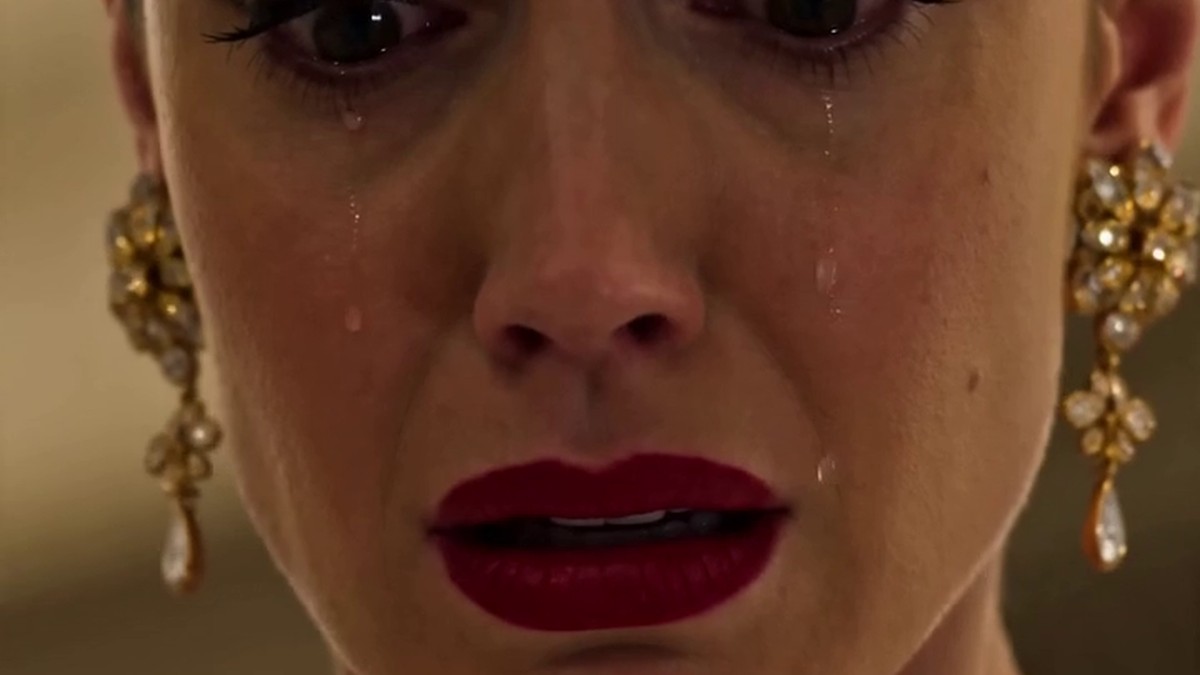
Not the tears. Not the desperation carved into her small, dirt-smudged face. Just the stubborn grip of two tiny hands wrapped around a leather strap that clearly didn't belong to her.
At least, that's what everyone assumed.
The hotel lobby made the assumption easy. Polished marble floors. Chandelier light spilling gold across everything it touched. Guests drifting past in silk and cashmere, luggage wheeled by staff who'd been trained, above all else, to maintain the illusion that nothing uncomfortable existed in this world. A ragged little girl crouched on that gleaming floor was more than an inconvenience.
She was a problem to be solved.
The woman holding the handbag was stunning in the way that money makes people stunning — white dress, red lips, gold at her throat and wrists, her entire presence suggesting she had never once been told no. When the child grabbed the brown leather strap, the woman's composure cracked like fine porcelain hitting stone.
"Let go of that." Her voice dropped to something sharp and cold. "You little thief."
Somewhere behind them, a guest sucked in a breath. Someone else murmured it quietly, the way cowards do — *call security* — and within moments a guard in a black suit was cutting through the crowd, face unreadable, hand already reaching.
The girl didn't move. Tears cut clean tracks through the grime on her cheeks, but her jaw was set.
"Please." Her voice barely made it above a whisper. "That bag belonged to my mother."
A short, incredulous laugh escaped the woman's lips. "This bag belongs to *me*."
"Miss." The guard stepped in close. "Release the bag."
She shook her head — a hard, desperate side-to-side motion — and held on tighter.
"She told me to protect it. She made me promise."
The woman wrenched backward.
The child held fast.
For one suspended moment, the entire lobby stilled. Every polished, perfumed, indifferent person in that room watched two figures locked in a silent war over a piece of leather, neither willing to surrender what they believed was theirs.
Then the clasp gave way.
The bag lurched sideways and struck the floor.
Something slid free — a photograph, old and slightly curled at the edges, skimming across the marble like a falling leaf. Behind it, small and delicate and catching the chandelier light, rolled a bracelet no bigger than an infant's wrist.
The guard reached them first. He crouched, picked up the photo — and went completely still.
The woman snatched it from his hand, furious, already drawing breath to speak.
She never spoke.
Her face simply fell apart.
The photograph showed a young woman — hardly more than a girl herself — cradling a newborn wrapped in a pink blanket. And there on the baby's tiny wrist, unmistakable, was the bracelet now lying against the cold marble floor.
The wealthy woman lowered herself slowly, as if her legs had stopped trusting her. Her hand trembled as her fingers closed around the bracelet.
"This belonged to my daughter." The words came out hollowed out, scraped clean of everything except grief. "My daughter who disappeared."
The lobby had gone churchlike in its silence.
The child watched her with wide, uncertain eyes.
"My mother told me her real name was Lily," she said softly.
The woman's breath caught like a hook behind her ribs.
"My daughter's name was Lily."
Neither of them moved. The air between them felt fragile, the way air feels before something either breaks or becomes whole.
"She said if I ever found a woman in a white dress," the child continued, her voice barely holding together, "I was supposed to give her the bag. She said the woman would understand."
The woman looked down at the handbag with different eyes now. Slower eyes. And there — half-hidden within the silk lining, tucked into a seam as though placed there by hands that had taken their time, that had thought carefully about this moment — was an envelope, folded once.
Three words on the front, written in ink that had faded just slightly with time.
*Mom, forgive me.*
She didn't open it immediately. She just held it against her chest, that envelope, the bracelet pressed into her palm, the photograph face-up on the marble between her knees.
The bag had traveled a long road to reach her.
It hadn't been carrying leather and hardware.
It had been carrying a goodbye.
The child watched her from across that small, impossible distance — not moving, not speaking, just watching with those too-old eyes that children only get when they've been asked to carry things meant for adults.
The guard straightened slowly and took a step back. He seemed to understand, the way that some people instinctively do, that there are moments in which authority has nothing to offer.
The woman in white looked up.
"What's your name?" she asked.
"Clara."
"How old are you, Clara?"
"Eight." A pause. "And three months."
Something shifted in the woman's expression — a calculation happening somewhere behind her eyes, quiet and devastating.
"What was your mother's name?"
Clara's chin trembled once, controlled immediately. "Everyone called her Ren. But her real name was Lily." She watched the woman carefully. "She died four days ago."
The lobby hadn't recovered its noise. The guests who'd been drifting past in silk and cashmere had stilled without quite realizing it, caught in the gravity of something they couldn't name. The chandelier went on pouring its indifferent gold across all of them.
The woman looked back down at the envelope in her hands.
*Mom, forgive me.*
She turned it over. Turned it back. Her red lipstick seemed suddenly like a costume, like armor that had stopped fitting somewhere in the last sixty seconds.
"She wrote this," she said. Not a question.
Clara nodded. "She wrote it a long time ago. She made me learn what to do with the bag before she got too sick to talk." Her voice was matter-of-fact in the way that grief teaches children to be matter-of-fact. "She made me practice."
"Practice."
"Finding you. She described your dress. She said white, always white. She said you'd be in a hotel like this one." Clara glanced around at the marble and the gold light. "We tried two others first."
The woman pressed her lips together hard.
Two other hotels. A dying woman. An eight-year-old practicing the words she'd need to say when the moment came. The whole architecture of it — the planning, the faith required, the sheer determination to get a message delivered from the far side of an uncrossable distance — arrived in the woman's chest all at once and nearly flattened her.
She opened the envelope.
The paper inside was a single sheet, folded twice, the handwriting small and careful and slightly uneven in the way of someone writing in a difficult position. Or with unsteady hands.
She read it.
She read it again.
Then she folded it carefully, returned it to the envelope, and held it against her chest the same way she'd been holding it before — but differently now. The way you hold something you intend to keep.
"She explains everything," the woman said quietly. To no one. To herself. To the lobby ceiling.
"She told me she explains everything," Clara confirmed.
"She was sixteen when she left." The words came out scraped thin. "We'd had a fight. A terrible fight. The kind you have when you both say things that can't be unsaid." She stopped. "I spent nine years looking for her."
Clara nodded slowly. "She knew."
"She knew I was looking?"
"She said she couldn't come back because she was ashamed. She said she kept waiting until she wasn't ashamed anymore." Clara's voice dropped. "She waited too long."
The woman made a sound that wasn't quite a word. Her hand came up to her mouth.
"She wanted to come back," Clara said. There was urgency in it — the urgency of a child who has practiced saying something important and needs to say it right. "She told me to make sure you knew that. That she wanted to. Every day."
The chandelier went on burning above them.
The woman lowered herself the rest of the way until she was sitting fully on the cold marble floor of the hotel lobby, white dress pooling around her, envelope against her chest, bracelet pressed so tightly into her palm that it would leave a mark. She was fifty-something and elegant and entirely destroyed and she did not seem to care at all that she was sitting on the floor.
The guard looked at the remaining guests. The remaining guests looked at the guard. By some unspoken agreement, they began to quietly exist elsewhere.
Clara stayed.
She stood in front of the woman with the bag's broken strap in her hands and waited with the particular patience of someone who has already survived the worst of it and now simply needs to know what comes next.
"Where have you been staying?" the woman finally asked.
"A shelter. Near the train station."
"Alone?"
"There's a woman there. She's been kind."
The woman in white looked up at Clara for a long moment — really looked, the way she hadn't allowed herself to look yet. The dirt on her face. The too-small jacket. The shoes that had clearly walked a long distance across a city that wasn't built for walking.
The eyes, though.
She knew those eyes.
She had looked at those eyes in photographs for nine years.
"Clara." Her voice broke on the single syllable and she let it break. "I'm Margaret." She stopped. Tried again. "Your grandmother's name is Margaret."
The word landed between them like something physical.
*Grandmother.*
Clara stared at her. Whatever composure she'd been holding together — the practiced steadiness of a child on a mission, a child with a job to do — wavered for the first time.
"She told me," Clara said. "She told me about you."
"Good things, I hope." It came out almost like a joke. Almost.
"She told me you were stubborn." A pause so small it almost didn't exist. "She said I got it from both of you."
Something happened in Margaret's face then. It wasn't quite a smile and it wasn't quite crying and it was both of those things entirely, all at once, each one arriving at the same moment from opposite directions and colliding somewhere in the open.
She reached out her hand.
Clara looked at it for one breath. Two.
Then she sat down on the cold marble floor beside a woman she had never met, who had been looking for her mother for nine years, who was holding a letter and a bracelet and a photograph and the specific wreckage of a life that had tried, at the very end, to put itself back together.
She didn't take the hand. She leaned into the woman's side instead — a small, instinctive animal motion, a child finding warmth — and Margaret's arm came around her without hesitation, without thought, the way arms do when the body understands before the mind catches up.
They sat there on the lobby floor.
The chandelier burned on above them. The marble was cold and hard and indifferent, the way surfaces are when they were never meant to hold things as fragile as this.
But it held them anyway.
Clara still had the leather strap in her hands. The bag itself lay nearby, clasp broken, lining turned partly inside out, emptied of everything it had been asked to carry. It looked smaller now. More ordinary. Just leather and hardware, finally, after a very long road.
The bracelet — the one from the photograph, the one sized for an infant's wrist — lay in Margaret's open palm. She turned it once in the light, then reached over carefully and fastened it around Clara's wrist instead.
It was still too small. It barely closed.
But it closed.
"She kept her promise," Clara said quietly. "She made me keep mine."
Margaret tightened her arm around her granddaughter's shoulders.
"She did," she said. "She absolutely did."
Outside, the city went on being a city — loud and indifferent and enormous. But in the particular silence of that lobby, on that cold and gleaming floor, something that had been broken for nine years had quietly, improbably, with the stubborn help of an eight-year-old who had practiced her lines in a shelter near the train station — something had found its way back to whole.
Not repaired. Not the same as before.
Whole in the way that things become whole when enough of the missing pieces finally come home.



Le Testament sous le pommier
Je m'appelle Odette Vasseur, j'ai soixante-quatorze ans, et le jour où j'ai enterré mon deuxième mari, sa fille m'a jetée...


**Le dossier bleu**
L'infirmière avait pris ma tension trois fois quand elle a enfin croisé mon regard et détourné les yeux vers le...


# La clienta del pañuelo azul
Me llamo Marisol, tengo cincuenta y ocho años y llevo diecisiete trabajando en la caja tres del Publix de Coral...


# יתרון הבית
הריח הגיע אליה קודם — צבע טרי, משהו הדרי, כמו בחנות נרות. דנה כרמון לא הזמינה שום נרות. היא יצאה...


# יתרון הבית
הריח הגיע אליה קודם — צבע טרי, משהו הדרי, כמו בחנות נרות. דנה כרמון לא הזמינה שום נרות. היא יצאה...


# Rachunek uciekającej panny młodej
Głośniki nad głowami wciąż odtwarzały stare przeboje Anny Jantar, gdy moja matka wyrwała mikrofon didżejowi i uznała, że wesele potrzebuje...


# The Christmas I Stopped Being Their Bank
My daughter-in-law's fork froze halfway to her mouth when my son stood up and pointed at the door. "Pay rent...


La receta que Marisol dejó de cocinar
Marisol Reyes llevaba diecisiete años preparando pollo guisado con arroz y habichuelas para Ernesto, aunque él llegara pasadas las once...