
EN
The Butterscotch Nobody Wanted But Me

My name's Danny Reyes, I'm thirty-four, and I run the parts counter at a Ford dealership outside Tulsa. I need to say upfront: my mother-in-law thinks I'm the villain in this story. Maybe I am. But nobody ever asked me what it looks like from where I'm standing.
It started with butterscotch discs. The gold-wrapped kind, the ones that sit in a dish on somebody's coffee table for a year because nobody wants to be the one who eats the last one. My grandmother kept a bowl of them on her TV stand in Muskogee, and I'd sneak one every time we visited, unwrap it under the table so the crinkling wouldn't give me away. That candy tastes like her house — mothballs, a wood stove, the Braves game on mute. I still buy a bag every few months and eat one alone in my truck, which probably tells you something about where I'm at in life right now.
Here's the part my wife's mother, Carol, doesn't tell people. Four years ago, my father-in-law Ray got sick — pancreatic thing, moved fast — and before he died he signed the auto shop over to me. Not to Carol. To me. I'd been working the floor there since I was twenty-six, longer than I've been married to Marissa, and Ray trusted me with the books in a way he never fully trusted his own wife, because Carol had run two businesses into the ground before I ever showed up — a nail salon, then a scrapbooking store, both gone in under three years. Ray told me this himself, sitting in a hospital bed in Tulsa with a tube in his arm: "Don't let her touch the accounts, Danny. She means well. She just can't help herself."
So I didn't. And Carol has spent four years telling anyone who'll listen that I stole her husband's business out from under her, that I turned her own daughter against her, that I sit in that shop counting money that should've gone to her retirement.
What she doesn't say is that I kept her on payroll anyway. Doing what, exactly, nobody could ever say — greeting customers, mostly, and rearranging the same rack of air fresheners. I paid her twenty-two dollars an hour to do a job that didn't need doing, because Marissa asked me to, and because for a while I still believed family meant you carried people even when they didn't carry you.
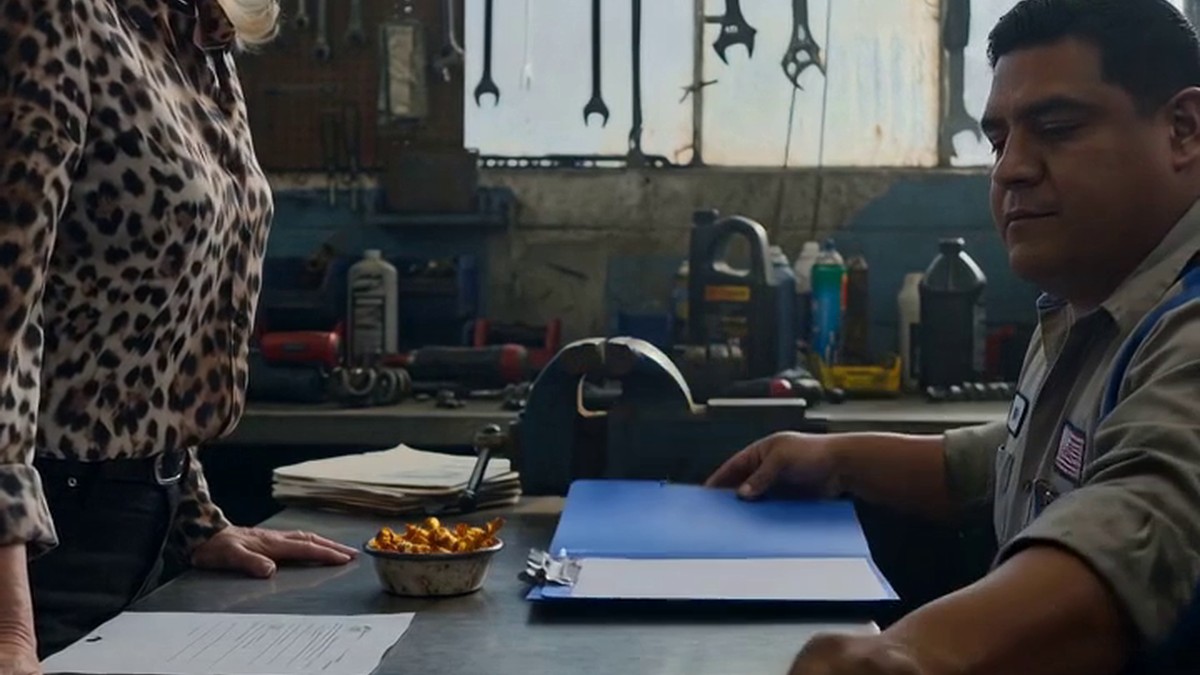
That ended on a Tuesday in June, out at the shop on 71st Street. I'd had the transmission bay repainted, one whole wall, and Carol came in with a folder — an actual folder, blue, the kind with the metal clasp — and set it on my desk like she was serving papers. Which, in a way, she was.
Inside was a letter from a lawyer in Broken Arrow, laying out her claim that Ray had been "not of sound mind" when he signed the shop over, that four years of my running it profitably was actually four years of me exploiting a grieving widow, and that she wanted fifty percent ownership, retroactive, plus back pay she said I owed her for "unrecognized managerial contributions."
Fifty percent. Of a shop that does about six hundred thousand a year, that I built from three bays to seven, that I refinanced twice on my own signature when Ray's medical bills were still bleeding us dry.
I didn't yell. I want that on the record, because Carol will tell you I did. What I did was call Marissa, right there in front of her mother, and ask her one question: "Did you know about this?"
My wife didn't answer for a second too long. That was the answer.
Turns out Carol had been at our house three separate Sundays that spring, "helping with the garden," while actually working Marissa over about how unfair it all was, how her mother deserved better, how a good husband would just split it fifty-fifty and stop being so uptight about paperwork. Marissa never told her no. She also never told me any of it was happening.
I drove home that night past the Braum's on Memorial, the one Marissa and I used to stop at for banana splits when we were dating, and I didn't stop. I sat in my driveway for twenty minutes with the engine off, because I already knew what I was going to do and I needed a minute before I did it.
The shop's actual name — the one on the sign, the one on every invoice — is Reyes Auto & Diesel. Ray put my last name on it the year I made shop foreman, three years before he got sick, because he said a man ought to see his own name on the thing he's building. Carol's lawyer either never checked that or figured it didn't matter. It mattered.
The next morning I called my own attorney, a woman named Priscilla Ford who'd handled the original transfer, and had her pull every document: the 2022 bill of sale, Ray's notarized statement of intent, the psychiatric evaluation Ray had insisted on getting done himself, unprompted, specifically so nobody could ever say what Carol's letter was now saying. Ray had been sharper about protecting me than I ever gave him credit for.
I also did something Carol never saw coming. I called Marissa's older brother, Deacon, who lives in Amarillo and has been estranged from Carol for six years over money she borrowed and never paid back. I told him everything. Deacon laughed — not a mean laugh, just tired — and said, "She tried this same move on me in 2019 with Dad's truck. I should've warned you."
Then I did the thing that actually mattered. I went to the shop, called Carol, and asked her to come in on Friday to "go over some paperwork." She showed up in the blue Buick Ray bought her, wearing the necklace with his wedding ring on it, and sat across from me at the same desk where she'd dropped that folder.
I didn't argue about the fifty percent. I slid across a single page: her termination letter, effective that day, with four weeks' severance — more than legally required, less than she expected. Next to it, a printed copy of Ray's notarized statement and the psych evaluation, dated eleven days before he signed the transfer. And next to that, her own lawyer's letter, with the section highlighted where he'd claimed the shop was "informally still under Raymond Whitfield's estate" — a claim that fell apart the second anyone looked at the actual filed deed.
"Ray protected this before he protected almost anything else," I told her. "I'm not fighting you for it. There's nothing to fight over. It was never yours to claim."
Carol didn't cry. She told me I'd turned her daughter against her, same line as always. I said her daughter had been in that garden three Sundays without saying a word to me, and maybe she should ask herself why Marissa needed convincing in the first place instead of just backing him.
What I didn't expect was Marissa, waiting in the parking lot when Carol walked out. I watched through the window. My wife didn't hug her mother. She didn't yell either. She just said something short — I couldn't hear it — and Carol got in the Buick and drove off toward Memorial Drive alone.
Marissa came inside and sat down across from me, in the chair her mother had just left warm.
"I told her she's welcome at our table on Sundays," she said. "Not at yours. Not anymore."
I didn't say anything clever back. I just reached into my desk drawer, where I keep a bag of butterscotch discs next to the stapler, and slid one across to her — the same kind my grandmother used to keep in that bowl on the TV stand. Marissa unwrapped it slow, the wrapper crinkling loud in that quiet office, and didn't say another word for a long minute.



Haar niveau
Ik heb die ochtend nog een bericht van Daan gekregen. “Marit, je redt ons echt. Ik betaal je alles terug...


The Butterscotch Nobody Wanted But Me
My name's Danny Reyes, I'm thirty-four, and I run the parts counter at a Ford dealership outside Tulsa. I need...


Мій ключ не підійшов
Це сталося у вівторок, о сьомій ранку, коли Марта ще спала. Я віддав ключі від нашої квартири своїй матері. Просто...


Oddałem Annie dwadzieścia siedem tysięcy. Nie otworzyła drzwi
Minął rok, odkąd przeniosłem się przez ulicę. Co rano staję przy oknie kuchennym w domu Kasi i patrzę na tamtą...


Celle qui est sortie de la brume
J’avais vingt-deux ans quand j’ai compris que les arrêts de bus ne mentent jamais, mais que les miroirs, eux, mentent...


М’ясо в духовці, лайки в мережі
Повідомлення від двоюрідної сестри з Кривого Рогу вискочило на екран саме тієї миті, коли Оксана підняла горнятко кави з дерев'яного...


Zarezerwowany stolik na dwoje
Pracuję w restauracji na Mokotowie już jedenasty rok. Gości przychodzi tylu, że mogłabym z nich ułożyć osobną książkę telefoniczną. Tamtego...


The Note That Stopped the Laughter
The richest people in Cleveland were laughing at me, and I was holding a tray of chicken bones. It was...