
EN
One day I’ll pay you back.

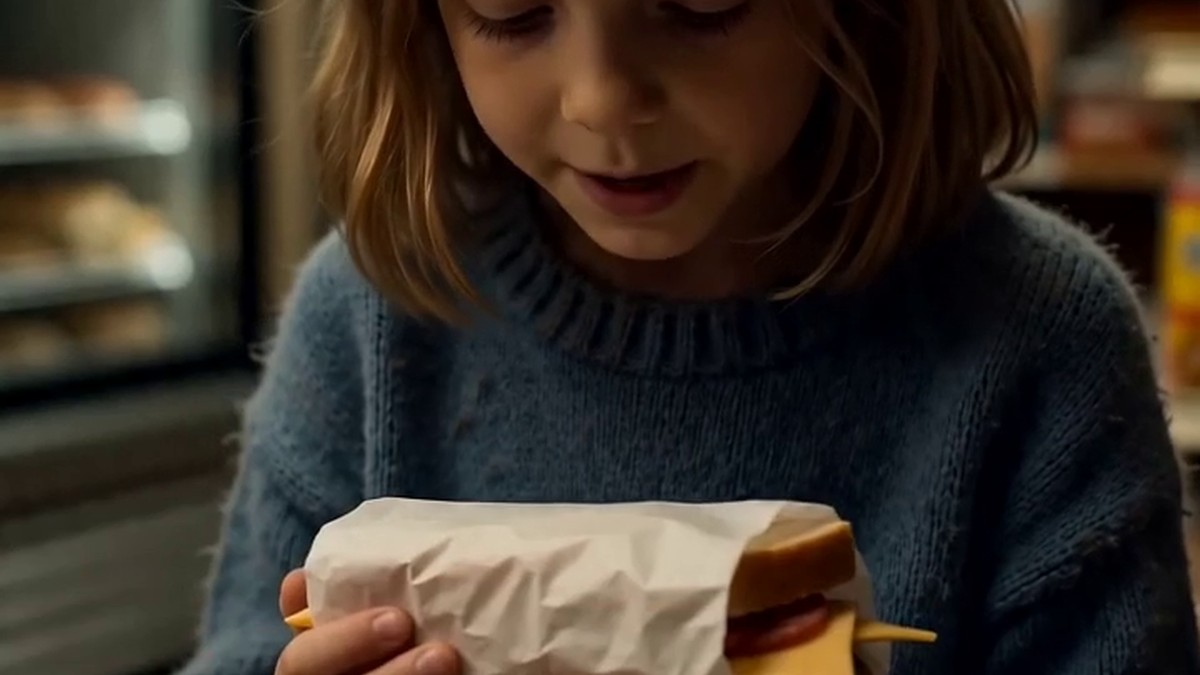
The little girl breathed the words so quietly they almost disappeared into the air.
She was wearing a blue sweater, washed so many times the color had nearly surrendered. The old shopkeeper studied her face. Something in his chest pulled tight.
"Please."
That single word carried everything she had left — which wasn't much. No money. No one waiting for her at home. Just threadbare pockets and a hunger that had taken up permanent residence behind her ribs.
His eyes drifted to the counter. One sandwich. The last one.
He ran the numbers in his head without meaning to. Giving it away meant an empty shelf tonight. Meant *he* went without. He knew that math by heart.
But then he looked at her again.
He picked up the sandwich and wrapped it slowly, deliberately — the way you wrap something that matters.
She took it with both hands and pressed it against her chest like it was made of gold. Maybe, to her, it was.
When she looked up, her eyes weren't just grateful. They were *burning* — quiet and fierce and absolutely certain.
"Someday I will repay your kindness, sir. I promise you."
He smiled. Reached out and gently touched the top of her head.
*Poor little thing,* he thought. *Sweet words from a hungry child.*
He believed it the way you believe something beautiful that you don't expect to last.
He had no idea.
Twenty years have a way of blurring at the edges — days fold into weeks, winters stack on top of each other, and the faces you remember best are the ones you never thought twice about losing.
The old shopkeeper's name was Harold Briggs. He was sixty-one now, though he moved like a man who had agreed to feel older. The shop — *Briggs & Son*, a name that outlasted the son by a decade — sat on the corner of Elm and Prospect, wedged between a laundromat that changed ownership every two years and a pharmacy that had stopped carrying the things people actually needed.
The neighborhood had changed. Harold hadn't.
He still opened at six. Still closed at seven. Still wrapped the last sandwich of the day the same way — slowly, deliberately — even when there was no one left to give it to.
—
The letter arrived on a Tuesday.
Plain envelope. No return address. His name written in handwriting so deliberate it looked like someone had thought carefully about every single letter before committing it to ink.
He almost threw it away. He got enough letters from banks.
He opened it instead.
Inside, a single notecard. Four sentences.
*You won't remember me. I was seven years old, a blue sweater, your last sandwich. I made you a promise that day — one I intend to keep. I'll be there Friday at noon. — A.*
Harold read it three times.
Then he set it on the counter and went back to work, because that was the only thing he knew how to do when the world tilted sideways without warning.
—
Friday arrived the way important days always do — dressed up as an ordinary morning.
Harold unlocked the shop at six. Rearranged a display he'd arranged a hundred times. Made coffee he didn't drink. Watched the clock with the focused attention of a man trying very hard to appear as though he wasn't watching the clock.
Noon came.
The bell above the door rang.
She walked in like someone who had learned to take up exactly the space she needed — no more, no less. Tall. Dark coat. The kind of calm that isn't born, it's *built*, assembled piece by piece over years of hard-won battles.
Harold looked at her face.
And something in his chest cracked open like an old door.
He didn't recognize the woman. But somewhere beneath the years and the polish and the quiet authority — somewhere very deep — he recognized the *eyes*. Burning. Fierce. Absolutely certain.
"Hello, Mr. Briggs," she said.
Her voice was steady. His was not.
"The blue sweater," he managed.
She smiled — and just for a second, she was seven years old again, pressing a sandwich against her chest like it was made of gold.
"Anna Vesper," she said, extending her hand. "Though back then I didn't have a last name I was proud of."
He shook it. Couldn't speak. She didn't seem to need him to.
—
She sat across from him at the small table in the back — the one he used for inventory and lunch and, occasionally, crying, when the numbers got bad enough.
She told him her story the way you tell something you've rehearsed only in private.
After that day with the sandwich, she'd been placed with a foster family three towns over. The family was decent, which was more than she'd had. There was a teacher — eighth grade, English — who looked at Anna's writing and said something that rearranged the furniture of her mind: *You think in a way that other people can't yet. Don't let anyone talk you out of it.*
She didn't.
She won a scholarship. Then another. Then she stopped needing them. She graduated early, worked nights at a hospital billing office while she finished her degree, and spent three years watching the gap between what patients needed and what they could actually access. That gap made her angry in a productive way. She co-founded a small health technology startup with a college friend and a business plan written on legal pads at a kitchen table. The company found its footing slowly — grant by grant, clinic by clinic — growing into something that placed medical services inside communities that had learned not to expect them.
By thirty-two, Anna Vesper was the kind of name that appeared in newspapers — not because she chased attention, but because she'd built something real. The sort of work that made people use words like *visionary*, which she found embarrassing.
She'd found Harold two months ago.
A private investigator, a county business license, and one very old memory of a hand gently touching the top of her head.
Harold listened to all of it without interrupting. When she finished, the shop was very quiet.
"I always wondered," he said, finally. "Whether you were okay."
"I know," she said. "That's one of the things I wanted to tell you."
Then she slid an envelope across the table.
He didn't move.
"Anna —"
"Open it."
He did.
He looked at it for a long time. Long enough that his coffee went completely cold. The number had more digits than he was accustomed to seeing with his own name attached.
"I can't —"
"You gave me everything you had," she said, cutting him off — not harshly, but firmly, the way you speak when you've thought something through to its final word. "That sandwich was your last one. I knew that even at seven. I could see it on your face." She paused. "This is not charity, Mr. Briggs. This is a debt I've been carrying for twenty years, and I'd like to set it down."
Harold looked up from the envelope.
His eyes were wet. He wasn't ashamed of that.
"The shop is failing," he said. It was the first time he'd said it out loud to anyone. The words cost him something.
"I know."
"I didn't want to close it. My father opened this place. His hands built that counter."
She nodded. Slowly. Like she understood the specific weight of inherited things.
"Then don't close it," she said. "Renovate it. Keep the counter. I have a proposal — and you can say no. A community meal program. I've been looking for a location with the right kind of roots." She looked around the shop — the worn floor, the handwritten price tags, the particular quality of the light. "This has roots."
Harold looked at the counter his father's hands had built.
He thought about the little girl in the blue sweater. He thought about a promise made by someone who had nothing — and kept by someone who had everything she'd built herself, stone by stone, year by year.
He thought about what it meant to give someone your last thing.
He hadn't known, that afternoon twenty years ago. He'd done it anyway.
That's the only way it works.
—
The renovation took three months.
Harold stayed open during all of it, because closing, even temporarily, felt like a concession he wasn't willing to make. He swept sawdust every morning. Answered questions from the contractors with the authority of a man who knew every inch of a place by heart.
The counter stayed.
On the day the meal program launched — a Thursday, gray October sky pressing low over the neighborhood — Harold stood behind that counter and watched people come through the door. Families. Kids who looked like they hadn't eaten a full meal in longer than they should say. Old men who came in alone and sat at the tables Anna had installed along the east wall.
Anna was there. She worked the room without working it — talking to people easily, remembering names after hearing them once, kneeling down to be at eye level with a small boy in a yellow jacket who couldn't have been more than six.
Harold watched her with him.
She said something. The boy laughed — sudden and bright, the kind of laugh that surprises even the person laughing.
She looked up and caught Harold's eye across the room.
She didn't smile, exactly. It was something quieter than a smile.
*We did this,* it said. *You started it twenty years ago, and we finished it today.*
Harold nodded once.
He turned back to the counter and wrapped a sandwich — slowly, deliberately.
The way you wrap something that matters.



Puchýř pod malíčkem Boženy Kovářové
Tmavá, vlhká noc koncem srpna. Božena Kovářová se probudila ve dvacet minut po jedné, protože ji na pravém chodidle tak...


Жената от третия етаж на улица „Пирин“
Казвам се Весела и от три години работя като нощна портиерка в блок на улица „Пирин“ в Пловдив — стар...


Il frigorifero di mio cognato e i cinquemila euro che non torneranno
Mi chiamo Dario Ferraris, ho quarantatré anni, faccio l'elettricista a Bergamo da quando ne avevo diciannove. Questa storia la devo...


Dvi šunų lizdai Nr. 9 ir nuotrauka, kuri sustabdė furgoną
Mano vardas Audrius Vaitkus, man šešiasdešimt treji, ir jau vienuolika metų savanoriauju Kauno rajono gyvūnų prieglaudoje, netoli Garliavos. Mačiau visko....


A jászberényi diófa, amelyik hatszázezer forintot ért meg egy családnak
A jászberényi diófa, amelyik örökre megmentett egy udvart Negyedik éve dolgozom a jászberényi piacon zöldséges standnál, pont szemben azzal a...


Žentas, kuris liko: Birutės akys devynerius metus
Mane vadina nedėkingu žentu. Taip sako uošvienės draugės prie bažnyčios Pasvalyje, kai aš parvežu ją iš poliklinikos ir padedu išlipti...


האלמנה מרחוב הדקלים
היה סוף אוקטובר, בבאר שבע עוד נשבה החמסין המאוחר שחודר דרך כל בד, לא משנה מה לובשים מתחתיו. אני לבשתי...


Свекървата ми изхвърли дрехите, а мъжът ми мълчеше
Стоях във всекидневната с разкъсан найлонов плик до краката и гледах празния рафт в гардероба. — Къде е ризата ми...