
З життя
“Take this kitten,” the woman begged at the market. The passerby’s reaction shocked everyone.

The box had been at her feet for three days, and the bottom was already soggy from the morning damp. Margaret adjusted the towel inside, counted the kittens—all five. Two grey, two tabby, one black with a white chest. The black one was asleep, the tabbies mucking about, the greys huddled together.
The market woke up slowly. Susan from the veggie stall had already stacked her apples in a neat pile, and they gave off that tart autumn smell that makes October stand out from every other month. The sky hung grey and heavy, and the cold crept under her jacket not all at once, but bit by bit, inch by inch, from her wrists to her elbows. The asphalt glistened from yesterday’s rain, puddles mirroring the stalls, the people, slices of sky.
Margaret blew on her fingers. They were red and stiff, and she’d forgotten her gloves at home because this morning she wasn’t thinking about gloves—she was thinking that today was the last day she could stand here. Tomorrow her daughter would come to pick up the cat, but she wouldn’t take the kittens. Her daughter had said, ‘Mum, where am I supposed to put five of them?’ And she was right. But being right didn’t solve anything—it just made something already hard even harder.
‘Would you like a kitten?’ Margaret said to anyone who slowed down. ‘They’re lovely, hand-reared. If it’s no trouble…’
People walked past. A woman with a pram smiled but shook her head. A man in overalls didn’t even look. A little girl about ten crouched down, reached out her hand, but her mother tugged her sleeve and dragged her away.
‘Who wants kittens in October?’ Susan said from the next stall, rearranging her apples. ‘In spring, maybe, but now… You should take them back.’
Margaret said nothing. ‘Back’ meant something she didn’t want to think about.
The black kitten woke up, lifted its head, squeaked. Margaret lowered her hand into the box and scratched behind its ear. The cardboard felt soft and damp under her fingers, already starting to peel at one corner.
He didn’t slow down, didn’t glance at the box and move on. He stopped, like he’d hit an invisible wall, and stood there for a few seconds, staring down.
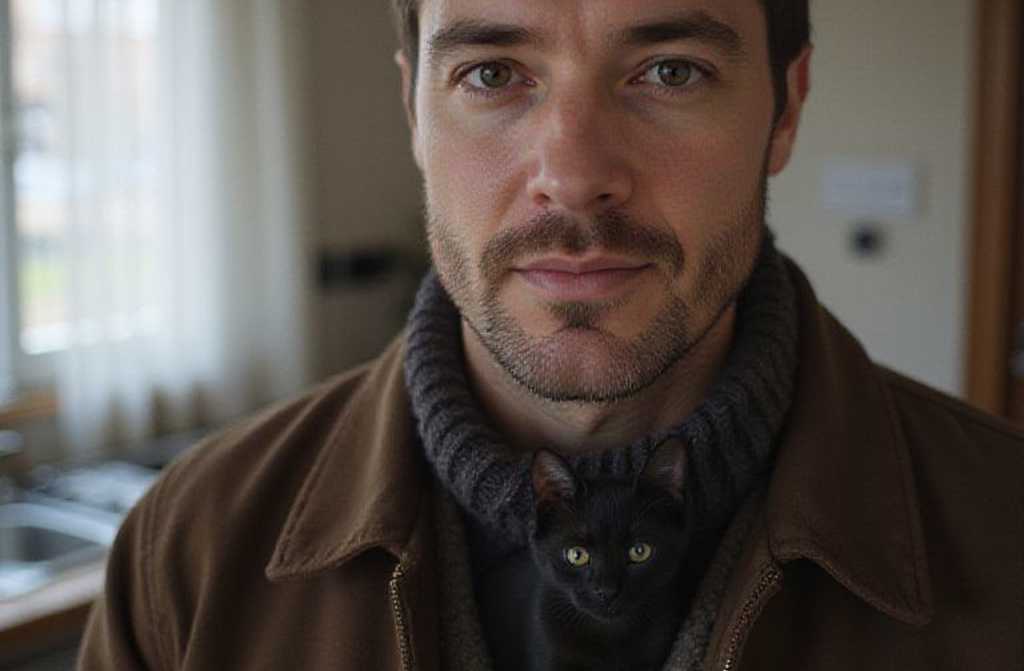
Thin, in a jacket worn at the elbows, hands in his pockets. A face like people who haven’t slept properly in a long time—not from work, but from something else. Pale eyes, tired. A three-day stubble, but neat, like he wasn’t growing it, just forgetting to shave.
‘How many?’ he asked.
‘Five,’ Margaret straightened up, tugged her jacket. ‘Two boys, three girls. A month and a week. Litter trained. If it’s not…’
‘I’ll take them.’
Margaret blinked.
‘Sorry?’
‘All of them.’
He pulled his hands out of his pockets and crouched down. He lifted the black kitten in one palm, looked it in the eye, gently parted its back legs to check, then put it back. That’s not how you take a puppy as a gift for a child. That’s how you take an animal if you know where to look and why.
Margaret stood there, not knowing what to do with her hands. The bag of food she’d brought every day suddenly wasn’t needed. The words she’d prepared for every passer-by weren’t needed either.
‘You… all of them?’ she repeated.
He nodded. He lifted the box. She saw his hands hold the cardboard carefully, gently, without squeezing.
‘Hold on,’ Margaret reached into her bag. ‘Here, there’s food, I bought it… And a special formula. They still need supplementing with a dropper, a little at a time. They’re not eating properly on their own yet.’
He took the bag. Didn’t thank her. Didn’t smile. Just nodded and walked off, the box swaying in time with his steps, and a little ginger tabby paw poked out, gripping the edge.
Susan whistled.
‘Well, I never. Took the lot. Bit odd, that one.’
Margaret didn’t answer. She watched his back and couldn’t understand why she didn’t feel relieved, even though this was exactly what she’d wanted for three days. Maybe because giving kittens to a stranger who didn’t say why isn’t quite the same as rehoming them. Rehoming means you know where they’re going. She didn’t. She only saw his hands, and they were the right sort of hands, and that should have been enough.
She pulled a notebook and pen from her bag. Followed him—luckily, it wasn’t far; the stranger went into the entrance of the next building. Margaret, like a spy, trailed him right up to his flat. Jotted down the address. Just in case. Or maybe not just in case.
A single pair of boots by the door. The hooks on the hallway wall were bare: four of them, shiny, and on each one there’d once hung a coat, a scarf, or an umbrella, but now they just stuck out of the wall like questions nobody was around to answer.
Tom set the box down on the kitchen floor. The kittens stirred, one squeaked.
He took off his jacket, hung it on the only occupied hook.
The radiator under the window was barely warm. October was creeping into November, and the heating had only just been turned on—the pipes still gave off heat like they didn’t quite believe it was time.
Tom crouched by the box. The black kitten was the first to lift its head and look right at him, with greenish, still-cloudy eyes, but already showing character. A strip of light from the window fell on the linoleum, and dust motes swirled in it, slow and indifferent to everything.
Tom opened the cupboard, found an old towel. Terry cloth, pale blue, long past its colour and softness. He laid it on the floor by the radiator, moved the kittens from the box onto the towel. They lay in a heap, paws tangled, and he didn’t separate them. Let them be.
Then he took the food and the milk formula from the bag. Put them on the table.
The formula needed to be warmed to thirty-eight degrees. Tom knew that like he knew his own name—not recalling, just knowing. He mixed it with warm water, put it on low heat, and stood at the stove with a kitchen thermometer he’d found in a drawer, waiting.
He’d packed his tools in a box, handed over the keys, written his resignation. Diane had left in April, and by October he’d stopped being a vet, because the hands that had healed other people’s animals couldn’t hold his own life together. And it had seemed right to just stop everything.
But his body remembered. The dropper settled between his index and middle finger the way it had thousands of times. His left hand picked up a kitten, turned it onto its back, brought the dropper to its lips. A drop of milk ran down its chin onto the towel, and the kitten started sucking, and Tom felt something in his wrist relax.
The black one first, because it was the smallest and gulped greedily, hurriedly, like it was afraid someone would take it away.
The greys together—they lay side by side and didn’t want to be separated, and while one fed, the other nuzzled its neck, and Tom held both with one hand.
The tabbies one at a time—they wriggled and squeaked, milk spilling down their chins and onto the towel, and he wiped them with the corner of the fabric, not annoyed, but out of habit, the way he’d done for years at the clinic, where owners looked anxious and he’d say ‘it’s all right, everything’s fine,’ and his voice calmed not just the animals but the people too.
Full, the kittens fell asleep. All five, on the towel by the radiator, piled on top of each other. The black one on top, white chest, paws dangling. Tom sat on the floor beside them and leaned his back against the wall. Watched them breathe. A thin, rapid, shared sound, like rustling.
Then he got up, washed the cup. Dried it and put it away. Got another, clean one. Poured himself tea. And as he drank, one of the tabbies woke up, wobbled over to his leg, and pressed its nose into his ankle. The nose was wet, cold, the size of a pea.
Tom wasn’t expecting a knock at the door, because the doorbell hadn’t worked for six months, and he hadn’t fixed it because there was no one to ring it. A knock. Three short raps with knuckles. The kind of knock from people who aren’t sure they’re welcome.
He opened it. Margaret stood on the doorstep in the same scarf, but today it was tied more neatly. In her hands, a bag that smelled of fried dough and onions.
‘Hello,’ she said, and added quickly: ‘I won’t stay long. I just wanted to ask. How are they? The kittens.’
Tom stepped aside. He didn’t invite her with words, just moved out of the way. Somehow he wasn’t even surprised she’d found him.
Margaret came in. The kittens were in the kitchen. The towel by the radiator, bowls beside it, each labelled in marker: ‘Black,’ ‘Grey-1,’ ‘Grey-2,’ ‘Tabby-M,’ ‘Tabby-F.’ Margaret looked at the bowls, at the marker labels, at the towel, and her throat tightened, because someone who labels bowls on the fourth day isn’t planning to give them away.
‘Here. I brought these,’ she held out the bag. ‘Pasties. I thought maybe…’
She didn’t finish, because she didn’t know how. ‘Maybe you’re hungry’ would sound awkward. ‘Maybe you’re lonely’ would be true, but it was too early for the truth.
Tom took the bag. Put it on the table. The black kitten was sitting on his shoulder, claws dug into his jumper, and Margaret noticed the jumper was full of pulls, and Tom hadn’t bothered to fix them.
‘Tea?’ he asked. The first full sentence of the whole conversation.
Margaret nodded. Sat down on a stool, put her hands on her knees. The kitchen was warmer than the hallway, and it smelled of milk, cat food, and something else.
The kitten jumped off Tom’s shoulder and climbed onto her lap, and she caught it automatically, the way you catch something that’s falling, without thinking. It was warm, and its claws pricked through her skirt fabric, and Margaret didn’t move it—just pressed her palm against its back, feeling the fast, tiny heartbeat under the fur.
Tom poured the tea.
A week later, Tom noticed the box wasn’t needed anymore. The kittens slept wherever they fancied: two on the armchair, one on the windowsill, the black one at his feet, the tabby girl on the jumper he’d thrown over a chair and forgotten about. The box stood empty in the corner, and he flattened it, put it by the door as a doormat. The cardboard was soft and worn, and the kittens, walking past, would scratch it out of habit, like you scratch something familiar.
Margaret came every other day. She’d bring pasties, or cottage cheese, or apples from that same market, from Susan’s stall. He fixed the doorbell in the second week. She’d ring, and that sound—sharp, rattly, old-fashioned—was better than any silence Tom had known in the past year.
Now his jacket and her scarf hung on the hooks in the hallway.
One morning, the black kitten ran out into the corridor through a slightly open door. Tom followed, picked it up, and the kitten pressed its paws against his chin, like it wanted to see what was beyond the door, further on. Tom looked too. The stairwell, a dusty window, light. He stood like that for a few seconds, holding the door open with his foot so it wouldn’t click shut.
Then he went back into the flat. Put the kitten down, and it ran to the kitchen, where the bowls were already clinking because the other four had heard footsteps and decided it was breakfast time. Tom didn’t lock the door. Margaret would be here soon.



A jászberényi diófa, amelyik hatszázezer forintot ért meg egy családnak
A jászberényi diófa, amelyik örökre megmentett egy udvart Negyedik éve dolgozom a jászberényi piacon zöldséges standnál, pont szemben azzal a...


Žentas, kuris liko: Birutės akys devynerius metus
Mane vadina nedėkingu žentu. Taip sako uošvienės draugės prie bažnyčios Pasvalyje, kai aš parvežu ją iš poliklinikos ir padedu išlipti...


האלמנה מרחוב הדקלים
היה סוף אוקטובר, בבאר שבע עוד נשבה החמסין המאוחר שחודר דרך כל בד, לא משנה מה לובשים מתחתיו. אני לבשתי...


Свекървата ми изхвърли дрехите, а мъжът ми мълчеше
Стоях във всекидневната с разкъсан найлонов плик до краката и гледах празния рафт в гардероба. — Къде е ризата ми...


Dvě stě padesát hodin, matko
Tereza seděla v kuchyni na sídlišti Lesná v Brně, byla půl čtvrté ráno, a za oknem svítila jediná rozsvícená lampa...


Konvice, co nikdy nevystydla
Jmenuji se Radka Bartošová, bydlím na sídlišti v Pardubicích, ve stejném paneláku už osmadvacet let, a naproti přes chodbu, ve...


מאה חמישים מטר על מגרש הכדורגל של בית הספר בעפולה
אני עובדת בבית הספר התיכון כבר שתים עשרה שנה, מזכירה במשרד המנהלת, ורואה הרבה דברים שהורים לא רואים. אבל את...


Il quaderno di ricette di mia suocera
Mi chiamo Massimo, ho quarantatré anni e faccio il ragioniere a Bergamo. Per dodici anni ho vissuto nella stessa palazzina...