
EN
I Was the Dog Nobody Wanted… Until a Widower’s Hands Changed Everything

I Was the Dog Nobody Wanted… Until a Widower’s Hands Changed Everything
The gravel under my haunches had gone from sharp to numb an hour ago. I’d stopped shifting my weight. Every joint had its own low hum of pain, and the November wind kept finding the bald patches on my hips. People walked past me like I was a broken fence post — something that had clearly been useful once, but now just took up space.
It was November 17, a Thursday, and the auctioneer’s voice was cracking over the PA as he sold off the last lots. A border collie pup in the next pen yapped and pranced, and three families crowded around. I watched a man in a Carhartt jacket count out bills for a gelding with a glossy coat. Horses went for $800, goats for $45. Nobody bid on me, because nobody had brought me to sell. I’d been dumped at the edge of the parking lot two counties back, and I’d followed the smell of hay and manure until my legs gave out.
Then I saw his boots. Old Red Wings, the leather cracked like dried mud. He had a paper sack in one hand — something from the hardware tent, a coil of wire poking out. He wasn’t looking for livestock. He was headed for the exit when he stopped, and I felt his gaze land on my ribs.
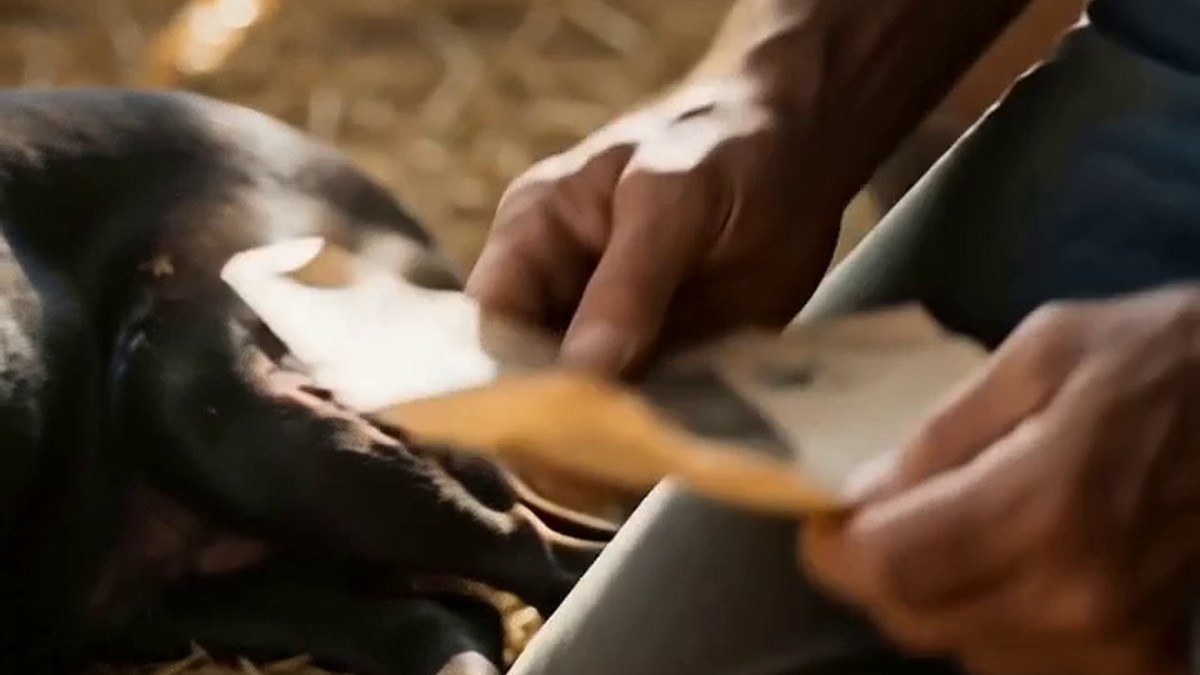
Most humans do this thing where their eyes slide off you the second they register the matted fur and the limp. This one squatted down. His knees made a sound like crumpling cardboard. He didn’t reach right away. He let his hand hang in the space between us, palm up, fingers curled loose. The back of his hand smelled of diesel and linseed oil.
I’ve learned to read human hands. Quick ones grab. Shaky ones are unpredictable. Steady ones, calloused at the base of the fingers — those sometimes mean food, sometimes a vet, sometimes a boot. I waited.
He waited.
A full minute must have passed. Then I stretched my neck, just enough, and pressed my muzzle into his knuckles. It wasn’t a nudge. It was an old question I hadn’t bothered to ask in years.
He answered by not pulling away.
“Well, hell,” he said. His voice was rough, like a man who talks to his tractor more than to people. “You’re coming with me.”
The truck was a rust-spotted Ford F-150 that smelled of coffee and damp wool. He lifted me into the passenger seat — I was too stiff to jump — and laid a saddle blanket over my back, one he’d picked up at the tack auction for $15, the price tag still stapled to a corner. Every pothole on the county road made me brace for the moment he’d change his mind and pull over. But he just kept driving, one hand on the wheel, the other resting on the bench seat between us.
We turned onto a gravel lane lined with split-rail fence. A farmhouse with a sagging porch. A barn with a tin roof that caught the last orange light. He killed the engine and sat there, looking at the house like it was a stranger.
“Lost my wife four winters back,” he said, not really to me. “Place got bigger after that.”
I didn’t understand the words, but I understood the hollowness in them. I’d heard that hollow sound before. The kind that comes after a long time alone. In shelters, in vet back rooms, in the voices of handlers packing their gear into cardboard boxes.
He opened my door and said, “Come see your new digs, old-timer.”
My back legs buckled on the first step down. He caught me under the chest without a word and helped me balance until I found my footing. The ground here was soft — not gravel, not concrete, but actual dirt with grass clippings. I smelled horses, chickens, woodsmoke, and somewhere close, the metallic tang of a creek.
He’d fixed a stall in the barn with straw a foot deep and a heated water bucket. There was a bowl of canned food mixed with kibble, warm to the touch. I ate while he sat on a tack trunk, not watching me, just being there.
That night, I slept without dreaming of cages.
The vet came the next morning. Dr. Ellis from Bitterroot Veterinary Hospital — a young woman with cold hands and a gentle mouth. I let her prod my spine and flex my joints because the man — his name, I’d learned, was Mack — stayed beside me the whole time. She shaved a patch on my inner thigh to draw blood and stopped.
“Mack, you see this?”
A faded ink mark, blue-black and blurry with age. A serial number and a tiny emblem shaped like a mountain peak.
She took a photo with her phone. “This is a service ID. Search and rescue, if I’m reading the logo right. Probably from the nineties.”
Mack leaned in. “He’s been through hell. You sure?”
She sent the photo to Dr. Callahan at Alpine Veterinary Services in Helena, a vet who used to coordinate K9 units for the Forest Service. When the exam was done, Mack paid the $187 bill in cash, thumbing the bills from a worn leather wallet.
Two days later, Mack got a phone call that made him set his coffee mug down very carefully.
“Ranger,” he said, testing the word aloud. “Your name was Ranger.”
The name landed somewhere behind my eyes. I didn’t remember it — my mind doesn’t hold timelines like a human’s — but my body did something strange. I stood up on my bad hip and my tail gave two low thumps against the barn floor.
That afternoon, he drove to the Ranch & Home in town and came back with a 30-pound bag of Purina Pro Plan Senior, the receipt still folded in his shirt pocket: $52.49. He emptied it into the galvanized bin by the grain barrels and muttered, “You eat better than I do now.”
Mack spent that evening at his kitchen table, reading printouts the vet had dropped off. Newspaper articles from the Bozeman Daily Chronicle. A photo of a black dog with a bright-eyed grin, standing next to a crew in orange jackets, dated November 14, 1998. A headline: “Search Dog Finds Missing Boy in Gallatin National Forest After 14-Hour Effort.” Another one, years later: “Avalanche Rescue K9 Retires After Distinguished Service.”
I couldn’t read the words, but I knew the smell of newsprint, the way humans hold something precious between their fingertips. Mack kept touching the photo, tracing the outline of my younger self, then rubbed his thumb across his cheek and wiped it on his jeans. He looked over at me for a long moment, lying on the braided rug by the woodstove. I lifted my head, and he just nodded a little, like I’d answered something.
“You spent your whole career finding people,” he said. “And nobody came looking for you.”
The story came out piece by piece. My handler died of a heart attack when I was eight. The volunteer unit lost funding and disbanded. I got shuffled to a cousin, then a neighbor, then a shelter out in Billings that didn’t check my history. The paperwork that proved I’d once pulled a child from a ravine evaporated somewhere in a county clerk’s basement.
The rescue team’s old captain — a woman named Sharon — drove three hours to see me. She was seventy now, with a walker and a trembling chin. The moment she stepped onto Mack’s porch, I caught her scent: mothballs, hand sanitizer, and something else, something buried under decades. The faint, powdery smell of nylon rope and pine needles.
I stood up. My tail did that thumping thing again. She crouched — slowly, because her knees were as bad as mine — and buried her face in my neck. Her hands shook as she touched my ears. She didn’t say my name. She just said, “There you are.”
Word gets around in small towns. People started showing up, some with cameras, some holding old photographs. A man in a wheelchair told Mack about the time my nose found his diabetic daughter in a snowdrift. A woman with two small children pressed a card into Mack’s hand and said, “That dog gave us twelve more years with our grandfather.”
I tolerated the attention. The pats. The selfies. But every time the voices swelled and the phone cameras flashed, I’d angle my body toward the one constant in the room. Mack’s hand would find the spot behind my ear, the one that’s always been tender since a fracture never healed right.
The town council invited us to a ceremony at the fire hall. They’d hung a banner that smelled of fresh ink and flapped in the draft from the overhead heater. Someone put a bandana around my neck — it smelled of starch and the chemical tang of new fabric. People clapped, and the sound bounced off the cinderblock walls. Mack stood beside me, his hand flat on my neck. He didn’t move much, his breathing even, like when he was fixing a fence. I leaned into his leg. Whatever was happening, his hand was still there.
They wanted me to pose for a photo next to a framed article of the forest rescue. Mack lifted me onto a bench so I could sit beside it. My hip screamed, but I kept my head up because his hand was still on me.
Afterward, we went home. Mack didn’t turn on the lights. He settled into his porch chair with the creaky slat and poured two fingers of whiskey from a bottle of Old Crow into a chipped enamel mug. I laid down on his feet, my gray muzzle across the scuffed toe of his boot, and watched the bats flicker against the purpling sky.
The crickets had slowed to a handful. The old gelding in the back pasture whickered once and fell silent. Mack didn’t say a word, but his hand came down and rested on my shoulder, his thumb tracing slow circles through my coat.
The porch slat creaked again as he shifted his weight. He let out a long breath, and I felt his ribs move through the boot and my own chest. The bats kept slicing the dark. I closed my eyes.



A jászberényi diófa, amelyik hatszázezer forintot ért meg egy családnak
A jászberényi diófa, amelyik örökre megmentett egy udvart Negyedik éve dolgozom a jászberényi piacon zöldséges standnál, pont szemben azzal a...


Žentas, kuris liko: Birutės akys devynerius metus
Mane vadina nedėkingu žentu. Taip sako uošvienės draugės prie bažnyčios Pasvalyje, kai aš parvežu ją iš poliklinikos ir padedu išlipti...


האלמנה מרחוב הדקלים
היה סוף אוקטובר, בבאר שבע עוד נשבה החמסין המאוחר שחודר דרך כל בד, לא משנה מה לובשים מתחתיו. אני לבשתי...


Свекървата ми изхвърли дрехите, а мъжът ми мълчеше
Стоях във всекидневната с разкъсан найлонов плик до краката и гледах празния рафт в гардероба. — Къде е ризата ми...


Dvě stě padesát hodin, matko
Tereza seděla v kuchyni na sídlišti Lesná v Brně, byla půl čtvrté ráno, a za oknem svítila jediná rozsvícená lampa...


Konvice, co nikdy nevystydla
Jmenuji se Radka Bartošová, bydlím na sídlišti v Pardubicích, ve stejném paneláku už osmadvacet let, a naproti přes chodbu, ve...


מאה חמישים מטר על מגרש הכדורגל של בית הספר בעפולה
אני עובדת בבית הספר התיכון כבר שתים עשרה שנה, מזכירה במשרד המנהלת, ורואה הרבה דברים שהורים לא רואים. אבל את...


Il quaderno di ricette di mia suocera
Mi chiamo Massimo, ho quarantatré anni e faccio il ragioniere a Bergamo. Per dodici anni ho vissuto nella stessa palazzina...